

Publishing Information
Editors
- Jennifer L. Gillett-Kaufman (UF/IFAS)
- Verena-Ulrike Lietze (UF/IFAS)
- Emma N.I. Weeks (UF/IFAS)
Contributing Authors
- Julie Baniszewski (UF/IFAS)
- Byron R. Coon (Argosy University) James P. Cuda (UF/IFAS)
- Amy L. Giannotti (City of Winter Park)
- Michael J. Grodowitz (U.S. Army Engineer Research and Development Center) Dale H. Habeck, deceased (UF/IFAS)
- Nathan E. Harms (U.S. Army Engineer Research and Development Center) Jeffrey E. Hill (UF/IFAS)
- Verena-Ulrike Lietze (UF/IFAS) Jennifer Russell (UF/IFAS) Emma N.I. Weeks (UF/IFAS)
- Marissa L. Williams (City of Maitland)
External Reviewers
- Nancy L. Dunn (Florida LAKEWATCH volunteer)
- Stephen D. Hight (USDA-ARS and Florida A&M University, Center for Biological Control) Mark V. Hoyer (UF/IFAS and Florida LAKEWATCH)
- Jerry C. Renney Jr. (Applied Aquatic Management)
- Kelle B. Sullivan (Florida Fish and Wildlife Conservation Commission)
Design (print edition)
- Mark S. Hendrick (Boyd Brothers Printing, Inc.), book cover
- Jane C. Medley (UF/IFAS), page template and diagrams
Hard copies of this book are available in limited quantities.
Publisher
UF/IFAS Entomology and Nematology Department
Acknowledgments
Funding for the development and printing of this book was provided by the US Department of Agriculture, National Institute of Food and Agriculture, Risk Avoidance and Mitigation Program (grant 2010-02825). The production of this guide would not have been possible without this generous financial support
Our special thanks go to Mark Hendrick (Boyd Brothers Printing, Inc.) for designing the front and back covers and to Jane Medley (UF/IFAS) for designing the page template of this guide as well as the graphics for the diagrams on pages 6, 15, 59 and 77. We thank the UF/IFAS Center for Aquatic and Invasive Plants for generously providing many images, and all photographers for allowing us to use their photos.
We thank Donald Rainey (UF/IFAS) for reviewing the Nutrient Management section in chapter 4 and Jeff Schardt (Florida Fish and Wildlife Conservation Commission) for assessing our responses to stakeholder questions in chapter 7.
Last but not least we appreciate the ongoing support received from our Extension advisory committee members Lorrie Bush (St. Lucie West Services District), Stephen Hight (U.S. Department of Agriculture, Agricultural Research Service; and Florida A&M University, Center for Biological Control), Jerry Renney (Applied Aquatic Management), Kelle Sullivan (Florida Fish and Wildlife Conservation Commission), and Bridgett Tolley (Osceola County and South Florida Water Management District); and the collaboration with our Extension partners Joan Bradshaw (UF/IFAS Extension, Emeritus), Ken Gioeli (UF/IFAS Extension, St. Lucie County), and Stacia Hetrick Delaney (formerly UF/IFAS Extension, Oscelola County).
Images and Photographs
All photographs in this guide were used with permission, and photographers are credited in each figure caption. Permission to use the photograph on the front cover, which was taken by Abhishek Mukherjee (UF/IFAS), was granted by James Cuda (UF/IFAS).
Credits for the large photographs on the chapter title pages go to Lyle Buss (UF/IFAS), chapter 6; Emma Weeks (UF/IFAS), chapters 1, 2, 3, 5, and 7; and the UF/IFAS Center for Aquatic and Invasive Plants (CAIP), chapter 4.
Credits for the small photographs on the chapter title pages go to Jeffrey Hill (UF/IFAS), chapter 6; Vic Ramey (UF/IFAS CAIP), chapter 2; Don Schmitz (UF/IFAS CAIP), chapter 1; Judy Shearer (U.S. Army Engineer Research and Development Center), chapter 5; Ron Slay (Florida Fish Farms), chapter 4; and Emma Weeks (UF/IFAS), chapter 3.
If you wish to use or reproduce any of the photographs in this guide for educational or other purposes, you must first receive permission from the photographer.
Contents
- How to Use this Guide
- About Hydrilla
- Why Can Hydrilla Be Bad for Florida’s Ecosystems?
- Goals of Hydrilla Management
- Integrated Pest Management (IPM)
- Developing an IPM Plan for Aquatic Weeds
- PAMS IPM
- Summary Table: Methods for Hydrilla IPM
- Selected References (IPM)
Chapter 2: How to Identify Hydrilla
- Description of Hydrilla
- Habitat
- Plant Habit
- Canopy
- Stems
- Leaves
- Turions
- Flowers
- Roots
- Tubers
- Look-alikes
- Canadian or Common Waterweed
- Brazilian Waterweed
- Summary: Hydrilla Identification
- Selected References (Hydrilla Identification)
- Distribution of Hydrilla in the U.S.
- List of States with Hydrilla Infestations as of 2014
- Introduction and Spread in Florida
- Invasive Properties of Hydrilla
- Early Detection and Intervention Guidelines
- What to Do When You Suspect a New Infestation
- How to Survey for Hydrilla
- How to Measure the Extent of an Infestation
- How to Report an Invasion in Florida
- Preventing New or Recurring Hydrilla Infestations
- Federal Laws and Regulations
- Nonindigenous Aquatic Nuisance Prevention and Control Act of 1990
- National Invasive Species Act of 1996
- Aquatic Nuisance Species Task Force
- State Laws and Regulations
- Florida State Law
- Selected References (Early Detection)
Chapter 4: Integrated Management Options
- Nutrient Management
- Green Industries Best Management Practices
- Selected References (Nutrient Management)
- Physical Control
- Hand Pulling
- Suction Harvesting
- Surface Barriers
- Benthic Barriers
- Drawdowns
- Dredging
- Chaining
- Selected References (Physical Control)
- Mechanical Control
- Mechanical Harvesting
- Considerations
- Selected References (Mechanical Control)
- Biological Control
- Herbivorous Fish
- Herbivorous Insects
- Pathogenic Fungus
- Summary Table: Potential Biological Control Agents of Hydrilla
- Selected References (Biological Control)
- Chemical (Herbicide) Control
- History of Aquatic Herbicide Use
- Herbicides Approved for Aquatic Use and Applied in Florida
- Selected References (Chemical Control)
Chapter 5: Proposals for Integrated Hydrilla Management
- Combining Different Tactics
- Hydrilla Tip Mining Midge and a Plant Pathogenic Fungus
- Hydrilla Tip Mining Midge and the Herbicide Imazamox
- Plant Pathogenic Fungus and Herbicides
- Selected References (Integrated Management of Hydrilla)
- Resistance Management
- What Is Resistance?
- Herbicide Resistance in Hydrilla Populations
- The Importance of Product Rotation
- A Case Report on Integrated and Resistance Management of Hydrilla in Florida
- How Can You Help Prevent Herbicide Resistance?
- Selected References (Resistance and Its Management)
- Management of Hydrilla in Different Water Body Types
- Characteristics of Different Water Bodies
- Management of Submersed Weeds in Different Waters
- Selected References (Different Water Bodies and Weed Control)
Chapter 6: Insects and Fish Associated with Hydrilla
- Featured Creatures: Hydrilla Leafcutter Moth
- Featured Creatures:Hydrilla Leaf-mining Flies
- Featured Creatures: Hydrellia Fly Parasitic Wasp
- Featured Creatures: Hydrilla Tip Mining Midge
- Featured Creatures: Hydrilla Stem Weevil
- Featured Creatures: Hydrilla Tuber Weevil
- Featured Creatures: Waterlily Leafcutter
- Featured Creatures: Asian Grass Carp
Chapter 7: Supplementary Information
- Contacts for Plant Identification and Management Advice
- Specialist Help for Solving Problems with Invasive Plants in Florida
- First Point of Contact in States with Hydrilla Infestations as of 2014
- Web Links to Hydrilla Fact Sheets
- Helpful Web Pages
- Printable PDFs
- FAQs and Stakeholder Feedback
- Spread the Word
- Glossary
Chapter 1: Introduction
By Verena-U. Lietz and Emma E. N. I Weeks

Throughout Florida and at least twenty-seven other states, the invasive freshwater plant hydrilla () causes damaging infestations that choke out native plants, clog flood control structures, and impede waterway navigation and recreational use.
This guide will help you identify hydrilla, describe commonly used integrated pest management (IPM) strategies, and provide you with contact information for further assistance when you or your clientele encounter hydrilla.
“IPM is the coordinated use of pest and environment information and available pest control methods to prevent unacceptable levels of damage by the most economical means with the least possible hazard to people, property and the environment.”
— U.S. Environmental Protection Agency (EPA)
Share this guide with others!
Help us spread the word that new strategies for hydrilla integrated pest management (IPM) are being investigated and developed.

Credit: Photographs by Verena Lietze, University of Florida.
How to Use this Guide
Use this guide to identify hydrilla (Figure 1), learn about commonly used integrated pest management (IPM) strategies, and find contact information for further assistance when you or your clientele encounter hydrilla.
Be aware that any approach that manipulates the waterways in your state requires compliance with federal and state laws. It makes sense to most people that the introduction of plants is prohibited. However, please realize that the removal of plants (even if well intended) is generally not allowed without prior permission. Always contact your state’s Fish and Wildlife Conservation Commission to receive appropriate guidance.
The methods described in this guide serve as a reference of options that are currently available to prevent and manage hydrilla infestations. But keep in mind that each water body is unique and needs to be assessed in order to install the best-suitable IPM plan.
Management is expensive and labor intensive, so good planning can save money and time. Consult with experts, develop an IPM plan that fits the environment and your budget,
and be open to adjustments. Such adaptive management includes learning from past mistakes, considering all resources, evaluating results, and gaining new knowledge as well as achieving desirable short-term and long-term outcomes.
One highlight of this guide is a case report that illustrates how important it is to adjust and expand management plans when you are faced with changing situations in infested water bodies (see page 70). Use the report as an orientation. It always helps to learn what people have done to make management programs successful.
About Hydrilla
Every year, the state of Florida spends millions of dollars managing this weed in our waterways. However, aquatic resource managers are facing a problem: hydrilla is showing resistance to the widely used herbicides fluridone and endothall.
To tackle this problem, UF/IFAS County Extension Faculty and Entomology and Nematology Department Faculty are implementing a U.S. Department of Agriculture (USDA) grant–funded program: the Hydrilla Integrated Pest Management Risk Avoidance and Mitigation Project (Hydrilla IPM RAMP). Within the framework of this project, new approaches for managing hydrilla are being evaluated (Figure 2).

Credit: Photographs by Dana Denson, Reedy Creek Improvement District.
Why Can Hydrilla Be Bad for Florida’s Ecosystems?
Remember that hydrilla is “good” in its native range. It is only when plants are introduced into a new habitat that they can begin disrupting the native environment. It is important to understand the negative impacts that hydrilla can have on an ecosystem before you consider techniques to include in your integrated management program.
Hydrilla, particularly when very dense and expansive, can reduce the number of other species, both flora and fauna, that are able to survive in the water body by:
- Reducing the level of dissolved oxygen available to other organisms
- Preventing sunlight penetration to other submersed plants
- Accessing nitrogen and phosphorus and limiting nutrients for use by other organisms
Hydrilla also can prevent the function of the water body by:
- Limiting water flow and causing flooding
- Preventing pumping (e.g., for irrigation or livestock watering)
- Preventing recreation, boating, swimming, fishing (Figure 3)
- Changing the relative densities of fish species available for fishing
Long term negative effects on the ecosystem include:
- Increased amount of sediment accumulation due to hydrilla decay
- Increased sedimentation over time, which—if not corrected—will cause water bodies to become shallow and eventually turn to wetlands
Finally, when hydrilla forms dense canopies at the surface, these areas provide excellent microhabitats. These habitats are known to provide mosquitoes with suitable breeding sites where the water is still and warm. Recent studies have discovered that hydrilla is a substrate for a newly discovered species of cyanobacterium, which produces a toxin that causes neurological disease in waterbirds including bald eagles and American coots.
Hydrilla is not the only plant we need to worry about. You should always be careful not to transport plants or animals to new ecosystems.

Credit: Photographs by Verena Lietze (top), University of Florida, and Don Schmitz (bottom), UF/IFAS Center for Aquatic and Invasive Plants.
Goals of Hydrilla Management
The two most important goals of every successful hydrilla management plan should be:
- To provide a sustainable, long-term, reduced-risk solution for hydrilla control
- To encourage resource managers to adopt new management tactics
What does this statement entail? Mostly: education, education, and education. Researchers all over the country are doing fantastic work to provide applicators, managers, and legislators with new data, updated methods, novel technologies, and innovative integrative approaches to alleviate the ever-increasing problems associated with invasive aquatic weeds.
Hydrilla not only has an inherently high competitive advantage over native aquatic plant species but also exhibits adaptive strategies to survive control methods. For example, the continuous application of a single effective chemical herbicide has led to the spread of herbicide-resistant biotypes of hydrilla.
In this guide, we therefore emphasize the importance of product rotation and integration of different control tactics for successful long-term management of this plant.
Integrated Pest Management (IPM)
The following definition of the term Integrated Pest Management (IPM) is given by the U.S. Environmental Protection Agency (EPA):
“IPM is the coordinated use of pest and environment information and available pest control methods to prevent unacceptable levels of damage by the most economical means with the least possible hazard to people, property and the environment.”
Coordinating the control efforts among stakeholders allows not only combining expertise but also sharing resources and tools. Stakeholders often include private, federal, state, county, and tribal entities.
Remember that IPM is based on a continuum. You can have anything from all natural and cultural controls (like native insect herbivores and hand harvesting weeds) to chemical control options. When we consider chemical control options, we often think of them as a last resort.
What distinguishes IPM from conventional pest control is that IPM goes beyond the action of going out and facing an existing problem. The principles of IPM encourage us to go one step further or, actually, take a step back and start before a problem has built up. IPM therefore includes four major steps:
- PREVENTION: One of the most important tactics in IPM is to manage an area in a way that pests and weeds will not have the chance to become a threat. In an aquatic system, this may involve regular surveys to help detect infestations at an early stage, when manual removal is still possible and effective. Implementing control at an early stage increases the chance of eradication and decreases the costs and environmental impacts of management.
- MONITORING AND IDENTIFYING PESTS OR WEEDS: Insects and weeds are not automatically harmful. Depending on the habitat in which they occur, they may remain at low densities and under certain circumstances even be beneficial. It is therefore important to monitor and correctly identify all species in a habitat.
- SETTING ACTION THRESHOLDS: Some pests or weeds may not harm the environment when their density remains below a certain threshold. Action is required when this threshold is passed so that the pest or weed population will not grow out of control and cause environmental and economic damage. For invasive aquatic weed species, such as hydrilla, this threshold is very low, because these species usually have a high competitive advantage over native species and will literally take over the environment.
- CONTROL: When steps 2 and 3 indicate that the pest or weed has become a problem that can no longer be alleviated by preventive methods, it is time to identify the best-possible control method or methods. The best-possible methods will pose the least risk to the environment and health of other organisms and provide the most effective results in an acceptable timeframe and at reasonable cost.
Developing an IPM Plan for Aquatic Weeds
The following information is based on the publication How to Create a Lake Management Plan by Jess M. VanDyke from a cooperative project between Florida Department of Environmental Protection and Florida LAKEWATCH.
The development of a management plan is a stepwise process:
- Notice the infestation; identify the weed.
- Act fast! If you only see a few weeds, perhaps suction harvesting or careful hand pulling should be done first to keep the weed from spreading out of control as you develop an action plan.
- Form a working group of representative stakeholders from all user groups.
- Request from all group members a list of problems associated with the infestation.
- Arrange a meeting to assess the list and write a concise problem statement.
- Collect information on the weed and the specific environment (water body).
- Write a description of the water body including its environment and use.
- List possible solutions (this is a brainstorming effort, and all ideas are allowed); be sure to list solutions that have different modes of action.
- Evaluate each listed solution based on its expected effectiveness, longevity, confidence, applicability, potential negative impacts, capital costs, and operation/ maintenance costs.
- Based on the evaluation, refine the list of solutions.
- Write a first draft of a management plan; be sure to include as many IPM options as possible.
- Seek feedback from as many user groups as possible.
- Based on the feedback, revise the management plan.
- Find funding.
- Implement the plan.
- Monitor and document the results.
Documentation of the results cannot be overemphasized. Data from monitoring will indicate when adjustments to the IPM plan may become necessary.
PAMS IPM
Do you know about PAMS? The letters stand for Prevention, Avoidance, Monitoring, and Suppression. Our information on hydrilla IPM will help you fit your management plan into the PAMS IPM model in the following ways:
PREVENTION AND AVOIDANCE—providing educational material that will help stakeholders to prevent the spread of resistant hydrilla.
MONITORING—looking for new areas where susceptible and resistant hydrilla biotypes may be introduced.
SUPPRESSION—integrating herbivory by the hydrilla tip mining midge with a fungal plant pathogen and/or low doses of a new acetolactate synthase (ALS) inhibiting herbicide as a viable strategy for long-term sustainable management of hydrilla (Figure 4).

Summary Table: Methods for Hydrilla IPM
Table 1. Methods for Hydrilla IPM
1 Specialized equipment needed2 Usually not permitted in Florida3 Need controlled water level
Selected References (IPM)
CAIP (Center for Aquatic and Invasive Plants). 2011. Integrated plant management. In Developing management plans, Center for Aquatic and Invasive Plants, University of Florida. http://plants.ifas.ufl.edu/manage/developing-management-plans/integrated-plant-management
EPA (U.S. Environmental Protection Agency). 2012. Integrated pest management (IPM) principles. URL: http://www.epa.gov/opp00001/factsheets/ipm.htm (17 April 2014).
Nelson LS, Shearer JF. 2009. Integrated weed management strategies for control of hydrilla.
U.S. Army Engineer Research and Development Center. Vicksburg, Mississippi. APCRP Technical Notes Collection, ERDC/TN-APCRP-CC-09.
Netherland MD, Schardt JD. 2011. A manager’s definition of aquatic plant management.In Developing management plans, Center for Aquatic and Invasive Plants, University of Florida. URL: http://plants.ifas.ufl.edu/manage/developing-management-plans/a-managers-definition-of-aquatic-plant-control (20 May 2014).
Sytsma MD, Parker M. 1999. Aquatic vegetation in canals: A guide to integrated management. Oregon Department of Agriculture and U.S. Environmental Protection Agency Region X, 51 pp.
VanDyke JM. 1993. How to create a lake management plan. Florida Department of Environmental Protection and Florida LAKEWATCH, Florida, 10 pp.
Chapter 2: How to Identify Hydrilla
Verena-U. Lietze and Emma N.I. Weeks

This chapter will describe hydrilla and two aquatic plant species that look very similar to hydrilla.
Description of Hydrilla
The following sections will give you detailed descriptions of the hydrilla plant including its canopy on the water surface and its individual parts.
Habitat
Hydrilla grows in literally all freshwater habitats including springs, streams, rivers, lakes, ponds, reservoirs, and canals. It tolerates low light intensity, high turbidity, and a range of water qualities.
The optimum temperature for hydrilla growth is 68-81°F (20-27°C). However, hydrilla can survive at temperatures of 86°F (30°C) and is relatively cold hardy being present as far north as Maine and Washington. In many areas of the U.S., the stems and leaves die back during the winter but are quickly replaced by new growth in the spring. The turions and tubers are protected more from the cold than the stems and leaves and will survive in the sediment to produce new plants when the warm weather returns in the spring.
Hydrilla is able to grow at a lower light intensity than most other submersed aquatic weeds; it requires just 1% of full sunlight. This means that it can grow at greater depths than most other submersed plants. Hydrilla is frequently found growing in lakes at depths of 9 feet (3 m) but also is found growing 45 feet (15 m) deep in Kings Bay, Crystal River, Florida.
Nutrient conditions do not seem to impact the ability of hydrilla to infest a water body. However, the hydrilla in a water body with low nutrient levels is less likely to become dense and topped out. Hydrilla has been found growing in nutrient-rich (i.e., eutrophic) and nutrient-poor (i.e., oligotrophic) lakes. Hydrilla even tolerates salinity levels of up to 7% (equivalent to 70 parts per thousand [ppt] or 70 g/kg), which is twice as high as the average salinity level of ocean water. For comparison, the salinity of freshwater usually is less than 0.05% (0.5 ppt). Despite the ability to tolerate high salinity, hydrilla prefers freshwater environments and usually is outcompeted by other plant species in brackish water of high salinity.
Plant Habit
Hydrilla is a submerged, perennial, rooted plant with slender, vertically growing stems (Figure 5). Stems are sparsely branched until they reach the water surface, where profuse branching leads to a dense canopy.

Credit: Photograph by Vic Ramey, UF/IFAS Center for Aquatic and Invasive Plants. Drawing by UF/ IFAS Center for Aquatic and Invasive Plants.
Canopy
When the vertically growing stems reach the top 2 feet below the water surface, they begin to branch and form a dense mat of plant material. About 80% of hydrilla’s biomass is in this top canopy. At this stage, hydrilla is described as being “topped out.” The dense surface canopy may remain rooted or may break loose resulting in floating mats of vegetation (Figure 6).

Credit: Photograph by William Haller, UF/IFAS Center for Aquatic and Invasive Plants.
Stems
Stems (Figure 7A+B) can be up to 33 feet (10 m) long, depending on the depth of the water body. Under water, they are erect and generally not branched; at the water surface, they branch heavily. Near the sediment, stems can form stolons, which are stems that grow along or just below the surface of the sediment and produce new roots at the nodes as well as new plants from buds.
Leaves
Key term
Whorl (leaf whorl)
an arrangement of three or more leaves emerging and radiating from a common node along the stem
Leaves (Figure 7C+D) are small and narrow, just about 1/10 inch (2.5 mm) wide and 1/4 to 3/4 inch (6 to 18 mm) long. They grow in whorls of 4-8 (often 5; Figure 7C) around the stem. The leaf margins are saw-toothed, and the leaf midrib carries one or more small, sharp teeth on the underside (Figure 7D).

Credit: Photographs by Lyle Buss, University of Florida.
Turions
Turions (Figure 8) are buds in leaf axils. They are cylindrical in shape, about 1/4 inch (6 mm) in diameter, and dark green in color. Turions break off and fall into the sediment, where they overwinter and produce new plants in the spring.

Credit: Photographs by Lyle Buss, University of Florida.
Flowers
The female flowers (Figure 9) grow on individual long stalks to float on the water surface. Their three sepals and three petals are whitish and about 1/6 inch (4 mm) long. In Florida and the southern U.S. range of hydrilla distribution, no male flowers are found because only the female dioecious form of hydrilla is present. In northern states, the monoecious form of hydrilla (with male and female flowers on the same plant) is present.
Male flowers (Figure 9) are tiny and greenish in color, grow close to leaf axils on the shoot tips, and eventually break loose and float to the water surface.

Credit: Photographs by Matthew Purcell, U.S. Department of Agriculture, Agricultural Research Service, Australian Biological Control Laboratory CSIRO Ecosystem Sciences (left), and Michael J. Grodowitz, U.S. Army Engineer Research and Development Center (right). Drawings by UF/IFAS Center for Aquatic and Invasive Plants.
Roots
Roots (Figure 10, top) are thin and long, whitish to light brown in color, and anchored in the sediment. Roots can also form at the nodes along the stem or at the end of loose stem fragments.
Tubers
Tubers (Figure 10) are similar to turions, except that they form from rhizomes (modified below-ground stems) in the sediment. They are enlarged potato-shaped rhizomes,about 1/2 inch (12 mm) long, and yellowish brown in color. Tubers can stay viable in the sediment for several years before they sprout new shoots. They can stay viable for several days out of water. Sprouting sometimes is induced after a drawdown or a chemical treatment.

Credit: Photographs by Lyle Buss, University of Florida.
Look-alikes
Two aquatic plants commonly found in U.S. freshwater bodies look very similar to hydrilla. They are Canadian or common waterweed and Brazilian waterweed.
Canadian or Common Waterweed
Canadian or common waterweed (Elodea canadensis, Figure 11) is native to the United States. It does not produce subterranean tubers and feels softer than hydrilla because the leaves do not have teeth on the midrib. Canadian waterweed is densely whorled with two to three leaves per whorl and is considered to be beneficial at a low density.

Credit: Photographs by William Haller (left photo) and Vic Ramey (right photo), UF/IFAS Center for Aquatic and Invasive Plants.
Brazilian Waterweed
Brazilian waterweed (Egeria densa, Figure 12) is non-native and invasive. Its leaves are about an inch (25 mm) long, finely toothed on the margins, and arranged in whorls of four to five. They carry no teeth on the midrib and feel softer than hydrilla. Brazilian waterweed does not produce tubers.

Credit: Photographs by William Haller (left photo) and Vic Ramey (right photo), UF/IFAS Center for Aquatic and Invasive Plants.
Summary: Hydrilla Identification

Selected References (Hydrilla Identification)
Barko JW, Smart RM, McFarland DG, Chen RL. 1988. Interrelationships between the growth of (L.f.) Royle and sediment nutrient availability. Aquatic Botany 32: 205-216. https://doi.org/10.1016/0304-3770(88)90116-7
Glomski LM, Netherland MD. 2012. Does hydrilla grow an inch per day? Measuring short-term changes in shoot length to describe invasive potential. Journal of Aquatic Plant Management 50: 54-57.
Hall DW, Vandiver VV, Gray CJ. 1991. Hydrilla, (L.f.). Agronomy Department, Florida Cooperative Extension Service, Institute of Food and Agricultural Sciences, University of Florida, document SP37. URL: http://edis.ifas.ufl.edu/pdffiles/FW/ FW01800.pdf (22 April 2014).
Haller WT, Sutton DL, Barlowe WC. 1974. Effect of salinity on growth of several aquatic macrophytes. Ecology 55: 891-894. https://doi.org/10.2307/1934427
Haller WT, Miller JL, Garrard LA. 1976. Seasonal production and germination of hydrilla vegetative propagules. Journal of Aquatic Plant Management 14: 26-29.
Langeland KA. 1996. (L.f.) Royle (Hydrocharitaceae), “the perfect aquatic weed.” Castanea 61: 293-304.
Netherland MD, Haller WT. 2006. Impact of management on the sprouting of dioecious hydrilla tubers. Journal of Aquatic Plant Management 44: 32-36.
Van TK, Haller WT, Bowes G. 1976. Comparison of the photosynthetic characteristics of three submersed aquatic plants. Plant Physiology 58: 761-768. https://doi.org/10.1104/pp.58.6.761
Chapter 3: Early Detection
Verena-U. Lietze and Emma N. I. Weeks

This chapter will describe the distribution of hydrilla in the U.S., explain why this aquatic plant has become invasive, and guide you through methods of early detection and intervention. Invasive plants are regulated on the federal and state levels, so we have summarized the most important laws for you.
Distribution of Hydrilla in the U.S.
To date (2014), at least twenty-seven states have recorded hydrilla infestations (see Figure 13), and three states are on the lookout with early eradication programs planned.
To find the first point of contact in states with hydrilla infestations, please refer to the list provided on page 126.

Credit: Map created by the U.S. Geological Survey, Department of the Interior/USGS, available in the public domain.
List of States with Hydrilla Infestations as of 2014
Female dioecious form
- Alabama (AL)
- Arizona (AZ)1
- Arkansas (AR)
- Florida (FL)
- Idaho (ID)
- Louisiana (LA)
- Mississippi (MS)
- Tennessee (TN)
- Texas (TX)
Monoecious form
- Delaware (DE)
- District of Columbia (DC)
- Indiana (IN)
- Maine (ME)
- Maryland (MD)
- Massachusetts (MA)
- Missouri (MO)
- New Jersey (NJ)
- New York State (NY)
- Pennsylvania (PA)
- Washington (WA)2
Both forms
- California (CA)
- Connecticut (CT)
- Georgia (GA)
- North Carolina (NC)
- South Carolina (SC)
- Virginia (VA)
- Wisconsin (WI)
States on the lookout
- Illinois (IL)
- Michigan (MI)
- Ohio (OH)
1 Eradicated from two ponds in the mid-1980s, no new infestations
2 Possibly eradicated
Introduction and Spread in Florida
The female dioecious biotype of hydrilla made its way from Asia to Florida in the 1950s as an exotic aquarium plant. It was released by an aquarium owner into a freshwater body in the Tampa Bay area.
Within forty years of this introduction, hydrilla populations have established in over 70% of Florida’s watersheds (Figure 14). From Florida, dioecious hydrilla has spread to most of the southeastern coastal states.
The monoecious biotype of hydrilla was first detected in Maryland in the 1970s and is thought to originate from Korea. It now is present along the eastern and western coasts as far north as Maine and Washington State, respectively, and as far south as Georgia and California, respectively. Infestations also occur in inland states (see Figure 13).
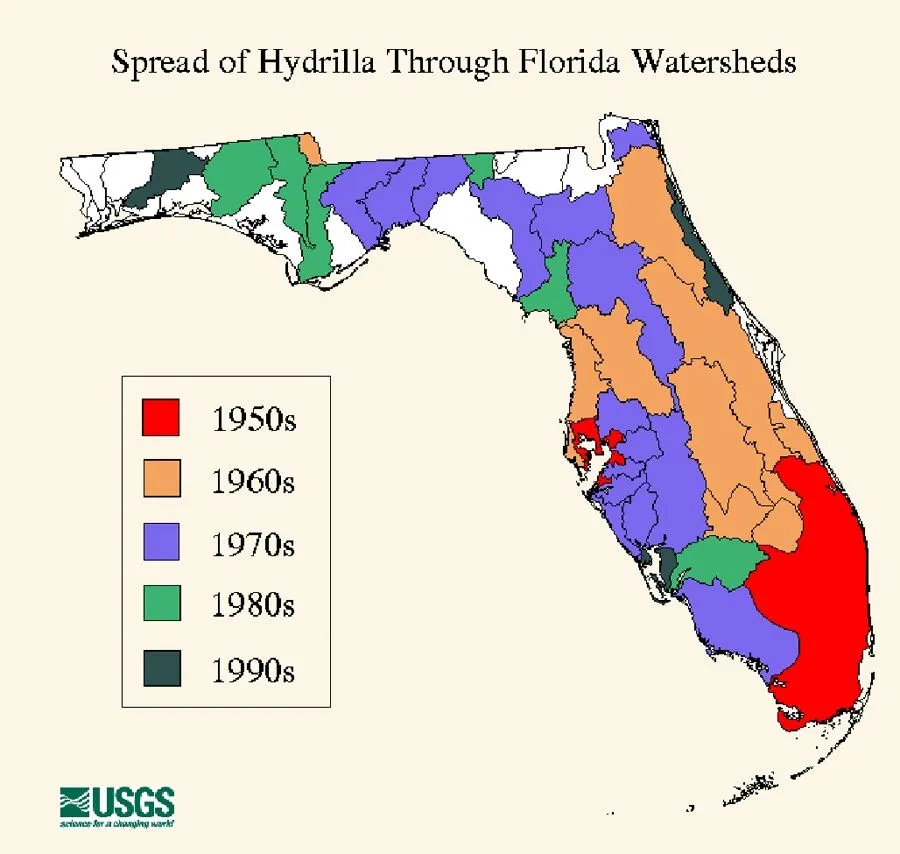
Credit: Map created by the U.S. Geological Survey, Department of the Interior/USGS, available in the public domain.
Invasive Properties of Hydrilla
There are several reasons why hydrilla is invasive. They define why this species is able to outcompete native aquatic weeds and how hydrilla has been able to spread so extensively.
TOLERANCE TO DIFFERENT HABITATS: Hydrilla thrives in a wide variety of conditions, from low to high temperature, low to high nutrient content, and low to high pH. It is even capable of growing in waters with salinity up to 7%.
LACK OF NATURAL ENEMIES: As hydrilla is exotic and not native to the U.S., it has no native natural enemies, so its growth can continue relatively unchecked.
FAST GROWTH: Each growing tip of hydrilla grows up to one inch per day. Once the plant starts to branch profusely near the water surface, the actual increase in biomass is exponential. In a recent experiment, a single nine-inch-long shoot produced over 3,200 inches of growth in five weeks.
COMPETITION FOR SUNLIGHT: Hydrilla is capable of growing in low-light conditions, down to 1% full sunlight. This allows hydrilla to start growing early in the year and for a long period each day, so it grows faster than other submersed plants. Once topped out, the plant blocks light from reaching other plants.
MULTIPLE METHODS OF PROPAGATION: Hydrilla uses multiple methods to propagate, including turions, tubers, fragments (Figure 15), and—where the monoecious type is present—seeds from flowers. Tubers and turions are very difficult to kill, and each tuber may grow into a plant that produces several thousand new tubers per square meter. Fragments are often taken from one water body to another on boating and fishing equipment. About 50% of fragments that have just one whorl of leaves will regenerate and form new plants (Figure 16).

Credit: Photographs by Lyle Buss, University of Florida.
Early Detection and Intervention Guidelines
If you think you have a new infestation of hydrilla or another invasive weed or animal that you have not seen before, you should contact one of the state officials listed in the First Point of Contact in States with Hydrilla Infestations section (page 126). These contacts should be able to help you find the correct point of contact for your situation.
What to Do When You Suspect a New Infestation
You have noticed (or somebody who called your office reported) increased growth of aquatic weeds on a shoreline? The weed looks like hydrilla or another species of invasive aquatic weeds? Here is what you do:
- Collect a sample of the weed to take or send to a specialist for identification. If this is not possible or permitted, then take photographs. It would also be helpful to record the GPS coordinates of the sample site.
- Call your local Extension office and report the problem.
- Call your state’s Fish and Wildlife Commission or Department of Environmental Protection and have them connect you with an aquatic weed specialist.
- Ask the specialist to assist you in identifying the weed and, if appropriate and necessary, in developing a management plan that will be in compliance with state and federal laws.
Remember, when you call the specialist to seek assistance with identification, write down the mailing instructions you receive from the specialist so that the sample will arrive intact and the specialist will be able to identify the plant.
Water body managers may have the resources and expertise to conduct an initial survey and provide the contacted specialist with details about the infestation. In the next three sections, we describe general initial steps that one can take when a new infestation occurs.
How to Survey for Hydrilla
Early detection under water may allow removal of the plants before they reach the surface and begin to form profusely branched, dense vegetation mats. In shallow areas, surveying the bottom from a boat with a viewing tube or from the water by snorkeling is possible. In deep waters, scuba diving might be necessary. An underwater video system is useful for scanning large areas.
For the survey, space and locate transects by GPS and make sure to include deep water areas as well as key points, such as boat ramps, swimming areas, intakes, and habitats of fish and birds.
Use ID cards or keys to identify the plants you record. If in doubt, take a plant sample and submit it for identification (see Contacts for Plant Identification and Management Advice on page 126). If you can, include the roots because hydrilla grows characteristic tubers that facilitate quick identification.
Most often, hydrilla enters a new habitat with water flow, boats, or aquatic birds. It is therefore important to survey areas such as inlets, upstream waters, access points, and known habitats of wading or shore birds.
How to Measure the Extent of an Infestation
Mapping the extent of a hydrilla infestation can be tricky. During early invasion, hydrilla disperses mainly by tubers and turions that remain in the sediment and will sprout in the following growth season.
When you discover hydrilla growth, follow up with visual inspection expanding in concentric circles from the center of growth. You may also follow the direction of the water current. In large water bodies, focus your attention on likely sources of invasion, such as inlets, boat ramps, docks, and bird habitats.
Get a rough estimate of coverage, for example, the number of stems per area unit or the extent of the area covered by topped-out hydrilla. Measuring and monitoring the extent of an invasion will help you determine if the applied control tactics are successful in reducing the infestation.
There are several standardized techniques that have been developed for aquatic vegetation monitoring. Automatic electronic depth finders, which distinguish sediment from plant material, can be very useful to calculate the extent of an infestation. Whichever method you choose, try to be as thorough as possible. It is best to use a map of the water body; if none is available, draw one. Outline features of the shoreline and add reference points.
How to Report an Invasion in Florida
Once the presence of hydrilla is confirmed, contact the Florida Fish and Wildlife Conservation Commission to notify the town or county in which the infested water body is situated.
Also, contact your local UF/IFAS Extension Office. You can find contact information on page 126 of this guide.
Are you Extension faculty? Here are actions you can take:
- Try to identify all stakeholder groups and contact as many as possible. These may include park staff, shoreline property owners, lake associations, birdwatchers, boaters, anglers, swimmers, and water suppliers, to name a few.
- Install educational signage at access points (docks, boat ramps, etc.) and write press releases for local media.
- Use local events to raise awareness in the public. People need to know what they can do to prevent the spread of invasive aquatic weeds. Many don’t even know that hydrilla is invasive and causes environmental damage as well as economic losses.
Preventing New or Recurring Hydrilla Infestations
REMEMBER: PREVENTION COSTS LESS THAN TREATMENT!
Most freshwater bodies are suitable habitats for hydrilla because this invasive aquatic weed can tolerate a wide range of environmental conditions. Previously infested water bodies, of course, are already known to support hydrilla growth and should receive special attention.
A successful hydrilla education program needs to reach everyone who visits water bodies—in other words, people of all ages and interests. These include families with kids and dogs, boaters, anglers, hunters, water sport enthusiasts, water gardeners, park and lake managers, aquatic plant managers, and pesticide applicators.
HOW CAN YOU HELP PREVENT THE SPREAD OF HYDRILLA AND OTHER INVASIVE AQUATIC PLANTS AND ANIMALS?

Credit: Photographs by unknown (A) and Don Schmitz (B), UF/IFAS Center for Aquatic and Invasive Plants. Drawing (C) by the California Department of Fish and Wildlife.
- Do not empty your aquarium contents into waterways (Figure 17A). If you want to dispose of aquatic plants from your aquarium, place them onto a plastic sheet and allow them to dry out completely before you dispose of them in the trash.
- Clean your boat, trailer, live wells, fishing equipment, and diving gear before and after you visit a water body. Do this at the boat ramp, so that you won’t forget later (Figure 17B+C).
- Do not place any plant material back into the water. Dispose of plant material in on-site trash cans or in your household trash. Do not compost hydrilla or any other aquatic weeds.
- Did your dog go swimming? Please wash and brush your dog thoroughly before allowing your pet to jump into new waters.
- Be aware that possession of hydrilla without a permit is illegal in Florida.
Federal Laws and Regulations
Hydrilla is a federally listed aquatic nuisance species. The federal regulations regarding the management of such species in the United States were enacted in 1990 and reauthorized in 1996 (see sections below). We retrieved the information in the following three subsections from a fact sheet published by the National Oceanic and Atmospheric Administration (NOAA) Fisheries Service.
Nonindigenous Aquatic Nuisance Prevention and Control Act (NANPCA) of 1990
The Nonindigenous Aquatic Nuisance Prevention and Control Act (NANPCA) was enacted in November 1990. Its main goals were: (1) to prevent the introduction and spread of invasive aquatic species into the waters of the United States; (2) to minimize the economic and ecological impacts caused by established nonindigenous aquatic species; and (3) to install a program that assists the states in the management and removal of nonindigenous aquatic species.
National Invasive Species Act (NISA) of 1996
In 1996, the National Invasive Species Act (NISA) reauthorized and amended the Nonindigenous Aquatic Nuisance Prevention and Control Act (NANPCA). Of great importance was the nationwide implementation of measures that would prevent the unintentional transport of established nuisance species to inland lakes and rivers within the United States. Two important pathways for such transport include recreational boat traffic and commercial barge traffic.
You can download the complete NISA of 1996 (PDF file, 20 pages) from the public domain. URL: http://www.anstaskforce.gov/Documents/NISA1996.pdf
Aquatic Nuisance Species (ANS) Task Force
The Aquatic Nuisance Species (ANS) Task Force was established by the NANPCA and reauthorized by the NISA to coordinate activities among federal agencies and between federal agencies and organizations on the regional, state, tribal, and local levels.
Chairpersons of the ANS Task Force are the director of the U.S. Fish and Wildlife Service and the undersecretary of Commerce for Oceans and Atmosphere. The membership includes 13 federal agencies and 12 ex-officio members. Regional panels, issue-specific committees, and work groups established by the ANS Task Force coordinate activities of the government with those of the private sector and with other North American interests.
State Laws and Regulations
- Is on the Federal Noxious Weed List (U.S. Department of Agriculture, Animal and Plant Health Inspection Service, since the year 2000)
- Is on the State List of Noxious Weeds in Arizona, California, Florida, Maine, Mississippi, Nevada, New Hampshire, New Mexico, North Carolina, Oregon, South Carolina, Texas, Vermont, and Washington
- Is on the State List of Prohibited Plant Species in Indiana, Michigan, Nebraska, and Oklahoma
- Is on the Florida Prohibited Plants list, Florida Department of Environmental Protection
- Is on the Florida Exotic Pest Plant Council (FLEPPC) list of invasive plants
- Is, according to the FLEPPC, a Category I plant, which means it is “an invasive exotic plant that is altering native plant communities by displacing native species, changing community structures or ecological functions, or hybridizing with natives”
Florida State Law
Since July 2008, Florida’s invasive plant management program has been under the direction of the Florida Fish and Wildlife Conservation Commission (FWC).
The FWC determines the timing and the level of hydrilla management on each public water body after analyzing risks (addressing human health, economy, ecology, etc.), current water body conditions, primary uses, and available control technologies.
Florida law (F.S. 369.20) requires all persons intending to control or remove aquatic vegetation from waters of the state to obtain a permit from the FWC’s Invasive Plant Management Section unless an exemption for the activity has been provided in statute or rule (Chapter 68F-20).
Selected References (Early Detection)
Barko JW, Smart RM, McFarland DG, Chen RL. 1988. Interrelationships between the growth of (L.f.) Royle and sediment nutrient availability. Aquatic Botany 32: 205-216. https://doi.org/10.1016/0304-3770(88)90116-7
Glomski LM, Netherland MD. 2012. Does hydrilla grow an inch per day? Measuring short-term changes in shoot length to describe invasive potential. Journal of Aquatic Plant Management 50: 54-57.
Haller WT, Sutton DL, Barlowe WC. 1974. Effect of salinity on growth of several aquatic macrophytes. Ecology 55: 891-894. https://doi.org/10.2307/1934427
Haller WT, Miller JL, Garrard LA. 1976. Seasonal production and germination of hydrilla vegetative propagules. Journal of Aquatic Plant Management 14: 26-29.
Langeland KA. 1996. (L.f.) Royle (Hydrocharitaceae), “the perfect aquatic weed.” Castanea 61: 293-304.
Madeira PT, Jacono CC, Van TK. 2000. Monitoring hydrilla using two RAPD procedures and the Nonindigenous Aquatic Species database. Journal of Aquatic Plant Management 38: 33-40.
Owens CS. 2006. Viability of hydrilla fragments exposed to different levels of herbivory. Journal of Aquatic Plant Management 44: 145-147.
USDA (U.S. Department of Agriculture) National Invasive Species Information Center. 2014. Aquatic species profile: hydrilla. URL: http://www.invasivespeciesinfo.gov/aquatics/ hydrilla.shtml (22 April 2014).
USDA (U.S. Department of Agriculture) Natural Resources Conservation Service Plants Database. No date. (L. f.) Royle, waterthyme. URL: https://plants.usda. gov/core/profile?symbol=HYVE3 (22 April 2014).
Van TK, Haller WT, Bowes G. 1976. Comparison of the photosynthetic characteristics of three submersed aquatic plants. Plant Physiology 58: 761-768. https://doi.org/10.1104/pp.58.6.761
Chapter 4: Integrated Management Options
Emma N.I. Weeks and Verena-U. Lietze

A variety of tactics can be used to manage hydrilla infestations. Please be aware that almost all types of management or control measures will require you to obtain a permit before you begin to manipulate the environment!
The next sections will give you detailed information on different approaches of hydrilla control that could be incorporated into an integrated pest management (IPM) plan. Some are very specific to hydrilla, whereas others are used to manage a variety of invasive aquatic plants.
Please remember: Prevention costs less than treatment! See our Integrated Pest Management section that starts on page 4. Prevention should be the first step in any hydrilla IPM plan.
Nutrient Management
Excessive amounts of nutrients (especially nitrogen and phosphorus) will foster plant growth and may lead to an overabundance of aquatic vegetation. The major source of phosphorus is sediment that erodes from adjacent landscapes. Major sources of nitrogen are runoff from agricultural, turf, and sewage areas, atmospheric deposition, and leaching from septic tanks and sandy soils.
Monitoring these potential sources is important to ensure that they are not responsible for excessive nutrient loading into a water body that could be avoided. Updating aged septic tanks and maintaining stormwater treatment systems can be helpful in reducing nutrient loading. In agricultural areas, the use of fertilizers and irrigation systems can be planned to reduce runoff into neighboring water bodies.
In residential areas, similarly careful fertilization and irrigation of plants is helpful, but in addition, the type of vegetation surrounding the water body can help to protect it from runoff of nutrients. A study in Florida showed that increasing amounts of woody
ornamental vegetation when compared to planting only turfgrass decreased the amount of nitrogen and phosphorus in the runoff.
When hydrilla gets out of control in a water body, it is usually only able to do so because of high nutrient levels, particularly nitrogen. Reducing the nutrient sources would be a more permanent way to reduce the ability of invasive plants like hydrilla to take over the water body. However, most water bodies in Florida naturally contain sufficient amounts of nutrient to facilitate plant growth and algal blooms without any external sources.
Keep this in mind when you evaluate a hydrilla infestation. Find out: Is there a possibility to reduce nutrient sources? Alternatively: Would it be feasible to change the nutrient content in the water?
Aluminum salts, iron salts, or calcium salts, when added to the water, bind to phosphorus in the water and the sediment and thereby immobilize phosphorus. This can be very effective for preventing or reducing the impact of algal blooms, which often occur following hydrilla control if there has been no effort to reduce nutrient sources.
Rooted vascular plants, such as hydrilla, are more limited by nitrogen than phosphorous. Unfortunately, there are no readily-available treatments for immobilization of excess nitrogen. To reduce the nitrogen load in water bodies, the best option is to improve management of runoff from nitrogen-rich areas. In the short-term, nitrogen-rich waters can be rerouted further downstream.
Nutrient management has been used successfully to control algae and improve water quality. However, removal of algae increases the clarity of water and thereby may facilitate the growth of weeds. Consult with experts and learn more with the Green Industries Best Management Practices (GI-BMPs) described in the next section.
Advantages and Disadvantages of Nutrient Management
Advantages: no hydrilla fragmentation, potentially not labor intensive, inexpensive
Disadvantages: not selective, does not remove hydrilla or kill tubers
Green Industries Best Management Practices (GI-BMPs)
The GI-BMPs are a science-based educational program for Green Industries workers (lawn-care and landscape-maintenance professionals), brought to you by the UF/IFAS Florida-Friendly Landscaping™ program. The GI-BMPs teach environmentally safe landscaping practices that help conserve and protect Florida’s ground and surface waters. They can also save the Florida homeowner money, time, and effort; increase the beauty of the home landscape; and protect the health of your family, pets, and the environment.
This training is designed to provide corporate, governmental, environmental, and other personnel the Best Management Practices for lawn and landscape. Learn what impact the BMPs will have on your business or municipality. Developed by the Florida Department of Environmental Protection (FDEP) and endorsed by the pest control industry, this training is provided by the UF/IFAS Florida-Friendly Landscaping™ program with partial funding by the FDEP through a Nonpoint Source Management (Section 319h) grant from the U.S. Environmental Protection Agency.
Who Gets Trained in the GI-BMPs?
Florida Statute 482.1562 states that all current commercial fertilizer applicators must have a license from the Florida Department of Agriculture and Consumer Services (FDACS) as of January 1, 2014. To get this license, each Green Industries worker must be trained in the GI-BMPs and receive a certificate of completion from UF/IFAS and FDEP. Additionally, many non-commercial Green Industries applicators or other workers are required to pass the training by local ordinances or voluntarily participate in the program to better serve their clients.
Who Should Attend?
- Supervisors and employees in the lawn care, pest control, or landscape industries
- Municipal parks and recreation facility supervisors and employees
- Irrigation industry workers
- Commercial property managers
- City and county planning department staff
- City and county environmental department or water quality staff
- City and county commission staff
- Builders and developers
- Landscape designers and architects
- Golf course employees
- Anyone working in the areas of water quality, urban development, or environmental issues
Where can I find GI-BMP training classes?
In-person training classes are held at various UF/IFAS Extension offices around the state, industry offices, trade shows and association meetings, public buildings, and many other sites. For the training schedule, go to the URL: https://gibmp.ifas.ufl.edu/
GI-BMP Online and DVD training also available:
- Industry professionals now have the option of taking the GI-BMP training online or using the free DVD training set.
- For online training information, go to the URL: https://gibmp.ifas.ufl.edu
- For DVD training information, go to the URL: https://gibmp.ifas.ufl.edu/
Materials and Certification
Attendees will receive:
- Training in all major aspects of the GI-BMP manual
- GI-BMP manual (It is strongly recommended that you obtain and study this GI-BMP manual prior to attending class). Download the manual for free at the URL: http:// gibmp.ifas.ufl.edu (on the top of the page, click the link “Click here to learn more about the GI-BMP program”)
- Certificate of completion (mailed 2 weeks after training—must pass post-test)
- Up to four Continuing Education Units (CEUs) for pesticide license holders—for in-person training only
How do I obtain my Limited Commercial Fertilizer Applicator Certificate (LCFAC)?
This certification, often referred to as the “state fertilizer license,” is issued by Florida Department of Agriculture and Consumer Services (FDACS).
- Apply online at the URL: http://www.freshfromflorida.com
- Download the LCFAC application form at the URL: http://www.freshfromflorida.com
- More LCFAC information from the FDACS is available online. URL: http://www.freshfromflorida.com
Selected References (Nutrient Management)
Badruzzaman M, Pinzon J, Oppenheimer J, Jacangelo JG. 2012. Sources of nutrients impacting surface waters in Florida: A review. Journal of Environmental Management 109: 80-92. ttps://doi.org/10.1016/j.jenvman.2012.04.040
Bellaud M. 2009. Cultural and physical control of aquatic weeds, pp 35-40. In Gettys LA, Haller WT, Bellaud M (editors). Biology and control of aquatic plants: A best management practices handbook. Aquatic Ecosystem Restoration Foundation, Marietta, Georgia.
Cantliffe D, Gilreath P, Haman D, Hutchinson C, Li Y, McAvoy G, Migliaccio K, Olczyk T, Olson S, Parmenter D, Santos B, Shukla S, Simonne E, Stanley C, Whidden A. 2009. Review of nutrient management systems for Florida vegetable producers: A white paper from the UF/IFAS vegetable fertilizer task force. University of Florida, IFAS Extension. URL: https://edis.ifas.ufl.edu/hs1156 (8 May 2014). https://doi.org/10.32473/edis-hs1156-2012
Entry JA, Gottlieb A. 2014. The impact of stormwater treatment areas and agricultural best management practices on water quality in the Everglades Protection Area. Environmental Monitoring and Assessment 186: 1023-1037. https://doi.org/10.1007/s10661-013-3436-4
GI-BMP (Green Industry Best Management Practices). 2014. Training and program overview. URL: http://fyn.ifas.ufl.edu/professionals/BMP_overview.htm (23 July 2014).
NFREC (North Florida Research and Education Center). No date. Nutrient management programs. UF/IFAS North Florida Research and Education Center. URL: http://nfrec.ifas. ufl.edu/programs/nutrient_management_programs.shtml (8 May 2014).
Qin ZX, Shober AL, Beeson RC, Wiese C. 2013. Nutrient leaching from mixed-species Florida residential landscapes. Journal of Environmental Quality 42: 1534-1544. https://doi.org/10.2134/jeq2013.04.0126
Stanley CD, Clarke RA, McNeal BL, Macleod BW. 2013. Impact of agricultural land use on nitrate levels in Lake Manatee, Florida. University of Florida, IFAS Extension. URL: http:// edis.ifas.ufl.edu/ss428 (8 May 2014).
Washington State. No date. Lake restoration and management for algae. Department of Ecology, State of Washington. URL: http://www.ecy.wa.gov/programs/wq/plants/algae/ lakes/lakerestoration.html (8 May 2014).
Physical Control
Physical control involves manipulating the physical environment in hydrilla-infested waters and may include the techniques described in the following sections. Bear in mind that most of the physical control methods (except for hand pulling and suction harvesting) are non-selective and affect all organisms in the manipulated area.
CAUTION: With many physical control methods, roots and tubers often stay behind and are a source for reinfestation, because hydrilla sprouts from tubers that can remain dormant in the sediment for several years.
Hand Pulling
Manual removal of plant material (Figure 18) brings success only when the entire plant, including roots and tubers, is removed. As the terms hand pulling and manual removal give away, this is real hands-on, labor-intensive work because you literally grab the hydrilla and pull it out of the water. This technique is particularly helpful in early infestations.
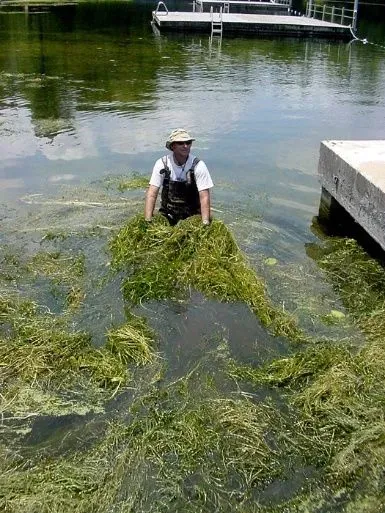
Credit: Photograph by UF/IFAS Center for Aquatic and Invasive Plants.
If hydrilla has spread to deep water areas, scuba divers will have to do this work. This takes time and may be expensive. Each diver removes around 90 plants per hour, and the cost is usually in the range of $400 to $1,000 per acre.
Advantages and Disadvantages of Hand Pulling
Advantages: selective, removes hydrilla
Disadvantages: unlikely to remove tubers, labor intensive, expensive, can cause fragmentation of plants
Suction Harvesting
This technique is particulalrly helpful in early infestations. The method is performed by divers who use hoses that are attached to a vacuum pump to selectively remove the target plant by the root system (Figure 19). The removed plant is deposited in a bag at the surface that traps the plant material but allows the water and sediment to drain back into the water body. Ideally, the divers manually pull hydrilla plants out of the sediment and so make sure that they do not leave behind tubers, which will sprout into new plants.

Credit: Photograph by UF/IFAS Center for Aquatic and Invasive Plants.
Like hand pulling, suction harvesting is labor intensive if done properly and involves specialized equipment. The costs are high, each acre may take up to a month to clear and cost from $1,000 to $25,000 depending on the speed of results. Suction harvesting is best followed by dredging to remove tubers and prevent regrowth. Dredging is a process during which mud, weeds, and other materials are scooped out of the bed of a water body (see page 34 for more details).
Advantages and Disadvantages of Suction Harvesting
Advantages: selective, removes hydrilla and tubers
Disadvantages: labor intensive, expensive, can cause fragmentation of plants
Surface Barriers
Surface barriers are non-selective options to keep areas of water bodies free of floating plant masses. Fences and booms often are used in areas created for swimming or for boat traffic. The plant material that accumulates within the barriers must be removed to prevent build-up of debris and release of nutrients into the water.
Fences usually consist of wire that is fixed to posts. The posts must project at least 2 feet above the mean annual water elevation of the waterway and must be marked with reflectors that can be seen from all directions of possible boat traffic. Booms consist of a floating barricade attached to a mesh skirt of variable depth (Figure 20). The mesh skirt allows water to flow but prevents plant movement.

Credit: Photograph by UF/IFAS Center for Aquatic and Invasive Plants.
Costs for installing surface barriers vary depending on the materials used and the amount of accumulated plant material that needs to be restricted.
Advantages and Disadvantages of Surface Barriers
Advantages: inexpensive, not labor intensive, no hydrilla fragmentation
Disadvantages: not selective, hydrilla not removed, tubers not killed
Benthic Barriers
Be advised that in Florida, it is illegal to cover large underwater areas, because it is possible that subterranean gas formations accumulate and may lead to dangerous eruptions.
Small patches of hydrilla populations may be controlled by covering the sediment with opaque fabric to exclude sunlight. Without sunlight, the plants cannot photosynthesize and will die. The fabric also acts like a weed blocker and provides a physical barrier to new growth (Figure 21).

Credit: Photograph by Matthew Vogt, New England Aquatic Services LLC.
Benthic barriers often are used in small ponds. Their use in areas with monocultures of invasive plants can be highly successful and can have minimal non-target effects. The barrier usually is made of plastic, fiberglass, nylon, burlap, or other non-toxic material. The barrier is rolled out from the shore and secured to the sediment with weights.
Professional installation costs in the range of $10,000 to $20,000 per acre. Although the barriers may last several seasons, they will need to be periodically cleaned. As always: Get expert help from your county’s Extension office, your city, or the Fish and Wildlife Conservation Commission. Do not go out and try to solve the problem by yourself.
Advantages and Disadvantages of Benthic Barriers
Advantages: removes hydrilla and kills tubers, no hydrilla fragmentation
Disadvantages: not selective, labor intensive, expensive, possible gas buildup, illegal in some states
Drawdowns
Lowering the water level is a possible control approach in water bodies with water level control structures. Without water, hydrilla plants dry out, die, and decompose (Figure 22). However, the exposure of the sediment to desiccation and extreme temperatures may also harm native aquatic plants and animals (such as frogs, turtles, mollusks, etc.).

Credit: Photograph by Jeff Schardt, UF/ IFAS Center for Aquatic and Invasive Plants.
In general, a period of 6-8 weeks is necessary to allow for full desiccation. Be aware that drawdowns will not kill vegetative propagules, such as turions and tubers. Following a drawdown, a plant species that uses turions and tubers to reproduce, for example hydrilla, may expand by taking advantage of the cleared area.
Drawdowns should be completed in the winter as it is easier to desiccate the plants in the absence of rain and high humidity. During winter, the risk is lower that the target plant may expand into deeper areas that cannot be fully drained. Unfortunately winter coincides with high wildlife and recreational use of water bodies in Florida.
To control hydrilla through drawdowns, these should be scheduled during winter and late summer. The first drawdown in the winter will kill existing plants and stimulate the
sprouting of new plants in the sediment. The second drawdown in the late summer will kill these plants just before they can produce new tubers.
In most states, drawdowns must be authorized. Check with your state and local jurisdictions to find out about permits and other requirements.
Advantages and Disadvantages of Drawdowns
Advantages: inexpensive, not labor intensive, no hydrilla fragmentation
Disadvantages: hydrilla not removed, tubers not killed, not selective
Dredging
Dredging (Figure 23) is a process during which nutrient-rich sediment is removed from the bottom of a water body. As a result, nutrient-poor layers of the sediment are exposed and the depth of the water column is increased, thereby reducing the amount of nutrients available for plant growth and the amount of sunlight that reaches the bottom. For hydrilla, which is able to grow in very deep water, it would be unfeasible to excavate the water body to depths below the light compensation point. Hydrilla needs just 1% of sunlight to grow.

Credit: Photograph by UF/IFAS Center for Aquatic and Invasive Plants.
Dredging can impact the ecosystem due to the disturbance and removal of sediment. During dredging, aquatic organisms on or in the sediment may be damaged or removed. When sediment becomes suspended, light penetration is reduced, which reduces photosynthesis and consequently the release of oxygen by plants. Fish may be impacted when fine particles clog or damage their gills. As the particles settle on undisturbed sediment, they may smother benthic habitats or organisms.
To reduce non-target effects, use turbidity barriers or silt curtains around the site to limit the impacted area. The barrier or curtain is supported at the top through a boom-like floatation system and weighted at the bottom to ensure the suspended sediment is trapped. Additionally, changes to the sediment will alter the flow of a river or canal and may have other unpredicted impacts.
Depending on the water body, it may be necessary to get an environmental resource permit or a dredge and fill permit (in the Northwest Florida water management district) from the Florida Department of Environmental Protection or the appropriate Water Management District before you begin.
Advantages and Disadvantages of Dredging
Advantages: removes hydrilla and tubers, not labor intensive
Disadvantages: not selective, hydrilla fragmentation, expensive
Chaining
Chaining is a process where two tractors, one on either side of the water body, drag a chain across the bed of the water body. This method is particularly useful in canals that often have this type of access. As the chain moves along the sediment, plants are ripped up and float to the surface. As with other physical methods, care must be taken to remove all of the fragmented plant material.
Advantages and Disadvantages of Chaining
Advantages: inexpensive, not labor intensive, hydrilla removed
Disadvantages: not selective, tubers are not killed, fragmentation
Selected References (Physical Control)
Bellaud M. 2009. Cultural and physical control of aquatic weeds, pp 35-40. In Gettys LA, Haller WT, Bellaud M (editors). Biology and control of aquatic plants: A best management practices handbook. Aquatic Ecosystem Restoration Foundation, Marietta, Georgia.
CAIP (Center for Aquatic and Invasive Plants). 2011. Physical control. Center for Aquatic and Invasive Plants, University of Florida. URL: http://plants.ifas.ufl.edu/manage/control-methods/physical-control (21 April 2014).
Haller WT, Miller JL, Garrard LA. 1976. Seasonal production and germination of hydrilla vegetative propagules. Journal of Aquatic Plant Management 14: 26-29.
Migliaccio KW, Boman B, Hinton J, Hancock K. 2008. BMP: Ribbon barriers. Agricultural and Biological Engineering Department. University of Florida, IFAS Extension. https://doi.org/10.32473/edis-ae432-2008
Mechanical Control
There are several types of machines that are utilized for aquatic plant management including cutters, shredders, rotovators, and harvesters. Harvesting, as the name suggests, results in removal of the plant material from the water body. Cutting, shredding, and rotovating involve the cutting of plant material into pieces that are too small to remain buoyant, and so they sink to the bottom. It is not advisable to use methods that cut hydrilla into small pieces as hydrilla is able to regenerate from fragments, so this method would increase the hydrilla problem. Mechanical harvesting can be very useful for hydrilla control and is described in detail below.
Mechanical Harvesting
Mechanical harvesting of hydrilla can be completed by specialized harvesters or by the combination of draglines or track hoes and disposal equipment (Figure 24).
Draglines and track hoes are large shovel machines. Draglines are cast using a cable system, and then the attached shovel scrapes plants and other material back to the shore. Track hoes are claw-like shovels that dig down into the sediment and pull plants back to shore.
Both draglines and track hoes can be mounted onto a barge for offshore management.
In Florida, mechanical harvesting usually is performed by specialized machines (i.e., harvesters) that chop the hydrilla in large pieces and remove the cut hydrilla from the water and transport it to designated sites on shore for disposal and decomposition.
Mechanical harvesters can operate in water bodies with a depth of at least one foot (about 30 cm) and have a cutting width from 5 to 12 feet (1.5 to 4.0 m). They operate relatively quickly creating an open area of one acre in approximately one hour.
Be aware that the machine is cutting the top of the plant only, the lower portions of the plant and roots are remaining in the water. Due to this, harvesting could be likened to mowing your lawn—it will have to be repeated before too long!
Caution: If hydrilla fragments are left behind in the water, they will produce new plants. In addition, the roots and tubers that are left behind are a source for re-infestation, because hydrilla sprouts from tubers that can remain dormant in the sediment for several years.
One important consideration is the effect on non-target organisms. As well as not being selective with plants that are removed, mechanical harvesting can also kill animals that are within the harvested area. Examples of commonly killed animals are fish, crayfish,
frogs, turtles, and snails. Juvenile sport fish have been shown to be particularly likely to get caught up in the removed plant mass. Studies have shown that 15-30% of some species can be removed from an area during a single harvest.

Credit: Photographs by Jeff Schardt (top photo) and unknown (bottom photo), UF/IFAS Center for Aquatic and Invasive Plants.
Mechanical control may be considered when an infestation covers nearly the entire water body. During early colonization, however, fragmentation and incomplete removal during harvesting could further enhance the spread and growth rate of hydrilla.
Several companies have specialized in mechanical harvesting and should be consulted. To find them on the Internet, conduct a search using search terms like “aquatic mechanical harvesting,” “aquatic weed harvesting,” and “lake harvesters.” If you hire a company to harvest your plant material, make sure the machine is well cleaned and carefully inspected before it is allowed to enter a new water body. Fragments of other invasive plants may be covering the machine and could be introduced if appropriate attention is not given to cleaning the machine between uses.
QUOTE: “I would like to know the results of the mechanical harvesting:
- How much is to be harvested
- How much was harvested-is it equal to what was scheduled to be harvested
- When is it scheduled to be harvested
- Where the harvested material will be dumped
- When it is dumped, is the site screened for nesting birds and other animals
- Most importantly,what else was harvested and how much…fish, snakes, turtles, birds, apple snails, mollusks, eel grass, Kissimmee grass, etc.”
— J.W.
Before you plan a mechanical harvesting project, contact your city or county to find out what permits are required and if mechanical harvesters would be allowed.
Be aware that residents in your area would like to be informed of hydrilla management plans and outcomes. Website reports and updates or newspaper articles are a great way to spread the word about what you are doing.
Advantages and Disadvantages of Mechanical Control
Advantages: removes hydrilla, not labor intensive
Disadvantages: not selective, expensive, fragmentation, tubers not killed
Selected References (Mechanical Control)
Haller WT. 2009. Mechanical control of aquatic weeds, pp 41-46. In Gettys LA, Haller WT, Bellaud M (editors). Biology and control of aquatic plants: A best management practices handbook. Aquatic Ecosystem Restoration Foundation, Marietta, Georgia.
McGehee JT. 1979. Mechanical hydrilla control in Orange Lake, Florida. Journal of Aquatic Plant Management 17: 58-61.
USACE (U.S. Army Corps of Engineers). 2012. Mechanical control methods. U.S. Army Corps of Engineers. URL: http://glmris.anl.gov/documents/docs/anscontrol/ MechanicalControlMethods.pdf (21 April 2014).
Biological Control
Biological control is the intentional use of one organism to control or manage the growth of another organism.
A number of organisms that eat or infect hydrilla have been identified and have been or currently are being evaluated or used to keep hydrilla infestations in check. We call
such organisms natural enemies. When natural enemies are used to manage, suppress, or eliminate invasive plants, people refer to them as biological control agents. You will find a list of all potential biological control agents of hydrilla on page 48.
Natural enemies of weeds can be herbivores (organisms that eat plants) or pathogens (organisms that cause diseases). Natural enemies of hydrilla that have been discovered include herbivorous fish, herbivorous insects, and a pathogenic fungus.
Biological control of aquatic weeds using herbivores requires that the herbivore has a preference for the target weed as a food source over other available food sources, with particular concern for native species.
There are two different approaches for biological control. Classical control involves the importation of a biological control agent. Usually the agent is identified during scouting missions to the native range of the invasive weed. Non-classical control involves either augmentative control, which is supplementing the natural populations of one or more natural enemies by mass release, or conservation control, which is protecting the natural enemy populations. Both of these techniques have been attempted for biological control of hydrilla.
Once identified, classical biological control agents are not instantly released. There are many steps that must be followed to ensure that the organism is safe before the release permit will be granted by the U.S. Department of Agriculture. These steps include host-range studies both in the native range of the invasive weed and in the laboratory under quarantine conditions on plants native to the U.S. Testing will be completed to determine how successful the organism is likely to be through climate tolerance studies and evaluation of hydrilla control efficacy.
Herbivorous Fish
The Asian grass carp (Ctenopharyngodon idella, Figure 25) is a non-specific yet effective consumer of hydrilla and other aquatic plants. Use of Asian grass carp to control hydrilla is classical biological control as these organisms were imported for that purpose.

Credit: Photograph by Ron Slay, Florida Fish Farm
Sterile grass carp have been used successfully to reduce hydrilla biomass in closed water systems. Because this fish is a non-native species, only sterile (triploid) grass carp can be released, and a permit is required in many states.
Contact your state’s Fish and Wildlife Commission or a comparable regulatory agency about state-specific rules and regulations. Refer to the Contacts for Plant Identification and Management Advice section on page 126 to find a first point of contact in your state.
In Florida, for example, you will need to contact the Florida Fish and Wildlife Conservation Commission and request a permit for purchase and release of sterile grass carp. Refer to the Florida State Law section on page 25.
For more details on the Asian gras carp, check out the UF/IFAS Featured Creatures article in chapter 6.
Advantages and Disadvantages of Biological Control with Asian Grass Carp
Advantages: removes hydrilla preferentially, inexpensive, not labor intensive
Disadvantages: not selective, tubers not killed, hydrilla fragmentation
Steps for Using Asian Grass Carp in Florida
- Identify your problem plant: Ensure that it is one of the favorite foods of the Asian grass carp. The five most-preferred species in order of preference are hydrilla, musk grass (Chara spp.), southern naiad (Najas guadalupensis), Brazilian waterweed (Egeria densa) and watermeal (Wolffia spp.).
- Determine the level of management you are looking for: Asian grass carp will likely remove all plant material from the water body; in some cases (e.g., golf course ponds or canals) this may be desirable but in others this may be undesirable (e.g., ornamental ponds).
- Get permission from any other users of the water body: For example, property owners, and homeowner's associations.
- Contact the Florida Fish and Wildlife Conservation Commission for a permit: Asian grass carp release in Florida is restricted to permit holders only. You will fill out an application detailing the water body, which will be checked by a biologist. The biologist will recommend stocking rates, which will be a condition of your permit. More information is available from the Florida Fish and Wildlife Conservation Commission’s website. URL: http://myfwc.com/wildlifehabitats/invasive-plants/grass-carp/
- Install barriers to any escape routes: The biologist will identify potential escape routes, which need to be fitted with barriers before fish are released. Barriers should have a maximum gap of 1.5 inches (provided the stocked fish are greater than 10 inches in length). As the applicant, you are required to get approval for and subsequently to maintain these barriers. More information on barrier construction is available from the Florida Fish and Wildlife Conservation Commission’s website (see above).
- Identify a supplier: The Florida Fish and Wildlife Conservation Commission will provide a list of certified suppliers. In 2014, there were 42 certified suppliers, and 38 of them are located in Florida. You must use one of these suppliers if you release Asian grass carp in Florida.
Stocking Rates and Costs
The Florida Fish and Wildlife Conservation Commission typically recommends between three and ten Asian grass carp per acre, and each fish costs between $5 and $15. Therefore, costs can be as low as $15 per acre.
When stocking with Asian grass carp, consider that they will eventually need to be removed once control of the aquatic weed has been achieved. Removal is not easy (without killing all fish in the water body) and requires a permit.
Asian grass carp are generally only permitted to be stocked into closed water bodies; in open water bodies, any canals or channels leading into other areas must be blocked with barriers to prevent fish escape. The barriers need to have a fine-enough mesh to prevent the smallest fish swimming through and must be high enough so that the fish cannot jump over them.
Sterility
Sterile Asian grass carp were developed by subjecting eggs to stress—either heat stress (hot or cold) or pressure. The stress causes the egg to retain an extra set of chromosomes and become triploid instead of diploid. Triploid individuals cannot reproduce as the presence of three chromosomes disrupts meiosis and prevents the production of viable eggs and sperm.
In triploid female fish, egg production does not occur, but in triploid male fish, sperm production can be induced. However, offspring from such triploid males were malformed, most died within one week, and the remainder died within a month. So although physiologically the males are not sterile, triploid grass carp are functionally sterile.
Concerns over the success rate of the sterilization technique have led to screening for diploid individuals by measuring the diameter of cell nuclei, as triploid individuals have larger nuclei. Blood samples are taken from every single fish that is to be sold as a certified triploid grass carp, and the sample is tested by the owner of the company (Figure 26) to ensure that the diameter of the cell nuclei is large enough to indicate the amount of DNA that would be present if the organism had three sets of chromosomes and is therefore sterile.
Additionally, the U.S. Fish and Wildlife Service visit the facility and test a randomly selected sample of each lot to verify the triploidy and sterility of the lot to be released. If a single diploid fish is found in the sample, the owner must retest the whole lot.

Credit: Photograph by Ron Slay, Florida Fish Farms.
Considerations
Birds, snakes, otters, and other species of fish may prey on small Asian grass carp. Largemouth bass (Micropterus salmoides Lacepede) are a particular problem, and in their presence, any Asian grass carp smaller than 18 inches (45 cm) may be consumed.
Therefore, if largemouth bass are present, stock fish that are larger than 12 inches (30 cm) or 1 lb (0.45 kg). If the plant material is dense, smaller fish will have increased chance of survival, so if fish are added following chemical or mechanical control, then one should consider stocking with larger fish.
In order that hydrilla consumption by the fish exceeds the growth rate of the plant, several factors need to be considered including age and sex of the fish. Depending upon these factors and the abundance and location of the plants within the water body, a stocking density needs to be selected (as done during the management described in Figures 27 and 28). Water quality factors may also play a role—particularly low dissolved oxygen (less than 3 ppm) and high temperatures (greater than 85°F or 27.8°C) may reduce management success.
In water bodies with such problems, it would be necessary to remove some of the weed biomass before stocking with fish. If herbicides or mechanical harvesting are used, it is necessary to wait before stocking with fish, because when hydrilla is killed with herbicide or removed by a harvester, the oxygen level in the water is likely to drop. It is important for fish survival that the oxygen level is allowed to stabilize (above 3 ppm minimum) before fish are introduced into the water body. After removal of some of the hydrilla biomass, lower stocking rates of carp will be needed to achieve management.
When Asian grass carp is used as part of an integrated pest management program, most other tactics should be completed before stocking with fish so that the fish are not effected by subsequent control efforts. After application of herbicides containing amine endothall or copper, which may have a negative effect on fish at the label rates, a waiting period will allow the ingredients to degrade sufficiently before the carp are added to the water body. It is also advisable to stock during colder months when fish are more likely to acclimatize well and less likely to contract diseases.
An ecosystem that has been supplemented with grass carp will change in several ways if the aquatic vegetation is eliminated. Firstly, growth of algae and abundance of phytoplankton will increase causing a decrease in water clarity. Fish species that are reliant on vegetation (e.g., chain pickerel, bluespotted sunfish, and golden topminnow) will decline and those that feed on phytoplankton (e.g., gizzard shad and threadfin shad) will increase in number. This has occurred in several lakes in Florida that were stocked with grass carp.
When using Asian grass carp, be aware that once the hydrilla is under control, if the fish are not removed, they will start to eat other less preferred but still highly palatable species. The top ten most preferred plant species for Asian grass carp are listed to the left (extracted from Sutton et al. 2012).

Credit: Photographs by David Sutton (retired), University of Florida

Credit: Photographs by David Sutton (retired), University of Florida.
Plant species consumed by the Asian grass carp (in order of preference):
- Hydrilla
- Muskgrass
- Southern Waternymph
- / Southern Naiad
- Brazilian Waterweed
- Watermeal
- Duckweed
- Azolla / Waterfern / Mosquitofern
- Pondweeds
- Coontail
- Torpedograss
Remember: A permit is required for use, possession, and removal of Asian grass carp, and only certified triploid Asian grass carp may be used for management of aquatic weeds in Florida.
Herbivorous Insects
In addition to fish, insects also can be efficient consumers of plant material. Of the insects found associated with hydrilla, six species have been assessed for their impact on hydrilla infestations. You will find a brief description of these insects on the next few pages. For details and more photos of these insects and several others that have been described to occur on hydrilla in Florida, read the UF/IFAS Featured Creatures articles in chapter 6.
In the 1970s, researchers began searching for herbivorous aquatic insects that would consume hydrilla in amounts sufficient to reduce hydrilla biomass. They identified a number of promising insects, which have been or are being tested for their potential as biological control agents for hydrilla. In the 1980s, several insect species that specifically feed on hydrilla were introduced and released in the U.S. as classical biological control, these include two species of weevils and two species of flies.
There also have been several species that have been identified as potential agents for non-classical control through augmentation or mass rearing of an organism and release
to supplement the wild populations. These two organisms, one moth and one non-biting midge, are believed to be not native but they were not deliberately introduced for hydrilla biological control. Their route of arrival to the U.S. is unknown, but they were most likely introduced along with hydrilla.
Each organism will be discussed below in some detail, but if you would like more information on their biology, please review the UF/IFAS Featured Creatures articles in chapter 6.
Advantages and Disadvantages of Biological Control with Herbivorous Insects
Advantages: inexpensive, not labor intensive, selective, hydrilla removed in laboratory tests
Disadvantages: tubers usually not killed, hydrilla fragmentation
Classical Biological Control Agents
Classical biological control involves the importation of a biological control agent, usually a natural enemy from the native range of the invasive plant.
HYDRILLA STEM WEEVIL
The hydrilla stem weevil, Bagous hydrillae O’Brien (Insecta: Coleoptera: Curculionidae), is a semi-aquatic weevil that feeds on submersed hydrilla during both the larval and adult life stages (Figure 29).
The hydrilla stem weevil larvae feed within the stems, and the adults feed on the leaves and around the leaf nodes. The hydrilla stem weevil is native to Australia where it was collected in 1982. The weevil was introduced into water bodies in the U.S. in 1991. Unfortunately, the hydrilla stem weevil has not established in Florida. It is believed that the reason lies in the life cycle.
The hydrilla stem weevil larvae require a terrestrial habitat to pupate. In the native range, hydrilla mats break off and drift to the side, and the larvae pupate in the stranded plant material on the bank or directly in the silt of the bank itself. As accumulation of plant material at the edge of the water body rarely occurs in Florida, the life cycle of this insect cannot be completed.
For more details on the hydrilla stem weevil, check out the UF/IFAS Featured Creatures article in chapter 6.

Credit: Photographs by Gary Buckingham, U.S. Department of Agriculture, Agricultural Research Service.
HYDRILLA TUBER WEEVIL
The hydrilla tuber weevil, Bagous affinis Hustache (Insecta: Coleoptera: Curculionidae), is a semi-aquatic weevil (Figure 30). The larvae and the adults of this species feed on hydrilla.

Credit: Photographs by U.S. Department of Agriculture, Agricultural Research Service.
The hydrilla tuber weevil larvae feed on the tubers, and the adults feed on tubers, stems, and leaves. The hydrilla tuber weevil is native to India, where it was collected in 1982, and was introduced into U.S. water bodies in 1987. Unfortunately, like the hydrilla stem weevil, the hydrilla tuber weevil has not established in Florida. Lack of establishment is believed to be due to it not being possible for the weevil to complete its life cycle in Florida.
The hydrilla tuber weevil adults lay their eggs into stranded hydrilla or the soil as the water retreats in the dry season. The larvae hatch and migrate to tubers where they feed. The larvae of this species pupate within the tuber or in the surrounding soil. Exposed tubers are rare in Florida so this species is unable to complete its life cycle.
For more details on the hydrilla tuber weevil, check out the UF/IFAS Featured Creatures article in chapter 6.
HYDRILLA LEAF-MINING FLIES
The hydrilla leaf-mining flies or Hydrellia species flies are another group of hydrilla-eating insects (Figure 31). Hydrellia species flies feed on hydrilla during the larval stage. The larvae are leaf miners; they burrow into the leaves and feed on the inner tissue. Feeding results in transparent leaves, which reduces the photosynthetic capacity of the plant. The mined leaves are also less buoyant, and the plant will sink and die if heavily infested.

Credit: Photographs by Lyle Buss, University of Florida.
There are four species in Florida, two native and two introduced. The two introduced species are the Asian hydrilla leaf-mining fly, Hydrellia pakistanae Deonier, and the Australian hydrilla leaf-mining fly, Hydrellia balciunasi Bock (Insecta: Diptera: Ephydridae). The species with the potential to have the highest impact on hydrilla is the Asian hydrilla leaf-mining fly, Hydrellia pakistanae. It was introduced to Florida after being collected in India. Its native range includes India, Pakistan, and China. The fly has dispersed, and to date, most hydrilla-infested water bodies support populations of Hydrellia pakistanae.
Although this fly is found everywhere that hydrilla is a problem, it does not seem to be assisting in management. One of the reasons given for this lack of impact success is that the populations stay low, perhaps due to parasitism by the hydrellia fly parasitic wasp, Trichopria columbiana (Ashmead) (Insecta: Hymenoptera: Diapriidae).
For more details on the hydrilla leaf-mining fly and the hydrellia fly parasitic wasp, check out the UF/IFAS Featured Creatures articles in chapter 6.
Non-Classical Biological Control Agents
Non-classical biological control involves supplementing native or naturalized populations of insects, or conservation of insect populations to increase numbers.
HYDRILLA TIP MINING MIDGE
The hydrilla tip mining midge, Cricotopus lebetis Sublette (Insecta: Diptera: Chironomidae, Figure 32), is another promising hydrilla control candidate. Hydrilla tip mining midge larvae feed and develop inside growing stem tips and cause the damaged tips to break off and decompose. Extensive herbivory would prevent growth of the hydrilla and the formation of hydrilla surface mats. The adults are non-feeding (and therefore non-biting) and short-lived.

Credit: Photographs by Jerry Butler (retired), University of Florida
Unlike the previous three species, the hydrilla tip mining midge was discovered in Florida.
U.S. Department of Agriculture researchers identified the midge from hydrilla exhibiting stunted growth in Kings Bay, Crystal River. It is not known how the midge arrived in the U.S., but this insect is not believed to be native. It was most likely introduced along with hydrilla by the aquarium trade.
The UF/IFAS Hydrilla IPM RAMP research team currently is evaluating the control potential of the hydrilla tip mining midge in an integrated approach when it is combined with other management tactics. Results of our research are being published and studies are still underway.
For more details on the hydrilla tip mining midge, check out the UF/IFAS Featured Creatures article in chapter 6. For more details on the research of the UF/IFAS Hydrilla IPM RAMP team on integrated methods with the hydrilla tip mining midge see pages 66 and 67. Future results and updated information will be posted on the UF/IFAS Hydrilla IPM RAMP website (see page 47
HYDRILLA LEAFCUTTER MOTH
The hydrilla leafcutter moth, Parapoynx diminutalis Snellen (Insecta: Lepidoptera: Crambidae, Figure 33), also was found feeding on hydrilla in Florida. The larvae of the moth feed on hydrilla leaves and stems and use plant material to construct cocoons.

Credit: Photographs by Lyle Buss, University of Florida.
Although the main food source for the hydrilla leafcutter moth is hydrilla, the larvae are not host specific and will complete their development on several other aquatic plants.
Although the moth was originally discovered in Florida in 1976, its native range is in Asia, Africa, and Australia. Prior to this discovery, the moth had been identified during scouting trips to India and Pakistan in 1971 and considered as a potential biological control agent for hydrilla. However, due to its generalist feeding, an importation permit was not granted. The route of arrival into the U.S. of the moth is unknown, but the moth is believed to have arrived with hydrilla via the aquarium industry.
Another closely related moth that frequently feeds on hydrilla is the waterlily leafcutter moth, Elophila obliteralis (Walker) (Insecta: Lepidoptera: Crambidae, Figure 34). Like the larvae of the hydrilla leafcutter moth, the larvae of this species feed on hydrilla but are even less specific than the hydrilla leafcutter moth.

Credit: Photographs by James Cuda (top) and Lyle Buss (bottom), University of Florida.
For more details on the hydrilla leafcutter moth and the waterlily leafcutter moth, check out the UF/IFAS Featured Creatures articles in chapter 6.
Pathogenic Fungus
As mentioned before, natural enemies of plants include not only animals that would feed on them but also microorganisms that can cause disease. The fungus Mycoleptodiscus terrestris (Mt) is a pathogen of hydrilla. It was isolated first in 1987 from hydrilla growing in different parts of the U.S. and subsequently formulated and tested as a biological control agent. The fungal inoculum operates much like a chemical herbicide in that it contacts, penetrates, and kills hydrilla.
The infection occurs 8-24 hours after application. Within 4-7 days, the plant will begin to yellow, and by 7-14 days, the upper plant material will begin to disintegrate. Although the entire plant is not killed by the treatment, the fungus provides short-term to intermediate control of the vegetative mats that cause the greatest issue when hydrilla is topped out.
Under various experimental conditions, Mt fungus has significantly reduced hydrilla biomass when applied alone or in combination with chemical herbicides (Figure 35). When Mt fungus was combined with fluridone, hydrilla biomass was reduced by 93% compared to an untreated control. Either treatment alone achieved a maximum biomass reduction of 40%.

Credit: Photographs by Judy Shearer, U.S. Army Corps of Engineers.
This difference shows that the two control methods can be combined to give a synergistic effect, meaning that the effect of the two methods together is greater than the sum of the effect of the two methods. Similar results were observed when Mt fungus was combined with the herbicide endothall.
Currently, the Mt fungus cannot be released into Florida water bodies. A permit needs to be obtained to import the fungus. However, at present (2014), the Mt fungus is not commercially available. Hydrilla IPM RAMP researchers now are testing its compatibility with the hydrilla tip mining midge. Read more about our results on page 66.
Advantages and Disadvantages of Biological Control with Pathogenic Fungus
Advantages: no non-target toxicity, species specific, works well when integrated with other methods
Disadvantages: slow acting, low success rate when used alone
Summary Table: Potential Biological Control Agents of Hydrilla
Table 2. Potential Biological Control Agents of Hydrilla
Selected References (Biological Control)
CAIP (Center for Aquatic and Invasive Plants). 2011. Biological control. Center for Aquatic and Invasive Plants, University of Florida. URL: http://plants.ifas.ufl.edu/manage/control-methods/biological-control (21 April 2014).
Colle D. 2009. Grass carp for biocontrol of aquatic weeds, pp 61-64. In Gettys LA, Haller WT, Bellaud M (editors). Biology and control of aquatic plants: A best management practices handbook. Aquatic Ecosystem Restoration Foundation, Marietta, Georgia.
Colle DE, Shireman JV. 1994. Use of grass carp in two Florida lakes, 1975 to 1994. In Proceedings of the grass carp symposium, U.S. Army Corps of Engineers, Vicksburg, Mississippi. URL: http://plants.ifas.ufl.edu/manage/sites/all/pdf/grass_carp_94/111%20 Colle%20[27367].pdf (24 March 2014).
Cuda JP. 2009. Introduction to biological control of aquatic weeds, pp 47-53. In Gettys LA, Haller WT, Bellaud M (editors). Biology and control of aquatic plants: A best management practices handbook. Aquatic Ecosystem Restoration Foundation, Marietta, Georgia.
Cuda JP. 2009. Insects for biocontrol of aquatic weeds, pp 55-60. In Gettys LA, Haller WT, Bellaud M (editors). Biology and control of aquatic plants: A best management practices handbook. Aquatic Ecosystem Restoration Foundation, Marietta, Georgia.
Cuda JP, Charudattan R, Grodowitz MJ, Newman RM, Shearer JF, Tamayo ML, Villegas B. 2008. Recent advances in biological control of submersed aquatic weeds. Journal of Aquatic Plant Management 46: 15-32.
Shearer JF. 2001. Dose response experiments on Mycoleptodiscus terrestris formulations on . U.S. Army Corps of Engineers ERDC TN-APCRP-BC-02. URL: http:// el.erdc.usace.army.mil/elpubs/pdf/apcbc-02.pdf (23 April 2014).
Sutton DL, Vandiver VV, Hill J. 2012. Grass carp: A fish for biological management of hydrilla and other aquatic weeds in Florida. Florida Agricultural Experiment Station Bulletin 867, 13 pp. URL: https://edis.ifas.ufl.edu/fa043 (30 April 2014).
Chemical (Herbicide) Control
An herbicide is a type of pesticide that is used for killing plants, usually weeds. An aquatic herbicide is used in aquatic ecosystems for the control of aquatic plants that are having an adverse effect on the environment. Always check to be sure an herbicide is still legal for use in your area before you make an application.
Advantages and Disadvantages of Chemical Control
Advantages: removes hydrilla, inexpensive, not labor intensive, no fragmentation of plants
Disadvantages: often not selective without selective use, usually does not kill tubers
History of Aquatic Herbicide Use
Although aquatic herbicides have been used since the late 1880s to control invasive aquatic plants, the majority of management was implemented by mechanical and physical efforts. Unfortunately, these methods alone were not able to keep up with the invasive properties of aquatic weeds, and in 1902, an act was passed by U.S. congress that permitted the use of mechanical, chemical or any other means for extermination of the weeds. Several methods were used, of these only copper remains in use to this day.
New herbicides began to be developed in the 1940s, and by 1975, around 500 new pesticides had been discovered. The broad-scale application of herbicides to
environmentally sensitive areas led to public and professional concern. Consequently, the Environmental Protection Agency (EPA) was formed in 1970 to regulate pesticide
registration and use to protect humans and the environment from potential side-effects of pesticide applications. Presently, due to concerns of pesticide use and resistance, integrated pest management programs are being designed to ensure sustainable control.
Currently, there are fourteen active ingredients that are registered for use in Florida waterways by the EPA and the Florida Department of Agriculture and Consumer Services (FDACS). Eight of these are labeled as specifically targeting hydrilla. Of these, six were used in 2013 for control of hydrilla in Florida. See the Summary Table on page 53 for a breakdown of these chemicals and their uses in Florida. Further information about each of the eight active ingredients is provided below.
Depending on the habitat and vegetation, several active ingredients have the potential to control hydrilla selectively—in other words, to kill hydrilla while not affecting other aquatic plant species.
In some situations certain herbicides may not be permitted for use. Before using herbicides, make sure that your aquatic applicator license is up-to-date, that you have permission from local authorities to apply an herbicide to a water body, that you have read the label (see pages 57-61), and that you follow the recommendations for personal protective equipment (PPE), and application rate and time!
Herbicides Approved for Aquatic Use and Applied in Florida
The aquatic herbicide that is used will depend on the type of water body and extent of the problem. It is important to consider non-target effects of each herbicide on animals and plants. In sensitive areas, such as conservation areas, it is not desirable to apply a
broad-spectrum herbicide that is toxic to invertebrates if an alternative is available. Broad-spectrum herbicides may kill many species of plants and potentially insects and other animals and—especially if used incorrectly—may have a negative impact on the ecosystem.
There are several important things to consider when choosing an herbicide:
- Contact or systemic (see below for description)
- Selectivity for target plant
- Toxicity to animals
- Speed of control
- Duration of control
When you have selected your appropriate herbicide, it is important to consider timing of the application. Timing is crucial for safe and effective hydrilla control. In Florida, control during the summer months is not advisable as the dissolved oxygen content of the water is often so low already that the ecosystem could not handle dead plant material that would further reduce the oxygen levels. Treatment during Florida’s rainy season is not advised as high variation in the water level can dilute concentrations of herbicide and reduce effectiveness.
In the spring in Florida, native plants begin to grow and become more susceptible to herbicide treatments. Hydrilla continues to grow later in the fall and begins to grow earlier in the spring than most native plants, and this growth habit is part of the reason why it has such an advantage over native plants. This is the window of opportunity when herbicide treatments can be selective towards hydrilla. In addition to these factors, you may need to consider the other users of the water body and their timing requirements (for example, wildlife, recreational acivities, and irrigation needs).
Remember: A state permit may be required prior to herbicide application depending on the area being treated. Contact the Florida Department of Agriculture and Consumer Services (FDACS) and the Florida Fish and Wildlife Conservation Commission (FWC) before making any applications of pesticides to get advice on effective treatments and permits that may be necessary.
Contact or Systemic
Aquatic herbicides may have contact or systemic action. Contact herbicides cause injury to exposed plant tissue and usually are fast acting. However, as the herbicide does not move through the plant, only exposed tissue is damaged. Regrowth may occur relatively quickly from undamaged plant material or protected roots or rhizomes. A negative impact of the fast kill by contact herbicides is the rapid drop in oxygen caused by decaying plant tissue, which may cause fish mortality. An example of a contact herbicide currently used for hydrilla control in Florida is endothall (2014).
Systemic herbicides are absorbed into the plant tissue and then moved throughout the plant to the site of action. Systemic herbicide treatments will have an effect on plant tissue that is not directly treated. Systemic herbicides are slower acting than contact herbicides. One benefit of slower action is that there is a less dramatic effect on oxygen levels as the dying plants decay, which improves fish survival. An example of a systemic herbicide currently used for hydrilla control in Florida is fluridone (2014).
Selectivity for Target Plant
Some herbicides are selective in their actions, although many are not and have broad-spectrum effects on many species of plants. The selectivity of broader-spectrum herbicides can be increased by well-planned applications. Several factors can influence the selectivity of an herbicide including timing of the application, method of application, and concentration. Treating during the winter and spring will provide selective control of hydrilla as most other plants are dormant during this time.
Selectively treating only monocultures of hydrilla with broad-scale application methods, such as aerial spraying, will reduce effects on non-target plants. If the hydrilla is mixed with native non-target plants, then spot applications will reduce effects on desirable species. Concentration also can be used to alter selectivity. Applying low concentrations of herbicides for longer periods of time often provides selective control of hydrilla and protects native vegetation.
Toxicity to Animals
Most herbicides that demonstrate any level of toxicity to animals are restricted in use; an example is copper, which is toxic to animals when applied at incorrect concentrations. During the registration process for aquatic herbicides, the U.S. Environmental Protection Agency (EPA) takes great care to issue permits for only those active ingredients or formulations that will not harm animals. Furthermore, aquatic plant managers are advised to use the least toxic of the herbicides suitable. For example, herbicides that act on the acetolactate synthase pathway are specific to plants as animals lack this enzyme. Herbicides that act on this pathway are the systemic herbicides bispyribac-sodium, imazamox, and penoxsulam.
Speed of Control
Contact herbicides in general are faster acting than systemic herbicides. Systemic herbicides need time to move through the plant to the sites of action. Although in many instances a quick fix is desirable, this can lead to additional problems. If a lot of plants die quickly, then the oxygen level in the water drops, which can have non-target effects particularly on fish. If contact herbicides are to be used on a large area with high plant density, it may be desirable to remove some of the vegetation first through mechanical harvesting or other methods.
Duration of Control
Although contact herbicides act quicker, systemic herbicides usually have a longer duration of control. This is because more plant tissue is damaged and because the tubers and turions are sometimes killed. Duration of control is important as increased applications of herbicide cost more money, involve more labor, and lead to more chemical input into the ecosystem.
Herbicides Used for Hydrilla Control in Florida
Eight of the herbicides approved for aquatic use in the United States are being used currently in Florida for hydrilla control (see Summary Table in the next section). The following sections provide an overview of their modes of action and the advantages/ disadvantages associated with their use.
A number of helpful documents are available for you if you need to familiarize yourself with the safe use of pesticides. Find what you need at the UF/IFAS Electronic Data Information Source (EDIS).
SUMMARY TABLE
The use of trade names in this publication is solely for the purpose of providing specific information. UF/IFAS does not guarantee or warranty the products named, and references to them in this publication do not signify our approval to the exclusion of other products of suitable composition. All chemicals should be used in accordance with directions on the manufacturer’s label do not signify our approval to the exclusion of other products of suitable composition. All chemicals should be used in accordance with directions on the manufacturer’s labelto them in this publication do not signify our approval to the exclusion of other products of suitable composition. All chemicals should be used in accordance with directions on the manufacturer’s label do not signify our approval to the exclusion of other products of suitable composition. All chemicals should be used in accordance with directions on the manufacturer’s label
Table 3. Aquatic Herbicides Approved for Use in Public Waters in Florida.
This table lists the aquatic herbicides that are approved for use in Florida’s public waters and are labeled for use with hydrilla and/or were used in 2013 for hydrilla control. Check with the UF/IFAS Pesticide Information Office for label changes.
1 Information extracted from the UF/IFAS Center for Aquatic and Invasive Plants website.
2 Information extracted from the Florida Fish and Wildlife Conservation Commission Annual Report of Pollutant Discharges to Surface Waters of the State from the Application of Pesticides, 2013.
3 n/a = not applicable
BISPYRIBAC-SODIUM
Bispyribac-sodium is a systemic herbicide that accumulates in the growing regions of the plant and inhibits enzymes that are necessary for amino acid production and plant growth. Bispyribac-sodium is not fast acting. The plant stops growing and eventually dies over a period of several months.
Advantages and Disadvantages of the Aquatic Herbicide Bispyribac-sodium
Advantages: low non-target toxicity, fairly selective for submersed weeds, reduced impact on other organisms due to slow plant death and decay
Disadvantages: slow acting
COPPER
Copper is used mainly for algae control, but there are several products labeled for use with hydrilla. It is a contact herbicide that kills a range of aquatic plants and algae. Copper is fast acting. Although it is an essential nutrient for plants, an abundance of copper interferes with plant metabolism.
Chelated copper products are more effective as they stay in solution longer than salts that were traditionally used. The use of copper is permitted only in waterways with no alternative, as it is toxic at low doses to fish and mollusks. However, copper is often used in drinking-water sources where use of other herbicides is restricted.
Advantages and Disadvantages of the Aquatic Herbicide Copper
Advantages: fast acting, can be used in drinking-water sources
Disadvantages: toxic to fish and mollusks, broad-spectrum herbicide, quick kill impacts other organisms due to plant death and decay, will accumulate in sediment
DIQUAT
For submersed plants like hydrilla, diquat acts as a contact herbicide. Diquat is fast acting and kills by producing free radicals that interfere with photosynthesis. Diquat does not work well in muddy waters as the positively charged chemical is quickly absorbed by negatively charged peat and clay.
There are strict restrictions on the use of diquat around drinking water sources. For example, in flowing water, diquat cannot be applied 1,600 ft upstream or 400 ft downstream of a potable water intake site. For hydrilla control, diquat needs to be used in combination with an herbicide with another mode of action, for example, copper or endothall.
Advantages and Disadvantages of the Aquatic Herbicide Diquat
Advantages: fast acting
Disadvantages: restrictions around drinking water sources, cannot be used alone for hydrilla control, does not work well in muddy water, quick kill impacts other organisms due to plant death and decay
ENDOTHALL
Endothall is a fast-acting contact herbicide that is used primarily for submersed aquatic vegetation. It is absorbed quickly by the leaves that come in contact with the chemical. Endothall has several modes of action—it can inhibit plant protein and lipid synthesis, disrupt cell membrane integrity, and reduce the activity of certain plant enzymes.
Depending on the concentration, endothall usually kills the plant within 12-36 hours.
Control is relatively long, with treatments usually required no more than every six months. There are two types of endothall, potassium endothall and amine endothall. Although amine endothall is slightly more effective on plants, it is 200-400 times more toxic to fish and so should be used with caution. Due to the development of resistance to other chemicals in hydrilla, endothall is currently being used extensively in Florida.
Advantages and Disadvantages of the Aquatic Herbicide Endothall
Advantages: fast acting, long duration of control
Disadvantages: quick kill impacts other organisms due to plant death and decay
FLUMIOXAZIN
Flumioxazin is a contact herbicide that inhibits photosynthesis causing cell death. Exposed plant tissue becomes yellow and brown. Following four hours of exposure, treated plants will die within a few days to a week.
Advantages and Disadvantages of the Aquatic Herbicide Flumioxazin
Advantages: fast acting
Disadvantages: quick kill impacts other organisms due to plant death and decay
FLURIDONE
Fluridone is a systemic herbicide that enters the plant through the roots and shoots and causes the destruction of chlorophyll preventing photosynthesis. The shoot tips of treated plants become pink or white. Fluridone is not fast acting, and the plant eventually dies from starvation.
For optimum control of hydrilla, the concentration must be maintained for several months. Following extensive use of fluridone for hydrilla management, fluridone-resistant hydrilla is now present in Florida. It is advisable to perform a pre-application bioassay to determine the resistance of local hydrilla populations to fluridone prior to large-scale applications.
Advantages and Disadvantages of the Aquatic Herbicide Fluridone
Advantages: low non-target toxicity, area controlled is larger than area treated, long-term control, reduced impact on other organisms due to plant death and decay
Disadvantages: slow acting, fluridone resistance, broad spectrum
IMAZAMOX
Imazamox is a systemic herbicide with a similar mode of action as bispyribac-sodium. The herbicide penetrates plant tissue and inhibits amino acid production in growing regions. Like bispyribac-sodium, imazamox is not fast acting. Although growth is affected relatively quickly and the plant may yellow after 1-2 weeks, death will not occur for several weeks.
Imazamox is used at high doses to kill hydrilla and at lower doses as a growth regulator.
Advantages and Disadvantages of the Aquatic Herbicide Imazamox
Advantages: low non-target toxicity, reduced impact on other organisms due to slow plant death and decay, regulates growth immediately and at low doses
Disadvantages: slow acting
PENOXSULAM
Penoxsulam is a systemic herbicide with the same mode of action as bispyribac-sodium and imazamox in that it prevents growth by inhibition of amino acid production. Plant death occurs very slowly, and herbicide concentration must be maintained for 3-4 months to achieve control. Combination with herbicides with other modes of action, such as endothall, may reduce this exposure time and provide faster results.
Advantages and Disadvantages of the Aquatic Herbicide Penoxsulam
Advantages: low non-target toxicity, reduced impact on other organisms due slow to plant death and decay
Disadvantages: slow acting, better in combination
Understanding Herbicide Labels
All containers of herbicide must have a label that provides the applicator with specific information that they need to apply the product safely, legally and effectively. See Figure 36 for an example of an aquatic herbicide label.
It is against the law to change, remove or destroy a label. It is also against the law to misuse an herbicide by not following the specifications on the label. The herbicide is only approved to be used as stated on the label. It is not advice. It is the law! Using the herbicide in any other way is a violation of federal and state law and applicators that misuse herbicides could face imprisonment.
All labels should provide:
- Product information
- Safety information
- Environmental information
- Directions for use
- Storage and disposal instructions
PRODUCT INFORMATION
The product information is usually the first part of the label (Figure 36). The first item to consider is the EPA use classification. Herbicides can be classified as restricted use or general use. Restricted use pesticides (also called RUPs) will have a notification at the top of the first page of the label. The label in Figure 36 is not restricted use and so does not list the notification.
Restricted use herbicides may only be purchased and applied by a pesticide applicator who is certified and licensed in the state of Florida. To our knowledge, there are no restricted use pesticides currently registered for use as aquatic herbicides in Florida. General use herbicides may be purchased by the public and do not necessarily require certification.
However, if you are applying herbicides for your work, your employer may require that you become certified and licensed.
The brand or trade name is the next item to notice. This is the name given to the product by the manufacturer. The brand name often has an abbreviation to indicate the type of formulation. For example, G usually means granular, D for dusts, WP for wettable powder, and E or EC for emulsifiable concentrate. The label that you are reading is specific to that product and formulation and cannot be used to apply another product even if the active ingredient is the same.
Underneath the brand name you will usually find the active ingredient list, which includes active and other ingredients with a percentage by weight amount. The active ingredients are the part of the product that is having the effect on the target weed. The ingredients may be provided as common names (e.g., imazamox) or chemical names (e.g., 2-[4,5-dihydro-4-methyl-4-(1-methylethyl)-5-oxo-1H-imidazol-2-yl]-5-(methoxymethyl)-3-pyridinecarboxylic acid).
There should be two pieces of EPA information, the EPA registration number and the EPA establishment number. The EPA registration number indicates that the product has met federal registration requirements. The number provides information about the product, manufacturer and distributor. The EPA establishment number identifies the facility that formulated the product.
The manufacturer will provide their name and address and a warranty disclaimer. The warranty disclaimer usually states that the product conforms to the chemical description on the label and is fit for purpose. The warranty does not extend to misuse of the product or use under abnormal weather conditions.
SAFETY INFORMATION
The safety information provided on an herbicide label is based on extensive chemical and biological testing and should be carefully considered. There will usually be a Child Hazard Warning as children are the most at risk of pesticide poisoning (see Figure 36).
There will be a signal word, this indicates the toxicity of the product (not the active ingredient) to humans. The signal word may be: DANGER POISON, DANGER, WARNING or CAUTION. DANGER POISON indicates that the product is highly toxic and may cause illness through exposure to the skin, ingestion or inhalation. Ingestion of a few drops to a teaspoonful of a product labeled with DANGER POISON (Category I) can be lethal. Products labeled DANGER may irritate the eyes and skin if these areas are exposed.
Products labeled WARNING (Category II) are moderately toxic and ingestion of one teaspoon to one ounce can be lethal. Products labeled CAUTION may be category III or IV. Category III is slightly toxic, ingestion of one ounce to one pint can be lethal. Category IV is relatively non-toxic and ingestion of one pint to one pound can be lethal. Any category I products labeled DANGER, must also have a statement of practical treatment that describes what to do in an emergency should exposure occur. Labels of less toxic products may also provide first aid instructions.
If an exposure occurs and the label advises you to seek medical attention you should take the pesticide label with you to the hospital. If this is not possible make sure that you have the brand name and manufacturer so that the medical professional can look up the information.
The potential hazards to humans and animals will be provided, the specific hazard, route of exposure and precautions to avoid exposure will be given. For example, “Harmful if swallowed or inhaled. Avoid breathing dusts.” The physical or chemical hazards will be listed somewhere on the label, such as risk of fire or explosion. The label will provide precautionary measures to reduce the risk of the hazard. For example, if a product is flammable the label may read “do not use or store near heat or open flames.”
In addition to these precautions, information about suggested personal protective equipment (PPE) also will be provided. Examples of PPE include specific types of clothing, eye wear, waterproof gloves and chemical resistant shoes. The list provided on the label is the minimum that you should use when applying the herbicide.

Credit: Label used with permission from the UF/IFAS Center of Aquatic Invasive Plants.
ENVIRONMENTAL INFORMATION
The section of the label on environmental hazards will detail any potential hazards for other plants, animals or the environment (see Figure 36). Information will be provided about the hazards as well as ways to avoid impacts on non-target organisms. If the product has been shown to be toxic to honeybees or fish this will be mentioned in this section.
DIRECTIONS FOR USE
There should be a statement emphasizing to the user the legal importance of following the label instructions (see Figure 36). Products that will be used in agriculture should have a statement that informs the user that Worker Protection Standard 40 CFR Part 170 applies. This section should also provide specific information to the worker about re-entry times, training required, emergency assistance and required PPE.
When considering the rest of the directions for use section, the user should look for several pieces of information:
- Where the product can be applied
- The amount of product to apply
- How the product should be applied
- The timing and frequency of applications
- Limitations on water use following treatment, e.g. drinking, swimming, fishing, irrigation and livestock watering
- The target pests
- Any other information specific to the product
Aquatic herbicide applicators always check item number 1 first to find out whether the product is labeled for the site or not. If it is not, there is no reason to read any further, the product may not be used.
The use of a product to target a pest that is not included in the list on the label could result in an off-label application and misuse of the product. The product may not work, and the user assumes all risks associated with the application. However, according to the 2013 Florida Statutes, title XXXII, chapter 487, 487.031, it is not unlawful to “apply a pesticide against any target pest not specified in the labeling if the application is to a crop, animal, or site specified on the label or labeling, provided that the label or labeling does not specifically prohibit the use on pests other than those listed on the label or labeling.”
STORAGE AND DISPOSAL INSTRUCTIONS
The instructions will be given for correct storage of the product (see Figure 36). Pay particular attention to recommended temperatures. Storing the product above or below this range may result in the active ingredient becoming ineffective. Some herbicides should not get wet, particularly dusts or granular formulations, in this case instructions will be provided to store the product in a dry place.
Information about proper disposal of leftover product or product containers should be provided. Usually any unaltered leftover product that is not used according to the label should be returned to the manufacturer. Product that has been altered, such as diluting or mixing with a carrier for spraying, should be disposed of in an approved waste disposal facility. Some empty containers may be returned to the manufacturer. Otherwise, the user may be advised to triple rinse containers and discard them into sanitary landfill. Remember—for every product the suitable methods for disposal will be different and even for the same product they may change over time. Always check the label before disposing of any product or product containers.
Aquatic Herbicide Applicator License
All people that apply or supervise the application of restricted use pesticides in Florida must be certified and licensed by the Florida Department of Agriculture and Consumer Services (FDACS). However, it is recommended that all applicators who use herbicides for management of aquatic plants should be licensed. The FDACS has a special licensing category called Aquatic Pest Control for this purpose. Most people that are employees of companies that are contracted to perform application of herbicides for aquatic pest control, i.e., application to standing or running water, banks or shorelines, are required to be certified.
There are two classes of license including a public applicator, which is an applicator employed by public or government agency and a commercial applicator, which is an applicator that is licensed to apply herbicides on any property. The certification
requirements are the same for both, but the limits of use and fees are different. Both classes must pass two examinations, a general knowledge about pesticides use exam and the Aquatic Pest Control specific exam.
These exams can be taken at UF/IFAS County Extension offices by appointment. Call to make an appointment and check that your local Extension office can perform both examinations. The study materials can be purchased from the UF/IFAS Extension Bookstore.
Once you have passed the two exams, you will receive notification from the FDACS Certification and Licensing Office and your license will be valid for four years.
In order to renew your license, without needing to retake the exam, you must complete Continuing Education Units (CEUs). To renew your license you need four core CEUs plus category CEUs depending on the category of applicator. Aquatic Pest Control applicators need 16 category CEUs in addition to the four core CEUs.
Continued Education Units are earned by attending in person or online approved CEU classes. Education providers such as County Agricultural Extension Offices offer training programs with CEU credits. Applicators must keep track of CEUs earned and submit documentation when they renew their license (CEU Record of Attendance forms).
An excellent option for applicators to gain CEUs is the Hydrilla IPM CEU approved course. Applicators in the Aquatic Pest Control, Private Applicator Agricultural Pest Control, and Right-of-way Pest Control can earn one category CEU by completion of our online training. Applicators can download the workbook and complete the questions while watching the online lessons. The Hydrilla IPM workbook and training enrollment form then needs to be mailed in and a signed completed CEU Record of Attendance form will be returned.
Visit the UF/IFAS Hydrilla CEU course webpage to download the workbook, watch the lessons, and find more information about the course. URL: http://pesticide.ifas.ufl.edu/courses/HydrillaIPM.shtml
Summary Table: Advantages and Disadvantages of Herbicides Available for Hydrilla Control
[table]
Selected References (Chemical Control)
CAIP (Center for Aquatic and Invasive Plants). 2010. Herbicide labels. Center for Aquatic and Invasive Plants, University of Florida. URL: http://plants.ifas.ufl.edu/manage/control-methods/chemical-control/herbicide-labels (8 May 2014).
CAIP (Center for Aquatic and Invasive Plants). 2011. Chemical control. Center for Aquatic and Invasive Plants, University of Florida. URL: http://plants.ifas.ufl.edu/manage/control-methods/chemical-control (21 April 2014).
Fishel FM. 2012. Pesticide labelling: Signal words. University of Florida, IFAS Extension. URL: http://edis.ifas.ufl.edu/pi137 (8 May 2014).
Fishel FM. 2013. Interpreting pesticide label wording. University of Florida, IFAS Extension. URL: http://edis.ifas.ufl.edu/pi071 (8 May 2014).
Fishel FM. 2014. The Florida Department of Agriculture and Consumer Services (FDACS) Continuing Education Unit (CEU) system for certified pesticide applicators. University of Florida, IFAS Extension. URL: http://edis.ifas.ufl.edu/pi077 (8 May 2014).
Fishel FM. 2014. Understanding safety data sheet language. University of Florida, IFAS Extension. URL: http://edis.ifas.ufl.edu/pi072 (8 May 2014).
Langeland K, Fishel FM. 2012. Licensing of aquatic herbicide applicators in Florida. University of Florida, IFAS Extension. URL: http://edis.ifas.ufl.edu/pi011 (8 May 2014).
Netherland MD. 2009. Chemical control of aquatic weeds, pp 65-77. In Gettys LA, Haller WT, Bellaud M (editors). Biology and control of aquatic plants: A best management practices handbook. Aquatic Ecosystem Restoration Foundation, Marietta, Georgia.
Skogerboe J, Pennington T, Hyde J, Aguillard C. 2004. Combining endothall with other herbicides for improved control of hydrilla—a field demonstration. U.S. Army Corps of Engineers, ERDC/TN APCRP-CC-04. URL: http://el.erdc.usace.army.mil/elpubs/pdf/ apccc-04.pdf (21 April 2014).
Wilson PC, Wu J. 2012. Aquatic toxicology notes: Diquat. University of Florida, IFAS Extension. https://doi.org/10.32473/edis-ss569-2012.
Wilson PC, Wu J. 2012. Aquatic toxicology notes: Endothall. University of Florida, IFAS Extension. https://doi.org/10.32473/edis-ss570-2012.
Chapter 5: Proposals for Integrated Hydrilla Management
Emma N.I. Weeks and Verena-U. Lietze

This chapter presents current research that explores the options of combining—that is, integrating—different control methods in comprehensive hydrilla integrated pest management (IPM) plans. Furthermore, it addresses the problem of resistance and introduces methods of hydrilla management in different types of water bodies.
Combining Different Tactics
The next three sections will offer you some insight into the research that is involved in developing an IPM plan. Please also refer to the IPM section starting on page 4. IPM will help you combat hydrilla in new ways. We are hopeful that the tactics and approaches described in this guide will help you find reduced-risk methods for the management of hydrilla, so you can address potential concerns from stakeholders like those we have listed on page 131.
Hydrilla Tip Mining Midge and a Plant Pathogenic Fungus
Results from short-term aquarium experiments showed that the hydrilla tip mining midge, Cricotopus lebetis, is compatible with the plant pathogenic fungus Mycoleptodiscus terrestris (Mt). Moreover, within only 28 days, a synergistic effect was seen (Figure 37). The combined treatment with a high dose of Mt fungus and a low density of hydrilla tip mining midge larvae significantly reduced hydrilla biomass by almost 80% when compared with the untreated control.
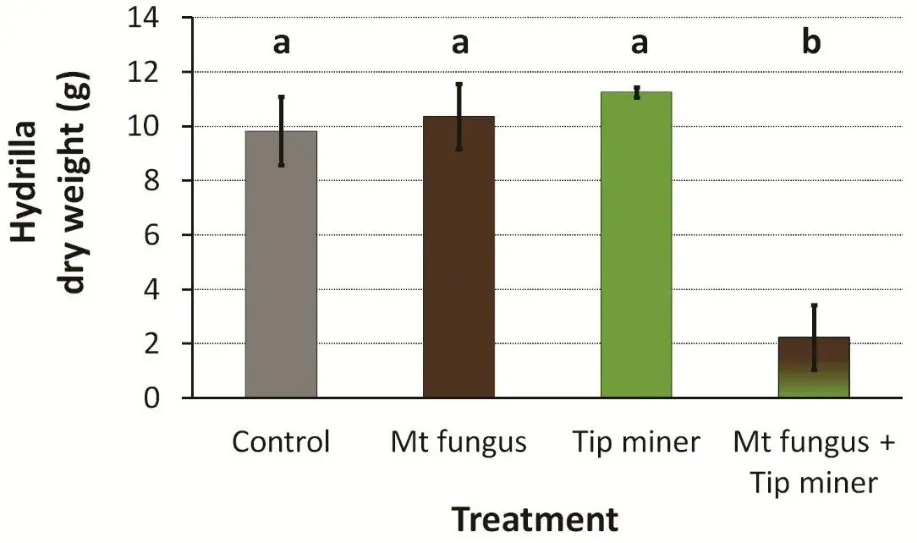
Credit: Special thanks to Judy Shearer (ERDC) and James Cuda (UF/IFAS) for sharing their results.
This approach is a combination between two different biological control agents. Our hypothesis is that the midge larvae feeding in the hydrilla tips open up the plant tissue for increased penetration of the fungus. It is important to note that careful selection of dosages seems necessary to achieve this effect. You can get more information on the hydrilla tip mining midge on page 45 and on the plant pathogenic Mt fungus on page 47.
Hydrilla Tip Mining Midge and the Herbicide Imazamox
Results from short-term aquarium experiments showed that the hydrilla tip mining midge, Cricotopus lebetis, is compatible with the herbicide imazamox. Furthermore, within only 28 days, the combined treatment had a synergistic effect on hydrilla (Figure 38). It
significantly reduced the numbers of hydrilla shoot tips by about 50% when compared with the untreated control. Individual treatments, however, were not effective.
This approach is a combination between biological and chemical control. Our hypothesis is that the imazamox treatment causes the branching of the hydrilla, which provides additional feeding sites for the midge larvae. The midge larvae then feed in the hydrilla
shoot tips causing them to die and break off. These results demonstrate the importance and effectiveness of integrated approaches to weed control. You can get more information on the hydrilla tip mining midge on page 45 and on the herbicide imazamox on page 56.

Credit: Special thanks to Judy Shearer (ERDC) and James Cuda (UF/IFAS) for sharing their results.
Plant Pathogenic Fungus and Herbicides
Compatibility of the plant pathogenic fungus Mycoleptodiscus terrestris (Mt) with aquatic herbicides has been researched extensively since the 1990s and was overseen by the U.S. Army Corps of Engineers at the Engineer Research and Development Center in Vicksburg, Mississippi.
Results from laboratory experiments showed that the Mt fungus is compatible with several herbicides including diquat, endothall, and fluridone. Within only 21 to 35 days, a synergistic effect was seen. For example, combined treatment of hydrilla with the Mt fungus and fluridone significantly reduced hydrilla biomass by 92% when compared with the untreated control and by over 80% when compared with the individual treatments (Figure 39).
This approach is a combination between biological and chemical control. Our hypothesis is that the combination of the fungus with herbicides provides additional control because the modes of action are different. Any tolerance or resistance of hydrilla to either tool used alone could result in treatment failure. When the tools are combined, the plant has less chance to survive. When the fungus is applied alone, it kills only the part of the plant that it contacts. When the herbicide is applied alone, there may be issues with tolerance or resistance.
In the field, these tools are highly complementary when applied in combination, particularly with slow-acting synergistic herbicides. The Mt fungus provides relatively fast initial control, and the herbicide provides a long-lasting effect on the reduced biomass that remains. You can get more information on the Mt fungus on page 47 and on the herbicides diquat, endothall, and fluridone on pages 54-56.

Credit: Special thanks to Judy Shearer (ERDC) for sharing her results.
Selected References (Integrated Management of Hydrilla)
Nelson LS, Shearer JF. 2009. Integrated weed management strategies for control of hydrilla.
U.S. Army Engineer Research and Development Center. Vicksburg, Mississippi. APCRP Technical Notes Collection, ERDC/TN-APCRP-CC-09.
Nelson LS, Shearer JF, Netherland MD. 1998. Mesocosm evaluation of integrated fluridone–fungal pathogen treatment on four submersed plants. Journal of Aquatic Plant Management 36: 73-77. https://doi.org/10.21236/ADA363773
Netherland MD, Shearer JE. 1996. Integrated use of fluridone and a fungal pathogen for control of hydrilla. Journal of Aquatic Plant Management 34: 4-8.
Shearer JF, Nelson LS. 2002. Integrated use of endothall and a fungal pathogen for management of the submersed aquatic macrophyte . Weed Technology 16: 224-230. https://doi.org/10.1614/0890-037X(2002)016[0224:IUOEAA]2.0.CO;2
Sytsma MD, Parker M. 1999. Aquatic vegetation in canals: A guide to integrated management. Oregon Department of Agriculture and U.S. Environmental Protection Agency Region X, 51 pp.
Resistance Management
Resistance management has become a major issue in hydrilla control. For many years, researchers and applicators did not worry about the development of herbicide resistance in dioecious hydrilla populations because they assumed that only one biotype resided in the
U.S. This biotype demonstrated high susceptibility to available herbicides. However, time has proven these assumptions wrong as more and more populations of resistant biotypes of hydrilla emerge.
What Is Resistance?
Within a given population, a plant species that once was susceptible to a given rate of a given herbicide may no longer be controlled by exposure to this herbicide. Such resistance will occur after repeated exposure to the herbicide, because only those individuals or biotypes with a trait that helps them survive the exposure to the herbicide (often due to a slight genetic difference) will continue to grow and reproduce. As a consequence, application rates have to be increased, and eventually, the use of the herbicide is no longer feasible. The entire population is now resistant to this herbicide.
A plant species that is resistant to a certain herbicide may also show cross-resistance, that is, resistance to another herbicide with a similar mode of action. For example, hydrilla populations that are resistant to fluridone also are resistant to norflurazon, because both herbicides have the same mode of action—they inhibit the enzyme phytoene desaturase.
Resistance is not the same as tolerance. A plant species that shows herbicide tolerance has never been susceptible to this herbicide. Such tolerance can be based on genetically determined physical or biochemical traits (such as a thick cuticle or a detoxifying metabolic pathway) that protect the plant from the effects of the herbicide.
Herbicide Resistance in Hydrilla Populations
Various chemical, mechanical, and biological methods have been investigated for managing hydrilla infestations in an attempt to control the explosive growth of the weed, but none to date (2014) have been as effective as the synthetic chemical herbicide fluridone (trade name Sonar®).
About a decade ago, it was discovered that hydrilla had developed resistance to fluridone, which is a systemic herbicide for aquatic systems approved by the U.S. Environmental Protection Agency for managing this submersed invasive aquatic weed. In 2011, the first reports documented resistance of hydrilla to endothall, a fast-acting contact herbicide also approved for aquatic use in the U.S. The resistance problem is increasing, and new tools and tactics to cope with this problem need to be developed.
The spread of resistant hydrilla biotypes to other water bodies within the U.S. is inevitable. What is not known is how to effectively control hydrilla as it loses its susceptibility to fluridone and endothall. Lack of such knowledge is a critical problem because, until it becomes available, the spread of resistant hydrilla biotypes and the higher herbicide concentrations needed to control them will increase the cost to state and federal programs to manage this weed. In addition, the higher herbicide rates will pose a risk to non-target organisms including agricultural and ornamental plants that depend on safe water for irrigation.
The Importance of Product Rotation
Reliance on one product is no longer acceptable in aquatic plant control. Given the costs, labor, and time involved in developing novel herbicides, we need to make sure that products, once they are approved for use, yield the desired control results. Rotating applications between herbicides of different modes of action will support this objective.
We hope you will go beyond thinking about herbicide products as your sole management option, remember the IPM continuum (see page 4). We cannot stress enough the importance of developing an IPM plan. You should have several different tactics at work in your management area to reduce the impact of hydrilla.
Furthermore, when you notice that hydrilla populations in your area are no longer susceptible to previously effective herbicide treatments, immediately contact your local aquatic weed specialist (refer to the Contacts for Plant Identification and Management Advice section on page 126).

Credit: Photograph by Tim Egan, City of Winter Park
The information in this section is not based on replicated research performed by the University of Florida. This information was provided to share field techniques that are being applied by our peers (Figure 40) and are showing promising results.
A Case Report on Integrated and Resistance Management of Hydrilla in Florida
By Amy L. Giannotti and Marissa L. Williams
We have been actively involved in hydrilla management here in Winter Park since the late 1960s. Our 23-year-old stormwater utility program fully funds hydrilla management and water quality related issues on 23 lakes within the City. Historically, hydrilla management was accomplished via the use of mechanical harvesters in the 1960s, and then as it became increasingly difficult and expensive to control, the City incorporated the use of endothall products that were used regularly for a number of years in spot-treatment scenarios.
When fluridone was introduced in the 1990s, Winter Park began using this systemic herbicide intermittently with endothall to rotate the mode of action that was impacting the plants. After two failed fluridone treatments in 2005 and 2007, fluridone was discontinued. The Winter Park Chain of Lakes entered the FWC funded program in 2008, and in order to combat the rapidly spreading hydrilla, we stocked the lakes with a relatively low rate of Asian grass carp in conjunction with continued herbicide treatments.
In 2009 and 2010, several whole-lake treatments were done using endothall at low rates, and monitoring was conducted before, during, and after the treatments to ensure target concentrations were achieved and to provide further data on the use of endothall in cold weather whole-lake scenarios to Dr. Netherland at the U.S. Army Corps of Engineers.
Ironically, both of these treatments yielded unexpected results where hydrilla was still growing and showed no sign of impact even though lethal doses were reached in the water column. Evaluation of these plant communities confirmed that these two lakes harbored the only known population of hydrilla which is not only resistant to fluridone, but is also resistant to endothall.
Since then, our reliance on Asian grass carp has increased, and we are utilizing new herbicides on the market (Clipper™ containing flumioxazin, Clearcast® containing imazamox) as well as unique combinations of these new and old herbicides, and we will be incorporating some of the new herbicide products (Tradewind® containing bispyribac-sodium, Galleon® containing penoxsulam, and Clearcast® containing imazamox) in the fall of 2014 should the need arise. However, unlike the contact herbicides, which are applied to localized areas of the lake and have minimal irrigation restrictions, these new products treat the hydrilla in the entire lake all at once. As such, the irrigation restrictions associated with the use of these new herbicides are lengthy. Based on current label requirements, it may be necessary to cease irrigation for up to four months.
Few people realize that there are small clusters of naturally resistant plants living within a given population of hydrilla. Repeated use of the same products over time kills off only those plants that are susceptible, leaving behind the resistant plants to regenerate and eventually dominate the community. By altering the modes of action that chemically affect the plant, we hope that these uniquely tolerant populations will be impacted by the new herbicides and combinations, thus reducing the likelihood that multiple resistance issues will develop again in this system.
How Can You Help Prevent Herbicide Resistance?
Here are some important actions for you to keep in mind:
- Use an integrated management plan that includes tactics other than chemical control (see the Developing an IPM Plan for Aquatic Weed Infestations section on page 5).
- Always consider non-chemical methods first (such as physical or mechanical control and biological control agents).
- If you have to use chemical control methods (i.e., herbicides), rotate products that are suitable for hydrilla control (see Summary Tables on pages 53 and 63 for more details).
- Use herbicides only when water and weather conditions are suitable and according to the instructions on the label.
- Apply herbicides at the recommended rates, so that plants are not exposed to ineffective concentrations of the active ingredient.
Selected References (Resistance and Its Management)
Berger S, MacDonald GE. 2011. Suspected endothall tolerant hydrilla in Florida. Proceedings of the Southern Weed Science Society 64: 331.
Michel A, Arias RS, Scheffler BE, Duke SO, Netherland MD, Dayan FE. 2004. Somatic mutation-mediated evolution of herbicide resistance in the nonindigenous invasive plant hydrilla (). Molecular Ecology 13: 3229-3237. https://doi.org/10.1111/j.1365-294X.2004.02280.x
Netherland MD. 2009. Chemical control of aquatic weeds, pp 65-78. In Gettys LA, Haller WT, Bellaud M (eds.), Biology and control of aquatic plants: A best management practices handbook. Aquatic Ecosystem Restoration Foundation, Marietta, Georgia.
Puri A, Haller WT, Netherland MD. 2009. Cross-resistance in fluridone-resistant hydrilla to other bleaching herbicides. Weed Science 57: 482-488. https://doi.org/10.1614/WS-09-060.1
Management of Hydrilla in Different Water Body Types
QUOTE: “[I’d like to see] information on what works best to control hydrilla in moving/ quiescent water.” —G.A.
This quote is an important request because the extent of water flow will affect the distribution and concentration of herbicides and biological control organisms. It also impacts the direction in which hydrilla may spread. Different water bodies therefore require different approaches to hydrilla management.
Characteristics of Different Water Bodies
The following sections describe key characteristics of different water bodies and how they may affect aquatic weed management. More detailed information is available through the UF/IFAS Center for Aquatic and Invasive Plants. Scan the QR code on the left to connect direcly to the website.
Rivers and Streams
Florida’s landscape includes almost 1,700 rivers and streams. They are bodies of moving freshwater originating from springs and ranging in width from a few feet to about 2 miles. They are essential for the transport of nutrients and sediment to the abundant wetland areas of our state. Besides their many ecological functions, rivers support a number of commercial, agricultural, and recreational uses.
Canals
Canals span thousands of miles across Florida. They are artificially constructed waterways that can be as small as a few feet wide and deep and as large as several hundred feet wide and up to 35 feet deep. Canals support various functions, such as navigation between natural water bodies, irrigation, flood and drainage control, and recreation.
Lakes and Ponds
Florida harbors almost 8,000 lakes and ponds. Each one is a unique ecosystem with a characteristic shape, hydrology, geology, flora, and fauna. A pond is defined as a body of water that is surrounded by land and shallow enough so that an adult could wade through the water. In general, a lake is defined as a large (at least 4 acres) body of water that is surrounded by land and is deeper than a pond—so deep that an adult could not wade through the water.
Some lakes and ponds have formed naturally, others were constructed artificially. Lakes and ponds have important functions including irrigation, flood control, drinking water supply, recreation, and navigation. Depending on the inflow and outflow of water and on wind and other factors, some lakes and ponds, although seemingly still on the surface, have considerable water movement. However, the movement is generally much less than that observed in rivers and streams.
Impoundments
An impoundment is a body of water that is confined within an enclosure. It is formed artificially “by the construction or excavation of a basin or the obstruction of stream flow in such a manner as to cause the collection of a body of water which would not have formed under natural conditions” (North Carolina Administrative Code 1990).
Impoundments serve as reservoirs of water that can be used for irrigation or hydraulic processes. Large impoundments generally exhibit considerable water movement because of thermal currents and/or wind.
Management of Submersed Weeds in Different Waters
The following sections provide an overview of management tactics that could be combined in different types of water bodies.
Management of Submersed Weeds in Flowing Water
Aquatic vegetation is less of a problem in rivers and streams than in other water bodies such as lakes and ponds. However, when excessive plant growth occurs or invasive weeds do grow in these areas, there can be a big effect on water flow and use of the waterway can be restricted (Figure 41). The movement of water from one area to another poses several problems in aquatic weed control. In particular, although submerged weeds are rooted in the sediment and not as affected by the movement as floating weeds, surface mats like those produced by hydrilla may break off and float to new areas, where they can start new infestations.

Credit: Photograph by Verena Lietze, University of Florida.
Although physical control methods are difficult to implement in flowing water, they are often applied. Hand removal and suction harvesting are likely to be the most appropriate methods to use in these sensitive ecosystems. In wider rivers, booms and barriers may be used to keep waterways clear of weeds.
Due to fragmentation of the plants and the risk of infestation of previously uninfested water bodies, mechanical control should probably be avoided if possible. Any fragments produced during removal will be carried downstream to potentially infest new water bodies. However, in some situations mechanical harvesting is performed.
Biological control agents can be used in rivers and streams if the agents are adapted to living in such conditions. The release of introduced species into these areas probably should be avoided as the spread will be hard to track in flowing water. Herbivorous insects that are approved biological control agents could be used, and the flowing water could even provide an advantage by moving individuals to other hydrilla-infested areas. Triploid Asian grass carp cannot be used in streams and rivers; although these carp are sterile, it is not permitted to release them into open water bodies unless precautions are taken to restrict the fish to certain areas. Asian grass carp are long lived and will consume other types of vegetation if they end up in a water body without hydrilla. It is recommended that Asian grass carp should only be released in closed water bodies.
In rivers and other flowing water bodies, chemical control can be difficult as the water flow quickly diminishes the concentration of herbicide active ingredients in the treated area. Additionally, the water flow increases the possibility that non-target areas and organisms are exposed to potential hazards of applied herbicides. Herbicide residues in runoff water must always be below the threshold levels allowed for the uses of that water. In general, the water flow makes repeated treatments necessary.
Management of Submersed Weeds in Canals
Aquatic vegetation is frequently an issue in canals. The presence of any aquatic vegetation in irrigation systems such as canals affects the water flow and limits its use. One aspect of canals that provides for more management options is the fact that they are manmade so preventive control through smart design can be applied during the construction of canals. Banks with a steep slope offer little area with shallow water (less than 2 to 3 feet deep) where aquatic weeds would become established. Furthermore, leveling and smoothing of the banks will eliminate areas that otherwise might be hard to reach when weeds need to be removed.
As a physical control, lining of the canals (i.e., creating benthic barriers) can help prevent initial establishment of weed populations. Be advised that in Florida, it is illegal to cover large underwater areas, because it is possible that subterranean gas formations accumulate and may lead to dangerous eruptions. Other physical control methods such as hand pulling and suction harvesting may be used but should be left to experts. Canals are frequently deep with steep sides and fast flowing water so conditions are not easy for manual plant removal. One person working in an 18 feet wide canal can hand pull vegetation at a rate of approximately 15 feet per hour.
Chaining is used in canals that have access to both sides. As always with mechanical harvesting it is important to collect all fragmented plant material. Aquatic plants grow best in sediment that is 10-20% organic matter. Removal of the top layer of sediment by dredging typically removes organic matter making fewer nutrients available for plant growth. Dredging also removes tubers along with the sediment. In some cases the sediment can be removed to below the depth that plants can grow. For hydrilla this is unlikely to be effective as hydrilla can grow in very deep water, it has been found at a depth of 45 feet in Crystal River, Florida!
Drawdowns are applicable in canals with a dam or water control structure. As with other water bodies, drawdowns should be completed in the winter. If canals are not used for navigation, physical control with boom barriers also is an effective means to prevent clogging of water control structures.
Mechanical control with harvesters or drag lines can be used in canals. Harvesters used in canals are usually tractor mounted and operate from the bank with a cutting bar on a hydraulic boom.
Biological control using Asian grass carp is an option provided the water body is closed. Screens may be installed to prevent movement into open areas. As in irrigation canals, any vegetation can be a problem for the utility of the water body then Asian grass carp are a great option as they will eventually remove all of the vegetation from the canal and keep it that way for many years. One problem with Asian grass carp is that they may cluster in certain areas of the canals. They prefer earthen canals to concrete lined canals and will leave shallow areas of depth less than one meter so the control provided may not be even throughout the system. Additionally, if the carp manage to remove all the vegetation and are hungry they may start to eat terrestrial vegetation such as overhanging plants and turf on the edge of the water body. Herbivorous insects may be useful in canals.
Depending on the water movement, chemical control options are similar to those in flowing or in static water. It is important to check whether the water from canals will be used for other purposes, such as irrigation or drinking water supply for humans or other animals. In these cases, temporary or permanent restrictions may not allow the use of certain herbicides.
Management of Submersed Weeds in Static Water
Lakes, ponds and reservoirs are the water bodies that most commonly suffer with vegetation problems. Excessive vegetation prevents recreational use, such as fishing, swimming, and boating. In summer and winter, extremes in temperature cause plant material to die off, which results in an oxygen shortage. This oxygen shortage, if extreme enough, may result in fish kills.
Preventive control can be applied during the construction of ditches and ponds. If the banks are designed with a steep slope, areas with shallow water (less than 2 to 3 feet deep) where aquatic weeds become established can be reduced easily and substantially.
Furthermore, leveled and smoothed banks are easy to access so that weeds can be removed quickly should they begin to grow.
Furthermore, a fertilization regimen might help reduce the establishment of rooted aquatic plants because the nutrients will foster the growth of beneficial plankton, which in turn reduces the amount of sunlight available below the water surface. Care should be taken when applying fertilizers to water bodies as excessive nutrients often results in algal blooms and adding fertilizers might be illegal in your area. The type of algae that dominates will depend on the nitrogen to phosphorus ratio. If the level of nitrogen is low, then blue-green algae thrive; if the level of phosphorus is low, then green algae dominate. Green algae are better for the ecosystem than blue-green algae as they are a food source for many organisms.
Of the physical control tactics, drawdowns in combination with removal of the roots (including tubers) of hydrilla can be effective in lakes and ponds that allow manipulation of the water level. Drawdowns should be conducted in late fall and last throughout winter. Manual removal is a feasible method near the shore line when small amounts of plant material during early infestations are to be removed. Shallow ponds and lakes may allow for effective dredging.
The success of mechanical control depends greatly on the accessibility of the infested area, which is unique to almost every lake or pond. Even though certain equipment may perform well in one habitat, it may not be suitable in another. To increase the chance of long-term control, mechanical harvesting should best be followed by additional methods, such as the introduction of biological control agents.
The Asian grass carp has been used very successfully as a biological control tactic to reduce and manage hydrilla infestations in lakes and ponds (Figure 42). It is important to prevent the fish from moving to other water bodies, so inlets and outlets must be secured by fences or gates. You can find details and important considerations on the use of grass carp for biological control of hydrilla on pages 39-43.

Credit: Photograph by David Sutton (retired), University of Florida.
Chemical control of submersed weeds, such as hydrilla, in static water or water with slow movement can best be conducted by surface spraying, injection into the water column, or application of granules.
Surface and injection treatments apply the herbicide as concentrate with specialized delivery systems. These systems are very effective because they are calibrated appropriately to deliver the correct amount of herbicide and use GPS units to guide the application equipment.
Granular products are most effective when applied evenly across the water surface. The granules will sink to the bottom, where they target the submerged weeds and, through slow-release formulations, provide long-term exposure of the weed to the chemical.
Options for integrated management in lakes and ponds are numerous and greatly depend on the specific situation found in the infested habitat. To develop a successful customized management plan, consult with aquatic weed specialists in your area.
Management of Submersed Weeds in Large Impoundments
Reservoirs that are used for recreation and water storage are likely to become infested with hydrilla due to the frequent introduction of boats that may carry attached hydrilla fragments from use at a previous location.
Physical control is possible in large impoundments. In particular, you can take advantage of the water control structures in these artificial water bodies and perform a drawdown (Figure 43). Exposing just the shallow areas where most plant material will be growing will enable fish and other aquatic animals to survive during the process. As with all other water bodies, a drawdown should be done in the winter. Barriers or booms may be used to restrict the weeds to certain areas and prevent disruption of activities or use of the water body. Dredging may be used, particularly in artificially constructed impoundments, to remove the nutrient-rich sediment and reduce the suitability of the soil for plant growth.

Credit: Photograph by Jeff Schardt, Florida Department of Environmental Protection.
Mechanical control methods can be particularly helpful when the water body is used for drinking water or livestock watering and herbicide use may be undesirable. Mechanical harvesting removes the vegetation and so reduces the nutrient load on the system and also does not entail any post-treatment restrictions.
When suitable biological control agents are available, these can be used effectively in dammed rivers and other impoundments. Asian grass carp have effectively controlled hydrilla in reservoirs. When introducing grass carp, you must ensure that any access to open water bodies is blocked by screen of the correct size to prevent grass carp exit. Incremental stocking, which means starting at low numbers of fish and observing the level of control before adding more, may even permit some submerged aquatic plants to remain.
Chemical weed control that is found effective in lakes and ponds often performs poorly in large impoundments because of the differences in water flow and current. To overcome
this difficulty, it can be helpful to apply the maximum recommended rate, select fast-acting herbicides (see Chemical Control section on pages 51-57, 63), use granular formulations, conduct bottom (injection) treatments, or conduct a spray treatment during times with minimum wind. If the impoundment is used for irrigation, make sure to apply only those herbicides that are labeled for such use and observe the post-treatment use restrictions.
Selected References (Different Water Bodies and Weed Control)
Everest JW, Jensen J, Masser M, Bayne DR. No date. Chemical weed control for lakes and ponds. Circular ANR-48. The Alabama Cooperative Extension Service, Auburn University, Alabama, 8 pp.
Gorham P. 2008. Aquatic weed management in waterways and dams. Primefact 30: 1-8.
Kirk JP, Morrow JV Jr, Killgore KJ, De Kozlowski SJ, Preacher JW. 2000. Population response of triploid grass carp to declining levels of hydrilla in the Santee Cooper Reservoirs, South Carolina. Journal of Aquatic Plant Management 38: 14-17. https://doi.org/10.1577/1548-8675(1997)017<0038:CAGAPA>2.3.CO;2
North Carolina Administrative Code. 1990. Section .0300: Control of impounded water. 15A NCAC 18B .0301 Definitions.
Peterson DE, Lee CD. 2005. Aquatic plants and their control. Kansas State University Agricultural Experiment Station and Cooperative Extension Service.
Sytsma MD, Parker M. 1999. Aquatic vegetation in canals: A guide to integrated management. Oregon Department of Agriculture and U.S. Environmental Protection Agency Region X, 51 pp.
U.S. EPA (Environmental Protection Agency). 1976. Aquatic pest control, apply pesticides correctly, a guide for commercial applicators. EPA Office of Pesticide Programs, Washington, D.C., 10 pp.
Utah Department of Agriculture. 2008. Study guide for aquatic (surface water) pest control. Utah Department of Agriculture, Salt Lake City, Utah, 25 pp.
Chapter 6: Insects and Fish Associated with Hydrilla

Contributing Authors Listed with Each Section. Links open in new window.
Hydrilla Leafcutter Moth
Hydrilla Leaf-mining Flies
Hydrellia Fly Parasitic Wasp
Hydrilla Tip Mining Midge
Hydrilla Stem Weevil
Hydrilla Tuber Weevil
Waterlily Leafcutter
Asian Grass Carp
Chapter 7: Supplementary Information
Emma N.I. Weeks and Verena-U. Lietze
 This chapter will provide you with useful contact information should you encounter hydrilla in your environment. It also includes links to fact sheets and a section with frequently asked questions and answers that can help you convey information to your clientele. We hope you will be inspired by our suggestions how to spread the word about hydrilla in your area. Last but not least, a short glossary explains terms that we used throughout this guide.
Contacts for Plant Identification and Management Advice
Before anybody can take steps towards weed control, they need to verify that the aquatic plant that is causing a problem is an invasive species. Expert help to identify aquatic plant species is available in most counties.
If you are unsure about identification and want to learn more, contact your local UF/ IFAS Extension office and ask what parts of the plant to collect if you are asked to bring in a sample. If you are unable to collect a sample, then photographs of the plant can also be really helpful. Please be aware that even the experts can get stumped if you do not provide them with a proper sample or information on where the sample was collected.
Specialist Help for Solving Problems with Invasive Plants in Florida
In addition to contacting your local UF/IFAS Extension office, you have several options:
- You may submit a photo to the UF/IFAS Distance Diagnostic and Identification System (DDIS) online. URL: https://ddis.ifas.ufl.edu
- You may send questions to the UF/IFAS Center for Aquatic and Invasive Plants
- (CAIP), Gainesville, FL 32653, Phone: 352-273-3667, E-mail: CAIP-website@ufl.edu
- You may call or write to the Florida Fish and Wildlife Conservation Commission, Invasive Plant Management Section (Main Office), 3900 Commonwealth Blvd., MS 705 Tallahassee, FL 32399, Phone 850-617-9430, Fax 850-245-2835
First Point of Contact in States with Hydrilla Infestations as of 2014
ALABAMA (AL): Doug Carr, Alabama Department of Conservation and Natural Resources, Wildlife and Freshwater Fisheries Division, Aquatic Education Program, Phone: (334) 242-3884
ARIZONA (AZ): Arizona Game and Fish Department, 5000 W. Carefree Highway, Phoenix, AZ 85086-5000, Phone: (602) 942-3000
ARKANSAS (AR): Arkansas Game and Fish Commission, 2 Natural Resources Drive, Little Rock, AR 72205, Phone: (501) 223-6300, Phone (toll free): (800) 364-4263, Email: askAGFC@agfc.state.ar.us
CALIFORNIA (CA): California Department of Food and Agriculture, Plant Health and Pest Prevention Services, Sacramento, CA 95832, Phone: (916) 654-0768, Pest Hotline: (800) 491-1899, Email: ipcinfo@cdfa.ca.gov
CONNECTICUT (CT): Connecticut Agricultural Experiment Station Invasive Aquatic Plant Program (CAES IAPP), 123 Huntington Street, New Haven, CT 06511, Phone: (203) 974-8512
DELAWARE (DE): Delaware Invasive Species Council, Delaware Department of Agriculture, 2320 South Dupont Highway, Dover, DE 19901, Phone: (302) 698-4587, Email: disc@delawareinvasives.net
DISTRICT OF COLUMBIA (DC): Gina Ramos, Senior Weed Specialist, Bureau of Land Management, WO 220, 1849 Street, NW, Washington, DC 20240, Phone: (202) 912-7226, Email: gramos@blm.gov
FLORIDA (FL): University of Florida/IFAS, Center for Aquatic and Invasive Plants, 7922 NW 71 Street, Gainesville, Florida 32653, Information Office Phone: (352) 392-1799; or Florida Fish and Wildlife Conservation Commission, Invasive Plant Management Section (Main Office), 3900 Commonwealth Blvd., MS 705, Tallahassee, FL 32399, Phone: (850) 617-9430
GEORGIA (GA): Center for Invasive Species and Ecosystem Health, College of Agriculture and Environmental Sciences, University of Georgia, Tifton, GA 31794, Phone: (229) 386-3298
IDAHO (ID): Idaho Department of Water Resources, State Office, 322 East Front Street, Boise, ID 83720, Phone: (208) 287-4800, Email: IDWRinfo@idwr.idaho.gov
ILLINOIS (IL): Illinois’ Hydrilla Task Force, Email: HydrillaHunt@niipp.net; or Illinois-Indiana Sea Grant College Program, University of Illinois, 1101 W. Peabody Drive, 350 National Soybean Research Center, MC-635 Urbana, IL 61801, Phone: (217) 333-6444, Email: iisg@illinois.edu; or Pat Charlebois, Aquatic Invasive Species Coordinator, Illinois Natural History Survey, Prairie Research Institute, c/o Chicago Botanic Garden, Phone: (847) 242-6441, Email: charlebo@illinois.edu
INDIANA (IN): Indiana Department of Natural Resources, Division of Fish and Wildlife, Indianapolis, IN 46204, Phone: (317) 234-3883, Email: dkeller@dnr.IN.gov; or Purdue University Extension, Purdue Plant & Pest Diagnostic Laboratory, West Lafayette, IN 47907, Phone: (765) 494-7071
LOUISIANA (LA): Louisiana Sea Grant College Program, 237 Sea Grant Building, Louisiana State University, Baton Rouge, LA 70803, Phone: (225) 578-6710
MAINE (ME): Maine Department of Environmental Protection (ME DEP), Phone: (800) 452-1942; or Maine Natural Area Program, Phone: (207) 287-8041
MARYLAND (MD): Maryland Department of Natural Resources, 580 Taylor Avenue, Annapolis, MD 21401, Phone: (877) 620-8367
MASSACHUSETTS (MA): Department of Conservation (DCR), Phone: (617) 626-1411 or (617) 626-1395
MICHIGAN (MI): Great Lakes Aquatic Nonindigenous Species Information System (GLANSIS), Toll-free phone: (877) STOP-ANS; or directly contact Rochelle Sturtevant, GLANSIS manager, Phone: (734) 741-2287, Email: rochelle.sturtevant@noaa.gov
MISSISSIPPI (MS): John D. Madsen, Mississippi State University, GeoResources Institute (GRI), Mississippi State, MS 39762, Phone: (662) 325-2428, Email: jmadsen@gri.msstate.edu
MISSOURI (MO): Missouri Department of Conservation Southwest Regional Office, Phone: (417) 895-6880
NEW JERSEY (NJ): Pat Rector, Environmental and Resource Management Agent, Rutgers, The State University of New Jersey, New Jersey Agricultural Experiment Station, Cooperative Extension of Morris County, Phone: (973) 285-8300 x225, Email: rector@njaes.rutgers.edu
NEW YORK STATE (NY): Roxanna Johnston, Watershed Coordinator, City of Ithaca, Phone (607) 273-4680, Email: roxannaj@cityofithaca.org; or Cornell Cooperative Extension Tompkins County, Ithaca, NY 14850, Phone: (607) 272-2292, Email: tompkins@cornell.edu
NORTH CAROLINA (NC): Aquatic Weed Control Program, Division of Water Resources, North Carolina Department of Environment, Health, and Natural Resources, Raleigh, NC, Phone (919) 733-4064; or North Carolina Department of Agriculture and Consumer Services, Weed Specialist, Phone: (800) 206-9333; or Eric Boyda, coordinator of the Appalachian Ohio Weed Control Partnership, Phone: (740) 534-6578, Email: appalachianohioweeds@gmail.com
PENNSYLVANIA (PA): Pennsylvania Fish and Boat Commission, Division of Environmental Services, Bellefonte, PA 16823, Phone: (814) 359-5147
SOUTH CAROLINA (SC): Aquatic Nuisance Species Program, South Carolina Department of Natural Resources (SCDNR), West Columbia, SC 29172, Phone: (803) 755-2872, Email: invasiveweeds@dnr.sc.gov
TENNESSEE (TN): Tennessee Valley Authority (TVA), Environmental Information Center, Phone: (800) 882-5263
TEXAS (TX): Texas A&M AgriLife Extension Service, College Station, TX 77843, Phone: (979) 845-7800, Email: help@agrilife.org
VIRGINIA (VA): Virginia Department of Game and Inland Fisheries, Richmond, VA 23230, Phone: (804) 367-1000, Email: dgifweb@dgif.virginia.gov
WASHINGTON STATE (WA): Washington Invasive Species Council, Olympia, WA 98501, Phone (877) 9-INFEST, Email: InvasiveSpecies@rco.wa.gov; or report online at www.InvasiveSpecies.wa.gov; or Jenifer Parsons, Washington State Department of Ecology, Yakima, WA 98902, Email: jenp461@ecy.wa.gov; detailed instructions at URL: https://www.ecy.wa.gov/programs/wq/plants/plantid/mail.html
WISCONSIN (WI): Wisconsin Department of Natural Resources (DNR), Madison, WI 53707, Phone: (608) 267-3531
Web Links to Hydrilla Fact Sheets
We have compiled a list of useful fact sheets that were developed by different state and federal agencies that you can find on the internet. Some are incorporated as pages into websites and others are in practical PDF format so you can print them.
Helpful Web Pages
BugwoodWiki. 2012. Hydrilla. Information developed by the Center for Invasive Species and Ecosystem Health at the University of Georgia. URL: http://wiki.bugwood.org/Archive:BCIPEUS/Hydrilla (23 July 2014).
BugwoodWiki. 2013. Hydrilla. Information developed by The Nature Conservancy. URL: http://wiki.bugwood.org/Hydrilla_verticillata (23 July 2014).
Invasive.org. 2003. Invasive plants of the Eastern United States. URL: http://www.invasive. org/eastern/species/2626.html (23 July 2014).
Invasive Species Specialist Group. 2006. Global invasive species database. URL: http://www.issg.org/database/species/ecology.asp?si=272&fr=1&sts=sss (23 July 2014).
National Park Service and U.S. Fish and Wildlife Service, Invasive Plants of the Eastern United States. 2003. Plant invaders of mid-Atlantic natural areas. URL: http://www.invasive.org/eastern/midatlantic/hyve.html (23 July 2014).
SEEPPC (Southeast Exotic Pest Plant Council). 2010. Hydrilla. Archive. URL: http://wiki.bugwood.org/Archive:SEEPPC/Hydrilla_-_Hydrilla_verticillata_%28L._f.%29_Royle (23 July 2014).
The New York Invasive Species Clearinghouse, Cornell Cooperative Extension Invasive Species Program. 2012. New York invasive species information. URL: http://www.nyis.info/index.php?action=invasive_detail&id=16 (23 July 2014).
USDA-APHIS (U.S. Department of Agriculture, Animal and Plant Health Inspection Service). No date. Federal Noxious Weed Disseminules of the U.S. URL: http://keys.lucidcentral.org/keys/FNW/FNW%20seeds/html/fact%20sheets/Hydrilla%20verticillata.Htm (23 July 2014).
Washington State Noxious Weed Control Board. 2010. Hydrilla. URL: http://www.nwcb.wa.gov/detail.asp?weed=73 (23 July 2014).
Printable PDFs
FLEPPC (Florida Exotic Pest Plant Council) and University of Florida. No date. (L.f.) Royle. URL: http://www.fleppc.org/ID_BOOK/Hydrilla%20verticillata.pdf (23 July 2014).
FWC (Florida Fish and Wildlife Conservation Commission). No date. Division of Habitat and Species Conservation, Invasive Plant Management Section, Weed alert, hydrilla. URL: http://plants.ifas.ufl.edu/weedalert/invasiveplants_hydrilla.pdf (23 July 2014).
Hydrilla Task Force of the Cayuga Lake Watershed in NY State. 2013. Stop Hydrilla! URL: http://ccetompkins.org/sites/all/files/347/stophydrilla.pdf (23 July 2014).
Michigan Department of Environmental Quality. 2005. Heading off hydrilla. URL: http://www.nyis.info/user_uploads/files/Michigan%20DEQ%20hydrilla%20factsheet.pdf (23 July 2014).
Mississippi State University, Geosystems Research Institute. No date. Hydrilla. URL: http://www.gri.msstate.edu/research/invspec/factsheets/2P/Hydrilla.pdf (23 July 2014).
North Carolina State University, Agricultural Extension Service. 1992. Hydrilla. A rapidly spreading aquatic weed in North Carolina. URL: http://www.weedscience.ncsu.edu/quaticweeds/hydrilla.PDF (23 July 2014).
State of Indiana. 2009. Aquatic invasive species. URL: http://www.in.gov/dnr/files/hydrilla.pdf (23 July 2014).
Washington Invasive Species Council. No date. Stop the invasion. URL: http://www.invasivespecies.wa.gov/documents/priorities/HydrillaFactsheet.pdf (23 July 2014).
Washington State Noxious Weed Control Board. 2013. Written findings of the Washington State Noxious Weed Control Board. URL: http://www.nwcb.wa.gov/siteFiles/Hydrilla_ verticillata.pdf (23 July 2014).
Wisconsin Department of Natural Resources. 2009. Hydrilla. URL: http://dnr.wi.gov/lakes/cbcw/publications/WT-884.pdf (23 July 2014).
FAQs and Stakeholder Feedback
Here are a few questions and concerns to consider when you are talking about and planning hydrilla management. We included several “real-life” comments we have received from various stakeholders, because we feel they deserve your consideration.
QUOTE: “At our HOA we added Asian grass carp at 7.5 per acre; the problem continued and we treated with Sonar; now we are considering additional Asian grass carp to bring it up to 10.5 [carp] per acre to control the new growth this year.” —J.M.
RESPONSE: J.M. correctly is expecting new growth in the year after successful herbicide treatment. It is important to remember that hydrilla forms tubers and turions that may remain viable (and undetected) in the sediment until the environmental conditions allow new growth. However, now that you have provided some control, the Asian carp that you already have in the water body may be able to keep up with the new growth.
Remember that Asian grass carp are very difficult to remove once they have been introduced. Too many Asian grass carp will result in removal of almost all plant material from the water body, which may also be undesirable depending on the situation. Contact the Florida Fish and Wildlife Conservation Commission for advice on stocking rates (see the Steps for Using Grass Carp section on page 40) specific to your water body and be aware that your permit for stocking grass carp is limited to the stocking rate that they recommend.
QUOTE: “I cannot evaluate submersed plants, but I have noticed a definite decline in the pickerelweed [after the release of grass carp]. I don’t know if there is a connection. I’m not aware that carp eat pickerelweed.” —R.S.
RESPONSE: The Asian grass carp is a generalist herbivore and readily feeds on aquatic plants other than hydrilla. Therefore, this biological control agent is best used in water bodies that need to be relatively free of aquatic vegetation, for example, in lakes with high boat traffic. In addition, the stocking rate (the number of Asian grass carp released per unit of water volume) is crucial to maintain a balanced relationship between the long-lived fish and the aquatic vegetation that is its food source.
QUOTE: “On our 250 acre lake, we have stocked triploid Asian grass carp in three installments and have mechanically harvested the weed when it was topping out—a couple of years ago. We have not used any other biologic control agents. There has been a dramatic reduction in the visible hydrilla, but this has been accompanied by a substantial reduction in clarity, presumably owing to algae benefitting from the increase in nutrients.” —R.S.
RESPONSE: When invasive plants, such as hydrilla, form monocultures in a water body and become topped out, the water clarity is often high. This is because the dense plant material is producing a lot of oxygen, blocking sunlight to the water column, and storing away nutrients so that they are not available for other organisms. Once the hydrilla is gone, the oxygen levels decrease, the sunlight can penetrate, and the nutrients are returned to the ecosystem. This allows algae to bloom. You have several options, but before you start, it might be a good idea to test the level of nitrogen and phosphorus to understand the problem better. The Green Industry Best Management Practices (GI-BMP) program has additional information you might find useful in your community. See page 29 for details.
First, examine the water body for potential sources of excessive nutrients. Reducing nutrient loading of the water body will improve lake health in the long-term. However, most water bodies in Florida naturally contain sufficient amounts of nutrient to facilitate plant growth and algal blooms without any external sources.
Second, it would be advisable to begin planting native aquatic plant species. Focus on plant species that the carp do not like to eat, such as spatterdock (Nuphar advena), eelgrass (Vallisneria americana), and fragrant waterlily (Nymphaea odorata), to prevent their consumption.
Third, manipulation of the nutrient availability is possible, particularly if the problem is due to excess phosphorus. Products can be added to the water to bind the phosphorus. See the Nutrient Management section on page 28. The type of algae that dominates will depend on the nitrogen to phosphorus ratio. If the level of nitrogen is low, then blue-green algae thrive; if the level of phosphorus is low, then green algae dominate. Green algae are better for the ecosystem than blue-green algae as they are a food source for many organisms. If blue-green algae and an excess of phosphorus are your problem and there are no options for controlling erosion from adjacent landscapes (the usual source of excess phosphorus), then manipulation of phosphorus level using the available products is a good option.
So you may be wondering if hydrilla control was the best option! Although a large biomass of hydrilla produces lots of oxygen, it also uses a lot of oxygen so on cloudy days the level of dissolved oxygen in the water may actually be very low, too low to support many species of plant, fish, or invertebrates. Topped-out hydrilla also prevents sunlight from reaching below the canopy preventing the growth of other submersed aquatic plants. A small area of hydrilla in your 250-acre lake would not be a problem, but hydrilla reproduces quickly and will soon spread. Once hydrilla has taken over, the number of species that can survive in the low-light, low-oxygen environment is limited. You will soon have a monoculture of hydrilla with little other flora.
QUOTE: “Last year I’ve seen herbicide sprayings that looked like they were getting paid by the gallon! Large dead masses in strange areas and dead cypress seedlings along river banks! Just think there must be a better way that benefits Florida’s wildlife. I see no benefit from massive sprayings other than opening to boat traffic? It’s just that after they spray, the area is void of life for quite some time.” —R.H.
RESPONSE: The decision to manage aquatic plants within a water body is never taken lightly. All herbicide treatments in public water bodies are regulated by the Florida Fish and Wildlife Conservation Commission (FWC). Any treatments in public water bodies or private water bodies that are linked to waters of special concern require a permit from the FWC. The FWC has specific guidelines that consider the impact on non-target species, with particular attention to endangered species. The FWC guidelines state:
“Application of herbicides shall be conducted at all times in a manner to cause the least possible adverse effect on human health, safety, recreational uses, non-target plants, fish, or wildlife.”
When choosing the most appropriate herbicide to use against hydrilla, the FWC biologists consider which herbicide will 1) provide the greatest protection to human health, 2) provide the greatest protection to non-target organisms, and 3) be most effective at controlling hydrilla. All aquatic herbicides are rigorously tested before they are granted registration by the U.S. Environmental Protection Agency and the Florida Department of Agriculture and Consumer Services. These tests include non-target toxicity testing to determine the products and rates that are safe to use in ecologically sensitive areas.
Systemic pesticides are often used for control of submersed plants as the effect of the chemical is not limited to the plant parts that contact the chemical. Instead, the chemical moves throughout the plant killing areas that were not exposed. For this reason, plants that grow near and take up herbicide-treated water are often effected and may sometimes be killed when this type of herbicide is applied. One example of an herbicide that will have this effect is fluridone: Trees and shrubs growing in water treated with this active
ingredient may develop chlorosis or yellowing. However, chlorosis in non-target terrestrial plants is usually temporary, and the plants recover once the concentration of herbicide in the water declines.
It also is possible that R.H. described a foliar application made to emersed or floating vegetation growing in and around shoreline shrubs and trees as part of maintenance control. These treatments are often made using the contact herbicide diquat, which controls the targeted floating species and may defoliate non-target species like cypress. However, any cypress needles sprayed with diquat will regrow quickly, whereas the treated target species will remain absent. These maintenance control treatments may seem excessive, but they are highly targeted to small patches of invasive plants.
It is our responsibility as informed citizens to protect our environment. If you observe what you consider to be inappropriate use of aquatic herbicides, then you can contact the regional biologist at the Florida Fish and Wildlife Conservation Commission.
QUOTE: “I would like to see how [hydrilla management] affects birds and other wildlife and not a blanket statement that it does no harm. I would like to be constantly updated about how it affects the endangered snail kite. —J.W.
QUOTE: “I would like to see better and more consideration for the snail kite and other birds (eagles) who must forage during the winter months, especially since they seem to get going earlier these days. That is, do nothing during the early nesting season.” —S.W.
RESPONSE: J.W. and S.W. are not the only concerned citizens. It is important to be honest about potential side effects that a hydrilla management plan will have on non-target organisms, such as other aquatic plants and wildlife.
Any plan that is developed by the Florida Fish and Wildlife Conservation Commission for the management of hydrilla and other aquatic weeds in public waters includes considerations for non-target animal protection including snail kites. Although herbicides
have no direct effect on snail kites or their prey, apple snails, there is concern over the effect of habitat loss and disturbance if hydrilla is controlled in snail kite nesting and foraging areas. Therefore, hydrilla control is not allowed during the period of snail kite nesting and peak juvenile foraging (a period that can extend from January to August).
An excerpt from the Everglade Snail Kite Brochure published by the Florida Fish and Wildlife Conservation Commission (FWC):
“Snail kites have been protected by state and federal law under the Endangered Species Act since 1967, making it illegal to harass, kill, capture or collect them. This includes protection from activities that disrupt normal breeding, feeding or sheltering.”
QUOTE: “In the past, the FWC has taken the lead on the lake plants. […] Our problem down here is the fertilizers! Both grazing and lawn chemicals, and sometimes both together - ‘improved’ grazing. […] Since [the lake] is surrounded on the N, W, E by homes and grazing, I see no end to the problem.” —S.W.UOTE: “In the past, the FWC has taken the lead on the lake plants. […] Our problem down here is the fertilizers! Both grazing and lawn chemicals, and sometimes both together - ‘improved’ grazing. […] Since [the lake] is surrounded on the N, W, E by homes and grazing, I see no end to the problem.” —S.W.
RESPONSE: Florida is tackling this problem with the Green Industries Best Management Practices (GI-BMP) training program (see page 29). These guidelines were developed within the framework of Florida-Friendly Landscaping™.
Spread the Word
Everyone who visits water bodies should be aware of the problems caused by hydrilla and other invasive aquatic plants and of steps to prevent infestation and spread. Read on to get more ideas.
- Talk to your friends about invasive aquatic plant management.
- Bring up the topic at the next fishing tournament.
- Chat with people at the boat ramp when you launch into a fun day on the lake or river.
- Educate the public and have fun with it!
ARE YOU INVOLVED IN PUBLIC EDUCATION? Contact your local UF/ IFAS Extension office for material you can use and for help with your programming. Each office has brochures and other educational print items available as well as PowerPoint presentations that you can use for events. Our team members will be happy to present our material or provide a display for aquatic weed workshops, field days, and other events to raise public awareness on invasive aquatic plants.
ALWAYS REMEMBER: Everyone who visits water bodies should be aware of the threats posed by hydrilla and other invasive aquatic plants and of the steps that are necessary to prevent infestation and spread.
ARE YOU PLANNING AN EVENT? We can loan you banners and provide you with educational materials that include 2-page brochures, 6-inch bookmarks (with ruler scale), web cards, and 14-page booklets (Figure 98).

Credit: UF/IFAS
Glossary
BIOTYPE
a form of the same plant species that shows special characters (for example, presence/absence of male or female flowers, resistance to a chemical herbicide, tolerance to extreme temperatures)
DIOECIOUS
female and male flowers occur on different plants
DIPLOID
a cell with two sets of chromosomes, usually one set is from the organism’s mother and one set is from the organism’s father; diploid cells are the building blocks for meiosis
DISTRIBUTION
the geographical range in which the plant occurs
HABITAT
an area or environment where a plant, fungus, or animal normally lives and grows
HERBICIDE
a substance that kills weeds (usually a chemical compound)
HERBIVOROUS [ADJ.], HERBIVORY [N.]
plant-eating
INDIGENOUS
occurring naturally in a place or region
MEIOSIS
when a diploid cell divides into haploid cells to produce reproductive gametes (this is the process required to produce sperm and eggs or pollen and ovules)
MONOCULTURE
the agricultural practice of growing one crop on a farm or in a production area
MONOECIOUS
female and male flowers occur on the same plant
NUCLEUS (CELL NUCLEUS) [SING.], NUCLEI [PL.]
a membrane-bound organelle found in most cells; this organelle contains most of a cell’s genetic material, and it is where the chromosomes are located
PATHOGENIC
disease-causing
PESTICIDE
a substance that is used to destroy insects or other organisms that are considered harmful to cultivated and native plants or animals
pH
a term used in chemistry to indicate the acidity or alkalinity of a solution based on the availability of free hydrogen; values range from 1 to 14; pH 7 = neutral, low pH (1 to <7) = acidic, high pH (>7 to 14) = alkaline
RESISTANCE [N.], RESISTANT [ADJ.] (TO HERBICIDES)
the ability of a plant to survive the exposure to a typically lethal dose of herbicide
SUBMERSED
a plant with most leaves growing underwater; flowers and some of the leaves may float on the water surface
SYNERGISTIC EFFECT
the effect caused by two methods or agents together is greater than the sum of the effects of each individual method or agent
TERRESTRIAL
relating to the earth, for example, an organism that lives on land (as opposed to one that lives in water)
TRIPLOID [ADJ.], TRIPLOIDY [N.]
when an organism has three sets of chromosomes; this is a rare condition in nature and leads to sterility in most organisms
WHORL (LEAF WHORL)
an arrangement of three or more leaves emerging and radiating from a common node along the stem
