
 IFAS Extension

Insects and mites can cause severe problems in the produc- tion of watermelon, squash, cucumber, and cantaloupe either through direct feeding damage to the crop or through the transmission of disease agents, such as the aphid-borne mosaic viruses. Common pests of cucurbits are described below. The importance of a particular insect will vary by region and by crop. For example, root maggots are more important in north Florida and melon thrips in south Florida. Pickleworm and melonworm rarely attack watermelon.
For each pest described, a table of management options will be found after the damage. These tables will be expanded as more information becomes available. Table 11, at the end of this publication, lists pesticides labeled for the major cucurbits grown in Florida: cucumber, squash, cantaloupe, and watermelon. Pesticides for controlling insects not described below can be found by looking under the "Insects" column in the table.
Beneficial Insects
Bees are essential for cucurbit production. It has been estimated that eight or more visits per blossom are neces- sary for optimum fruit set and healthy fruit development in watermelon. The morning hours are most critical for pollination, but bees will continue to forage into the afternoon, so during bloom, application of insecticides harmful to bees should be made in the evening. Biological and cultural controls should be used as much as possible to preserve, not only bees, but also other beneficial insects. Some of the predators and parasites important in the management of insect and mite pests are mentioned in the following sections.
Melon Aphid, Aphis gossypii Glover
Description
Melon aphids are soft-bodied insects, almost egg-shaped when viewed from above (Figure 1). The largest ones are not much longer than one-sixteenth of an inch in length. Their color can vary from pale yellow to dark green to almost black. A pair of small tube-like structures called cornicles extends backward and upward from the posterior of the aphid, above a small tail-like structure (cauda). The first individuals to colonize a plant will usually have wings, but then wingless aphids become the dominant form until crowding occurs or the plant deteriorates. Then winged aphids will be produced again to disperse to other plants.

Biology
Melon aphids reproduce very rapidly. Average temperatures of 78 to 80°F are highly favorable for aphid development. They feed by inserting their long, piercing-sucking mouthparts into the plant's vascular system and sucking out the plant sap. In doing so, they excrete large amounts of sugary, sticky honeydew. Honeydew is a source of food for a black fungus known as sooty mold and for ants. The ants visiting aphids colonies for honeydew will actually protect them from attack by other insects and may move them to other leaves.
Damage
On watermelon and cantaloupe, the first sign of aphid damage is a downward curling and crumpling of the leaves, which also appear thickened and may glisten with sticky honeydew. On squash, aphids are often found on lower leaves, flower buds and flowers. If plants are heavily attacked when very young they may be killed. This aphid is also involved in the spread of several viruses that affect all cucurbits.
Silverleaf Whitefly
Description
The adult silverleaf whitefly is small, less than 1/16 of an inch in length, and has powdery white wings held tent-like over a yellow body while at rest (Figure 2). Adult females lay pointed oblong yellow eggs that darken at the tip just before hatching. A mobile first instar or crawler stage settles on the leaf and develops through sessile second, third, and fourth instars, which look like semi-transparent, flat, oval scales. Later instars, more yellow and more easily seen without the aid of a hand lens, typically have very distinct eyespots and are referred to as "red-eyed nymphs."

Biology
The life cycle from egg to adult can be as short as two weeks under very warm temperatures. Eggs and early immature stages of whitefly generally occur on the underside of younger leaves. Whitefly adults also concentrate on younger leaves where they lay the most eggs. Larger nymphs are typically more numerous on older leaves. Whiteflies feed in the plant vascular system (phloem) through a stylet similar to that of aphids and, like aphids, process a relatively large volume of plant sap by excreting excess liquid in the form of honeydew.
Damage
Silverleaf whiteflies can affect the crop directly by feeding and by acting as a vector of viruses such as Squash vein yellowing virus, Cucurbit leaf crumple virus, and Cucurbit yellow stunting disorder virus, which have been reported in Florida in the last five years. Squash vein yellowing virus is responsible for a devastating disease of watermelon, known as watermelon vine decline. Plants often die shortly before or during harvest, and fruit show necrosis of the rind when cut open. When whiteflies are very numerous, the sticky honeydew they produce supports the growth of sooty mold on leaves. Squash and pumpkin are susceptible to silverleaf, a disorder caused by feeding of immature stages. For unknown reasons, epidermal cells separate from the cells below them, leaving air spaces, which make the leaves appear silver. New growth will be normal once whiteflies are controlled.
Rindworm Complex
Description and Biology
Any caterpillar (larval stage of moth) that feeds on the surface of watermelon fruit is considered a rindworm, although many of these insects feed primarily on stems and foliage. At any given time and location, different species may be present. Currently, in Florida, beet armyworm and cabbage looper (described in more detail in the following paragraphs) are the most abundant, but at other times, granulate cutworms, tobacco budworms, corn earworm, and other armyworms may be important. Control measures may vary for each species so it is important to identify them properly. In general, it is much easier to control these insects when they are small.
Cabbage looper, Trichoplusia ni (Hubner) (Figure 3), feeds on a variety of crops. The adults are night-flying moths with brown, mottled forewings marked in the center with a small, silver figure eight. They lay their eggs (small, ridged, round, greenish-white) singly on both upper and lower leaf surfaces. The eggs hatch into larvae that are green with white stripes running the length of their bodies. The caterpillar has three pairs of slender legs near its head and then three pairs of thick prolegs near the end of its body. Cabbage loopers move in a characteristic looping motion, alternately stretching forward and arching its back as it brings the back prolegs close to its front legs. After feeding for two to four weeks, the caterpillar, about 1.25 inches long when fully grown, spins a cocoon and pupates. The adults emerge 10 days to two weeks later. There can be several generations per year depending on climate.

Beet armyworm, Spodoptera exigua (Hubner) (Figure 4), also feeds on many crops and weeds. The highly mobile adult moth has dark forewings with mottled lighter markings and hind wings thinly covered with whitish scales. Each female can lay over 600 eggs, generally in masses of about 100 on the undersides of leaves in the lower plant canopy. Very young caterpillars feed in groups and then disperse as they grow older (third instar). The dull green caterpillars have wavy, light-colored stripes lengthwise down the back and broader stripes on each side. After feeding from one to three weeks, they construct a cocoon and pupate, emerging as adults about one week later. Beet armyworm survives the winter in south Florida and can complete many generations a year there. From south Florida, adults migrate into north Florida and other parts of the Southeast.

Damage
Caterpillars feed on stems and foliage, but their feeding on the rind of the watermelon causes the most economically important damage. The irregularly-shaped white to tan blotches left after the caterpillar feeds on the upper layers of the rind make the fruit less marketable.
Pickleworm, Diaphania nitidalis
Description
The moth (Figure 5) has a wing expanse of about 1.2 inches. The wings are a semi-transparent yellow color bordered by dark brown. Eggs are very small, initially white but quickly turning yellow. Young larvae (Figure 6) are a creamy white color with dark gray or black spots. The spots are lost at the last molt. The fifth instar larva, often green in color, turns a coppery color before pupating.


Biology
Moths are active only at night. When they are a few days old, females begin laying eggs in small clusters of 2 to 7, mostly on buds, flowers, and other actively growing plant parts. Each female moth can produce up from 300 to 400 eggs. Young larvae are often found in flower buds. They often burrow into the fruit as they grow larger. When ready to pupate, they leave the fruit and move to leaves.
Damage
Pickleworm attacks squash, pumpkin, cantaloupe, and cucumber, but rarely watermelon. Damage to flowers reduces fruit production. Fruit are ruined when larvae burrow into them. When populations are very high, larvae may burrow into the apical meristem. Because the larva is usually inside a plant part, control is difficult.
Melonworm, Diaphania hyalinata
Description
The wingspan of the moth (Figure 7) is about 1 inch. Wings are white and edged with dark brown. Eggs are very small, oval, and flattened. They are white or greenish initially but quickly turn yellow. Newly hatched larvae are colorless but after molting become yellow-green (Figure 8). The last instar has two white stripes running the length of the body. The stripes disappear when the caterpillar pupates. The pupa is dark brown and often found in a loose cocoon in a fold of leaf.


Biology
Melonworm is present throughout the year in south Florida but must disperse northward each year. It usually reaches north Florida in June and can complete several generations before the onset of cold weather. Moths are active at night and rest under leaves during the day. They deposit their eggs in small clusters in buds, stems and leaves. The larva completes its development in about 14 days and then pupates, remaining in the pupal stage about 9 to 10 days.
Damage
Melonworm feeds on leaves and occasionally on the surface of fruit. Summer and winter squash are its preferred hosts. High populations will defoliate plants leaving nothing but leaf veins. On less preferred hosts like cantaloupe, larvae may feed on the surface of the fruit, leading to the name rindworm (a name also used to describe several caterpillars feeding on watermelon rind).
Cucumber Beetles, Acalymma vittatum (Fabricius), Diabrotica undecimpunctata howardi Barber, Diabrotica balteata Le Conte
Description
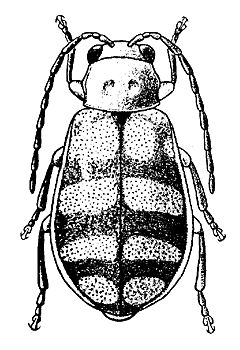
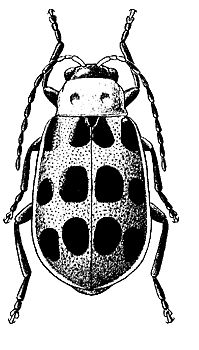
There are three species of cucumber beetles that attack cucurbits in Florida. They are considered occasional pests. Banded cucumber beetle (Diabrotica balteata) (Figure 9) is more common in the southern part of the state, and the spotted cucumber beetle (Diabrotica undecimpunctata howardi) (Figure 10) is more common in North Florida. The striped cucumber beetle (Acalymma vittatum) may also be found but is not as common. All three species are approximately 1/4 inch in length. The banded cucumber beetle is green with yellow bands across the top; the spotted has 12 black spots on a yellow-green background. The striped cucumber beetle has 3 black stripes lengthwise along its yellow body. Larvae are yellowish-white and worm-like and may reach a length of 3/4 inch. They have three pairs of legs, a brown head, and a brown plate at the other end.
Biology
Adult beetles will feed on wild hosts (i.e., sunflower, dandelion, Rosaceae family) until cucurbits are available. Once plants emerge or are transplanted, cucumber beetle adults can appear in the field in large numbers in a very short time. Beetles are most active in the morning and late afternoon. Females begin to lay eggs as they disperse throughout the field. Eggs hatch in 6–9 days while the larval stage lasts 2–3 1/2 weeks. Pupation takes 6–10 days.
Damage
Adult beetles feed on emerging plants or transplants. Feeding damage can occur very quickly with cotyledons usually being fed on first and then foliage. Beetles can also feed on stems below plastic mulch. Plants will begin to wilt and then collapse due to the stem feeding. The larva of the cucumber beetle feeds on roots and stems and can cause severe damage to very small plants, but less damage to larger plants with more fully developed root systems. Later in the season beetles can feed on watermelon rind causing mostly cosmetic damage to the fruit, which may reduce marketability. Beetles can transmit Erwinia tracheiphila, the causal agent of bacterial wilt, to some cucurbits (watermelon is not affected).
Leafminers, Liriomyza sativae Blanchard, L. trifolii Burgess
Description and Damage
Leafminers have been occasionally reported as a major pest in south Florida. The adult leafminer is a small fly (Figure 11), about 1/8 to 1/10 of an inch long with a yellow abdomen. The fly inserts her eggs in feeding punctures on the upper leaf surface. Larvae (maggots) feed between the upper and lower leaf surfaces, creating meandering mines that enlarge as the larvae grow. After approximately two weeks in warm weather the larva completes development and leaves the mine, dropping to the ground to pupate. The complete life cycle can be as short as 18 to 21 days. Infestations can be more severe late in the growing season, particularly if adults migrate out of nearby crop residue into late-planted fields. Defoliation of the crop late in the season can lead to sun scalding of the fruit.

Thrips, Melon Thrips, Thrips palmi Karny; Tobacco Thrips, Frankliniella fusca (Hinds)
Description
Thrips are very small (1/25 to 1/10 inches long) (Figure 12), slender insects that, depending on the species, feed on leaves, pollen, and flower parts. Tobacco thrips adults are dark in color. It is usually not possible to identify thrips to species level without the aid of a microscope.

Damage
Thrips palmi is by far the most serious thrips pest of water- melon. So far, in the United States, it has been reported only in Hawaii and south Florida, where it attacks several vegetable crops. In watermelon, its feeding causes bronzing of foliage and destruction of vine tips, leading to limited canopy development. Tobacco thrips has been mainly reported as a pest of seedling watermelon plants in central and north Florida. Feeding damage to developing leaves leads to scarring that is similar to abrasion by blowing sand.
Seedcorn Maggot, Delia platura (Meigen)
Description
Adults (Figure 13) are the size of small houseflies and are grayish-brown. The maggots (Figure 14) are pale, yellowish-white and reach a length of 1/4 inch when fully grown.


Biology
Flies become active in early spring and begin to search for organic matter to lay their eggs. Fields that have a cover crop that has just been plowed under are very attractive to flies. Flies prefer cool, wet (moist) conditions. The females lay eggs in soil and at the base of transplants. Eggs hatch quickly and first instar maggots bore into seed or the stem of seedlings.
Damage
Seeds are destroyed. If the maggot feeds inside the stem of a seedling, the feeding injury causes the plant to wilt and eventually die. In Florida, maggots cause problems mainly in the northern part of the state during cool, wet springs in fields with high organic matter.
Wireworms, Agriotus spp., Melanotus spp. and Other Elateridae
Description
Wireworms (Figure 15) are the shiny, hard-bodied, slender larvae of the click beetle. Larvae (Figure 16) are brownish yellow and 1/2–1 1/2 inches long. Adults are large, brown beetles that make a clicking sound when they try to right themselves after being on their backs.


Biology
Depending on species, wireworm larvae can stay in the soil for 1 to 5 years. Eggs are laid singly in soil 1 to 6 inches deep in spring or summer. Hatching takes place in 2 to 4 weeks. Because of the long egg-laying period, overlapping generations (larvae of different sizes) are present. Adults prefer to oviposit into grassy areas, which include rye, wheat, oats, mixed pastures, or old fields, and even potatoes.
Damage
Larvae drill into seeds, stems, or roots of plants. They can cause wilting only days after transplants are in the field.
Mole Crickets
Description
Of the 10 species of mole crickets, only a few are pests. The tawny mole cricket is the most damaging to vegetable crops (Figure 17). The presence of mole crickets can be detected by the meandering tunnels they create. Approximately 1/2 inch in diameter, tunnels are just below the surface and resemble miniature ground mole tunnels.

Biology
In the southeastern United States, there is one generation per year. Eggs are laid in chambers, 4 to 12 inches underground, from April through June. Eggs hatch after about three weeks. The adults of the previous generation die off during May and June and most of the new generation reaches the adult stage in the fall and early winter. These adults overwinter and breed in the spring. For two to three months in the spring, tawny mole crickets are most commonly seen during their brief mating flights, which begin shortly after sunset.
Damage
Mole crickets mainly feed on plant roots. At night, in warm, wet weather, they will also feed on stems and leaves at surface level. Their tunneling in, around, and under the developing root system, in addition to feeding, is particularly damaging to young seedlings. Bahiagrass is a preferred food and cucurbit fields that were in bahiagrass pasture the previous year may harbor large populations.
Management
In areas where mole crickets are known to cause problems, a preplant application of an insecticide that is incorporated into the soil is the most useful control measure. Because of the damage done to pastures and turf, much effort has gone into finding natural enemies of this pest in South America and releasing them in the United States.
Tables
|
Labels change frequently. Be sure to read a current product label before applying any chemical. Also refer to Table 19.2 for biopesticide and other alternative products labeled for disease management. | |||||||
|
Insect or mite pest |
MOA Code1 |
Trade Name (Active Ingredient) *Restricted |
Rate (Product/acre) |
Max rate product per season |
Days to Harvest |
REI (hours) |
Remarks2 |
|
Aphids |
1B |
Dimethoate 4EC (dimethoate) |
melons: 1 pt watermelons: 0.5 – 1 pt |
2 pt per year |
3 |
48 |
Highly toxic to bees. Not for squash or cucumber. |
|
1B |
Malathion 5EC Malathion 8 (malathion) |
5EC: cucumber: 1.5-2.8 pt; summer squash: 2.0-2.8 pt; winter squash: 1.6 pt 8: 1.75 pt, 1.00 pt for winter squash |
5EC: 5.6 pt for cucumber 8.4 pt for summer squash, 4.8 pt for winter squash 8: 3.5 pt for cucumber, 5.25 for summer squash, 3.0 pt for winter squash |
1 |
24 |
5EC: Squash and cucumbers only. Maximum of 2 8: Squash and cucumbers only | |
|
3A |
*Brigade 2 EC (bifenthrin) |
2.6-6.4 fl oz |
19.2 fl oz |
3 |
12 |
Do not make more than 2 applications after bloom. Highly toxic to foraging bees. | |
|
4A |
Actara (thiamethoxam) |
1.5-5.5 oz |
11.0 oz |
0 |
12 |
Apply before pests reach damaging levels. Highly toxic to foraging bees. | |
|
4A |
Admire Pro (imidacloprid) (see appropriate labels for other brands) |
7-10.5 oz Planthouse: 0.44 fl oz/10,000 plants |
10.5 fl oz |
21 (soil) |
12 |
Will not control thrips in flowers. Do not use with other Group 4A insecticides. Planthouse: One application to transplants. See label for use on mature greenhouse cucumbers. | |
|
4A |
Assail 30SG (acetamiprid) |
2.5-5.3 oz |
26.5 oz |
. |
12 |
No more than 5 applications per blooming. See label for soil application instructions (21 days to harvest). | |
|
4A |
Belay Insecticide (clothianidin) |
3.0-4.0 fl oz |
12 fl oz |
7 |
12 |
Do not apply when plants are blooming. See label for soil application instructions (21 days to harvest). | |
|
4A |
Platinum 75SG (thiamethoxam) |
5-11 fl oz |
1.66-3.67 oz 11 fl oz 3.67 oz |
30 |
12 |
For most crops that are not on the label, a 120-day plant-back interval must be observed. Highly toxic to foraging bees. | |
|
4A |
Scorpion 35SL Insecticide (dinotefuran) |
foliar: 2-7 fl oz soil: 9-10.5 fl oz |
10.5 fl oz (foliar) or 21 fl oz (soil) |
foliar: 1 soil: 21 |
12 |
Use only one application method (soil or foliar). Do not use with other Group 4A insecticides. Highly toxic to foraging bees for more than 38 hours after application. See label. | |
|
4A |
Venom Insecticide (dinotefuran) |
foliar: 1-4 oz soil: 5-6 oz |
foliar: 6 oz soil: 12 oz |
foliar: 1 soil: 21 |
12 |
Highly toxic to foraging bees. Use only one application method (soil or foliar). Note that pests controlled differ depending on application method. | |
|
4D |
Sivanto 200SL (flupyradifurone) |
foliar: 7-14 fl oz soil: 14-28 fl oz |
foliar: 28 fl oz soil: 28 fl oz per crop season |
foliar: 1 soil: 21 |
4 |
foliar: Minimum application interval: 7 days soil: For soil application methods, see label. Soil maximum: no more than 3 crop seasons per year. | |
|
9B |
Fulfill (pymetrozine) |
2.75 oz |
5.5 oz |
0 |
12 |
Minimum of 7 days between applications. | |
|
9C |
Beleaf 50SG (flonicamid) |
2.0-2.8 oz |
8.4 oz |
0 |
12 |
Begin applications before pests reach damaging levels. | |
|
15 |
Rimon 0.83EC (novaluron) |
9-12 fl oz |
36 fl oz |
1 |
12 |
Do not apply more often than every 14 days. Do not use adjuvants. | |
|
28 |
Exirel (cyantraniliprole) |
7.0-20.5 fl oz |
61.6 fl oz |
1 |
12 |
Do not apply a total of more than 0.4 lb ai per acre of cyazypyr or cyantraniliprole-containing products per crop, either as foliar or soil applications. | |
|
-- |
Aza-Direct (azadirachtin) |
1-2 pts, up to 3.5 pts, if needed |
0 |
4 |
Antifeedant, repellant, insect growth regulator. OMRI-listed2. | ||
|
-- |
Azatin XL (azadirachtin) |
5-21 fl oz |
10.25 fl oz |
0 |
4 |
Antifeedant, repellant, insect growth regulator. Rate depends on pest-see label. | |
|
-- |
M-Pede 49% EC, Des-X (Soap, Insecticidal) |
1-2%V/V |
0 |
12 |
OMRI-listed2. Do not apply to stressed plants (high heat or drought conditions). | ||
|
-- |
Oil, Insecticidal; SunSpray 98.8%; Ultra- Fine; JMS Stylet Oil, Saf-T-Side, Others |
1-2 gal/100 gal JMS: 3-6 qt/100 gal (JMS) |
0 |
4 |
Organic Stylet-Oil and Saf-T-Side are OMRI- listed2. | ||
|
Beetles (including cucumber beetle, flea beetle) |
1A |
Sevin 80S, 4F, XLR (carbaryl) |
80S: 0.63-1.25 lb 4F, XLR: 0.5-1.0 qt |
80S: 7.5 lb 4F, XLR: 6 qt |
3 |
12 |
Do not apply when plants are wet. Use of carbaryl has been reported to flare (increase) mites. Do not apply to plants in bloom. |
|
3A |
*Baythroid XL (beta-cyfluthrin) |
0.8-2.8 fl oz |
11.2 fl oz |
0 |
12 |
Can be used on all cucurbits in Crop Group 9. Highly toxic to foraging bees. | |
|
3A |
*Capture LFR (bifenthrin) |
3.4-8.5 fl oz, at planting |
8.5 fl oz |
N/A-applied at planting |
12 |
At planting, banded over open furrow or in-furrow with seed or transplant. | |
|
3A |
*Danitol 2.4EC (fenpropathrin) |
10.67-16 fl oz |
42.67 fl oz |
7 |
24 |
Highly toxic to foraging bees. | |
|
3A |
*Pounce 25WP (permethrin) |
6.4-12.8 oz |
76.8 oz, 51.2 for cantaloupe |
0 |
12 |
Use high rate for aphids and squash bug. Highly toxic to foraging bees. | |
|
3A |
*Warrior II (lambda-cyhalothrin) |
1.28-1.92 fl oz |
11.5 fl oz |
1 |
24 |
Do not apply to blooming crops. | |
|
4A |
Actara (thiamethoxam) |
1.5-5.5 oz |
11.0 oz |
0 |
12 |
Apply before pests reach damaging levels. Highly toxic to foraging bees. | |
|
4A |
Admire Pro (imidacloprid) |
0.44 fl oz/10,000 plants |
12 |
12 |
Planthouse: One application to transplants. See label for use on mature greenhouse cucumbers. | ||
|
4A |
Assail 30SG (acetamiprid) |
2.5-5.3 oz |
26.5 oz |
0 |
12 |
No more than 5 applications perseason. Do not use with other group 4A insecticides. Toxic to foraging bees. | |
|
4A |
Belay 50WDG (clothianidin) |
4.8-6.4 oz (soil application) |
6.4 oz |
Apply at planting |
12 |
See label for application instructions. Maximum rate per season is for soil and foliar combined. | |
|
4A |
Scorpion 35SL Insecticide (dinotefuran) |
foliar: 2-7 fl oz soil: 9-10.5 fl oz |
10.5 fl oz (foliar) or 21 fl oz (soil) |
foliar: 1 soil: 21 |
12 |
Use only one application method (soil or foliar). Do not use with other Group 4A insecticides. Highly toxic to foraging bees for more than 38 hours after application. See label. | |
|
4A |
Venom Insecticide (dinotefuran) |
foliar: 1-4 oz soil: 5-6 oz |
6 oz 12 oz |
foliar: 1 soil: 21 |
12 |
Highly toxic to foraging bees. Use only one application method (soil or foliar). Note that pests controlled differ depending on application method. | |
|
15 |
Rimon 0.83EC (novaluron) |
9-12 fl oz |
36 fl oz |
1 |
12 |
Do not apply more often than every 14 days. Do not use adjuvants. | |
|
Caterpillars (including armyworms, cabbage looper, corn earworm, cutworm, melonworm, pickleworm) |
3A |
*Ambush 25W (permethrin) |
6.4-12.8 oz |
6.4 lb |
0 |
12 |
Do not apply more than 8 applications at the highest rate per season. Highly toxic to bees. |
|
3A |
*Asana XL (0.66EC) (esfenvalerate) |
5.8-9.6 fl oz |
48 fl oz |
3 |
12 |
Do not apply more than 5 applications at high rate. For cutworm, summer and winter squash. Highly toxic to foraging bees. | |
|
3A |
*Baythroid XL (beta-cyfluthrin) |
0.8-2.8 fl oz |
11.2 fl oz |
0 |
12 |
Can be used on all cucurbits inCrop Group 9. Highly toxic to foraging bees. | |
|
3A |
*Brigade 2EC (bifenthrin) |
2.6-6.4 fl oz |
19.2 fl oz |
3 |
12 |
Do not make more than 2 applications after bloom. Highly toxic to foraging bees. | |
|
3A |
*Capture LFR (bifenthrin) |
3.4-8.5 fl oz, at planting |
8.5 fl oz |
N/A-applied |
12 |
At planting, banded over openat planting furrow or in-furrow with seed or transplant. | |
|
3A |
*Danitol 2.4EC (fenpropathrin) |
10.67-16 fl oz |
42.67 fl oz |
7 |
24 |
Highly toxic to foraging bees. | |
|
3A |
*Pounce 25 WP (permethrin) |
6.4-12.8 oz |
76.8 oz, 51.2 for cantaloupe |
0 |
12 |
Use high rate for aphids and squash bug. Highly toxic to foraging bees. | |
|
3A |
*Warrior II (permethrin) |
1.28-1.92 fl oz |
11.5 fl oz |
1 |
12 |
Do not apply to blooming crops. | |
|
5 |
Radiant SC (spinetoram) |
5-10 fl oz |
34 fl oz |
3;1 for cucumbers |
4 |
No more than 6 applications. Toxic to bees for up to 3 hours following application. | |
|
11A |
Agree WG (Bacillus thuringiensis subspecies aizawai) |
0.5-2.0 lb |
0 |
4 |
Apply when larvae are small for best control. OMRI-listed2. | ||
|
11A |
Biobit HP (Bacillus thuringiensis subspecies kurstaki) |
0.5-2.0 lb |
0 |
4 |
Treat when larvae are young. Good coverage is essential. Can be used in the greenhouse. OMRI-listed2. | ||
|
11A |
Crymax WDG (Bacillus thuringiensis subspecies kurstaki) |
0.5-2.0 lb |
0 |
4 |
Use high rate for armyworms. Treat when larvae are young. Not for organic production. | ||
|
11A |
Deliver (Bacillus thuringiensis subspecies kurstaki) |
0.25-1.5 lb |
0 |
4 |
Use higher rates for armyworms. OMRI-listed2. | ||
|
11A |
DiPel DF (Bacillus thuringiensis subspecies kurstaki) |
0.5-2.0 lb |
0 |
4 |
Treat when larvae are young. Good coverage is essential. For organic production. | ||
|
11A |
Javelin WG (Bacillus thuringiensis subspecies kurstaki) |
0.12-1.50 lb |
0 |
4 |
Treat when larvae are young. Thorough coverage is essential. OMRI-listed2. | ||
|
11A |
Xentari DF (Bacillus thuringiensis subspecies aizawai) |
0.5-2.0 lb |
0 |
4 |
Treat when larvae are young. Thorough coverage is essential. May be used in the greenhouse. Can be used in organic production. | ||
|
15 |
Rimon 0.83EC (novaluron) |
9-12 fl oz |
36 fl oz |
1 |
12 |
Do not apply more often than every 14 days. Do not use adjuvants. | |
|
18 |
Intrepid 2F (methoxyfenozide) |
4-10 fl oz |
64 fl oz |
3 |
4 |
Do not make more than 4 applications per season. | |
|
22 |
Avaunt (indoxacarb) |
2.5-6.0 oz |
24 oz |
3 |
4 |
Highly toxic to foraging bees. | |
|
28 |
Belt SC (flubendiamide) |
1.5 fl oz |
4.5 fl oz |
1 |
12 |
Rotate with products with a different mode of action. Do not use in enclosed structures. | |
|
28 |
Coragen (chlorantraniliprole) |
2.0-7.5 fl oz – drip, 3.5-7.5 – soil at planting, 2.0-7.0 – foliar |
15.4 fl oz (10 fl oz for combined at plant and drip chemigation soil application) |
1 |
4 |
May be applied through drip (chemigation), as well as to soil at planting, or as a foliar spray. | |
|
28 |
Exirel (cyantraniliprole) |
7.0-20.5 fl oz |
61.6 fl oz |
1 |
12 |
Do not apply a total of more than 0.4 lb ai per acre of cyazypyr or cyantraniliprole-containing products per crop, either as foliar or soil applications. | |
|
Fire ants |
7A |
Extinguish ((S)-methoprene) |
1.0-1.5 lb |
0 |
4 |
Slow-acting IGR (insect growth regulator). Best applied early spring and fall where crop will be grown. Colonies will be reduced after three weeks and elimi- nated after 8 to 10 weeks. May be applied by ground equipment or aerially. | |
|
7C |
Esteem Ant Bait (pyriproxyfen) |
1.5-2.0 lb |
2.0 lb |
1 |
12 |
Apply when ants are actively foraging. | |
|
Leafminers |
1B |
Dimethoate 4EC (dimethoate) |
melons: 1 pt watermelons: 0.5 – 1 pt |
2 pt per year |
3 |
48 |
Highly toxic to bees. Not for squash or cucumber. |
|
5 |
Radiant SC (spinetoram) |
5-10 fl oz |
34 fl oz |
3; 1 for cucumbers |
4 |
No more than 6 applications. Toxic to bees for up to 3 hours following application. | |
|
6 |
*Agri-Mek SC (abamectin) |
1.75-3.50 fl oz |
10.25 fl oz |
7 |
12 |
No more than 2 sequential applications. Must be mixed with an adjuvant-see label for types. Highly toxic to foraging bees. | |
|
17 |
Trigard (cyromazine) |
2.66 oz |
15.96 oz |
0 |
12 |
Do not make more than six applications. | |
|
28 |
Coragen (chlorantraniliprole) |
2.0-7.5 fl oz – drip, 3.5-7.5 – soil at planting, 2.0-7.0 – foliar |
15.4 fl oz (10 fl oz for combined at plant and drip chemigation soil application) |
1 |
4 |
May be applied through drip (chemigation), as well as to soil at planting, or as a foliar spray. | |
|
28 |
Exirel (cyantraniliprole) |
7.0-20.5 fl oz |
61.6 fl oz |
1 |
12 |
Do not apply a total of more than 0.4 lb ai per acre of cyazypyr or cyantraniliprole-containing products per crop, either as foliar or soil applications. | |
|
Mites |
6 |
*Agri-Mek SC (abamectin) |
1.75-3.50 fl oz |
10.25 fl oz |
7 |
12 |
No more than 2 sequential applications. Must be mixed with an adjuvant-see label for types. Highly toxic to foraging bees. |
|
10B |
Zeal (etoxazole) |
2.0-3.0 oz |
3.0 oz, 6 oz for cucumber |
7 |
12 |
Apply when populations are low.One application per season, except two for cucumbers (supplemental label). | |
|
20B |
Kanemite 15SC (acequinocyl) |
31 fl oz |
62 fl oz |
1 |
12 |
Do not apply more than twice per season. Do not apply by air. Melons, watermeln, and cucumbers only. | |
|
21A |
Portal (fenpyroximate) |
2.0 pt |
4.0 pt |
3, 1 for cucumber |
12 |
All melons, watermelon, and cucumbers. Two applications per season. Effective for broad mite control. | |
|
23 |
Oberon 2SC (spiromesifen) |
7.0-8.5 fl oz |
25.5 fl oz |
7 |
12 |
No more than 3 applications. See label for plant-back intervals. | |
|
-- |
Acramite-50WS (bifenazate) |
0.75-1.0 lb |
1.0 lb |
3 |
12 |
One application per season. | |
|
Squash bug, leaf-footed bug |
1A |
Sevin 80S, 4F, XLR (carbaryl) |
80S: 0.63-1.25 lb 4F, XLR: 0.5-1.0 qt |
80S: 7.5 lb 4F, XLR: 6 qt |
3 |
12 |
Do not apply when plants are wet. Use of carbaryl has been reported to flare (increase) mites. Do not apply to plants in bloom. |
|
3A |
*Brigade 2EC (bifenthrin) |
2.6-6.4 fl oz |
19.2 fl oz |
3 |
12 |
Do not make more than 2 applications after bloom. Highly toxic to foraging bees. | |
|
3A |
*Pounce 25WP (permethrin) |
6.4-12.8 oz |
76.8 oz, 51.2 for cantaloupe |
Use high rate for aphids and squash bug. Highly toxic to foraging bees. | |||
|
3A |
*Warrior II (lambda-cyhalothrin) |
1.28-1.92 fl oz |
11.5 fl oz |
1 |
24 |
Do not apply to blooming crops. | |
|
4A |
Assail 30SG (acetamiprid) |
2.5-5.3 oz |
26.5 oz |
0 |
12 |
No more than 5 applications perseason. Do not use with other group 4A insecticides. Toxic to foraging bees. | |
|
4A |
Scorpion 35SL Insecticide (dinotefuran) |
foliar: 2-7 fl oz soil: 9-10.5 fl oz |
10.5 fl oz (foliar) or 21 fl oz (soil) |
foliar: 1 soil: 21 |
12 |
Use only one application method (soil or foliar). Do not use with other Group 4A insecticides. | |
|
4A |
Venom Insecticide (dinotefuran) |
foliar: 1-4 oz soil: 5-6 oz |
6 oz 12 oz |
foliar: 1 soil: 21 |
12 |
Highly toxic to foraging bees. Use only one application method (soil or foliar). Note that pests controlled differ depending on application method. | |
|
4D |
Sivanto 200SL (flupyradifurone) |
foliar: 7-14 fl oz soil: 14-28 fl oz |
foliar: 28 fl oz soil: 28 fl oz per crop season |
foliar: 1 soil: 21 |
4 |
foliar: Minimum application interval: 7 days soil: For soil application methods, see label. Soil maximum : no more than 3 crop seasons per year. | |
|
15 |
Rimon 0.83EC (novaluron) |
9-12 fl oz |
36 fl oz |
1 |
12 |
Do not apply more often than every 14 days. Do not use adjuvants. | |
|
Thrips (check label for species controlled) |
1B |
Dimethoate 4EC (dimethoate) |
melons: 1 pt watermelons: 0.5 – 1 pt |
2 pt per year |
3 |
48 |
Highly toxic to bees. Not for squash or cucumber. |
|
5 |
Radiant SC (spinetoram) |
6-10 fl oz |
34 fl oz |
3;1 for4 cucumbers |
4 |
No more than 6 applications. Toxic to bees for up to 3 hours following application. | |
|
Whitefly |
3A |
*Brigade 2EC (bifenthrin) |
2.6-6.4 fl oz |
19.2 fl oz |
3 |
12 |
Do not make more than 2 applications after bloom. Highly toxic to foraging bees. |
|
4A |
Actara (thiamethoxam) |
1.5-5.5 oz |
11.0 oz |
0 |
12 |
Apply before pests reach damaging levels. Highly toxic to foraging bees. | |
|
4A |
Admire Pro (imidacloprid) |
0.44 fl oz/10,000 plants |
21 |
12 |
Planthouse: One application to transplants. See label for use on mature greenhouse cucumbers. | ||
|
4A |
Assail 30SG (acetamiprid) |
2.5-5.3 oz |
26.5 oz |
0 |
12 |
No more than 5 applications per season. Do not use with other group 4A insecticides. Toxic to foraging bees. | |
|
4A |
Platinum Platinum 75SG (thiamethoxam) |
5-11 fl oz 1.66-3.67 oz |
11 fl oz 3.67 oz |
30 |
12 |
For most crops that are not on the label, a 120-day plant-back interval must be observed. Highly toxic to foraging bees. | |
|
4A |
Scorpion 35SL Insecticide (dinotefuran) |
foliar: 2-7 fl oz soil: 9-10.5 fl oz |
10.5 fl oz (foliar) or 21 fl oz (soil) |
foliar: 1 soil: 21 |
12 |
Use only one application method (soil or foliar). Do not use with other Group 4A insecticides. Highly toxic to foraging bees for more than 38 hours after application. See label. | |
|
4A |
Venom Insecticide (dinotefuran) |
foliar: 1-4 ozsoil: 5-6 oz |
6 oz 12 oz |
foliar: 1 soil: 21 |
12 |
Highly toxic to foraging bees. Use only one application method (soil or foliar). Note that pests controlled differ depending on application method. | |
|
4D |
Sivanto 200SL (flupyradifurone) |
foliar: 7-14 fl oz soil: 14-28 |
foliar: 28 fl oz soil: 28 fl oz per crop season |
foliar: 1 soil: 21 |
4 |
foliar: Minimum application interval: 7 days soil: For soil application methods, see label. Soil maximum : no more than 3 crop seasons per year. | |
|
7C |
Knack IGR (pyriproxyfen) |
8-10 fl oz |
20 fl oz |
7 |
12 |
Immatures only. Apply when nymphs first appear. Do not apply more than twice per growing season. | |
|
9B |
Fulfill (pymetrozine) |
2.75 oz |
5.5 oz |
0 |
12 |
Minimum of 7 days between applications. | |
|
16 |
Courier 40SC (buprofezin) |
9.0-13.6 fl oz |
27.2 fl oz |
7 |
12 |
Immatures only. Insect growth regulator. Do not make more than 2 applications per season per crop or 4 per year. | |
|
23 |
Oberon 2SC (spiromesifen) |
7.0-8.5 fl oz |
25.5 fl oz |
7 |
12 |
No more than 3 applications. | |
|
28 |
Exirel (cyantraniliprole) |
7.0-20.5 fl oz |
61.6 fl oz |
1 |
12 |
Do not apply a total of more than 0.4 lb ai per acre of cyazypyr or cyantraniliprole-containing products per crop, either as foliar or soil applications. | |
|
28 |
Verimark (cyantraniliprole) |
6.75-13.5 fl oz |
at planting: 13.5 fl oz, drip chemigation: 20 fl oz (or 10 fl oz if at plant also used) |
1 |
4 |
Both at plant and drip chemigation. Do not apply more than 2 drip chemigation applications (one of at plant application used). | |
|
28,16 |
Vetica (flubendiamide and buprofezin) |
12.0-17.0 fl oz |
38 fl oz |
1 |
12 |
Do not apply more than 3 times per crop season. Use 14-17 fl oz for leafhoppers and whiteflies | |
|
– |
M-Pede 49% EC, Des-X (Soap, Insecticidal) |
1-2%V/V |
0 |
12 |
OMRI-listed2. Do not apply to stressed plants (high heat or drought conditions). | ||
|
Wireworm |
1B |
*Diazinon 50 W, *AG500 (diazinon) |
AG500: 2-4 qt 50W: 4-8 lb |
4 qt8 lb |
preplant |
12 |
Melons and watermelons only. Not for squash or cucumbers. One application per year. |
|
3A |
*Capture LFR (bifenthrin) |
3.4-8.5 fl oz, at planting |
8.5 fl oz |
N/A-applied at planting |
12 |
At planting, banded over open furrow or in-furrow with seed or transplant. | |
|
1 Mode of Action (MOA) codes for plant pest insecticides from the Insecticide Resistance Action Committee (IRAC) Mode of Action Classification v. 9.4, February 2020. Number codes (1 through 28) are used to distinguish the main insecticide mode of action groups, with additional letters for certain sub-groups within each main group. All insecticides within the same group (with same number) indicate same active ingredient or similar mode of action. This information must be considered for the insecticide resistance management decisions. un = unknown, or a mode of action that has not been classified yet. 2 Information provided in this table applies only to Florida. Be sure to read a current product label before applying any product. The use of brand names and any mention or listing of commercial products or services in the publication does not imply endorsement by the University of Florida Cooperative Extension Service nor discrimination against similar products or services not mentioned. OMRI listed: Listed by the Organic Materials Review Institute for use in organic production. | |||||||
|
* Restricted use insecticide. | |||||||
