
African honey bees (AHB –Box 1) and European honey bees (EHB) are the same species (Apis mellifera), but the two are classified as different sub-species. European honey bees (the honey bee most familiar to Americans) were first introduced to the Americas in the early 1600's by European explorers. For centuries, European honey bees have been selected by beekeepers for their robust honey production and storage behavior, their reduced regular swarming (colony splitting) tendencies, and their gentleness. The African honey bee (Apis mellifera scutellata) was brought to Brazil in the 1950s in an effort to increase honey production. However, 26 queens were accidentally released and thrived in Brazil's native environment, crossbreeding with European Honey Bees to produce the Africanized Honey Bee. Since then, Africanized bees have spread throughout South America, Central America, and into the southwestern United States and Florida. The Africanized honey bee is considerably more defensive than its European cousin. Consequently, it is important to understand key differences between the defensive Africanized bee and the docile European honey bee.
Visual Appearance
Africanized honey bees are slightly (approximately 10%) smaller than European honey bees. However, this size difference is very subtle, and it is nearly impossible to differentiate between the two without specific measurements and/or laboratory testing. The Florida Department of Agriculture and Consumer Services uses a morphometric test called FABIS (Fast African Bee Identification System) to identify colonies that have been eradicated from throughout the southeastern United States. If a bee's identity remains questionable after FABIS testing, FDACS will use a more comprehensive morphometric test, USDA-ID (Universal System for the Detection of African honey bees), to confirm the colony's identity.
Hive Defense and Stinging
Unlike wasps and hornets, honey bees can only sting once, and will die shortly afterward. Stinging is often a last resort in hive defense.
The venom of the Africanized honey bee is no more potent than that of the European honey bee. For a fatality to occur from venom toxicity, it normally would take about 10 stings per pound of body weight, from either an Africanized or European honey bee. The main difference between the European and Africanized honey bee is its defense response; an Africanized honey bee colony, if disturbed, will send more guard bees to sting, and will pursue for a longer distance and stay agitated for a longer period of time, than a European honey bee.

Credit: Ian McGuire, UF/IFAS
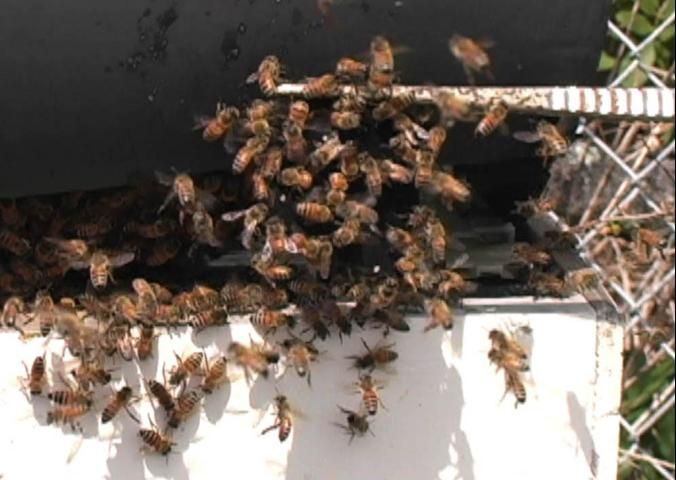
Credit: Ian McGuire, UF/IFAS
Swarming and Absconding
Swarming is a natural occurrence when the colony gets too large and resources are abundant. The colony rears a new queen and the hive splits roughly in half, creating two separate colonies. Absconding occurs when resources are scarce or there is a threat to the hive. The entire colony will abandon the hive for a new location. For more information about swarming, see Swarm Control for Managed Beehives (https://edis.ifas.ufl.edu/in970).

Credit: W. H. Kern, Jr., UF/IFAS
Selection of Nesting Site
Because Africanized honey bees swarm more often, fewer individuals are involved in each swarm, meaning they do not require a large cavity to build a nest and are often discovered in water meter boxes (Figure 4) and other man-made cavities. Having evolved in regions with constant resource availability, along with small nests and frequent swarming, AHBs do not have the same drive to store large reserves of honey like EHBs. European honey bees need a larger volume nesting site and tend to nest in hollowed tree cavities (Figure 5).

Credit: UF/IFAS Honey Bee Research and Extension Laboratory

Credit: UF/IFAS Honey Bee Research and Extension Laboratory

Credit: W. H. Kern, Jr., UF/IFAS
Resources
- UF/IFAS EDIS Documents, Subtopic Africanized Honey Bees
https://edis.ifas.ufl.edu/entity/topic/africanized_honey_bee
This site has extension documents with detailed information on AHB biology and distribution and on keeping your family and community safe from AHBs.
- AFBEE Program
https://entnemdept.ufl.edu/honey-bee/beekeeper-resources/african-bees/
The African Honey Bee Extension and Education Program was established by the Florida Department of Agriculture and Consumer Services and the University of Florida, and serves to educate all Floridians about the presence of African bees in Florida.
- Florida Department of Agriculture and Consumer Services, Division of Plant Industry, Bureau of Plant and Apiary Inspection, African Honey Bee Page https://www.fdacs.gov/Consumer-Resources/Health-and-Safety/Africanized-Honey-Bees
FDACS website provides links to videos, fact sheets, press releases, and more. It also includes a list of trained professionals available for bee removalor eradication.
Table 1.
|
European Honey Bee |
Africanized Honey Bee |
|
May send out 10–20 guard bees in response to disturbances up to 20 feet away (Figure 1). |
May send out several hundred guard bees in response to disturbances up to 120 feet away (Figure 2). |
|
Once agitated, will usually become calm within 1–2 hours. |
Once agitated, may remain defensive for days. |
|
Disturbed colony may result in 10–20 stings. |
A disturbed colony may result in 100–1000 stings. |
Table 2.
|
European Honey Bee |
African Honey Bee |
|
Swarm 1 or 2 times per year. |
Can swarm 10 or more times a year. |
|
Swarms are larger and need larger volume to nest. |
Swarms contain fewer individuals, and therefore a much smaller cavity is needed (Figure 3). |
|
Rarely abscond (completely abandon nest) from nesting location. |
Abscond often and relocate to more suitable nesting locations. |
Table 3.
|
European Honey Bee |
African Honey Bee |
|
Nest in large cavities, around 10 gallons in size. |
Nest in smaller cavities, 1 to 5 gallons in size. |
|
Typically nest in dry, above ground cavities. |
Will nest in underground cavities with a high moisture content. |
|
Nest in protected locations, rarely exposing the nest (Figure 5). |
Will nest in exposed locations, (e.g. hanging from a tree branch) (Figure 6). |
|
Due to larger colony size, nests are often easier to detect. |
Due to smaller colony size, nests often go undetected until disturbed. |