
History of the Mosaic Disease on St. Augustinegrass in Florida and the Development of Lethal Viral Necrosis
Mosaic disease of St. Augustinegrass was first reported in the 1960s in sugarcane producing areas of Florida (rural Palm Beach County). The disease was named for the distinct yellowing symptom it produced. Differences in susceptibility among St. Augustinegrass cultivars were noted, and resistance was used to minimize the impact of the disease over the last 50 years. The mildest cases of the disease produce symptoms that are easily overlooked and generally are not cause for concern. Survey efforts in the 1970s did not find the virus in St. Augustinegrass in central or north central Florida. In the 10 years prior to 2013, fewer than five samples with mild symptoms were brought to the attention of the Extension turfgrass pathologist at UF.
In 2013, samples were submitted with mosaic disease that had transitioned to severe necrotic streaking on leaf blades and plant death. These symptoms led to the failure of lawns in Pinellas Co., and the following year additional samples with the same widespread necrotic symptoms from Palm Beach Co. were submitted. The new and severe symptoms were associated with the Sugarcane Mosaic Virus (SCMV) and were named lethal viral necrosis because of similarity to maize lethal necrosis, which is also associated with SCMV in corn (maize).
Since 2014, lethal viral necrosis (LVN) and mosaic diseases have been confirmed in communities from Vero Beach in Indian River Co. south through Palm Beach Co., Miami, and the Florida Keys. On the west coast of the state, mosaic and LVN have been confirmed from Marco Island through Naples, Ft. Meyers, Charlotte Co., Sarasota Co., Manatee Co., and into Hillsborough Co. and Pasco Co. Samples with LVN also have been confirmed in St. Johns and Duval Cos. as well. The distribution within these affected counties is sporadic with some communities affected and not others.
Symptoms
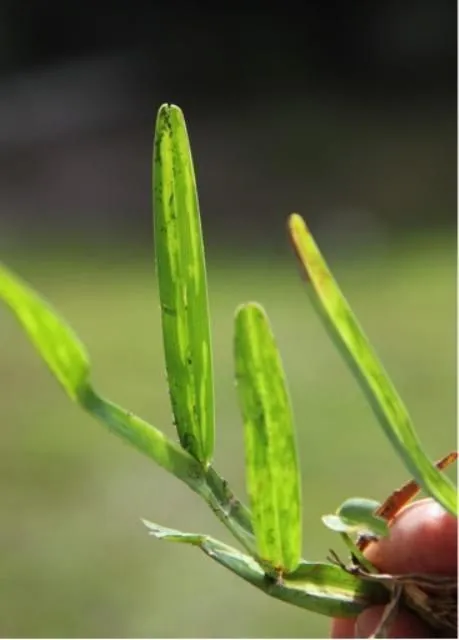
Mosaic disease symptoms occur on many plants, presenting as blotchy or streaky patterns of yellow and green color. Grasses showing mosaic symptoms tend to have broken yellow streaks running between veins on an otherwise green blade (Figure 1). Like most plant disease symptoms, mosaic patterns vary among grass varieties and species that they occur on and change appearance as the disease becomes more severe.
Credit: UF/IFAS
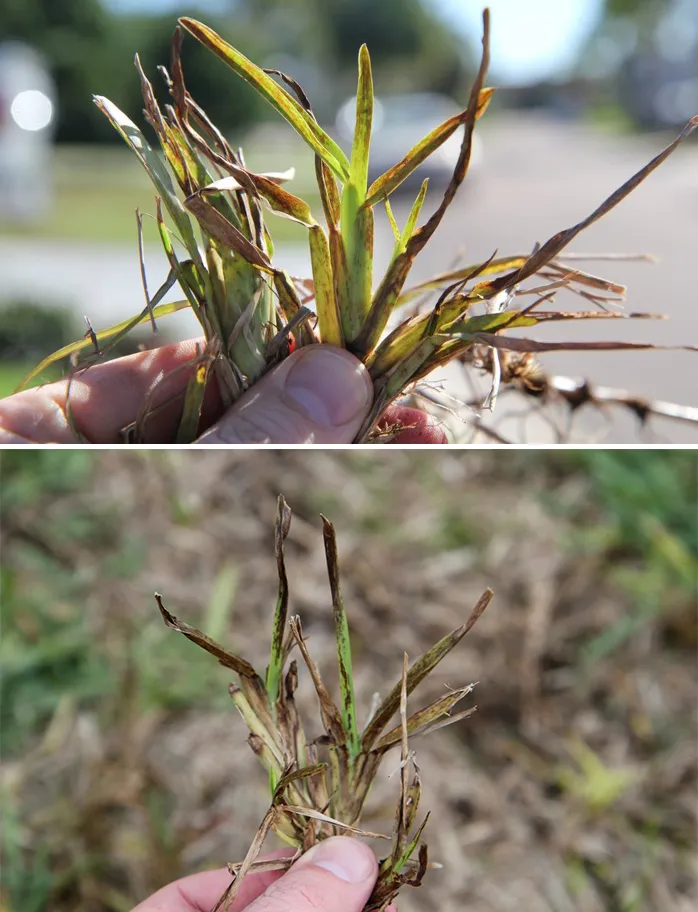
In the 2013 outbreak of the disease that occurred in Pinellas County, Florida, leaf symptoms included mosaic but transitioned in the fall of the year to necrotic lesions and dieback now characteristic of LVN (Figure 2). Symptoms of LVN developed into severe dieback that completely killed some infected lawns (Figure 3). The dieback and necrosis became more severe through the fall of the year (September to October) and progressed into spring, when some lawns started to recover. The same pattern has occurred each year with mild mosaic symptoms persisting year-round and LVN symptoms developing each fall and winter.
Credit: UF/IFAS

Credit: UF/IFAS
Causal Agent
SCMV is named for the host where it was first found, sugarcane, but the virus is known to cause disease in several grass species including corn, sorghum, and various other weedy and cultivated grasses. The virus belongs to the potyvirus family and is commonly found in sugarcane-producing areas of the state, although it currently is not a primary concern for sugarcane growers. The virus can change over time and has overcome resistance in sugarcane varieties in the past (CP 72-2086 in the mid-1990s).
Disease Spread
SCMV can be efficiently transmitted by mechanical means. Lawn mowers, line trimmers, and other equipment can transfer clippings and sap containing virus short distances within and from lawn to lawn. Aphids are known to transmit the virus as well, and they are thought to be important insect vectors for longer distance disease spread into new communities. The virus has the potential to spread on infected sod during the times of year when symptoms are mild and not obvious; however, no sod farm positives have been found to date. If sod is suspected to have symptoms of SCMV, it should not be used and should be submitted to the Extension Plant Diagnostic Center for confirmation.
The rate of spread of LVN to new communities and within communities after the initial detection has varied. In most cases, widespread detection within a community has occurred within 3 to 5 years. Movement between communities has varied and is less predictable, likely due to aphids, which are occasional but not common pests of St. Augustinegrass or particularly good flyers, being the primary long-distance vector.
Management
Plant host resistance is the best management tool for viral diseases. The most severe symptoms of LVN in this epidemic have been observed on 'Floratam' and ‘Provista’ St. Augustinegrass. 'Floratam' sod used to replace lawns that have died from LVN have failed from LVN again the following year. It is critical to install a variety that does not develop LVN in these cases.
All other commercial varieties tested to date except ‘Floratam’ and ‘Provista’ have become infected with SCMV and have developed mosaic symptoms, but did not die or develop LVN—they are more resistant. There are additional considerations and challenges when selecting a replacement cultivar besides SCMV susceptibility (see St. Augustinegrass for Florida Lawns).
Varieties used successfully include ‘Palmetto’, ‘Citrablue’, ‘Bitterblue’, and several others. It is important to purchase sod products directly from member growers of the Turfgrass Producers of Florida, because there have been cases of mislabeled sod purchased through third-party wholesalers. The ‘Floratam’ sod that was incorrectly labeled ‘Bitterblue’ and mistakenly installed in LVN landscapes failed the following year, requiring another renovation. Genetic confirmation of the LVN-affected lawns was conducted to confirm in those cases but is cost prohibitive for routine testing. The most consistent and reliable way to ensure a sod product is the advertised variety is to purchase from a licensed producer that can be found at the Turfgrass Producers of Florida website.
The virus also infects grasses in Cynodon (bermudagrass), Pennisetum (ornamental fountaingrasses), digitaria (crabgrass), and other genera; however, mosaic is currently only a concern on St. Augustinegrass in Florida. Zoysiagrass is not known to be a host of this virus. The virus survives in these alternative grass hosts within landscapes, so 'Floratam' should not be used once a lawn has failed from LVN. No strategy has allowed 'Floratam' to be used by eliminating the virus to date.
When resodding lawns with LVN, follow UF/IFAS guidelines for post-installation care (see Establishing Your Florida Lawn) and choose a variety other than 'Floratam'. Lawns also could be plugged with a less susceptible variety, but results from this method have not given satisfactory results. There is no need to treat or remove soil or take any extra precaution beyond selecting a resistant variety of grass other than 'Floratam' or 'Provista'.
To minimize disease spread in areas where the virus occurs, mowers and other equipment should be allowed to dry or be sanitized before moving between properties. The objective is to minimize movement of moist plant sap from infected plant material from lawn to lawn. Return clippings where the virus is known to occur rather than removing them from properties. Remove clippings and any other plant material from equipment before moving to another lawn or community and then allow the equipment plenty of time to dry, or spray down parts of equipment and workers' shoes that have the potential to transfer plant sap using dilute bleach, quaternary ammonia (Green-Shield), alcohol, or another sanitizing agent according to the label directions.
When mowing multiple lawns where the virus is known to occur, mow apparently healthy lawns before those with mosaic symptoms, and avoid mowing symptomatic lawns when the turfgrass canopy is wet where possible as this increases the efficiency of transmission (avoid mowing when dew, irrigation, or rainfall persists).
Fungicides and other pesticides are ineffective and cannot stop development or spread of this viral disease. Also, there are no known agronomic inputs that homeowners or lawn care companies can use to cure a lawn once it has become infected. The disease severity, which ranges from yellowing to death, will vary from lawn to lawn by variety of grass and by other environmental factors not well understood at this time. One potential complicating factor is that lawns with mosaic may also suffer from fungal diseases, weeds, insect pests, nematodes, etc. Managing fungal diseases and other pests on lawns with mosaic has not been observed to impact development of LVN.
Mosaic is just one of many diseases that may be causing problems on a lawn. To confirm the virus and other diseases, submit a sample to a UF/IFAS Plant Diagnostic Center. Manage other diseases through proper agronomic inputs and practices according to IFAS recommendations for your area.
For more information or education opportunities on mosaic and LVN, reach out to your local UF/IFAS Extension Office or visit one of the following resource pages:
- UF/IFAS Extension Palm Beach County: Lethal Viral Necrosis of St. Augustinegrass in Palm Beach County Florida
- UF/IFAS Extension Duval County: Lethal Viral Necrosis
- UF/IFAS Extension Miami-Dade County: Commercial Urban Horticulture Program