
Introduction
This publication focuses on nitrogen (N) requirements for irrigated field corn production for grain harvest using best management practices (BMPs) in Florida. The intended audience is irrigated field grain corn producers, agricultural consultants, Extension agents, Extension specialists, and researchers. The aim is to provide and recommend BMPs that comply with statewide BMP guidelines, maximizing the yield and economic return while minimizing environmental N losses. These guidelines present results from multi-year, multi-site, field-based research conducted by the University of Florida Institute of Food and Agricultural Sciences (UF/IFAS). The small plot research was conducted at the UF/IFAS North Florida Research and Education Center—Suwannee Valley (NFREC-SV) in Live Oak, Florida. This publication includes a recommendation in terms of N required per bushel of productivity.
Historically, before the 1980s, N recommendations for corn in Florida were primarily based on generalized yield goals, often suggesting a uniform application rate of approximately 1.0–1.2 lb N per bushel of expected yield; however, these recommendations did not account for the state’s diverse soil types, especially the sandy soils prone to nutrient leaching (Wright et al. 2022). During the 1980s and 1990s, UF/IFAS conducted extensive research to refine N recommendations (Wright et al. 2022). As part of this refinement, split applications were promoted to address leaching potential in sandy soil. Starter fertilizers were applied at planting (e.g., 30 lb ac⁻¹) to support early development, and the remaining N was supplied when corn reached 12–15 inches in height through side-dressing or fertigation. Together, these practices enhanced N use efficiency and reduced environmental losses.
From the 2000s to the present, Florida implemented BMPs for nutrient management in response to increasing concerns about water quality, particularly nitrate contamination in groundwater (Mylavarapu et al. 2021). Within this framework, UF/IFAS provided tailored N-rate recommendations based on planting density and irrigation status. For example, irrigated corn planted at 20,000, 25,000, and 30,000 plants ac⁻¹ is recommended to receive 180, 210, and 240 lb N ac⁻¹, respectively. Collectively, these BMPs are designed to optimize crop yields while protecting Florida’s water resources.
Recent studies in Florida have shown that applying 220 lb N ac-1 produces corn yields comparable to those achieved with 300 lb N ac-1, allowing for a 26% reduction in fertilizer use without sacrificing yield (Zamora-Re et al. 2020). Corn acreage declined from 400,000 acres in the 1970s to 100,000 acres by the late 1980s, but yields improved through increased irrigation during that time (Wright et al. 2022). These long-term changes, including advances in genetics, greater plant populations, and improved irrigation efficiency, emphasize the need to revise N guidelines to reflect current production practices.
Corn Nitrogen Requirements
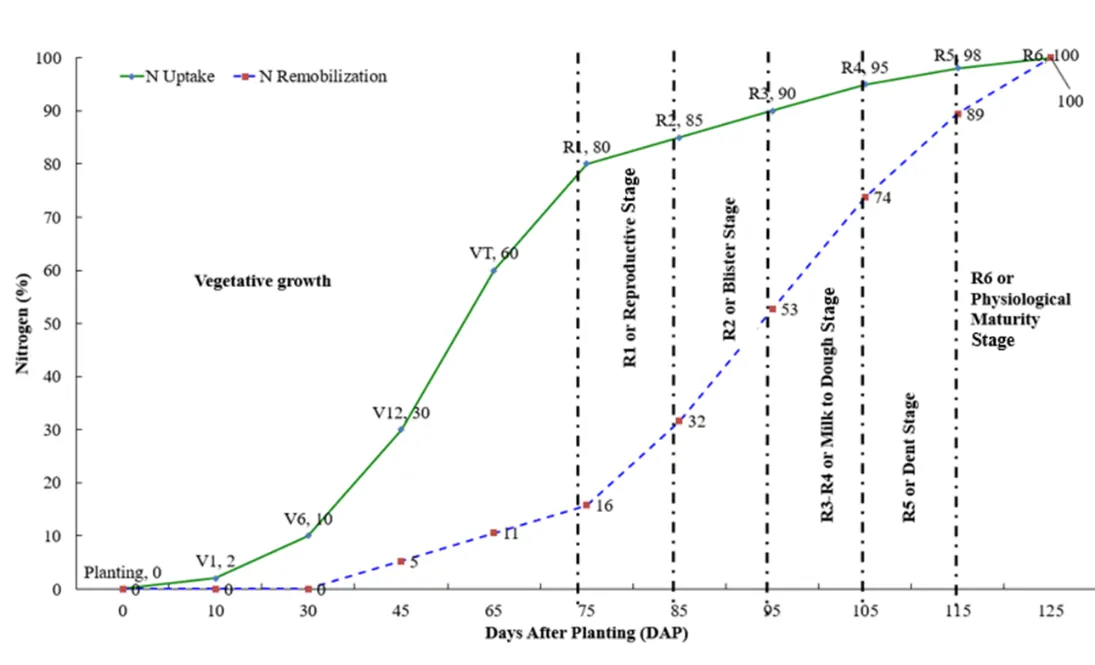
This publication outlines site-specific recommendations for corn N management. Reflecting recent nitrogen rate studies in other states, such as 1.3 lb N bu-1 of corn yield recommended in Mississippi (see Table 4 for details), the information in this publication supports an application rate of 1.37 lb N bu-1 of corn yield. This relationship results in N requirements of 246–274 lb ac-1 for a yield potential of ~180–200 bu ac-1. This range results in N agronomic recovery efficiency (ARE) of 60%–70%. Florida's average corn yield per acre (irrigated and non-irrigated) is in the range of 141 bu ac-1 (USDA-NASS 2024). Well-managed irrigated farms could yield between 150–200 bu ac-1 (Hollis 2013; The Balmoral Group 2024). At the 2024 Stakeholder Engagement Program (STEP) Corn Contest, the team in first place achieved a yield of 193 bu ac-1 with 280 lb N ac-1 (Williams 2025). This was the most profitable yield with the highest N efficiency. Following the STEP yield trend, the range was between 153–282 bu ac-1 with an N rate range of 210–280 lb N ac-1 (Sharma et al. 2024). This contest result confirms that our experiment yields were within the Suwannee Valley area range. The STEP results also confirm that 280 lb N ac-1 is the maximum N needed to produce the highest yield of 282 bu ac-1 when N is applied timely and efficiently. Timely means applying a higher amount of total requirement between the V6 and V14 leaf stages of corn growth (Sharma et al. 2025). Efficiently means banding during the early stages, especially at planting and the V6 leaf stage (Wright et al. 2022). These two strategies, timeliness and efficiency, are important because corn does not use much N during early growth and the late developmental stage (see Figure 1 for reference). Also, banding at early growth stages increases N use efficiency since the developing roots can immediately access fertilizer. Since yield potential depends on various factors like soil type, corn variety, climate, and several other variables (Wright et al. 2022; Morris et al. 2018), using a per-bushel framework of 1.0–1.37 lb N bu⁻¹ (Katoch et al. 2025; Wright et al. 2004, 2022) allows farmers to adjust N rates according to the yield potentials of specific irrigation pivots or land parcels.
These N rate recommendations should be implemented within the broader context of best management practices, as designed for Florida’s agricultural systems and outlined in the Vegetable Production Handbook of Florida. A primary consideration is precise irrigation management, scheduled based on soil moisture sensors (SMS), evapotranspiration (ET) data, and weather conditions, along with multiple, smaller irrigation events split by crop growth stage to minimize nutrient leaching and enhance uptake (Zotarelli et al. 2024). For N fertilizer, UF/IFAS recommends split applications (e.g., basal plus supplemental N) with adjustments based on plant tissue testing, leaching rainfall, and crop stage, as well as the use of precision practices like fertigation or controlled-release fertilizers to maximize nutrient use efficiency and reduce environmental risk (Liu et al. 2024).
These N adjustments will require proper irrigation management. Revisions to the N requirement will allow corn growers to maintain their maximum yield while mitigating water-quality impacts associated with over-fertilization, improper N application timing, and heavy/leaching rainfall events.
The first step to establishing proper guidelines for N fertilization in sustainable production is understanding the complex nature of corn plant growth and N uptake, which mimics an exponential growth pattern. Nitrogen uptake in corn is determined by the product of dry matter accumulation in plant tissues, including leaf, stem, cob, and grain. Typically, N uptake is very slow during the early stages of corn growth and increases rapidly after the V4 leaf stage through the R1 stage (Figure 1). Nitrogen translocation from leaves to grain in corn typically begins around the reproductive stages, specifically from R3 (milk stage) to R5 (dent stage). As illustrated in Figure 1, the uptake process follows this pattern:
1. V Stages
Nitrogen accumulates in leaf and root tissues during the early vegetative stages (V1 to V10+) (Ritchie et al. 1993; Ciampitti and Vyn 2012; Sharma and Bali 2017).
Nitrogen uptake is primarily directed toward the development of leaves, roots, and stems (Abendroth et al. 2011). At these stages:
- The plant establishes a strong root system to enhance nutrient and water uptake.
- Nitrogen is essential for chlorophyll production, which drives photosynthesis and energy accumulation.
- Deficiencies can lead to stunted growth, reduced leaf area, and lower potential yield.
By V6 through V8, the corn plant transitions from relying on seed reserves to absorbing nutrients from the soil. By V10 through V12, rapid N uptake occurs as the plant prepares for reproductive development.
2. R1 (Silking Stage)
This stage involves continued N uptake and kernel development as reproductive stages begin (Bender et al. 2013).
As the plant enters R1 (silking stage), N uptake remains substantial. This is a critical stage where
- Nitrogen continues to be absorbed from the soil and moves towards developing reproductive structures.
- The emergence of silk is vital for successful pollination and kernel setting.
- Any N deficiency at this stage can result in poor pollination, kernel abortion, and reduced grain yield.
3. R1 (Blister Stage)
This stage includes the initial remobilization of N from vegetative parts to kernels (Ciampitti and Vyn 2012, 2013).
During R2 (blister stage), kernels begin to form, but they are still mostly filled with water. Key N-related processes include the following:
- Nitrogen starts transitioning from vegetative parts (leaves and stems) to the developing kernels.
- However, the majority of N remains in vegetative tissues, sustaining continued photosynthesis.
- Kernel abortion resulting from stress (drought, nutrient deficiency) is still a risk at this stage.
4. R3 (Milk Stage) to R4 (Dough Stage)
These stages see increasing N mobilization to kernels (Ciampitti and Vyn 2012, 2013).
As the plant progresses through R3 (milk stage) and R4 (dough stage), kernel development intensifies in several ways:
- Kernels begin to accumulate starch, and the N demand shifts significantly from vegetative parts to grain.
- Older leaves and stems start remobilizing N to support kernel growth.
- Stress during this period can lead to smaller kernels and lower grain protein content.
5. R5 (Dent Stage)
During this stage, the majority of kernel N comes from remobilized N (Ciampitti and Vyn 2012, 2013).
By R5, over 50%–70% of the N needed for grain filling is remobilized from leaves, stems, and stalks. This stage is characterized by the following:
- N uptake from the soil declines as the plant relies more on stored N.
- Kernels transition from a soft dough texture to a more solidified state.
- A “milk line” moving downward in the kernel becomes visible, indicating starch accumulation.
6. R6 (Physiological Maturity)
The final stage concludes with the completion of N translocation (Ciampitti and Vyn 2012, 2013).
At R6 (physiological maturity), the grain-filling process is complete, and N translocation is nearly finished. At this stage,
- The kernels reach their final dry weight, and a black layer forms at the kernel base, signaling the cessation of nutrient flow.
- Nitrogen movement within the plant is minimal, and the remaining vegetative tissue begins to senesce.
- The final grain N concentration is determined, which influences grain protein levels.
Potential Corn Yield and N Fertilizer Application Timing for Florida
Potential corn yield and N fertilizer application timing in Florida depend on hybrid maturity and management. Early maturing varieties (80–95 days) are often used for double cropping or when planting late, medium maturity varieties (96–110 days) are most grown for grain and silage, and full-season varieties (110–125 days) are mainly planted in north Florida, where longer growing seasons allow for greater yield potential. The specific hybrid selection depends on soil type, irrigation availability, pest resistance, and yield goals. UF/IFAS corn variety trials can provide more information on varieties' yield and suitability for specific areas. (Visit the NFREC-SV website for the most recent corn variety evaluation results.)
Credit: Adapted from Bender et al. (2013).
Full-season varieties are most common in Florida. Hence, the rate and timing of N fertilization are crucial for successful production, especially during the vegetative and reproductive stages, with most N applications recommended between the V4 and R1 growth stages (Sharma and Bali 2017). The average corn yield in Florida varies significantly between irrigated and non-irrigated fields. While specific statewide irrigated data are limited, regional efforts illustrate the gap. In 2024, approximately 85,000 acres of field corn were planted and 47,000 acres were harvested for grain at an average 141 bu ac⁻¹, producing about 9.8 million bushels (USDA-NASS 2024), whereas on-farm trials in the Suwannee Valley (2022–2024) averaged ~230 bu ac⁻¹ and the Florida STEP corn competition (2023) on irrigated plots reported 153–282 bu ac⁻¹ with an average of ~205 bu ac⁻¹ (Sharma et al. 2024). Together, these findings suggest that irrigated corn in Florida can achieve yields exceeding 200 bu ac-1 with optimal management practices. However, actual yields can vary based on factors such as hybrid selection, soil fertility, pest management, and environmental conditions. For more detailed and localized data, consulting UF/IFAS Extension or reviewing the latest USDA reports is recommended.
Materials and Methods (How the Trials Were Conducted)
To ensure optimal nutrient management, a comprehensive soil fertility program should be based on soil test results, yield targets, and crop nutrient uptake. Fertilization programs that do not rely on soil testing can result in excessive or insufficient nutrient applications, negatively affecting crop performance and environmental sustainability. However, for N in sandy soils, particularly in the Suwannee Valley region of Florida, soil test reports typically indicate minimal N availability, often in the 1–2 ppm range (equivalent to 2–4 lb N ac-1) (Mylavarapu et al. 2021). Despite this limitation, soil testing remains essential for assessing the availability of macro- and micronutrients critical for successful crop production.
The sandy soils of Florida are highly prone to nitrate leaching, which makes it challenging to synchronize soil N availability with plant N uptake. The high N demand for corn worsens this challenge, as does the mobile nature of N in the soil and the region’s variable rainfall patterns. Split applications of N are recommended to improve N use efficiency (NUE) and minimize losses. This practice ensures that N availability aligns more closely with the crop’s growth stages, reducing the risk of leaching and improving nutrient uptake efficiency.
To address these challenges, UF/IFAS conducted multiple field studies between 2022 and 2024 to determine the optimal N fertilizer rate for maximizing corn yield, biomass production, and plant N uptake. These studies offer data-driven insights that support best management practices (BMPs) for N application in Florida’s unique soil and climatic conditions. All trials were conducted at the UF/IFAS North Florida Research and Education Center—Suwannee Valley (NFREC-SV) in Live Oak. Soil and climate conditions at this location generally match commercial production systems. A corn advisory committee, including corn growers, consultants, and IFAS nutrient management research faculty, provided oversight, including overall activities and annual results. Findings from these trials support precision nutrient management strategies that balance crop productivity with environmental stewardship.
‘Pioneer 1870’ was planted for three years (2022–2024) in two small-plot trials at NFREC-SV: site 1 (S1; 30°18′50.33″N, 82°54′08.81″W) and site 2 (S2; 30°18′16.01″N, 82°53′51.17″W). Plots were established with a John Deere 1705 four-row planter (30-inch row spacing) using a John Blue pump for starter fertilizer, at a seeding rate of ~30,000–32,000 plants ac⁻¹. Corn was planted in late March to early April and harvested in August yearly, following a typical spring-to-late-summer growing season in Florida. The treatments were arranged in a randomized complete block design with four replications. In 2022 and 2023, six N rates ranging from 0 to 350 lb N ac⁻¹ were applied in 70 lb N ac⁻¹ increments using urea as the N source. In 2024, an additional rate of 420 lb N ac⁻¹ was introduced to determine whether the yield response had plateaued, as previous rates had not yet captured the flattening of the response curve. Each experimental plot measured 20 ft × 40 ft and consisted of eight corn rows spaced 30 inches apart, with a 25 ft buffer between plots and blocks. It is important to note that 30 lb N ac-1 was applied at planting as a banded application to all plots except the control (Wright et al. 2022). The remaining N was applied by hand in six additional split doses based on corn growth stages, making a total of seven applications per treatment. The application was broadcast between rows and immediately watered with 0.25 inches of irrigation to mimic liquid fertilizer (fertigation) via center pivot, a common method in this region. This split application strategy was designed to synchronize N availability with corn uptake, which peaks between the V4 and V14 growth stages (Table 1). To avoid problems with phosphorus and potassium deficiencies and to assess N response, we applied extra fertilizers each year. In the first week after planting, we added about 292 lb ac-1 of potash and 150 lb ac-1 of triple super phosphate. About a month later, we also applied 464 lb ac-1 of potassium hydroxide. To prevent sulfur deficiency, which is common in sandy soils, we added 60 lb ac-1 of sulfur. These steps helped make sure the corn plants had enough nutrients to grow well.
Table 1. Nitrogen application rates and split-application schedule aligned with the growth stages of the ‘Pioneer 1870’ hybrid corn variety.
Irrigation was managed each season using soil moisture data from iMetos 3.3 sensors installed in early April and removed at harvest (2022–2024). Each system included a 24-inch Sentek TriSCAN probe and rain gauge connected to an iMetos data logger, placed 2 inches below the soil in a 280 lb N ac-1 plot. Proper irrigation timing was critical; without sensor-guided scheduling, over-irrigation or unexpected rainfall before or after irrigation could lead to significant nitrate leaching. Farmers can better match water applications to crop needs by using moisture sensors, helping to protect water quality and maximize N use efficiency. The total irrigation needed for corn to complete its life cycle is in the range of 20–24 inches (Wright et al. 2022). With normal rainfall, corn needs ~12–14 inches of irrigation yearly. This study provided 11–14 inches of irrigation on both research sites using a soil moisture sensor (Table 2). Between 18 and 28 inches of rainfall were recorded across three years of research trials on both locations.
Table 2. Total irrigation on sites 1 and 2 across the corn growth cycle.
Preplant soil samples were collected two weeks before planting at depths of 0–12 inches, 12–24 inches, and 24–36 inches. Seasonal soil sampling was conducted at 20-day intervals at the same depths. Aboveground biomass and plant height were measured every 20 days after planting. Three representative plants per plot were sampled by cutting them at the soil surface. At harvest, grain yield was determined from the two middle rows using an 8-XP plot combine (Kincaid, Haven, KS, USA), with yields standardized to 15.5% moisture. Grain yield and aboveground biomass were analyzed using linear mixed models, with N rate as a fixed effect and site and year as random intercepts to account for the two locations across three years. Because plots were re-established each year, no repeated-measures term was included. Fixed effects were evaluated with mixed-model ANOVA (α = 0.05). When the N-rate effect was significant, pairwise comparisons among rates used Tukey-adjusted estimated marginal means, and groups were reported with compact letters.
Results
Yield Results
In this study, grain yield responded strongly to N application (Figure 2). Analyses across three years and multiple sites showed no significant N rate × site (p = 0.48) or N rate × year (p = 0.09) interactions; therefore, yield data were pooled across years and sites. Yields increased significantly as N rates increased from 0 to 280 lb N ac⁻¹, but no further significant improvement was seen beyond this rate statistically. Yields remained relatively stable, ranging from 199 to 213 bu ac⁻¹, with N applications of 280, 350, and 420 lb N ac⁻¹. While the 280 and 350 lb N ac⁻¹ rates produced similar yields and were significantly higher than lower rates, the highest N rate of 420 lb ac⁻¹ did not result in a statistically different yield compared to 280 or 350 lb ac⁻¹ rates.
Take-Home Message for Growers: Applying N fertilizer can significantly boost corn yields. In this study, applying more than 280 lb N ac⁻¹ did not provide significant additional yield benefits. This is because applying more than 280 lb N ac⁻¹ results in only a minor yield increase, which was statistically insignificant. Matching N rates to crop needs helps optimize input costs and reduce environmental risks.

Credit: Lakesh Sharma’s Best Management Practices Lab, Department of Soil, Water, and Ecosystem Sciences, UF/IFAS.
Biomass Results
Similarly, the results showed that the N application rate significantly influenced aboveground biomass. Biomass increased steadily with increasing N rates, showing a significant boost up to 280 lb N ac⁻¹. Beyond this rate, biomass gains leveled off, with no significant difference between the 280, 350, and 420 lb N ac⁻¹ treatments, as indicated by overlapping letters in Figure 3.
This trend aligns with the balanced growth hypothesis, which suggests that plants allocate growth to the parts most actively acquiring resources.

Credit: Lakesh Sharma’s Best Management Practices Lab, Department of Soil, Water, and Ecosystem Sciences, UF/IFAS.
Nitrogen Use Efficiency
Two N use efficiencies were calculated to determine the optimum N rate that minimizes nitrate leaching potential: apparent recovery efficiency (ARE) and agronomic N use efficiency (ANUE).
ARE is the total N uptake by the plant.

Where TUN is the total N uptake by corn in a fertilized plot (lb N ac-1) at the applied N rate, TU0 is the total N uptake in the control (lb N ac-1), and Nf is the amount of fertilizer N applied (lb N ac-1).
ANUE is the total N removed by the crop as grain.

Where GYf is the grain yield (pounds of N per acre) at the applied N rate, GY0 is the yield in control (pounds of N per acre), and Nf is the amount of fertilizer N applied (pounds of N per acre).
Although differences among rates were not statistically significant, ARE trended highest at 280 lb N ac⁻¹ (65%), lowest at 420 lb N ac⁻¹ (51%), and intermediate at 350 lb N ac⁻¹ (54%) (Figure 4). ANUE declined with increasing N rate (Figure 5): it was greatest at 140 lb N ac⁻¹ and lowest at 420 lb N ac⁻¹. Taken together, 280 lb N ac⁻¹ remains the most practical production rate because it maximizes grain yield, maintains higher ANUE than the ≥350 lb N ac⁻¹ treatments, and provides greater yield than <280 lb N ac⁻¹.

Credit: Lakesh Sharma’s Best Management Practices Lab, Department of Soil, Water, and Ecosystem Sciences, UF/IFAS.

Credit: Lakesh Sharma’s Best Management Practices Lab, Department of Soil, Water, and Ecosystem Sciences, UF/IFAS.
Take-Home Message for Growers: Based on the results of our yield trials, corn requires approximately 1.37 lb N bu-1 of expected yield (Katoch et al. 2025). This relationship provides a practical basis for estimating N fertilizer requirements under similar field conditions (Table 3). Applying up to 280 lb N ac⁻¹ significantly increased biomass production; however, applying rates above 280 lb N ac⁻¹ did not provide significant additional yield benefits because applying more than 280 lb N ac⁻¹ results in only a minor, insignificant yield increase under soil and environmental conditions similar to those at NFREC-SV. This approach can help reduce unnecessary fertilizer costs and minimize the risk of N leaching. Table 3 illustrates recommended N rates corresponding to different yield potentials. Table 4 summarizes corn N recommendations from Extension programs across the Southeastern United States. While most states suggest N application rates between 1.0–1.25 lb N bu-1 of expected yield, total application amounts vary depending on soil types, irrigation, and management practices.
Table 3. Recommended N rates based on yield potential (1.37 lb N bu-1 of corn).
|
Yield potential (bushels per acre) |
Recommended N rate (pounds per acre) |
|---|---|
|
100 |
137 |
|
150 |
206 |
|
200 |
274 |
|
250 |
343 |
Table 4. The current N recommendations across southern states.
|
State |
N rate per bushel |
Typical total N rate |
Key notes |
Reference |
|---|---|---|---|---|
|
Georgia |
~1.0–1.2 lb N bu-1 |
180–240 lb N ac-1 |
Recommendations based on yield goals; adjustments made for previous crops and soil types. |
UGA Extension Corn Group (2024) |
|
Alabama |
1.0–1.25 lb N bu-1 |
120–200 lb N ac-1 |
Split applications are advised; rates vary with irrigation status and yield potential. |
Jordan (2024) |
|
Mississippi |
1.0–1.3 lb N bu-1 |
150–225 lb N ac-1 |
Emphasis on split applications to reduce nitrogen loss in warm, wet climates. |
Larson (2024) |
|
Louisiana |
1.0–1.25 lb N bu-1 |
200–250 lb N ac-1 |
Higher rates for clayey soils are due to nitrogen fixation; split applications are recommended. |
Parvej (2021) |
|
North Carolina |
~0.9 lb N bu-1 |
Variable |
Data from high-yield fields suggest efficient nitrogen use and recommendations tailored to specific conditions. |
Hambrick (2022) |
Conclusion
Based on the analysis of grain yield, aboveground biomass, ARE, and ANUE, the study found that 280 lb N ac⁻¹ under UF/IFAS NFREC-SV conditions is sufficient to achieve high corn grain yield and aboveground biomass. Applying greater than 280 lb N ac⁻¹ does not significantly increase yield but instead reduces nutrient use efficiency and may elevate leaching risk; therefore, rates above 280 lb N ac⁻¹ are not recommended. This helped determine the N requirement per bushel of corn, which was calculated to be approximately 1.37 lb N bu-1.
This information can help farmers make site-specific N decisions. Since many growers manage multiple irrigation pivots with different yield potentials, applying the same N rate everywhere may lead to over- or under-application. Instead, by using historical yield data, especially from the most recent five years, growers can tailor N rates to match the yield potential of each field or pivot, improving both efficiency and profitability.
Use your yield history to dial in N rates, applying about 1.37 lb of N per expected bushel, which is a practical starting point for optimizing N use across your farm. It is important to follow the number of splits of N application across critical growth stages, along with soil moisture sensor data to schedule irrigation that will avoid any potential N leaching. Historical data suggest that the average yield from irrigated corn ranges from 150–240 bu ac-1; however, dryland yield could range from 100–180 bu ac-1 (Wright et al. 2022). See Wright et al. (2022) for more information in the field corn production guide.
References
Abendroth, L. J., R. W. Elmore, M. J. Boyer, and S. K. Marlay. 2011. Corn Growth and Development. PMR 1009. Iowa State University Extension.
The Balmoral Group. 2024. Florida Statewide Agricultural Irrigation Demand: 2022–2050 Agricultural Water Demands. FSAID-11 Report. Florida Department of Agriculture and Consumer Services. https://www.fdacs.gov/content/download/116462/file/FSAID-11-Report.pdf
Bender, R. R., J. W. Haegele, M. L. Ruffo, and F. E. Below. 2013. “Nutrient Uptake, Partitioning, and Remobilization in Modern, Transgenic Insect‐Protected Maize Hybrids.” Agronomy Journal 105 (1): 161–170. https://doi.org/10.2134/agronj2012.0352
Ciampitti, I. A., and T. J. Vyn. 2012. “Physiological Perspectives of Changes Over Time in Maize Yield Dependency on Nitrogen Uptake and Associated Nitrogen Efficiencies: A Review.” Field Crops Research 133: 48–67. https://doi.org/10.1016/j.fcr.2012.03.008
Ciampitti, I. A., and T. J. Vyn. 2013. “Grain Nitrogen Source Changes Over Time in Maize: A Review.” Crop Science 53 (2): 366–377. https://doi.org/10.2135/cropsci2012.07.0439
Hambrick, T. 2022. “The how much N does a corn crop really need?” NC State Extension, Soil Fertility. https://soilfertility.ces.ncsu.edu/2022/01/the-how-much-n-does-a-corn-crop-really-need/
Hollis, P. L. 2013. “North Florida corn off to slow start, but potential is good.” Farm Progress, June 15. https://www.farmprogress.com/corn/north-florida-corn-off-to-slow-start-but-potential-is-good
Jordan, H. 2024. Performance of Corn Hybrids in Alabama, 2024. Alabama Agricultural Experiment Station at Auburn University. https://aaes.auburn.edu/blog/2024/08/12/performance-of-corn-hybrids-in-alabama-2024/
Katoch, K., D. A. H. de S. Leitão, D. A. Birhan, et al. 2025. “Optimizing Nitrogen Fertilizer Recommendations for Field Corn Grown in Florida Sandy Soils.” Agronomy Journal 117 (5): e70178. https://doi.org/10.1002/agj2.70178
Larson, E. 2024. Corn Fertilization. Publication No. 3591. Mississippi State University Extension. https://extension.msstate.edu/publications/corn-fertilization
Liu, G., E. H. Simonne, K. T. Morgan, et al. 2024. “Chapter 2. Fertilizer Management for Vegetable Production in Florida: VPH ch. 2, CV296, rev. 6/2024.” EDIS 2024 (VPH). https://doi.org/10.32473/edis-cv296-2023
Morris, T. F., T. S. Murrell, D. B. Beegle, et al. 2018. “Strengths and Limitations of Nitrogen Rate Recommendations for Corn and Opportunities for Improvement.” Agronomy Journal 110 (1): 1–37. https://doi.org/10.2134/agronj2017.02.0112
Mylavarapu, R., D. Wright, and G. Kidder. 2021. “UF/IFAS Standardized Fertilization Recommendations for Agronomic Crops: SS163/SL129, rev. 10/2021.” EDIS 2021 (5). https://doi.org/10.32473/edis-ss163-2021
Parvej, M. R., M. Foster, and S. Dodla. 2021. “Corn Nitrogen Management.” LSU AgCenter. https://www.lsuagcenter.com/articles/page1616180617871
Ritchie, S. W., J. J. Hanway, and G. O. Benson. 1993. How a Corn Plant Develops. Special Report 48 (revised). Iowa State University of Science and Technology Cooperative Extension Service.
Sharma, L. K., and S. K. Bali. 2017. “A Review of Methods to Improve Nitrogen Use Efficiency in Agriculture.” Sustainability 10 (1): 51. https://doi.org/10.3390/su10010051
Sharma, L. K., D. A. H. de S. Leitão, and H. Singh. 2025. “Unlocking the potential of technology: Estimating nitrogen requirement in corn using optical sensors: SL526/SS740, 1/2025.” EDIS 2025 (1). https://doi.org/10.32473/edis-ss740-2025
Sharma, V., K. Athearn, S. Bhambota, et al. 2024. Florida Stakeholder Engagement Program (STEP)—2023 Corn Contest Report. University of Florida Institute of Food and Agricultural Sciences, Extension.
UGA Extension Corn Team. 2024. 2024 Georgia Corn Production Guide. AP 132-01. University of Georgia Extension. https://grains.caes.uga.edu/content/dam/caes-subsite/grains/docs/corn/2024-Corn-Production-Guide.pdf
U. S. Department of Agriculture, National Agricultural Statistics Service (USDA-NASS). 2024. 2024 State Agriculture Overview of Florida. Quick Stats Database. Accessed February 16, 2026. https://www.nass.usda.gov/Quick_Stats/Ag_Overview/stateOverview.php?state=Florida&year=2024
Williams, S. 2025. “Stakeholder Engagement Program: A Corn Competition for Efficient Nitrogen and Irrigation Management in Florida.” UF/IFAS Blogs, January 9. https://blogs.ifas.ufl.edu/nmp/2025/01/09/stakeholder-engagement-program-a-corn-competition-for-efficient-nitrogen-and-irrigation-management-in-florida/
Wright, D., J. J. Marois, J. R. Rich, and R. K. Sprenkel. 2004. "Field Corn Production Guide: SS-AGR-85/AG202, 1/2004.” EDIS 2004 (1). https://doi.org/10.32473/edis-ag202-2004
Wright, D., I. Small, C. Mackowiak, Z. Grabau, P. Devkota, and S. Paula-Moraes. 2022. “Field Corn Production Guide: SS-AGR-85/AG202, rev. 8/2022.” EDIS 2022 (4). https://doi.org/10.32473/edis-ag202-2022
Zamora-Re, M. I., M. D. Dukes, D. Hensley, D. Rowland, and W. Graham. 2020. “The Effect of Irrigation Strategies and Nitrogen Fertilizer Rates on Maize Growth and Grain Yield.” Irrigation Science 38: 461–478. https://link.springer.com/article/10.1007/s00271-020-00687-y
Zotarelli, L., M. D. Dukes, and E. H. Simonne. 2024. “Chapter 3. Principles and Practices of Irrigation Management for Vegetables: VPH ch. 3, CV297, rev. 6/2024.” EDIS (VPH). https://doi.org/10.32473/edis-cv297-2023