
Introduction
Hard clams provide many benefits to Florida’s coastal ecosystems beyond supporting the clam aquaculture industry. One of these benefits is improved water quality through filtration and nutrient cycling. However, both pollution and overharvesting have led to a decline in native clam populations for many areas, resulting in a growing interest among restoration practitioners to rebuild clam populations. There are two clam species in Florida currently used in restoration. The first is the northern hard clam, Mercenaria mercenaria, which is native to the Atlantic coast and the primary species produced by the state’s clam aquaculture industry. The second species is the southern hard clam, Mercenaria campechiensis, which is native throughout Florida. These species are very similar and capable of hybridizing, but each may function differently. Understanding these differences is important when selecting a species for restoration projects.
This publication is intended for academics, restoration practitioners, and policy makers interested in shellfish restoration. First, we introduce the two species of hard clams and then compare their physiology and ecological functioning related to water quality. The goal of this publication is to describe the similarities and differences between these two species and to serve as a resource for selecting the best hard clam for a restoration project.
What are hard clams?
Hard clams belong to the genus Mercenaria, which consists of multiple clam species, including the southern (Mercenaria campechiensis) and northern hard clams (Mercenaria mercenaria). Hard clams are bivalves, which means they have two shells joined by a hinge (Figure 1). Unlike oysters, clams can burrow in the substrate using a muscular foot. Like oysters, hard clams are filter feeders. Clams use their inhalant siphon like a straw to draw in water for feeding. The exhalant siphon expels filtered water and waste, including feces. The clam’s gill anatomy allows it to sort captured particles, ingesting nutritious material and rejecting others. Ingested particles are either digested and absorbed or processed into feces. Rejected particles are ejected as pseudofeces. Together, feces and pseudofeces are referred to as biodeposits.

Credit: Tracey Saxby, Integration and Application Network (ian.umces.edu/media-library), modified to show hinge, foot, and siphons by L. Reynolds.
How do hard clams improve the environment?
Hard clams provide several ecosystem services—benefits that nature provides to people—in coastal waters. Clams improve water clarity by filter-feeding on suspended particles, such as algae. The reduced amount of algae in the water allows more light to reach the seafloor, supporting organisms, such as seagrasses, that are negatively impacted by reduced water clarity.
Seagrasses are ecosystem engineers that modify the environment and support various other species, including commercially important juvenile fish, manatees, and sea turtles. The relationship between seagrasses and clams is mutually beneficial. Seagrasses provide habitat and protection for clams from predators. In return, clams clear the water. Clearer water allows more light to reach seagrasses, which is necessary for them to photosynthesize and grow. Clams also support seagrass growth through their biodeposits, which can act as fertilizer. In North Carolina, when hard clams co-occur with seagrass, seagrass productivity and resilience to harmful events like storms and predation increase (Donaher et al. 2021).
Clam filtration and biodeposit production can also help remove nitrogen. Excess nitrogen is a major issue for coastal water quality. By filter-feeding, clams remove algae and other nutrient-rich particles from the water and deposit them into the sediment as biodeposits. This repackaging makes nitrogen less available for algae and enhances sediment denitrification—a microbial process in which usable forms of nitrogen (nitrate NO3) are converted into inert nitrogen gas (N2). Denitrification is important because it removes nitrogen that could otherwise fuel algal blooms and degrade water quality. Clams also store nitrogen in their tissues and shells. When clams are harvested, such as through commercial aquaculture operations, this nitrogen is removed from the environment.
The relationship among water quality, seagrasses, and clams has led to a growing number of projects that involve restoration of both organisms. For example, in Shinnecock Bay, New York, clam populations and water quality had declined, leading to the creation of spawner sanctuaries—a no-harvest zone where adult clams are planted in large numbers—in proximity to seagrass (Gobler et al. 2022). This restoration successfully improved water conditions, rebuilt the clam population, and increased the extent of seagrass beds over seven years. Building on the success of Shinnecock Bay, large investments in similar efforts are being made in Florida. Yet, questions remain about species selection and compatibility with restoration goals.
How do the two species of clams compare?
Northern hard clams have been the subject of more research than southern hard clams because of their aquaculture value, but there is growing interest in using the southern hard clam for restoration, primarily in southwest Florida, since it was historically dominant there. Morphological differences between the two species have been described, but since there is significant overlap, the effectiveness of visual identification is unclear. Further, few studies have compared these two clams in the same location under the same conditions, making it difficult to fully understand the similarities, differences, and potential efficacy in improving water quality. Variation in species-specific habitat preferences, environmental tolerances, and ecosystem service provisioning may affect restoration outcomes. Yet, inconsistent measurement techniques and study settings make it challenging to identify meaningful differences between the species. The following sections document current knowledge of the similarities and differences between hard clam species.
Morphological Characteristics
Although both species of hard clams look similar, the literature reports four key morphological traits generally used to differentiate between species (Figure 2). The first trait is the shape of the lunule (Figure 2A), or the small indentation close to the hinge of the two shells. Northern hard clams tend to have a wider lunule than the southern hard clam, although this trait is considered inconsistent (Kraeuter and Castagna 2001). The second trait is the color on the inside of the shell, with northern hard clams having purple coloration (Figure 2B). The third and fourth traits involve the concentric ridges on the shell. Northern hard clams either lack these ridges or have very low ones, while southern hard clams have more pronounced, elevated ridges (Figure 2C and Figure 2D).
We compared the morphology of 78 northern hard clams and 79 southern, hatchery-produced but not genetically identified, hard clams (Kaylor 2025). Among the northern hard clams in this dataset, 77% had low ridges and 71% had purple inside the shell, both of which are consistent with the literature. Yet, the remainder lacked these characteristics. Southern hard clams are described as having high ridges and no purple inside the shell. While 97% of the southern hard clams in this dataset had high ridges, only 58% lacked purple coloration inside the shell. Therefore, physical traits alone cannot guarantee correct identification of a clam.
When clam species co-occur (either naturally or in aquaculture settings), the two species can hybridize, or breed with each other, at low frequencies (Dillon and Manzi 1989). Hybrids may share overlapping traits and characteristics, which make it challenging to identify whether clams are pure species or hybrids without genetic testing.
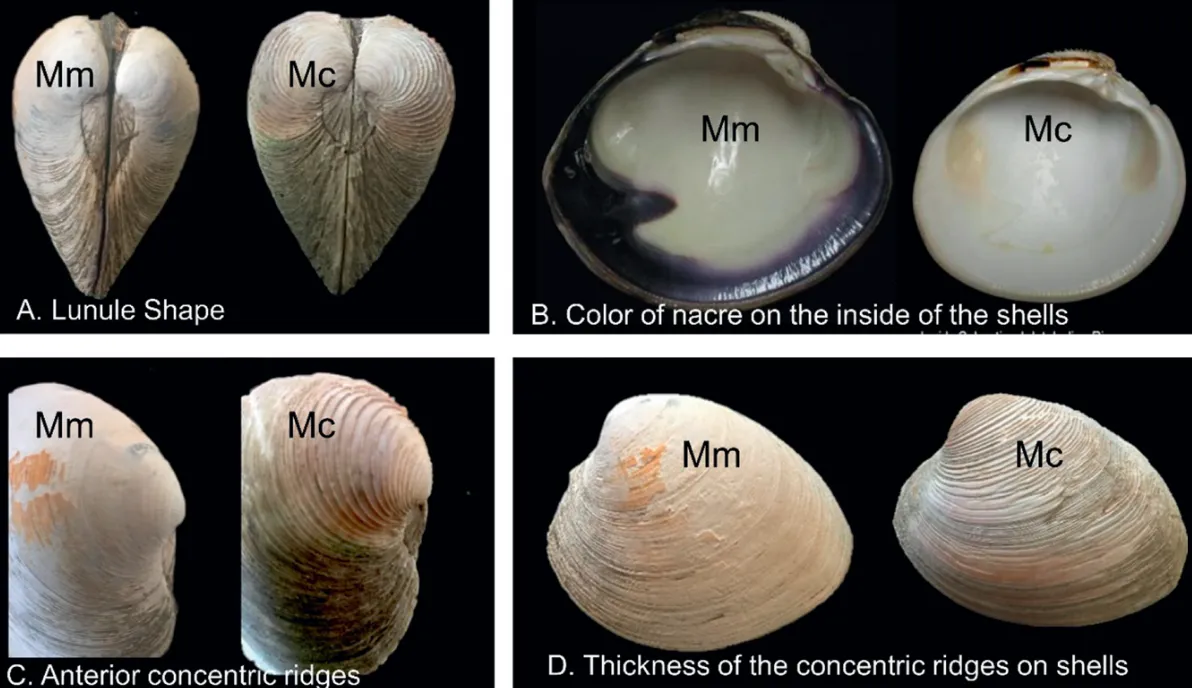
Credit: Used with permission from Heekenda et al. (2020).
Geographic Range
Both clam species have large geographic ranges that overlap along the mid and southern Atlantic coast of the United States. The northern hard clam ranges from the Florida Keys to the Gulf of St. Lawrence, Canada (Harte 2001) (Figure 3). The southern hard clam ranges from Florida to the Chesapeake Bay and is also found in the Gulf of America. Northern hard clams were introduced along Florida’s Gulf Coast in the 1950s for aquaculture purposes. Both species can be found in multiple sediment types, including mud and sand (Harte 2001). Although their geographic ranges overlap, the species do not generally co-occur. Northern hard clams are found in shallow waters (up to about 49 ft deep; Dillon and Manzi 1989), while southern hard clams are found from intertidal zones to deep (up to 120 ft) open ocean waters (Abbott and Morris 1995). However, some overlap has been observed (L. Sturmer, personal observation), and both species have been found in the Indian River Lagoon (Arnold 2001).

Credit: Adapted by C. Kaylor from Google Maps. Map data from 2025 Google, INEGI.
Temperature Tolerance
Northern hard clams may have a wider temperature tolerance than southern hard clams. The optimal temperature for growth of northern hard clams is between 16°C and 27°C (60.8°F–80.6°F), but they do not grow at temperatures below 8°C (46.4°F) or above 31°C (87.8°F) (Weber et al. 2023). Southern hard clams may be better adapted to the warmer temperatures and less suited for cold water (Surge and Walker 2006). However, a 2022 study exposed both species to heat stress of 24°C–34°C (75.2°F–93.2°F) over four weeks (Song et al. 2022). Southern hard clams were more sensitive to warming and lost weight, while northern hard clams showed mixed responses. As some of the northern hard clams still gained weight during the experiment, the results suggest they may ultimately have a higher tolerance of temperature changes than southern hard clams.
Salinity Tolerance
While northern hard clams are more tolerant of a range of temperatures than southern hard clams, they are less tolerant of low salinity. The optimal salinity range for northern hard clams is 20–30 psu, and their growth slows below 17 psu (Grizzle et al. 2001). Southern hard clams grow well in high saline water and are also more tolerant of low salinities than northern hard clams (Surge and Walker 2006).
Suspended Sediment Tolerance
Suspended sediments can affect the ability of filtering organisms, like clams, to function and grow properly. Northern hard clams have reduced growth rates in waters with higher concentrations of suspended sediments (Bricelj and Malouf 1984). Another study tested the effects of suspended clay particles on the southern hard clams and found no change in mortality, reflexes, or respiration after exposure (Devillier et al. 2024). Together, these findings suggest that southern hard clams may be more tolerant of suspended sediments than northern hard clams.
Growth Rate
Both species of hard clams demonstrate seasonal growth patterns visible as shell increments. These patterns can be used to estimate growth and age, much like tree rings. During faster growing seasons, a lighter, transparent ring forms on the shell, while bands appear darker during slow growth or stressful periods. One study in the Indian River Lagoon examined the growth rings of almost 400 clams, including northern and southern hard clams and their hybrids (Arnold et al. 1998). The study found that environmental factors like temperature and salinity have a greater impact on growth than genetic differences. These results suggest that both clam species would have similar growth rates when living in the same environment.
Clam Activities Related to Ecosystem Services
Effective use of clams for restoration and improved water quality depends, in part, on understanding how the different clam species function. To address this question, we conducted several laboratory experiments at the UF/IFAS Tropical Research and Education Center (TREC) using southern and northern hard clams obtained from a commercial hatchery but not genetically identified. Our study compared the species in optimal laboratory conditions and may not be representative of natural conditions.
The first measurements we conducted were related to the clearance rate, or the volume of water cleared of particles by a clam per unit time. Clearance rates quantify how effectively clams may enhance water clarity. The northern hard clam tended to clear more water than the southern hard clam. On average, the northern hard clams had a clearance rate of 136 mL hr-1 per gram dry tissue weight, while southern hard clams averaged 76 mL hr-1 per gram dry tissue weight (Kaylor 2025). These rates are lower than previously reported for northern hard clams, which may be due to differences in methodology.
We also measured biodeposition rates, the amount of biodeposits released by the clam over time. The biodeposition rate may influence the rate of nitrogen removal and the availability of nutrients to seagrasses. We found that northern and southern hard clams had similar biodeposition rates, both averaging 0.03 mg hr-1 clam-1 (Kaylor 2025). These rates are lower than those previously reported for northern hard clams. Although similar to the clearance rates, these lower rates may be due to differences in methodology.
Related to the clam’s metabolism, we also measured excretion rates. The excretion rate is the amount of ammonium (NH4+) released by a clam per unit time. These rates indicate how much nitrogen the clams are recycling and making available for other organisms, such as algae. With a density of ~400 clams m-2, we found that northern hard clams had an excretion rate of 4.9 mg N-NH4+ m-2 hr-1. Southern hard clams had an average excretion rate of 2.5 mg N-NH4+ m-2 hr-1 (Kaylor 2025).
In addition to clearance, biodeposition, and excretion rates, we also measured respiration rates. The respiration rate is the amount of oxygen (O2) consumed by a clam over time. Respiration rates are an indicator of a clam’s metabolism and can provide insight into how the clam is functioning. We found that the northern hard clam tended to have higher respiration rates compared to the southern hard clam, but these rates were not statistically different. With a density of ~400 clams m-2, northern hard clams had an average respiration rate of 66 mg O2 m-2 hr-1, while southern hard clams averaged 44 mg O2 m-2 hr-1 (Kaylor 2025).
We also examined how the two clam species affect sediment denitrification, the microbially mediated process that permanently removes N from the ecosystem. Denitrification is important to understand because the removal of nitrogen can help alleviate stress from nitrogen pollution. We found that sediment denitrification rates were similar between the two species (Kaylor 2025). With a density of ~400 clams m-2, northern hard clams had an average rate of 8.8 mg N-N2 m-2 hr-1, while southern hard clams averaged 9.1 mg N-N2 m-2 hr-1. Although we found denitrification associated with clam presence, denitrification rates were not higher than those measured for bare sediment without clams, indicating neither species affected nitrogen removal.
Uses and Limitations
Which clam can be used for restoration?
Both hard clam species are being utilized by restoration groups in Florida to rebuild clam populations and improve water quality. Because both species appear to provide similar water-quality services, there is no known functional difference between the two. Instead, practical factors, such as species availability, regulations, and site-specific characteristics, may play a more important role in determining which clam to use. For example, the southern hard clam’s ability to withstand high temperatures, low salinity, and high levels of suspended sediments, which are typical summertime conditions in many of Florida’s estuaries, make it a promising candidate for bivalve restoration and restoration aquaculture initiatives. It is important to note that the appropriate regulatory agencies (e.g., FWC, FDACS, DEP) must first review and authorize any restoration activity involving cultured bivalves before implementation to ensure they follow the guidelines of Florida’s existing regulatory frameworks.
What are the uncertainties?
This publication summarizes our current understanding of the two clam species being considered for restoration in Florida, but there are still uncertainties that need to be addressed systematically. First, visual identification of the two species is likely unreliable; therefore, there may be confusion about which species is which. Further, few studies directly compare the environmental preferences and ecosystem service provisioning of northern and southern hard clams. Most studies are conducted in various locations, using clams of varying ages and histories, which makes comparisons difficult. Florida’s environment is incredibly variable, spanning temperate to tropical conditions and including both Atlantic and Gulf coasts. Studies conducted at the northern end of the species’ ranges may not be directly relevant for Florida’s hard clams. In addition, results are mixed concerning the environmental tolerances of the two species. More data are needed to fully understand the differences between northern and southern hard clams. Ongoing research is helping to fill these gaps, including a study of the aquaculture of both species in Georgia (Manley et al. 2024) and multiple collaborations between researchers and the industry to identify genetic markers distinguishing the two species (Zeng et al. 2024). Further research will enhance guidance on selecting the most appropriate clam species, or hybrid if appropriate, for the restoration goals of the site.
Summary
- There is growing interest in hard clam restoration in Florida due to the numerous ecosystem services they provide, including water quality improvement and nutrient cycling.
- Florida is home to two species of hard clams: Mercenaria mercenaria (northern hard clam) and Mercenaria campechiensis (southern hard clam).
- The two species have distinct morphological characteristics, but these traits can be inconsistent. Clams can hybridize and exhibit a mix of characteristics, making visual identification a challenge.
- Northern hard clams may be more tolerant of a wider range of temperatures.
- Southern hard clams may be more tolerant of a wider range of salinities and higher suspended sediment loads.
- Both species are similar in size, growth rate, and metabolism.
- The two species have similar physiological rates and comparable impacts on water clarity and denitrification, suggesting there is no functional reason to choose one species over the other.
- Northern hard clams are easier to obtain because they are widely produced in aquaculture and have a longer shelf life in refrigerated storage. However, southern hard clams are native to Florida’s Gulf Coast.
- Species selection should be based on practical factors such as availability, regulatory requirements, and site-specific characteristics such as salinity, temperature, and suspended sediment levels.
- Differences in survival, growth, and reproduction between location and species should be considered when selecting a species for restoration.
Further Reading
Baker, S., K. Grogan, S. Larkin, and L. Sturmer. 2015. “Green” Clams: Estimating the Value of Environmental Benefits (Ecosystems Services) Generated by the Hard Clam Aquaculture Industry in Florida. UF/IFAS Shellfish Aquaculture Research & Extension, Nature Coast Biological Station. https://shellfish.ifas.ufl.edu/wp-content/uploads/environmental-benefits.pdf
Blair, S., C. Adams, T. Ankersen, M. McGuire, and D. Kaplan. 2015. “Ecosystem Services Valuation for Estuarine and Coastal Restoration in Florida: TP-204/SG134, rev. 1/2018.” EDIS 2015 (1). https://doi.org/10.32473/edis-sg134-2015
Spengler, C., J. Roth, and L. K. Reynolds. 2024. “Biodiversity as a Tool to Boost Seagrass Restoration Success: SL515/SS728, 3/2024.” EDIS 2024 (3). https://doi.org/10.32473/edis-ss728-2024
References
Abbott, R. T., and P. A. Morris. 1995. A Field Guide to Shells: Atlantic and Gulf Coasts and the West Indies. Houghton Mifflin Harcourt.
Arnold, W. S. 2001. “Bivalve Enhancement and Restoration Strategies in Florida, U.S.A.” Hydrobiologia 465: 7–19. https://doi.org/10.1023/A:1014596909319
Arnold, W. S., T. M. Bert, I. R. Quitmyer, and D. S. Jones. 1998. “Contemporaneous Deposition of Annual Growth Bands in Mercenaria mercenaria (Linnaeus), Mercenaria campechiensis (Gmelin), and Their Natural Hybrid Forms.” Journal of Experimental Marine Biology and Ecology 223 (1): 93–109. https://doi.org/10.1016/S0022-0981(97)00152-4
Bricelj, V. M., and R. E. Malouf. 1984. “Influence of Algal and Suspended Sediment Concentrations on the Feeding Physiology of the Hard Clam Mercenaria mercenaria.” Marine Biology 84 (2): 155–165. https://doi.org/10.1007/BF00393000
Devillier, V. M., E. R. Hall, V. Lovko, R. Pierce, D. M. Anderson, and K. A. Lewis. 2024. “Mesocosm Study of PAC-Modified Clay Effects on Karenia Brevis Cells and Toxins, Chemical Dynamics, and Benthic Invertebrate Physiology.” Harmful Algae 134: 102609. https://doi.org/10.1016/j.hal.2024.102609
Dillon, R. T., and J. J. Manzi. 1989. “Genetics and Shell Morphology in a Hybrid Zone Between the Hard Clams Mercenaria mercenaria and M. campechiensis.” Marine Biology 100: 217–222. https://doi.org/10.1007/BF00391961
Donaher, S. E., C. J. Baillie, C. S. Smith, et al. 2021. “Bivalve Facilitation Mediates Seagrass Recovery from Physical Disturbance in a Temperate Estuary.” Ecosphere 12 (11): e03804. https://doi.org/10.1002/ecs2.3804
Gobler, C. J., M. H. Doall, B. J. Peterson, et al. 2022. “Rebuilding a Collapsed Bivalve Population, Restoring Seagrass Meadows, and Eradicating Harmful Algal Blooms in a Temperate Lagoon Using Spawner Sanctuaries.” Frontiers in Marine Science 9: 911731. https://doi.org/10.3389/fmars.2022.911731
Grizzle, R. E., V. M. Bricelj, and S. E. Shumway. 2001. “Chapter 8: Physiological Ecology of Mercenaria mercenaria.” In Developments in Aquaculture and Fisheries Science, edited by J. N. Kraeuter and M. Castagna. Vol. 31. Elsevier. https://doi.org/10.1016/S0167-9309(01)80036-3
Harte, M. E. 2001. “Chapter 1: Systematics and taxonomy.” In Developments in Aquaculture and Fisheries Science, edited by J. N. Kraeuter and M. Castagna. Vol. 31. Elsevier. https://doi.org/10.1016/S0167-9309(01)80029-6
Heekenda, E. J., J. D. Austin, Z. Zhang, and H. Yang. 2020. “Phenotypic and Genetic Identification of Mercenaria mercenaria, Mercenaria campechiensis, and Their Hybrids.” Journal of Shellfish Research 39 (3). https://doi.org/10.2983/035.039.0304
Kaylor, C. 2025. “Florida Hard Clams: A Comparative Study of Morphology, Physiology, and Biogeochemical Cycling.” M.S. Thesis Research Seminar, February 26. University of Florida, Department of Soil, Water, and Ecosystem Sciences.
Kraeuter, J. N., and M. Castagna, eds. 2001. Biology of the Hard Clam. Vol. 31. Elsevier.
Manley, J., T. Bliss, E. Arneson, C. Phillips, C. Hemmel, and J. Pelli. 2024. Technical Manual for Farming the Southern Quahog, Mercenaria campechiensis, in Estuaries Characteristic of Coastal Georgia and the South Atlantic Bight. University of Georgia, Marine Extension and Georgia Sea Grant.
Song, J., J. D. Austin, and H. Yang. 2022. “Comparative Transcriptomics of the Northern Quahog Mercenaria mercenaria and Southern Quahog Mercenaria campechiensis in Response to Chronic Heat Stress.” Marine Biotechnology 24: 276–292. https://doi.org/10.1007/s10126-022-10101-7
Surge, D., and K. J. Walker. 2006. “Geochemical Variation in Microstructural Shell Layers of the Southern Quahog (Mercenaria campechiensis): Implications for Reconstructing Seasonality.” Palaeogeography, Palaeoclimatology, Palaeoecology 237 (2–4): 182–190. https://doi.org/10.1016/j.palaeo.2005.11.016
Weber, K., L. N. Sturmer, E. Hoover, and S. Baker. 2008. “The Role of Water Temperature in Hard Clam Aquaculture: FA151/FA151, 10/2007.” EDIS 2008 (1). https://doi.org/10.32473/edis-fa151-2007
Zeng, X., J. C. Yee, and H. Yang. 2024. “Rapid and Accurate Identification of Mercenaria mercenaria and Mercenaria campechiensis Using High-Resolution Melting Analysis.” Journal of Shellfish Research 43 (1): 111–118. https://doi.org/10.2983/035.043.0111