
Nitrogen-fixing legumes are planted as cover crops and in wildlife food plots, where they form beneficial relationships with soil microbes. These legumes grow nodules on their roots that can be plucked or scraped off easily. Conversely, legumes may grow root-knot nematode galls that are hard and part of the root. Pink or red color inside the tissue can indicate well-functioning nodulation. Legume cover crop biomass is a high-protein resource for game species, and decomposition of organic material through green chopping can increase soil fertility. Recognizing the difference between a nitrogen-fixing legume nodule and a root-knot nematode gall is important for assessing plant health and promoting biomass growth.
Introduction
Nitrogen-fixing legumes are an important cover crop in agriculture and a key plant in wildlife food plots. As root tips grow, they slough off dead cells and leak exudates, a constant food source for microbes. In return, some microbes provide legumes with a source of nitrogen for plant growth in a symbiotic relationship called biological nitrogen fixation (BNF). Many legume cover crops form nodules on their roots with legume bacteria Rhizobium (Wright et al. 2017). BNF allows the plant to thrive in conditions where little nitrogen is available.
This relationship can increase biomass production without the use of added fertilizers. The increased biomass is an additional source of nitrogen for subsequent crops, especially when the aboveground biomass is green chopped or mixed into the soil. Green chopping, cutting down the green top growth, leaves the roots in the soil along with the fixed nitrogen. The legume biomass also provides a high-protein food source for game species. Improving soil fertility through BNF may help offset fertilizer costs, especially when nodules are very active, allowing plants to produce more biomass for green chopping. To ensure legume cover crops are actively fixing nitrogen, identification of the nodules is important, especially when other growths may appear on the roots that are not nodules, such as root-knot nematode (RKN) galls. This publication compares nitrogen-fixing legume nodules with RKN galls to help growers more accurately assess the activity of nitrogen fixation in the field and discern whether plants are healthy (actively fixing nitrogen) or suffering from a pest outbreak.
Nitrogen-Fixing Nodules
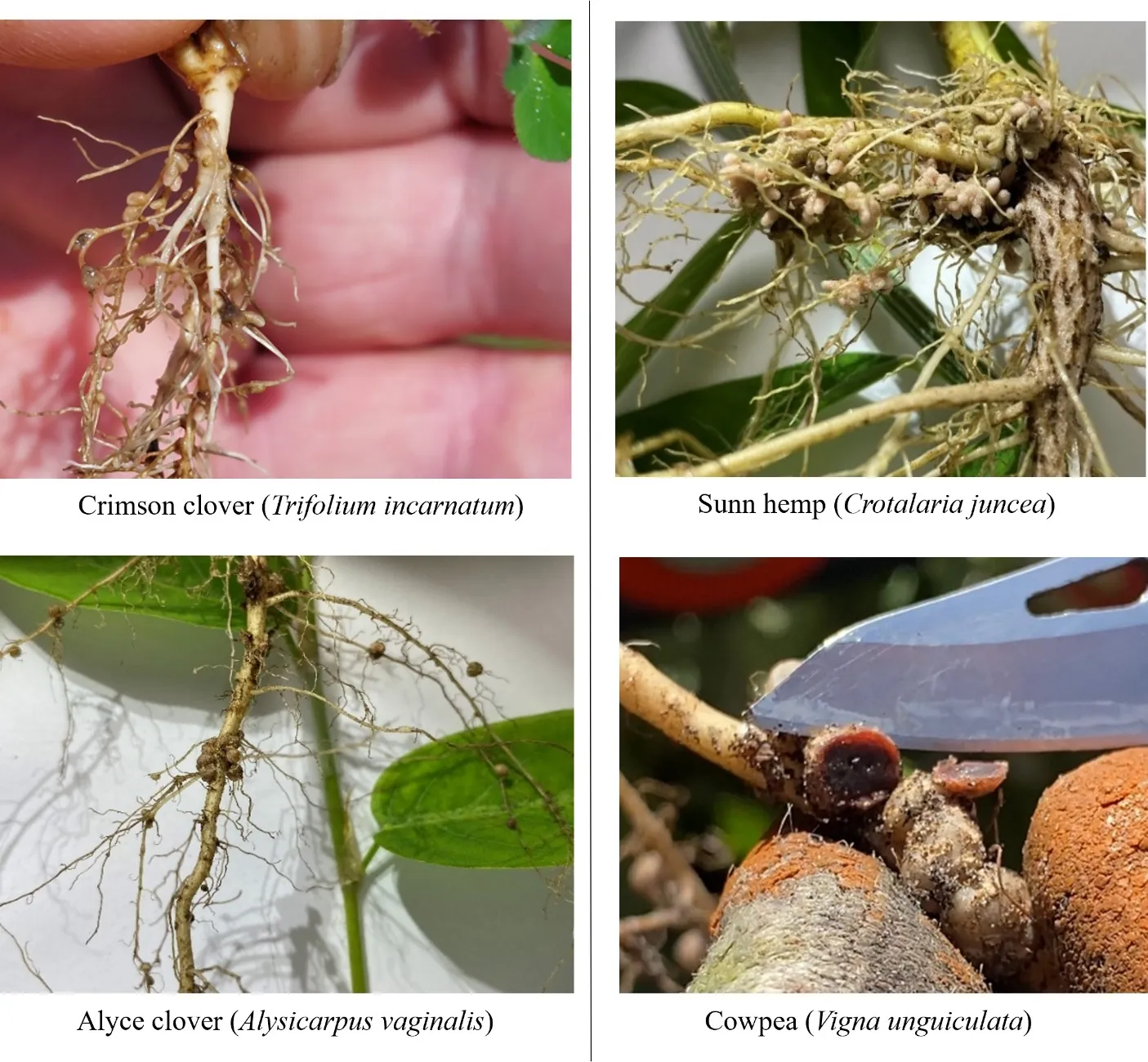
Nodules vary in shape and color but are often round in annual grain legumes or finger pill-shaped in perennial legumes. Inside tissue color is a strong indicator of nitrogen-fixing activity levels. Gray, white, beige, or green indicate little to no activity, while pink, red, and dark red indicate high activity. Nodules are usually soft enough to be crushed, sliced open, plucked, or scraped off rather easily. They can even fall off the roots while sampling and handling the plants (Figure 1).
Root-Knot Nematode Galls
Plant-parasitic nematodes are also microbes attracted to plant root exudates. However, when they form an association with plant roots, it does not benefit the plant. As a result, the nematodes are considered a pest. They form galls on roots, which may, at first glance, resemble nitrogen-fixing nodules, but there are key differences.
Root-knot nematode (RKN) galls are tumor-like growths that are hard and part of the root tissue (Figure 2) (Gill et al. 2023). They are irregular in shape and match the color of the root tissue, which is usually white or cream. RKN galls are not easily crushed between your thumb and forefinger, especially compared to nitrogen-fixing nodules. When sliced open, they lack green or red color.
The main group of plant-parasitic nematodes responsible for galls in most crops grown in Florida is Meloidogyne spp. Some legume cover crops, such as cowpea (Vigna unguiculata var. Iron/Clay), can reduce populations of RKN. Read more about this in Ask IFAS publication ENY063, “Cover Crops for Managing Root-Knot Nematodes.”
Credit: David Hébert, UF/IFAS

Credit: David Hébert, UF/IFAS
Biological Nitrogen Fixation
Host-specific bacteria must be present in the field for legume nodules to begin symbiosis. Sometimes, Rhizobium species are already present, but if no nodulation occurs or it occurs without any inner pink or red color, there may not be a high enough microbial population in the area. However, bacteria can be added back to the area by applying commercial-grade bacterial strains, either on the seed or in furrow at planting, or by incorporating soil from an area known to be inoculated (Gill et al. 2023).
Biological nitrogen fixation (BNF) in cowpea starts after seedling roots encounter Rhizobium species bacteria in the soil and form a nodule. Pink or red color inside the nodule is a strong indication of successful nitrogen-fixing activity or symbiosis, while green indicates little to no activity. Eventually, nodules stop fixing nitrogen and are discarded by the plant (Flynn and Idowu 2015) (Figure 3).

Credit: David Hébert, UF/IFAS
Benefits to Agriculture and Wildlife
BNF can positively impact agriculture and wildlife food plots because BNF results in ample legume cover crop biomass. In many circumstances, this biomass increases the viability of the following season’s cash crop, especially when green chopped or turned into the soil. After being macerated in the soil, the legume biomass decomposes and turns into plant-available nitrogen over several months. This can potentially add 70 to 100 lb per acre of nitrogen to the next crop, reducing the requirement for chemical fertilizer (Sharma et al. 2023). Read more about improving BNF in Ask IFAS publication SL501, “Improving Biological Nitrogen Fixation to Improve Soil Nutrient Status.”
Wildlife benefits from eating the large amount of biomass that BNF produces. Legume cover crops are a desirable, high-protein food source for young bucks in the dearth of food in winter and a resource for pollinators attracted to the flowers and leaf canopy cover. There is no need to chop this biomass into the soil to feed animals, as they can forage on the living plants that remain and grow throughout the season.
Roots and nodules continue to grow, mature, and decompose under no-till operations, adding some organic matter to the soil profile, but this amount of biomass is much less compared with the aboveground biomass that could be chopped in (Flynn and Idowu 2015). Legume cover crops may be harvested when they reach the seed and pod stages. As they senesce, aboveground stems and leaves of annual legumes help form a thatch or “soil armor,” holding in topsoil moisture. However, loose debris can also pile up in undesirable locations within rows, or wind and rain can carry it out of the field completely. Growers may decide to green chop some areas but not others, depending on the amount of biomass in each area. Overmaceration in sandy areas with little biomass can lead to significant moisture loss.
References
Flynn, R., and J. Idowu. 2015. “Nitrogen Fixation by Legumes.” Guide A-129. CES Publications. New Mexico State University Cooperative Extension Service, College of Agricultural, Consumer and Environmental Sciences. https://pubs.nmsu.edu/_a/A129/
Gill, H. K., Z. J. Grabau, and R. McSorley. 2023. “Cover Crops for Managing Root-Knot Nematodes: IN892/ENY063, rev. 1/2023.” EDIS 2022 (6). https://doi.org/10.32473/edis-in892-2023
Sharma, L. K., A. K. Sharma, A. Ogram, and H. Singh. 2023. “Improving Biological Nitrogen Fixation to Improve Soil Nutrient Status.” EDIS 2023 (4). https://doi.org/10.32473/edis-ss714-2023
Wright, D. L., C. Mackowiak, I. Small, and A. Blount. 2017. “Inoculation of Agronomic and Forage Crop Legumes: SS-AGR-154/AA126, rev. 12/2017.” EDIS 2017 (6). https://doi.org/10.32473/edis-aa126-2002