
Description
Students will learn about North Atlantic right whale life history. Students will read an informational publication about right whales and use information from the publication to complete worksheets.
Objectives
By the conclusion of the activity, students will:
- Be able to identify the external anatomy of a right whale
- Be able to explain why right whales were the "right whale" to hunt
- Be able to explain why right whales migrate to Florida in the winter and Canada's Bay of Fundy in the summer
- Be able to explain what a callosity is and understand how scientists use callosities to identify individual whales
- Be able to compare the external anatomy and feeding behavior of right whales and humpback whales
What You Will Need
- Copies of Introducing ... the Right Whale! reading material for each student (pages 11-3 to 11-7)
- Copies of The Right Whale student worksheet for each student (pages 11-8 to 11-11)
- Copies of humpback whale fact sheet (from Lesson 3) for each student
Standards
Sunshine State Standards
English Language Arts
- LAFS.4.RF.4.4 Read with sufficient accuracy and fluency to support comprehension.
Procedure
- Remind the students that they have been learning about different kinds of cetaceans. Now they are going to spend some time learning more about one particular cetacean, the North Atlantic right whale.
- Provide each student with a copy of the handout.
- Provide each student with a copy of the worksheet. Ask them to complete the worksheet as they read the article on right whales. You may want to have humpback whale fact sheets or other reference materials available to help with comparison between humpbacks and right whales.
Activity: Introducing the Right Whale (pages 11-3 to 11-11)
- Hand out the attached article (pages 11-3 to 11-7).
- Hand out the accompanying worksheet, The Right Whale—Student Worksheet.
- Students should work independently to read the article and complete the worksheet.
Activity: Learning More about Whaling
The New Bedford Whaling Museum has developed an activity workbook for grades 4 and up. This booklet is designed to take you and your students on a voyage back to a time when people thought whaling was a necessity, and the whaling port of New Bedford was known worldwide. It includes several suggested writing activities. You can access or download the workbook from girlonawhaleship.org.
Introducing ... the Right Whale!
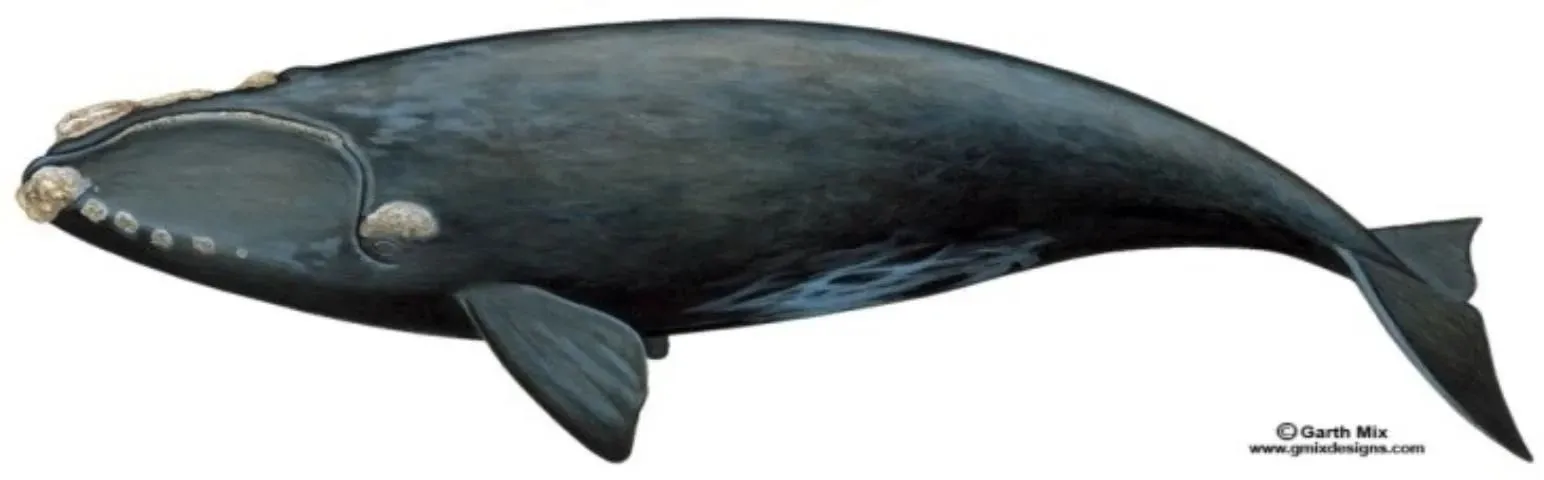
Credit: Garth Mix, gmixdesigns.com/Site/GMiX_Designs.html
Why do we call these whales the "right whales"?
More than 1,000 years ago, humans did not get oil from oil wells. Instead, oil was made from animal products. Whales, because of their massive size and thick layers of blubber, were an excellent source of oil.

The "right whale" was named because it was an ideal whale to hunt. Right whales are found close to shore. They swim very slowly, usually at the surface. When the whales were killed, the bodies would float. This made it easier for whalers to harvest the animal.
By 1935, there were very few North Atlantic right whales left. People could no longer make money hunting them. Right whales became protected. Other whales in US waters were not protected from hunting until 1972. That is when the Marine Mammal Protection Act was created. Today, native Alaskan people are allowed to hunt a few bowhead whales each year. No other whaling is allowed in US waters.
Is there only one "right whale"?
There are three different species of right whales. The one seen in Florida waters is the North Atlantic right whale. We will talk about that one the most. There are only about 400 North Atlantic right whales.
There is also a North Pacific right whale. These whales are found off the coast of Japan. There are very, very few North Pacific right whales left.
The Southern right whale is found off the coast of South America, Africa, and Australia. This group of right whales is doing very well; there are several thousand animals in this population.

Fun Facts about Right Whales
Right whales are baleen whales. They can grow to 55 feet in length and weigh 140,000 pounds.
Right whales are "skim feeders." They swim at the surface with their mouths open to catch plankton.
Female right whales visit the ocean area off the southeastern US in the winter. This is where the calves are born. In March or April, they begin to migrate north and spend the summer feeding in waters near Massachusetts and Canada.
Right whales have callosities on their heads. These are patches of skin that are covered with little white bugs called cyamids. The cyamids are also sometimes called whale lice. They do not seem to bother the right whales. The callosities on each whale form a unique pattern. Callosities are used like a fingerprint to identify individual right whales.

Cyamids are tiny creatures that are sometimes called "whale lice." Their white color makes the callosities visible to scientists who identify the whales.

Right Whales in Florida
Right whales come to Florida every winter. Pregnant whales begin arriving in December. The calves are born over the next few months. The right whales usually head north to their summer feeding grounds in March or April.

During certain years, only one or two new calves join the herd. In other years, there may be as many as 20 to 30 new calves. Currently, there are only about 450 North Atlantic right whales.

Summer Feeding
Right whales feed off the coast of New England and southeastern Canada, in a place called the Bay of Fundy. This place has water that is full of tiny plankton. Plankton is the main food source for right whales.
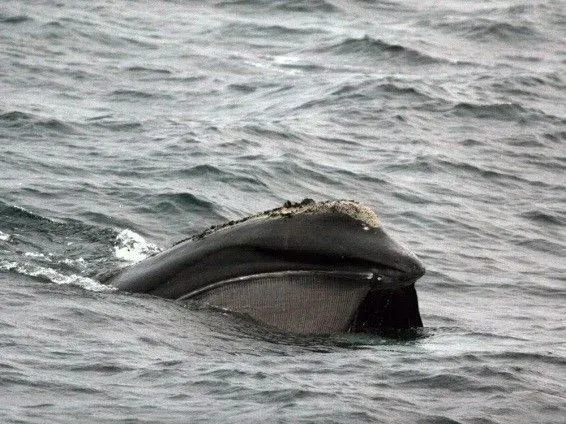
Right whales catch plankton by SKIMMING the surface of the water with their mouths open. They trap the plankton in their baleen.
Scientists watch the whales all summer while the animals feed in the Bay of Fundy. They photograph as many whales as possible and compare the photographs to images of known right whales. This allows the scientists to identify the whales they have seen. Researchers study the whales and check on the new calves.
The Bay of Fundy is a very large area. It can be difficult for scientists to find the whales. One method is using spotters who look for whales from airplanes. However, this is expensive and potentially dangerous.

Biologists often collect data from small planes. They take photographs to count whales when the whales surface for air.

Fun Fact: Whale-Tracking Dogs!
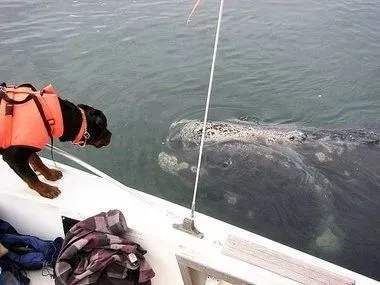
Another way scientists find the whales is by using dogs. Whale-tracking dogs are trained to smell whale poop. Yes, you read that right ... whale poop! The dogs sit on the front of the scientist's boat. Each dog wears its own life jacket! The dogs show the scientists where the whales are. Do you think your dog could be trained to track a whale?
The Right Whale—Student Worksheet

During the winter, very large baleen whales called RIGHT whales visit the northeast Florida coast. These whales arrive in December and leave in March or April.


- Why are these animals called "right" whales?
- Why do they visit Florida waters each winter?
- Identify the parts of this whale and fill in the blanks.
- Look carefully at the right whale above. Is this whale a baleen whale or an odontocete?
- Right whales feed by swimming at the surface with their mouths open. This is called _ K _ M M _ _ G. (Fill in the blanks.)
- Let's compare right whales and humpback whales.
Here is a list of terms that go with right whales, humpback whales, or both. Write each term in the proper place in the Venn diagram.
- Skim feeder
- Short triangular flippers
- Gulper
- Callosities
- Baleen
- Flukes
- Long white flippers
- Sings

- Right whales eat by skimming the surface of the ocean. Which of the following do you think they eat? Circle your answer.
Credit: OpenClipart-Vectors from Pixabay

Credit: Mudassar Iqbal from Pixabay

Credit: Amplionus/gettyimages.com
ANSWER KEY
During the winter, very large baleen whales called RIGHT whales visit the northeast Florida coast. These whales arrive in December and leave in March or April.
- Why are these animals called "right" whales?
They are slow swimmers. They are found close to shore. They floated when killed. All of these made them the "right" whale to hunt.
2. Why do they visit Florida waters each winter?
To have their calves or babies
3. Identify the parts of this whale and fill in the blanks.

4. Look carefully at the right whale above. Is this whale a baleen whale or an odontocete?
Baleen whale (or mysticete)
5. Right whales feed by swimming at the surface with their mouths open.
This is called S K I M M I N G. (Fill in the blanks.)
6. Let's compare right whales and humpback whales.
Here is a list of terms that go with right whales, humpback whales, or both. Write each term in the proper place in the Venn diagram.
Skim feeder Short triangular flippers
Gulper Callosities
Baleen Flukes
Long white flippers Sings

7. Right whales eat by skimming the surface of the ocean. Which of the following do you think they eat? Circle your answer.
Plankton