
Proper turfgrass identification is required before considering any lawn maintenance practices. Each of the different grasses used for Florida lawns have different management. Without accurate identification, mismanagement could occur, leading to undesirable results. Turfgrass identification can be challenging due to the lack of inflorescence or seedheads at certain times in their life cycle or due to being mowed off. Thus, other plant characteristics are used to help with turfgrass identification. This publication is intended for Florida lawn and landscape enthusiasts and landscape maintenance professions to help them identify different Florida turfgrasses. Some useful characteristics are found below and in Figure 1. Additionally, Figures 2–4 include a turfgrass identification key based on morphological characteristics. Lastly, another useful way to identify turfgrass is from the seedheads, which can be found in Figure 5.
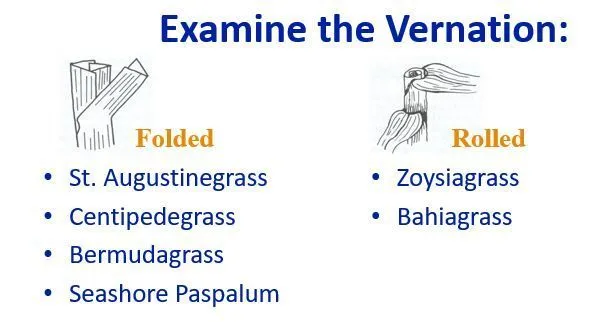
- Vernation — How new leaf blades emerge from the sheath.
- Leaf blade — Upper part of the grass leaf.
- Leaf tip — Shape of the leaf tip.
- Sheath — Lower part of the grass leaf that connects to the node.
- Collar — Location of where the sheath and blade come together.
- Ligule — Structure at the junction of the leaf sheath and blade.
- Auricle — Appendages that grow from the collar.
- Seedhead — Also called inflorescence; the flower head at the end of the stem.
- Growth habit — How a plant develops new plants or spreads. Turfgrasses used for Florida lawns typically spread laterally via stolons (aboveground stems) and/or rhizomes (belowground stems).

Credit: VectorMine –
Credit: Kevin Kenworthy, UF/IFAS

Credit: Kevin Kenworthy, UF/IFAS

Credit: Kevin Kenworthy, UF/IFAS

Credit: Kevin Kenworthy, UF/IFAS
Bahiagrass ( Flugge)
Bahiagrass (Figure 6) is viewed as a low-maintenance turfgrass that does well with limited water and fertilizer inputs. It forms an extensive, deep root system, and it is not prone to forming excessive thatch. However, it does produce tall seedheads, and it forms a relatively open turf canopy (Figure 6). Bahiagrass can be identified from the characteristics in Table 1. For more information on bahiagrass, refer to ENH6, “Bahiagrass for Florida Lawns” (https://edis.ifas.ufl.edu/LH006).
Table 1. Bahiagrass identification characteristics.
Characteristic | Description |
|---|---|
Vernation | Rolled, but can appear folded (Figure 7) |
Leaf blade | Medium to coarse textured |
Leaf tip | Pointed |
Sheath | Smooth or hairy; can be flattened |
Collar | Divided |
Ligule | Membranous with a fringe of hairs (Figure 8) |
Auricle | Absent |
Seedhead | “Y-shaped” (Figure 9) |
Growth habit | Thick woody rhizomes, which can have a slight purple color towards the base of the plant (Figure 10) |

Credit: Natasha Restuccia, UF/IFAS

Credit: Kevin Kenworthy, UF/IFAS

Credit: Kevin Kenworthy, UF/IFAS

Credit: Kevin Kenworthy, UF/IFAS

Credit: Kevin Kenworthy, UF/IFAS
Bermudagrass (Cynodon spp.)
Bermudagrass (Figure 11) is viewed as a high-maintenance turfgrass, and generally, it requires greater input levels compared to other Florida lawn grasses. It produces a vigorous, dense turf when managed properly. However, it can have poor tolerance to many pests, and it has poor cold and shade tolerance. Additionally, excessive thatch buildup is common due to its aggressive growth. Bermudagrass can be identified from characteristics in Table 2. For more information on bermudagrass, refer to ENH19, “Bermudagrass for Florida Lawns” (https://edis.ifas.ufl.edu/LH007).
Table 2. Bermudagrass identification characteristics.
Characteristic | Description |
|---|---|
Vernation | Folded (Figure 12) |
Leaf blade | Very fine to coarse textured (species and cultivar dependent) |
Leaf tip | Pointed |
Sheath | Smooth or with scattered/sparse hairs |
Collar | Narrow |
Ligule | Fringe of hairs (Figure 13) |
Auricle | Absent |
Seedhead | 3–5 spikes (Figure 14) |
Growth habit | Rhizomes and stolons with uneven/variable-length leaf spacing (Figure 15) |

Credit: Natasha Restuccia, UF/IFAS

Credit: Kevin Kenworthy, UF/IFAS

Credit: Kevin Kenworthy and Jason Kruse, UF/IFAS

Credit: Pawel Petelewicz, UF/IFAS

Credit: Kevin Kenworthy, UF/IFAS
Centipedegrass (Eremochloa ophiuroides [Munro] Hack.)
Centipedegrass (Figure 16) is viewed as a low-maintenance, slow-growing turfgrass that has low fertility requirements and grows well in acidic soils. It grows close to the ground and has a lighter green color than other Florida lawn grasses. Mismanagement, especially overfertilizing with nitrogen, can increase pest problems and reduce cold tolerance. Centipedegrass can be identified from the characteristics in Table 3. For more information on centipedegrass, refer to ENH8, “Centipedegrass for Florida Lawns” (https://edis.ifas.ufl.edu/LH009).
Table 3. Centipedegrass identification characteristics.
Characteristic | Description |
|---|---|
Vernation | Folded (Figure 17) |
Leaf blade | Medium textured; hairs on leaf margin |
Leaf tip | Blunt, rounded |
Sheath | Flattened |
Collar | Constricted with a broad blade and sheath; has hairs (Figure 18) |
Ligule | Membranous with cottony hairs (Figure 19) |
Auricle | Absent |
Seedhead | Spike (Figure 5) |
Growth habit | Stolons only, no rhizomes (Figure 20) |

Credit: Chase McKeithen, UF/IFAS

Credit: Kevin Kenworthy, UF/IFAS

Credit: Kevin Kenworthy, UF/IFAS

Credit: Kevin Kenworthy, UF/IFAS

Credit: Kevin Kenworthy, UF/IFAS
Seashore Paspalum (Paspalum vaginatum Swartz.)
Seashore paspalum (Figure 21) is viewed as a higher-maintenance turfgrass that does well in areas with high salinity. It produces a dense, dark-green turf when managed properly. However, it is prone to excessive thatch buildup. It has poor cold and shade tolerance, but it can withstand extended periods of low light intensity. Seashore paspalum can be identified from the characteristics in Table 4.
Table 4. Seashore paspalum identification characteristics.
Characteristic | Description |
|---|---|
Vernation | Folded (Figure 22) |
Leaf blade | Very fine to coarse textured (cultivar dependent) |
Leaf tip | Pointed |
Sheath | Smooth or sparsely hairy |
Collar | Narrow |
Ligule | Membrane with fine hairs on upper edge (Figure 23) |
Auricle | Absent |
Seedhead | Fork with two branches (Figure 5) |
Growth habit | Rhizomes and stolons with even leaf spacing (Figure 24) |

Credit: A.J. Lindsey, UF/IFAS

Credit: Kevin Kenworthy, UF/IFAS

Credit: Kevin Kenworthy, UF/IFAS

Credit: Kevin Kenworthy, UF/IFAS
St. Augustinegrass (Stenotaphrum secundatum [Walt.] Kuntze)
St. Augustinegrass (Figure 25) is adapted to most soils and climatic regions in Florida. It produces a dense, green to blue-green turf. It has relatively good salt tolerance, and certain cultivars have better shade tolerance than other Florida lawn grasses. However, it can produce excessive thatch when mismanaged, and it has poor wear tolerance. St. Augustinegrass, which is the most distinct turfgrass species in Florida, can be identified from the characteristics in Table 5. For more information on St. Augustinegrass, refer to ENH5, “St. Augustinegrass for Florida Lawns” (https://edis.ifas.ufl.edu/LH010).
Table 5. St. Augustinegrass identification characteristics.
Characteristic | Description |
|---|---|
Vernation | Folded (Figure 26) |
Leaf blade | Coarse textured |
Leaf tip | Blunt, rounded |
Sheath | Flattened, smooth |
Collar | Constricted with twist and broad leaf blade and sheath (Figure 27) |
Ligule | Few to fringe of hairs (Figure 28) |
Auricle | Absent |
Seedhead | Spike (Figure 5) |
Growth habit | Stolons only, no rhizomes (Figure 29) |

Credit: Natasha Restuccia, UF/IFAS

Credit: Kevin Kenworthy, UF/IFAS

Credit: Kevin Kenworthy, UF/IFAS

Credit: Kevin Kenworthy and Jason Kruse, UF/IFAS

Credit: Kevin Kenworthy, UF/IFAS
Zoysiagrass (Zoysia spp.)
Zoysiagrass (Figure 30) is adapted to a variety of soils and climatic regions in Florida; however, zoysiagrass maintenance is different from other Florida lawn grasses. Improper maintenance practices generally lead to undesirable turfgrass. Zoysiagrass produces a dense turf stand that is resistant to weed invasion when properly managed, and it has good salt, traffic, and shade tolerance. However, it can produce excessive thatch when mismanaged. Zoysiagrass can be identified from the characteristics in Table 6. For more information on zoysiagrass, refer to ENH11, “Zoysiagrass for Florida Lawns” (https://edis.ifas.ufl.edu/LH011).
Table 6. Zoysiagrass identification characteristics.
Characteristic | Description |
|---|---|
Vernation | Rolled (Figure 31) |
Leaf blade | Very fine to coarse textured; can have fine hairs above; leaf blades are stiff |
Leaf tip | Pointed |
Sheath | Smooth |
Collar | Broad to narrow (species dependent); some have long hairs |
Ligule | Fringe of hairs (Figure 32) |
Auricle | Absent |
Seedhead | Spikelet (Figure 33) |
Growth habit | Rhizomes and stolons; the internodes are generally more uniform compared to bermudagrass (Figure 34) |

Credit: Natasha Restuccia, UF/IFAS

Credit: Kevin Kenworthy, UF/IFAS

Credit: Kevin Kenworthy and Jason Kruse, UF/IFAS

Credit: Alejandra Sierra, UF/IFAS

Credit: Kevin Kenworthy, UF/IFAS
Table 7. Summary table of turfgrass identification characteristics.