
This Florida-Friendly Landscaping™ publication is part of a document series originally written by Edward F. Gilman. Visit https://FloridaFriendlyLandscaping.com to learn more about creating and maintaining attractive landscapes that protect Florida's water resources and environment.
Introduction
Hawaiian ti plant (Cordyline fruticosa) is an evergreen large shrub with an upright growth habit (Figure 1). Ti plant reaches a height of 3 to 10 feet and spread of 2 to 4 feet. It has large 8- to 18-inch leaves that have a spiral leaf arrangement (Figure 2). The broadleaf evergreen leaves are very showy and come in a variety of colors including green, red, burgundy, pink, purple, and variegated (Table 1). Leaf coloration depends upon cultivar selection (Table 1). The colorful Hawaiian ti plant is perfect for creating a tropical landscape effect, with its smooth, flexible leaves ranging in many bright colors. This plant also produces a panicle of flowers ranging from white, pale yellow, or purple, and measuring up to a foot in length (Figure 3). The flowers develop into a cluster of showy red berries (Figure 4). Ti plant makes an attractive specimen, may be used in a container or above-ground planter, is suitable for growing indoors as a houseplant in bright indirect light, may be used as an accent, or makes a bold statement in mass plantings.
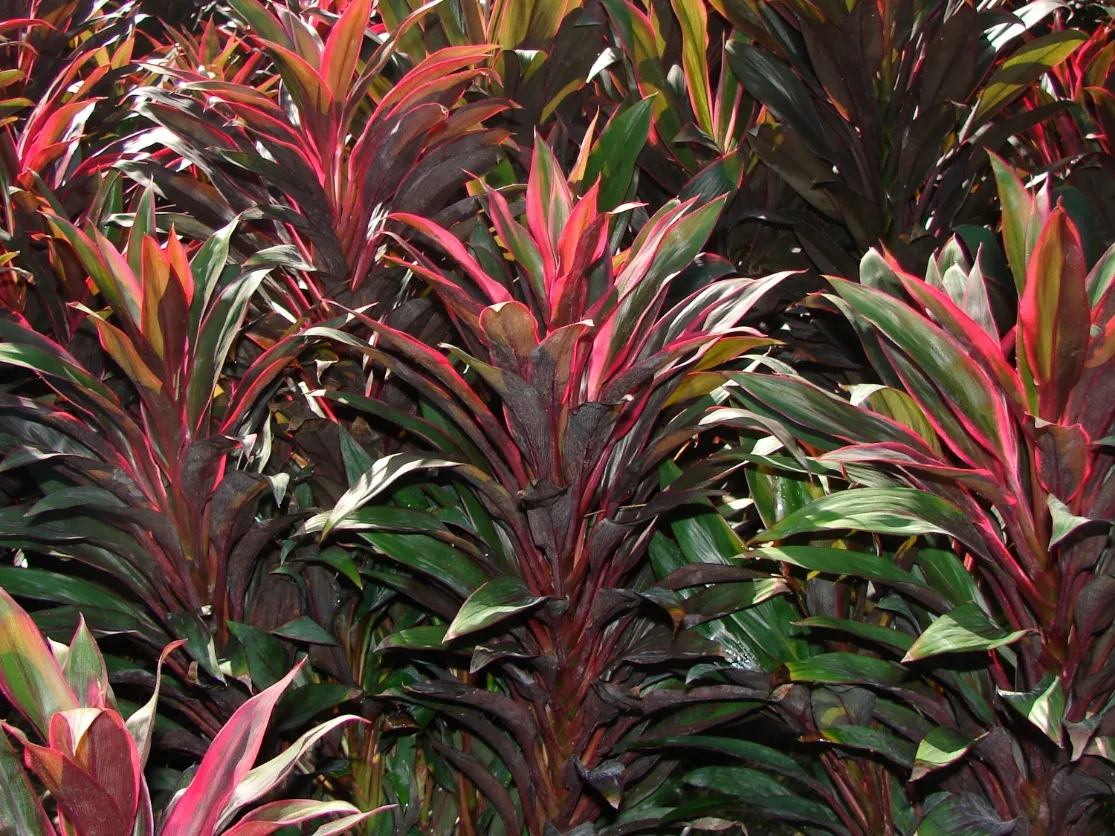
Credit: Ryan Fessenden

Credit: Ryan Fessenden

Credit: © ccdqp, some rights reserved (CC BY-NC) via iNaturalist

Credit: © Eugene Payos, some rights reserved (CC BY-NC) via iNaturalist
General Information
Scientific name: Cordyline fruticosa
Previous name(s): Cordyline termanalis (synonym)
Pronunciation: kor-dil-LYE-nee froo-tih-KOH-sah
Common name(s): ti plant; Hawaiian ti plant
Family: Asparagaceae
Plant type: shrub
USDA hardiness zones: 9B through 11B (Figures 5 and 6)

Credit: This map is based on the 2023 USDA Plant Hardiness Zone Map. Visit https://planthardiness.ars.usda.gov/ for specific zone information.

Credit: This map is based on the 2023 USDA Plant Hardiness Zone Map. Visit https://planthardiness.ars.usda.gov/ for specific zone information.
Planting month for zone 9: year-round
Planting month for zones 10 and 11: year-round
Origin: not native to North America
Invasive potential: not known to be invasive
Uses: specimen; container or above-ground planter; suitable for growing indoors; accent; mass planting
Availability: generally available in many areas within its hardiness range
Description
Height: 3 to 10 feet
Spread: 2 to 4 feet
Plant habit: upright
Plant density: open
Growth rate: moderate
Texture: medium
Foliage
Leaf arrangement: spiral
Leaf type: simple
Leaf margin: entire
Leaf shape: linear
Leaf venation: parallel
Leaf type and persistence: evergreen
Leaf blade length: 8 to 18 inches; variable
Leaf color: green; red; burgundy; pink, purple; variegated; dependent upon cultivar selection
Fall color: no fall color change
Fall characteristic: not showy
Flower
Flower color: white; yellow; lavender
Flower characteristic: spring flowering; showy
Fruit
Fruit shape: round
Fruit length: less than 0.5 inch
Fruit cover: fleshy
Fruit color: red
Fruit characteristic: showy
Trunk and Branches
Trunk/bark/branches: not particularly showy; typically multi-trunked or clumping stems
Current year stem/twig color: reddish
Current year stem/twig thickness: thick
Culture
Light requirement: plant grows in full sun; plant grows in partial shade; plant grows in full shade
Soil tolerances: slightly alkaline; acidic; clay; sand; loam
Drought tolerance: moderate
Soil salt tolerances: poor
Plant spacing: 36 to 60 inches
Other
Roots: usually not a problem
Winter interest: evergreen foliage
Pest resistance: long-term health usually not affected by pests
Toxicity: this plant displays low toxic characteristics; saponins in sap cause contact dermatitis, vomiting, and other issues if ingested
Use and Management
Hawaiian ti plant grows well in full sun, partial shade, and full shade. It is adaptable to a range of soil conditions with slightly acidic to slightly alkaline pH. Ti plant should be kept moist, but not overwatered, as this leads to disease issues. The large evergreen, colorful leaves and showy flowers and berries make ti plant a great addition to a tropical landscape. It may be used as a specimen or accent, or planted en masse, and is well suited for containers or above-ground planters. As a houseplant, it should be placed in a sunny location and kept at a high humidity.
Plants are easily propagated by cuttings or by sections of stem laid horizontally in a peat moss-sand mixture and kept moist.
Table 1. Various Hawaiian ti cultivars.


Design Considerations
Ti plant provides vibrant foliage in shades of red, pink, burgundy, and green, offering bold color, strong vertical form, and lush tropical texture in shaded to partly sunny plantings. Its upright, architectural habit makes it effective as a specimen near entries or patios, a foundation accent on protected exposures, a dramatic focal point in mixed tropical borders, or a container feature that adds height and contrast. Ti plant pairs well with broadleafed tropicals such as crotons (Codiaeum variegatum), gingers (various species), heliconias (Heliconia spp.), and philodendrons (Philodendron spp.) for layered color and mass; fine-textured companions like ferns, dwarf palms, and cast iron plant (Aspidistra elatior) help soften its structure; and low groundcovers such as liriope (Liriope muscari), mondo grass (Ophiopogon japonicus), or ornamental gingers (various species) create a cohesive base that highlights its vivid foliage.
Pests and Diseases
Pest issues include sensitivity to nematodes, mealy bugs, and mites. Ti plants are also susceptible to fluoride toxicity. Disease issues may include leaf spot and fungal diseases. Ensure proper cultural conditions to promote plant health.