
This publication helps the public understand why they might see or smell smoke and how to find out where it’s coming from by providing helpful tools and trusted sources for fire- and smoke-related information.
Fires and their resulting smoke can come from several sources. For instance, prescribed fires, which are carefully planned to meet specific objectives, are used to reduce the risk of wildfires, improve wildlife habitat, and achieve various land management goals (Figure 1) (NCWFMS 2014; Johnson and Hale 2002). Fires may also be used to dispose of debris piles after clearing land and to get rid of residential yard waste. In addition to prescribed fires, Florida also experiences wildfires, which, like prescribed fires, can produce smoke that travels great distances (Donovan et al. 2023; Bond et al. 2024). The purpose of this publication is to help the public understand why they might see or smell smoke, and to provide trusted resources for learning more about smoke impacts in their area.
While living in Florida, it is common to see or smell smoke from prescribed fires or wildfires. In places where prescribed fires aren’t used regularly, the chance of a wildfire increases. For example, research shows that in the southeastern United States, wildfire risk stays low for only two to three years after a prescribed fire (Addington et al. 2015). After that, the risk gets higher again. This explains why it’s important to have regular prescribed burns, even if they produce some smoke. Prescribed fires can help prevent bigger, more dangerous wildfires and keep firefighters safe. Learning more about smoke and where it comes from can help people anticipate its impacts and plan outdoor activities.

Credit: R. M. Crandall, UF/IFAS
How Is Smoke from Prescribed Fires Different from Smoke from Wildfires?
Both wildfires and prescribed fires create smoke, which can affect air quality and people’s health (Liu et al. 2009; Blades et al. 2014; Schweizer et al. 2019). Wildfires usually produce much more smoke much more quickly than prescribed fires (Haikerwal et al. 2015; Navarro et al. 2018; Jones et al. 2022). A Stanford University study found that where prescribed fires had recently occurred, wildfire damage dropped by 16% and smoke by 14% (Kelp et al. 2025). Prescribed fires are also different because they are carefully planned by fire experts. These experts use tools to predict where the smoke will go and try to reduce the fire’s impact, especially in areas where people are sensitive to smoke, such as schools or hospitals (Wade 2007; Jaffe et al. 2020; Wagner et al. 2024). They make careful decisions about when and how much to burn to help protect nearby communities (Ryan et al. 2013; Kobziar et al. 2015).
Both prescribed fires and wildfires create smoke that can seriously affect people’s health and safety. Smoke has tiny particles and other harmful pollutants that can cause breathing and heart problems, especially for people who are more at risk (Williamson et al. 2016; Prunicki et al. 2019; Schweizer et al. 2019). This includes people with asthma or other lung issues, young children, older adults, and those with limited access to healthcare (Schweizer et al. 2019). Smoke can also interfere with everyday life (Olsen et al. 2014), making it harder to enjoy outdoor activities, travel, or sightseeing (Liu et al. 2009; Schweizer et al. 2019).
If Smoke Is in the Air, Where Is It Coming From?
1. Prescribed Fires
Prescribed burning is a method for igniting planned fires that help maintain the health of the land. In the southeastern United States, many forests and grasslands need fire to stay healthy (Florida Forest Service 2024). Prescribed fires clear out dead plants, return nutrients to the soil, and help native plants and animals survive. They also reduce the chance of dangerous wildfires by removing dry, built-up fuel (vegetation), such as dead leaves and branches (Addington et al. 2015). Fires keep the land open and sunny (Figure 2), which is beneficial for many animals, including some that are endangered, such as gopher tortoises. People also use fire to improve grazing land, support healthy forests, and preserve traditions that have been passed down for thousands of years (Fowler and Konopik 2007).

Credit: R. M. Crandall, UF/IFAS
An excellent resource for determining where prescribed fires are located is WhyPrescribedFire.org. This user-friendly website features a map with points indicating where fires are currently burning (Figure 3). At the top of the main page, select “Burn Maps” and there will be a drop-down menu for Florida and Georgia. Select Florida, then either sign in to the system or cancel the pop-up. This will open a map of “active burn authorizations.” These are all planned fires that have received outdoor burn authorizations from the Florida Forest Service, based in part on National Weather Service weather predictions. The legend at the top-right of the map shows outdoor burn authorizations color-coded by fire type: yellow for active pile burns and green for active broadcast burns.
- Pile burns are relatively small in size and are used to burn a pile of vegetation or land-clearing debris. Click on specific points to open a pop-up showing the number of piles burning at that particular location. More piles often mean more smoke.
- Broadcast burns, also known as prescribed fires, are planned fires intentionally burned across a predetermined area. Click on a point for a pop-up showing the number of acres burning in a particular area. More acres often mean more smoke.
Explore the WhyPrescribedFire.org website to learn more about prescribed fire. It’s important to note that this site only provides information about prescribed fires and pile burns, not wildfires.
In Florida, prescribed fires can occur year-round, but they are most common from December to August. If there is smoke in the air, but there is nothing on the WhyPrescribedFire.org burn map, then there could be an active wildfire in the region.

Credit: Tall Timbers Research Station
2. Wildfires
Florida’s peak wildfire season is from April to June, but fires can occur at any time, depending on weather conditions, such as during a drought (Fill and Crandall 2020). Many wildfires in Florida are started by lightning, especially during spring and summer storms (Fill et al. 2019). Unfortunately, some fires are also accidentally or intentionally set by people. The worst wildfires, the ones that spread fast and create the most smoke, usually happen in places that haven’t used prescribed fire as a management tool. When areas go too long without fire, dry plants and dead leaves build up, making it easier for wildfires to spread quickly and become more dangerous.
To see if there is a wildfire in your region, visit the Florida Forest Service’s Fire Response Viewer at ffs.firesponse.com/public. This website features a public map that displays active wildfires where the Florida Forest Service (FFS) has personnel responding to contain the fire (Figure 4). This map is created and maintained by the Florida Forest Service dispatch centers located in each of the state's districts. For an interactive map of these districts, go to fdacs.gov/Forest-Wildfire and navigate to the Field Office Locations and Contacts page. These dispatch centers receive phone calls for suspected wildfires in the area. Keep in mind that this website only shows fires managed by the Florida Forest Service. It does not include information on other federal, county, municipal, or local fire response agencies, such as local fire departments, the USDA Forest Service, and the U.S. Fish and Wildlife Service.
The Fire Response Viewer has a legend in the lower left corner, showing whether the fire has been recently reported (green), is under active investigation (red), is contained (brown), or is controlled (black). It’s important to remember that first responders handling a wildfire call prioritize public safety, which sometimes means that updating the map with an active wildfire for public awareness isn’t the immediate priority. Therefore, there may be an active wildfire in the region that is not yet indicated on the map.
In wildland fire management, the terms “controlled” and “contained” refer to different stages in managing a fire:
- Contained—A fire is considered contained when firefighters have built a barrier, referred to as a control line, around the fire’s perimeter to stop it from spreading. However, flames may still be burning inside that area.
- Controlled—A fire is considered controlled when it is not only contained but also no longer poses a threat of escaping the established control lines. Controlled is a more advanced and secure stage than contained, indicating that firefighters are confident it won’t start spreading again.

Credit: Florida Forest Service
3. Burning of Yard Waste
Smoke from burning yard waste, like leaves and branches, usually contributes much less to the smoke in the air and is not likely to affect the regional air quality. This is because yard waste piles should be much smaller than the piles created from land-clearing debris. However, it's important to recognize that if maps don’t show prescribed fires or wildfires in the area, the smoke might be coming from a nearby neighbor. If you plan to burn yard waste, first familiarize yourself with safety requirements and any applicable local regulations, or burn bans, as they are commonly known. For more information, visit the Florida Forest Service website at fdacs.gov/Forest-Wildfire and navigate to the “Burn Yard Waste Safely” page.
Smoke and Air Quality
If smoke is in the air, it's a good idea to check the air quality in the area before going outside, especially if asthma or smoke sensitivity is a concern. This information can be found on many smartphone apps or online. Some weather apps include air quality information, and specialized apps are also available for this purpose. One simple way to check air quality is with the AQI from the Environmental Protection Agency (EPA), at epa.gov/air-quality. The AQI shows how clean or polluted the air is each day by measuring things like smoke, ozone, and other gases. Another resource to check the AQI is AirNow.gov or the AirNow mobile app. AirNow also features a tool that combines air quality data from multiple sensors to create an interactive map specifically related to fires.
Because of its unique geography, Florida rarely has poor air quality. It’s a peninsula, which means it’s surrounded by water. This helps keep the air moving because of sea and land breezes that blow in and out from the water almost every day (Box 1; Blanchard and Lopez 1985; Bao et al. 2023). Big lakes like Lake George in north-central Florida and Lake Okeechobee in south-central Florida also create lake breezes, which help move air around and push smoke away (Arritt 1993). This natural airflow makes it difficult for smoke to remain in one place for long, so the air usually remains clean and healthy to breathe (Dabberdt et al. 2004).
Box 1. Sea and Land Breezes
Sea Breezes Occur During the Day.
The land heats up faster than the ocean, so warm air rises over the land. Cool ocean air rushes in to take its place. That creates a sea breeze blowing from the ocean to the land.
Land Breezes Occur at Night.
Now the land cools down, but the ocean stays warmer. Warm air rises over the ocean, and cooler land air rushes out to sea. This results in a land breeze blowing from land to ocean.
Why Does This Matter?
Prescribed burners in Florida use these predictable wind patterns to control where smoke will go. It helps keep roads clear of smoke and protects air quality.
One other thing to consider is that smoke can travel a long distance. Depending on the size of the wildfire, it is possible to receive smoke from across the country. According to the Smoke-Ready Toolbox for Wildfires at epa.gov/Air-Research, the smoke from wildfires can travel really far, sometimes hundreds of miles, and can make the air unhealthy to breathe even in places far away from the fire (Figure 5). This toolbox offers excellent resources for communities to learn how to prepare for and respond to smoke events, including strategies to reduce exposure during these events.
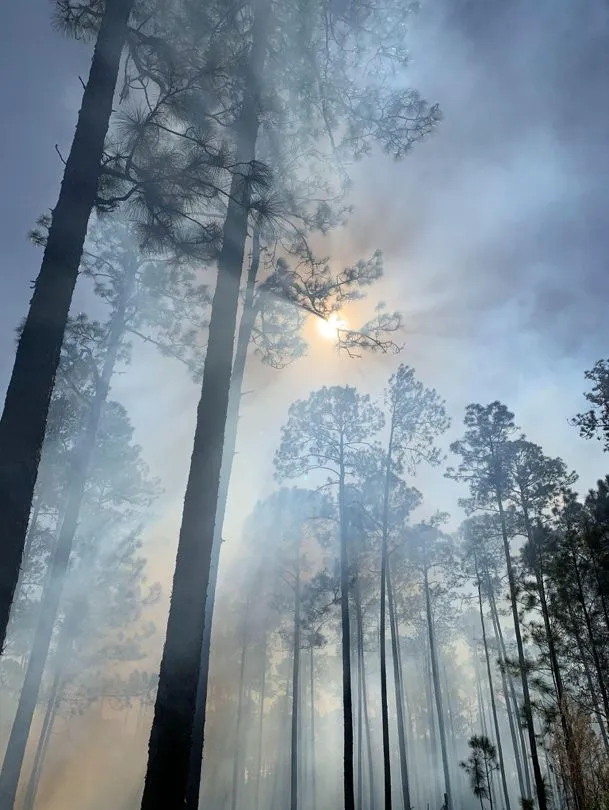
Credit: R. M. Crandall, UF/IFAS
Learn More
The Florida Forest Service, at fdacs.gov/Divisions-Offices, and Florida’s Water Management Districts, at FloridaDEP.gov, update the public on social media for both prescribed fires and wildfires. Learn more about prescribed fire in Florida on UF/IFAS Extension Polk County’s fun and educational “Naturally Florida” podcast at podcasts.apple.com or wherever you get your podcasts! It’s the episode from November 23, 2021, Florida on Fire: Prescribed Fire in the Sunshine State. This episode is now supplemented with an episode learning guide, which can be found at sfyl.ifas.ufl.edu (search for “prescribed fire in the sunshine state pdf”). Also, learn more in the Ask.IFAS.ufl.edu publication “Where There’s Fire, There’s Smoke: Air Quality and Prescribed Burning in Florida,”or visit the Southern Fire Exchange, SouthernFireExchange.org, for more fact sheets about fire and smoke in the southeast.
References
Addington, R. N., S. J. Hudson, J. K. Hiers, et al. 2015. “Relationships Among Wildfire, Prescribed Fire, and Drought in a Fire-Prone Landscape in the Southeastern United States.” International Journal of Wildland Fire 24:778–783.https://doi.org/10.1071/WF14187
Arritt, R. W. 1993. “Effects of the Large-Scale Flow on Characteristic Features of the Sea Breeze.” Journal of Applied Meteorology and Climatology 32 (1): 116–125.https://doi.org/10.1175/1520-0450(1993)032<0116:EOTLSF>2.0.CO;2
Bao, S., L Pietrafesa, P. Gayes, et al. 2023. “Mapping the Spatial Footprint of Sea Breeze Winds in the Southeastern United States.” Journal of Geophysical Research: Atmospheres 128 (7): e2022JD037524.https://doi.org/10.1029/2022JD037524
Blades, J. J., S. R. Shook, and T. E. Hall. 2014. “Smoke Management of Wildland and Prescribed Fire: Understanding Public Preferences and Trade-Offs.” Canadian Journal of Forest Research 44 (11): 1344–1355.https://doi.org/10.1139/cjfr-2014-0110
Blanchard, D. O., and R. E. Lopez. 1985. “Spatial Patterns of Convection in South Florida.” Monthly Weather Review 113 (8): 1282–1299https://doi.org/10.1175/1520-0493(1985)113<1282:SPOCIS>2.0.CO;2
Bond, L. A., L. K. Lundy, H. M. Miller, C. A. Crandall, J. M. Diaz, and R. M. Crandall. 2024. “Social media use reveals public perceptions of prescribed burning.” Journal of Applied Communications 108:3 https://doi.org/10.4148/1051-0834.2531
Dabberdt, W. F., M. A. Carroll, D. Baumgardner, et al. 2004. “Meteorological Research Needs for Improved Air Quality Forecasting: Report of the 11th Prospectus Development Team of the US Weather Research Program.” Bulletin of the American Meteorological Society 85 (4): 563–586.https://doi.org/10.1175/BAMS-85-4-563
Donovan, V. M., R. Crandall, J. Fill, and C. L. Wonkka. 2023. “Increasing Large Wildfire in the Eastern United States.” Geophysical Research Letters 50 (24): e2023GL107051.https://doi.org/10.1029/2023GL107051
EPA, Environmental Protection Agency. n.d. Air Quality Index (AQI) Basics. Available at https://www.airnow.gov/aqi/aqi-basics/
Fill, J. M., and R. M. Crandall. 2020. “Fire regimes are linked to precipitation patterns in the Southeastern U.S.” Global Change Biology 27 (4): e5–e6.https://doi.org/10.1111/gcb.15457
Fill, J. M., C. David, and R. M. Crandall. 2019. “Climate change lengthens southeastern USA lightning-ignited fire seasons.” Global Change Biology 25 (10): 3562–3569. https://doi.org/10.1111/gcb.14727
Florida Forest Service. 2024. “Prescribed Fire in Florida.” Retrieved July 18, 2025, from https://www.fdacs.gov/Forest-Wildfire/Wildland-Fire/Prescribed-Fire
Fowler, C., and E. Konopik. 2007. “The History of Fire in the Southern United States.” Human Ecology Review 14 (2): 165–176. https://www.jstor.org/stable/24707703
Haikerwal, A., F. Reisen, M. R. Sim, et al. 2015. “Impact of smoke from prescribed burning: Is it a public health concern?” Journal of the Air and Waste Management Association 65 (5): 592–598.https://doi.org/10.1080/10962247.2015.1032445
Jaffe, D. A., S. M. O'Neill, N. K. Larkin, et al. 2020. “Wildfire and Prescribed Burning Impacts on Air Quality in the United States.” Journal of the Air and Waste Management Association 70 (6): 583–615.https://doi.org/10.1080/10962247.2020.1749731
Johnson, A. S., and P. E. Hale. 2002. “The Historical Foundations of Prescribed Burning for Wildlife: A Southeastern Perspective.” In Proceedings: The Role of Fire for Nongame Wildlife Management and Community Restoration: Traditional Uses and New Directions, edited by W. Mark Ford, Kevin R. Russell, and Christopher E. Moorman. Gen. Tech. Rep. NE-288. Newtown Square, PA: U.S. Dept. of Agriculture, Forest Service, Northeastern Research Station, 11–23, 288.
Jones, B. A., S. McDermott, P. A. Champ, and R. P. Berrens. 2022. “More smoke today for less smoke tomorrow? We need to better understand the public health benefits and costs of prescribed fire.” International Journal of Wildland Fire 31 (10): 918–926.https://doi.org/10.1071/WF22025
Kelp, M., M. Burke, M. Qiu, I. Higuera, T. Liu, and N. Diffenbaugh. 2025. “Effect of Recent Prescribed Burning and Land Management on Wildfire Burn Severity and Smoke Emissions in the Western United States.” AGU Advances 6 (3): e2025AV001682 https://doi.org/10.1029/2025AV001682
Kobziar, L. N., D. Godwin, L. Taylor, and A. C. Watts. 2015. “Perspectives on Trends, Effectiveness, and Impediments to Prescribed Burning in the Southern U.S.” Forests 6 (3): 561–580.https://doi.org/10.3390/f6030561
Liu, Y., S. Goodrick, G. Achtemeier, W. A. Jackson, J. J. Qu, and W. Wang. 2009. “Smoke Incursions into Urban Areas: Simulation of a Georgia Prescribed Burn.” International Journal of Wildland Fire 18 (3): 336–348.https://doi.org/10.1071/WF08082
Navarro, K. M., D. Schweizer, J. R. Balmes, and R. Cisneros. 2018. “A Review of Community Smoke Exposure from Wildfire Compared to Prescribed Fire in the United States.” Atmosphere 9 (5): 185.https://doi.org/10.3390/atmos9050185
NCWFMS, National Cohesive Wildland Fire Management Strategy. 2014. “The National Strategy: The Final Phase in the Development of the National Cohesive Wildland Fire Management Strategy.” https://www.forestsandrangelands.gov/documents/strategy/strategy/communications/TheNationalStrategyFAQs_20140408.pdf
Olsen, C. S., D. K. Mazzotta, E. Toman, and A. P. Fischer. 2014. “Communicating About Smoke from Wildland Fire: Challenges and Opportunities for Managers.” Environmental Management 54:571–582.https://doi.org/10.1007/s00267-014-0312-0
Prunicki, M., R. Kelsey, J. Lee, et al. 2019. “The Impact of Prescribed Fire Versus Wildfire on the Immune and Cardiovascular Systems of Children.” Allergy 74 (10): 1989–1991.https://doi.org/10.1111/all.13825
Schweizer, D., H. K. Preisler, and R. Cisneros. 2019. “Assessing Relative Differences in Smoke Exposure from Prescribed, Managed, and Full Suppression Wildland Fire.” Air Quality, Atmosphere and Health 12:87–95.https://doi.org/10.1007/s11869-018-0633-x
Ryan, K. C., E. E. Knapp, and J. M. Varner. 2013. “Prescribed Fire in North American Forests and Woodlands: History, Current Practice, and Challenges.” Frontiers in Ecology and the Environment 11 (s1): e15–e24.https://doi.org/10.1890/120329
Wade, D. D. 2007. “Managing Smoke at the Wildland-Urban Interface” (No. 103). U.S. Department of Agriculture, Forest Service, Southern Research Station.https://doi.org/10.2737/SRS-GTR-103
Wagner, D., D. Godwin, and C. Fernandez. 2024. “Basic Smoke Management Practices for Prescribed Burning.” Southern Fire Exchange Factsheet 2024-2. Available at https://southernfireexchange.org/wp-content/uploads/2024-2.pdf
Williamson, G. J., D. M. S. Bowman, O. F. Price, S. B. Henderson, and F. H. Johnston. 2016. “A Transdisciplinary Approach to Understanding the Health Effects of Wildfire and Prescribed Fire Smoke Regimes.” Environmental Research Letters 11 (12): 125009.https://doi.org/10.1088/1748-9326/11/12/125009