
Introduction
Fire is a fundamental ecological process that maintains longleaf pine (Pinus palustris Mill.) savannas and woodlands. Historically, longleaf pine dominated extensive areas across the Coastal Plain of the southeastern United States and certain foothills of the southern Appalachians, including xeric sandhills, Coastal Plain flatwoods, and upland clayhills (Peet 2006; Carr et al. 2010; Zampieri and Pau 2022). However, urbanization, land-use change, and fire exclusion have reduced longleaf pine cover to less than 5% of its original 37.2-million-hectare range (Frost 1993; Figure 1). These ecosystems typically occur in regions that experience frequent, low-intensity surface fires that burn without killing mature trees (Platt 1999), maintaining open canopies and high understory biodiversity (Jose et al. 2006). This publication provides landowners with an overview of fire history in longleaf pine savannas and woodlands, describes fire-related traits that confer fire resilience across different life stages, and offers recommendations for implementing prescribed burning.

Credit: D. A. Bowers, UF/IFAS, adapted from Thompson 1999
Historic Role of Fire in Longleaf Pine Ecosystems
Fires maintain the ecological integrity of longleaf pine savannas and woodlands. Many animals, including gopher tortoises (Gopherus polyphemus) and red-cockaded woodpeckers (Leuconotopicus borealis), rely on the open, fire-maintained habitats that characterize longleaf pine savannas (Ashton et al. 2008; Martin et al. 2021). Optimal fire return intervals for longleaf pine regeneration range from one to three years (Waldrop and Lloyd 1990; Glitzenstein et al. 2003; Glitzenstein et al. 2012; Robertson et al. 2021). Patchy fires can enhance longleaf pine survival because some areas escape fire during each burn cycle (Robertson et al. 2019). In contrast, prolonged fire suppression promotes the growth of understory and midstory vegetation, allowing woody species to establish and accumulate leaf litter. This buildup degrades habitat quality and alters fire behavior, making even large longleaf pines susceptible to fires (Varner et al. 2005). Frequent fires also reduce aboveground competition by top-killing hardwoods, and they stimulate the growth of fire-adapted herbaceous species (Moser and Wade 2005).
Fires have maintained longleaf pine savannas and woodlands across the Coastal Plain for roughly 400 million years (Jose et al. 2006). Historically, lightning was the primary ignition source until about 12,000 to 13,000 years ago, when humans reentered the southern United States and began using fire as a management tool (Van Lear et al. 2005; Jose et al. 2006). Indigenous peoples played a vital role in sustaining these landscapes by burning to clear understory vegetation, improve wildlife habitat, and prepare land for agriculture (Fowler and Konopik 2007). As native populations declined and agricultural land use expanded, fire frequency and distribution changed. Burning became more localized for grazing and hunting and ceased altogether in plantations (Van Lear et al. 2005). Regular fires are essential for maintaining longleaf pine dominance and preventing invasion by other tree species, such as loblolly pine (Pinus taeda) and fire-intolerant mesic oaks (i.e., Quercus laurifolia or Quercus virginiana), which alter community structure and fire behavior when they establish (Wang et al. 2016). Without fire, open savannas often transition into closed-canopy hardwood forests (Glitzenstein et al. 2003; Brewer 2023). Consequently, due to widespread fire suppression and land-use change, longleaf pine savannas and woodlands have become imperiled ecosystems that now depend on active management to restore and maintain their natural structure and function.
Fire Adaptations
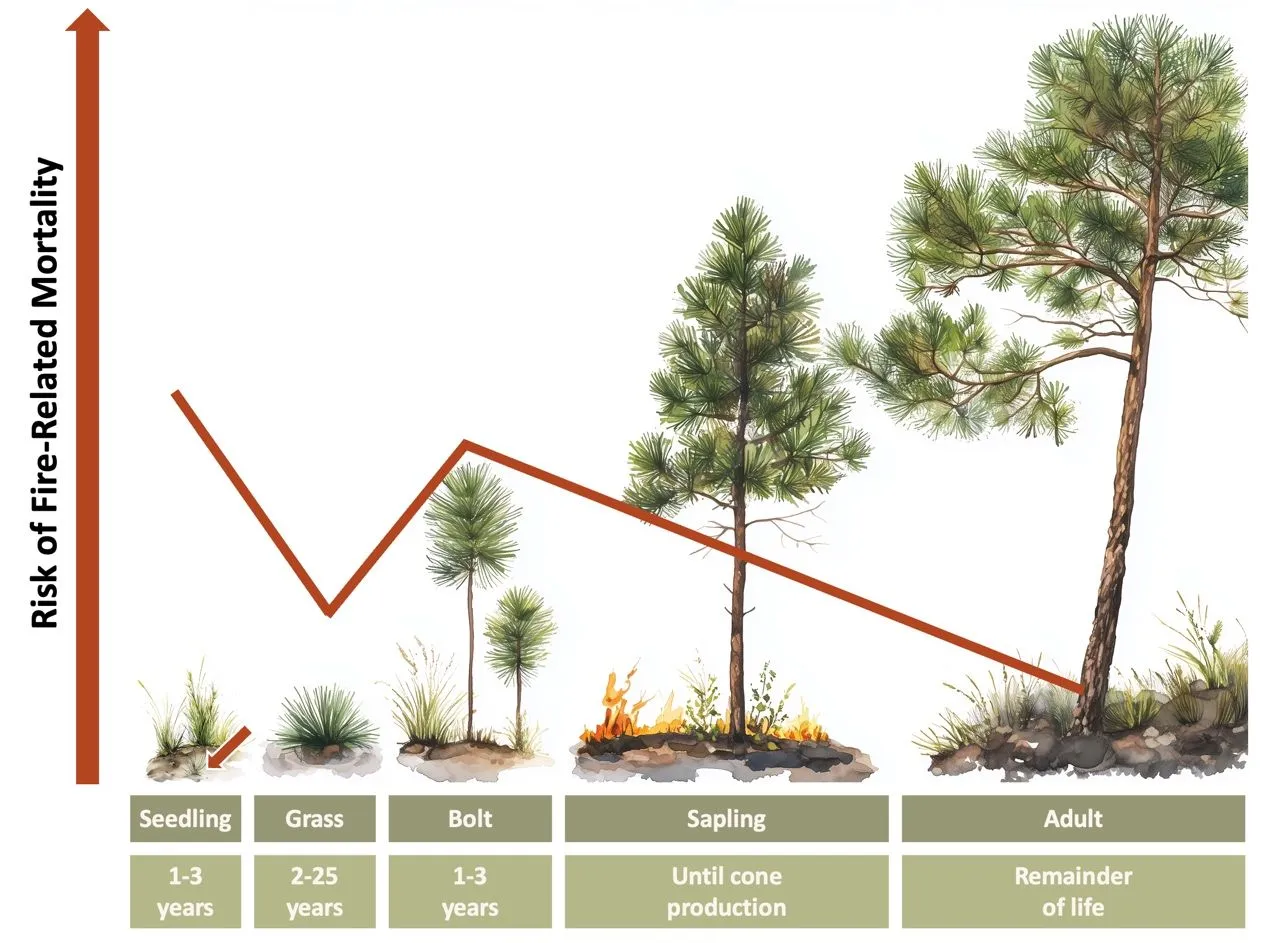
To effectively manage longleaf pine savannas, it is important to understand how the species grows and interacts with fire. All woody plants undergo both primary growth (upward growth) and secondary growth (outward growth). Primary growth allows trees to grow taller and access more sunlight. This process is controlled by the apical meristem, located in the apical bud at the top of the plant (Figure 2). Damage to the apical bud can severely hinder upward growth and, in some species, including longleaf pine, may reduce survival. Secondary growth, which occurs through the activity of the vascular cambium, produces new xylem (wood) and phloem (inner bark) each year. This process increases stem diameter, providing structural support and forming the protective bark characteristic of trees. Longleaf pine has evolved several adaptations that safeguard both the apical bud and vascular cambium, allowing it to thrive in fire-maintained ecosystems. Longleaf pine progresses through five distinct life stages, each with unique fire adaptations (Magee et al. 2022; Figure 3).

Credit: D. A. Bowers, UF/IFAS
Credit: D. A. Bowers, UF/IFAS; R. M. Crandall UF/IFAS
1. Seedling stage: A newly germinated seedling has only a few needles emerging from the root collar. At this early stage, individuals are especially vulnerable to fire because the dense bundle of protective needles has not yet developed.

Credit: D. A. Bowers, UF/IFAS
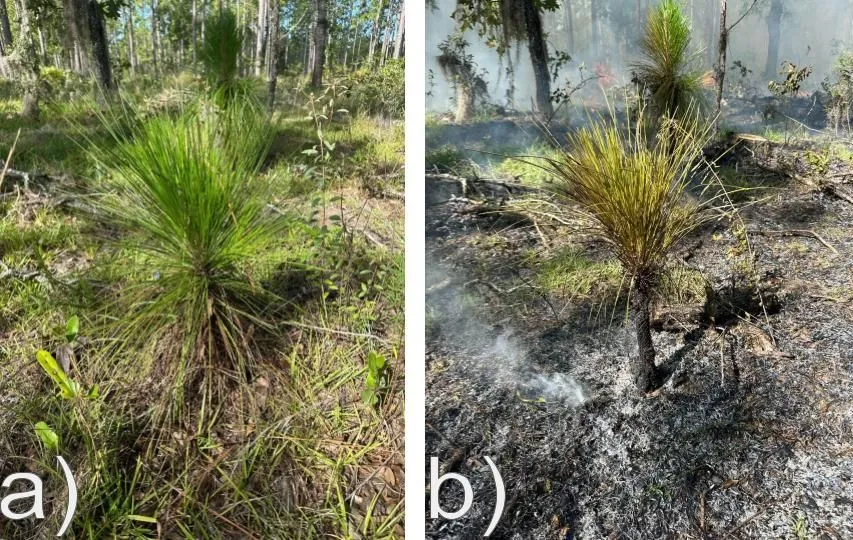
2. Grass stage: During the grass stage, longleaf pines exhibit little vertical growth for years. Instead, they develop dense whorls of needles resembling bunchgrasses. This tuft of needles insulates the plant during fires by diverting heat and protecting the apical bud. At the same time, longleaf pines develop a large taproot that stores resources and accesses groundwater, preparing the plant for rapid growth in the next stage.
Credit: D. A. Bowers
3. Bolt stage: Once sufficient resources are stored, grass-stage individuals undergo a period of rapid upward growth known as “bolting” (Figure 5; Magee et al. 2024). This growth raises the apical meristem above the height of typical flame fronts (Boyer 1990). However, during this transition, the tree’s bark remains thin, and the apical bud becomes exposed, making this stage more vulnerable to intense fires. If flames exceed the height of the young tree, mortality risk increases. In fact, bolt-stage longleaf pines have been shown to have a 16% higher likelihood of being killed by high-severity fires compared to individuals in the grass stage (Magee et al. 2022).

Credit: D. A. Bowers, UF/IFAS
4. Sapling and 5. adult stage: Once a longleaf pine grows above typical flame heights, it enters the sapling stage. During this stage, the bark thickens, enhancing resistance to fire damage. As the tree matures, it continues to increase in height and diameter until it reaches adulthood, a reproductive, cone-producing stage that typically begins about 30 years after vertical growth starts (The Longleaf Alliance, n.d). By this time, longleaf pines have developed thick, fire-resistant bark. Frequent fires naturally prune lower branches, reducing “ladder fuels” that could carry flames into the canopy and threaten the apical bud (Doran et al. 2023). Mature longleaf pines contribute to the fire regime by dropping needles that help carry surface fires across the landscape (Platt et al. 1988; Platt 1999). Adults typically retain their needles for two growing seasons. While seedlings are sensitive to intense burns (Hiers et al. 2009; Whelan et al. 2018), adult trees are highly fire-resistant. Lightning is the most common fire-related cause of mortality in mature individuals. Drought can increase fire susceptibility in trees, making them more prone to mortality. Pines with extensive bark damage can also die when exposed to fire due to the high flammability of pine resin.

Credit: D. A. Bowers, UF/IFAS
Recommendations for Implementing Prescribed Burning
Effective management of longleaf pine ecosystems requires an understanding of how fire interacts with the species’ different life stages. Frequent prescribed burning is the primary factor maintaining the exceptional biodiversity of these systems, as fires fueled by longleaf pine needles spread easily across the landscape (Mitchell et al. 2006). During the early years of establishment, fires must be carefully managed to ensure seedling survival. Land managers can adjust the intensity, timing, and frequency of burns to regulate tree density, particularly during the vulnerable seedling and sapling stages that often occur in abundance following mast years (i.e., when mature trees produce large seed crops simultaneously). If planting seedlings, it is best to wait one to two years before introducing fire, allowing young trees to establish and develop their protective needle clusters. In the grass stage, longleaf pine seedlings position their growing tip near the ground, surrounded by a dense tuft of needles that may burn but insulate the bud from heat damage (Willis et al. 2018). During these early stages, managers can reduce fire intensity by using backing fires that move against the wind and scheduling burns during cooler winter months.
Once trees reach maturity, the timing and frequency of prescribed burns can be adjusted to maintain ecosystem health and promote natural regeneration. Growing-season burns, especially after favorable seed years, help prepare the seedbed and improve germination success (Brockway et al. 2006). Long-term studies show that burning every one to three years produces the best results for supporting understory growth and plant diversity, while also effectively reducing woody shrub encroachment (Brockway and Lewis 1997). Growing-season burns are especially effective at maintaining the open structure and diverse understory typical of longleaf pine forest regeneration (Brockway et al. 2006); however, managers should avoid burning during excessively hot or windy conditions, as these conditions increase the risk of crown scorch. By carefully selecting burn conditions and techniques, such as using slower-moving backing fires instead of faster, more intense head fires, managers can minimize tree stress while achieving management objectives. When applied with skill and expertise, prescribed fire remains one of the most effective and economical tools for preserving the ecological health and biodiversity of longleaf pine ecosystems.
Prescribed fire is a valuable management tool for public land managers and private landowners seeking to maintain open, biodiverse longleaf pine savannas and woodlands. Because implementing fires requires careful planning, expertise, training, and proper permitting, it is essential to seek professional assistance before conducting burns. For guidance and resources, see the Ask IFAS publication “Resources for Prescribed Fires on Private Lands in Florida” (ask.IFAS.ufl.edu).
References
Ashton, K. G., B. M. Engelhardt, and B. S. Branciforte. 2008. "Gopher Tortoise (Gopherus polyphemus) Abundance and Distribution After Prescribed Fire Reintroduction to Florida Scrub and Sandhill at Archbold Biological Station.” Journal of Herpetology 42 (3): 523–529. doi.org/10.1670/06-246.1
Boyer, W. D. 1990. "Pinus palustris Mill. Longleaf Pine." Silvics of North America, 1, 405–412.
Brewer, J. S. 2023. "Mechanisms of Fire‐Maintained Plant Species Diversity in Species‐Rich Wet Pine Savannas.” Ecosphere 14 (1): e4387. doi.org/10.1002/ecs2.4387
Brockway, D. G., and C. E. Lewis. 1997. “Long-Term Effects of Dormant-Season Prescribed Fire on Plant Community Diversity, Structure and Productivity in a Longleaf Pine Wiregrass Ecosystem.” Forest Ecology and Management 96 (1–2): 167–183. doi.org/10.1016/S0378-1127(96)03939-4
Brockway, D. G., K. W. Outcalt, and W. D. Boyer. 2006. “Longleaf Pine Regeneration Ecology and Methods.” In The Longleaf Pine Ecosystem, edited by S. Jose, E. J. Jokela, and D. E. Miller. New York, NY: Springer. doi.org/10.1007/978-0-387-30687-2_4
Carr, S. C., K. M. Robertson, and R. K. Peet. 2010. “A Vegetation Classification of Fire-Dependent Pinelands of Florida.” Castanea 75 (2): 153–189. doi.org/10.2179/09-016.1
Crandall, R., J. Fill, A. Long, C. Randall, and D. Doran. 2023. “Fire in the Wildland-Urban Interface: Selecting and Maintaining Firewise Plants for Landscaping: Circular 1445 FR147, 10 2023.” EDIS 2023 (5). Gainesville, FL. doi.org/10.32473/edis-fr147-2023
Crandall, R. M., B. Ryver, D. R. Godwin, S. A. Johnson, A. Halbritter, and L. A. Bond. 2024. “Resources for Prescribed Fires on Private Lands in Florida: FOR410 FR481, 12 2024.” EDIS 2024 (6). Gainesville, FL. doi.org/10.32473/edis-fr481-2024
Fan, Z., W. K. Moser, C. Poyner, et al. 2021. “Assessment of Natural Regeneration of Longleaf Pine (Pinus palustris) 15 Years Post-Regeneration Control.” Canadian Journal of Forest Research 51 (10): 1558–1568. doi.org/10.1139/cjfr-2020-0392
Fowler, C., and E. Konopik. 2007. “The History of Fire in the Southern United States.” Human Ecology Review 4 (2): 165–176.
Frost, C. C. 1993. “Four Centuries of Changing Landscape Patterns in the Longleaf Pine Ecosystem.” In Proceedings of the Tall Timbers Fire Ecology Conference 18 (18): 17–43.
Glitzenstein, J. S., D. R. Streng, R. E. Masters, K. M. Robertson, and S. M. Hermann. 2012. “Fire-Frequency Effects on Vegetation in North Florida Pinelands: Another Look at the Long-Term Stoddard Fire Research Plots at Tall Timbers Research Station.” Forest Ecology and Management 264:197–209. doi.org/10.1016/j.foreco.2011.10.014
Glitzenstein, J. S., D. R. Streng, and D. D. Wade. 2003. “Fire Frequency Effects on Longleaf Pine (Pinus palustris P. Miller) Vegetation in South Carolina and Northeast Florida, USA.” Natural Areas Journal 23:22–37.
Hiers, J. K., J. J. O'Brien, R. J. Mitchell, J. M. Grego, and E. L. Loudermilk. 2009. “The Wildland Fuel Cell Concept: An Approach to Characterize Fine-Scale Variation in Fuels and Fire in Frequently Burned Longleaf Pine Forests.” International Journal of Wildland Fire 18 (3): 315–325. doi.org/10.1071/WF08084
Jose, S., E. J. Jokela, and D. L. Miller. 2006. The Longleaf Pine Ecosystem: Ecology, Silviculture, and Restoration. New York, NY: Springer. doi.org/10.1007/978-0-387-30687-2
Knapp, B. O., L. S. Pile, J. L. Walker, and G. Geoff Wang. 2018. “Fire Effects on a Fire-Adapted Species: Response of Grass Stage Longleaf Pine Seedlings to Experimental Burning.” Fire Ecology 14 (2): 1–16. doi.org/10.1186/s42408-018-0003-y
The Longleaf Alliance. (n.d.). Life stages—The tree. Retrieved October 20, 2025, from https://longleafalliance.org/what-is-longleaf/the-tree/life-stages/
Magee, L., K. Pandit, S. L. Flory, et al. 2022. "Life Stage and Neighborhood-Dependent Survival of Longleaf Pine after Prescribed Fire." Forests 13 (1): 117. doi.org/10.3390/f13010117
Martin, E. J., F. N. Gigliotti, and P. F. Ferguson. 2021. “Synthesis of Red-Cockaded Woodpecker Management Strategies and Suggestions for Regional Specificity in Future Management.” Ornithological Applications 123 (3): duab031. doi.org/10.1093/ornithapp/duab031
Mitchell, R. J., J. K. Hiers, J. J. O'Brien, S. B. Jack, and R. T. Engstrom. 2006. “Silviculture That Sustains: The Nexus Between Silviculture, Frequent Prescribed Fire, and Conservation of Biodiversity in Longleaf Pine Forests of the Southeastern United States.” Canadian Journal of Forest Research 36 (11): 2724–2736. doi.org/10.1139/X06-100
Moser, W. K., and D. D. Wade. 2005. “Fire Exclusion as a Disturbance in the Temperate Forests of the USA: Examples from Longleaf Pine Forests.” Scandinavian Journal of Forest Research 20 (S6): 17–26. doi.org/10.1080/14004080510041048
Peet, R. K. 2006. “Ecological Classification of Longleaf Pine Woodlands.” In The Longleaf Pine Ecosystem, edited by S. Jose, E. J. Jokela, and D. L. Miller. New York, NY: Springer. doi.org/10.1007/978-0-387-30687-2_3
Platt, W. J. 1999. “Southeastern Pine Savannas. In Savannas, Barrens, and Rock Outcrop Plant Communities of North America, edited by R. C. Anderson, J. S. Fralish, and J. M. Baskin. Cambridge: Cambridge University Press. doi.org/10.1017/CBO9780511574627.003
Platt, W. J., G. W. Evans, and S. L. Rathbun. 1988. “The Population Dynamics of a Long-Lived Conifer (Pinus palustris).” The American Naturalist 131 (4): 491–525. doi.org/10.1086/284803
Robertson, K. M., S. M. Hermann, and E. L. Staller. 2021. “Frequent Prescribed Fire Sustains Old Field Loblolly Pine–Shortleaf Pine Woodland Communities: Results of a 53-Year Study.” Journal of Forestry 119 (6): 549–556. doi.org/10.1093/jofore/fvab035
Robertson, K. M., W. J. Platt, and C. E. Faires. 2019. “Patchy Fires Promote Regeneration of Longleaf Pine (Pinus palustris Mill.) in Pine Savannas.” Forests 10 (5): 367. https://doi.org/10.3390/f10050367
Thompson, R. S., K. H. Anderson, and P. J. Bartlein. 1999. “Digital Representations of Tree Species Range Maps” from Atlas of United States Trees by Elbert L. Little, Jr. https://www.fs.usda.gov/database/feis/pdfs/Little/aa_SupportingFiles/LittleMaps.html
Van Lear, D. H., W. D. Carroll, P. R. Kapeluck, and R. Johnson. 2005. “History and Restoration of the Longleaf Pine-Grassland Ecosystem: Implications for Species at Risk.” Forest Ecology and Management 211 (1–2): 150–165. doi.org/10.1016/j.foreco.2005.02.014
Varner, J. M., III, D. R. Gordon, F. E. Putz, and J. K. Hiers. 2005. “Restoring Fire to Long‐Unburned Pinus palustris Ecosystems: Novel Fire Effects and Consequences for Long‐Unburned Ecosystems.” Restoration Ecology 13 (3): 536–544. doi.org/10.1111/j.1526-100X.2005.00067.x
Waldrop, T. A., and F. T. Lloyd. 1991. “Forty Years of Prescribed Burning on the Santee Fire Plots: Effects on Overstory and Midstory Vegetation.” In Fire and the Environment: Ecological and Cultural Perspectives, edited by S. C. Nodvin and T. A. Waldrop. General Technical Report SE-GTR-69. Asheville, NC: USDA Forest Service, Southeastern Forest Experiment Station. https://doi.org/10.2737/SE-GTR-69
Wang, G. G., L. S. Pile, B. O. Knapp, and H. Hu. 2016. “Longleaf Pine Adaptation to Fire: Is Early Height Growth Pattern Critical to Fire Survival?” In Proceedings of the 18th Biennial Southern Silvicultural Research Conference. e-Gen. Tech. Rep. SRS-212. Asheville, NC: U. S. Department of Agriculture, Forest Service, Southern Research Station.
Whelan, A. W., S. W. Bigelow, M. F. Nieminen, and S. B. Jack. 2018. “Fire Season, Overstory Density and Groundcover Composition Affect Understory Hardwood Sprout Demography in Longleaf Pine Woodlands.” Forests 9 (7): 423. doi.org/10.3390/f9070423
Zampieri, N. E., and S. Pau. 2022. “The Effects of Fire, Climate, and Species Composition on Longleaf Pine Stand Structure and Growth Rates Across Diverse Natural Communities in Florida.” Forest Ecology and Management 526:120568. doi.org/10.1016/j.foreco.2022.120568