
Introduction
Rollinia (Annona mucosa Jacq.) (sometimes called biribá) is a fast-growing tropical fruit tree in the Annonaceae family cultivated for its large, aromatic fruit with sweet custard-like pulp, used for fresh consumption and processing in humid tropical regions ranging from southern Mexico to southern Brazil. Rollinia can be grown successfully in south Florida, where it produces an extended crop during the warm months, is generally unaffected by major pests or diseases, and shows horticultural and commercial potential for local fresh markets and for processing into juices and related products. Rollinia was historically treated under the genus Rollinia (e.g., Rollinia mucosa), but major contemporary taxonomic backbones accept Annona mucosa as the correct species name (Costa and Müller 1995; Falcão et al. 1981; Plants of the World Online 2025; Sanchez, unpublished data). This publication provides information on rollinia botany, phenology, fruit characteristics, and recommended horticultural practices for commercial growers, county and state Extension faculty, and homeowners and students interested in growing this species.
Scientific Name
Annona mucosa Jacq. (formerly known as Rollinia mucosa and R. deliciosa, which are now considered the same species after the genus Rollinia was merged into Annona)
Common Name
Rollinia, biribá
Family
Annonaceae
Relatives
The genus Annona comprises approximately 160–170 species distributed throughout tropical and subtropical regions of the Americas, Africa, and Asia. Several species in the genus produce commercially important and widely consumed edible fruits, including cherimoya (Annona cherimola), sugar apple (Annona squamosa), soursop (Annona muricata), and atemoya (A. cherimola × A. squamosa) (Pinto 2005). In Florida, sugar apple, guanabana, and atemoya are grown commercially on a small scale. Pond apple (Annona glabra) is native to wetlands and coastal habitats and is primarily valued for ecological functions and as a rootstock rather than for quality fruit.
Origin and Distribution
Rollinia is native to the humid lowland tropics of Central and South America, with a natural range extending from southern Mexico through the Amazon Basin to southern Brazil. The species occurs primarily in lowland moist forests from sea level to approximately 3,000 ft (1,000 m) in elevation, where it is associated with warm, humid climates and well-drained moist soils. Wild and semi-wild populations are most common along forest margins, secondary forests, and disturbed sites, and the species has been widely cultivated throughout Amazonia and other humid tropical regions for its edible fruit (Maas et al. 1992). Rollinia is not considered invasive and is not listed on state or federal invasive or potentially invasive species lists in Florida or the United States (UF/IFAS 2018).
Importance
Rollinia is a regionally important fruit in the Amazon Basin, especially in Brazil, where it is harvested from wild, semi-wild, backyard, and small commercial plantings and sold primarily in local and regional markets. Production is concentrated in low-technology systems, and the fruit are valued for fresh consumption and for processing into juices and nectars. Despite the crop being widely cultivated and marketed locally, no comprehensive statistics are available on planted area, yield, or total production, reflecting the crop’s largely informal production structure (Costa and Müller 1995; Falcão et al. 1981).
Outside Amazonia, rollinia is grown at limited scale in parts of Central America. In Hawaii, rollinia is grown on a small but rapidly increasing, non-industrial scale and is primarily marketed through farmers’ markets, health food stores, and direct-to-consumer outlets, where demand has been driven by strong consumer interest and favorable price premiums in specialty fruit markets (Love and Paull 2011).
Description
Tree
Rollinia is a fast-growing tree with a naturally upright, vertical growth habit when unpruned. In native and semi-wild settings, trees commonly reach 13–66 ft (4–20 m) in height and may grow taller under favorable conditions. Under cultivation, tree height is typically managed at about 13–26 ft (4–8 m) through pruning to facilitate harvesting and canopy management. Trees grown from seed generally begin fruiting within three to four years after planting, depending on growing conditions and management practices (Falcão et al. 1981; Love and Paull 2011; Sanchez, unpublished data).
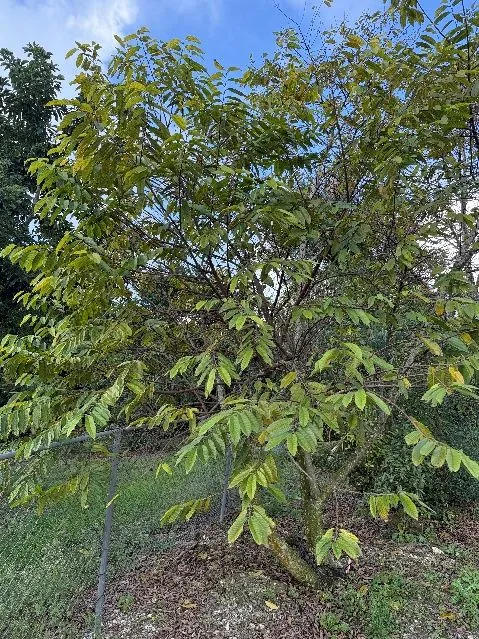
Credit: Federico Sanchez, UF/IFAS TREC
Leaves
Leaves are alternate and borne on short petioles. The leaf blade is narrowly elliptic to oblong, thin and papery (chartaceous), dark green on the upper surface, and a paler green on the underside. The apex is pointed, ranging from acute to acuminate, and the base is rounded to obtuse. Leaves typically measure 4–10 inches (10–25 cm) long and 1.5–3.5 inches (4–9 cm) wide. Fine pubescence (hairiness) is commonly present on the lower leaf surface, particularly along the veins (Falcão et al. 1981; Maas et al. 1992).
Flowers
Flowers are solitary or borne in small inflorescences, green-to-yellowish white, actinomorphic (radially symmetrical), and bisexual, with temporally separated female and male phases (protogynous dichogamy, in which the female phase precedes the male), a condition that promotes outcrossing. Trees often exhibit synchronous dichogamy, such that most flowers on an individual tree are predominantly in the same sexual phase at a given time. During the female phase, flowers emit a distinctly sweet, yeasty odor (Falcão et al. 1981; Maas et al. 1992).

Credit: © Leoš Smutný a Antonín Horáček, some rights reserved (CC-BY-NC) via iNaturalist
Pollination
Small beetles (e.g., nitidulid beetles) and ants are considered the most likely effective pollinators (Falcão et al. 1981; Maas et al. 1992). The combination of protogyny (temporally separated female and male flowering phases) and within-tree synchrony (many flowers on one tree in the same flowering phase) can limit effective pollen transfer and constrain fruit set when pollinator abundance is low. Hand pollination has been shown to markedly increase fruit set in other protogynous Annona species, and comparable increases have been observed in rollinia under south Florida conditions when manual pollination was applied during the female phase (Falcão et al. 1981; George et al. 1989; Kishore et al. 2012; Paull and Duarte 2012; Sanchez, unpublished data). High humidity during flowering may enhance the longevity of the stigma, thereby increasing fruit set. Short bursts of irrigation from low-rise sprinklers beneath the tree canopy can raise the relative humidity during flowering.
Fruit
The fruit of rollinia is made up of many visible segments all joined together into a single large structure (syncarpous aggregate fruit). The epicarp (outer layer) may be smooth or bear soft, pointed, conical protuberances (spiculate), and it turns yellow at maturity. Fruit vary widely in surface texture, shape, and size, ranging from smooth to strongly spiculate and from spherical to cordiform or irregular forms. The pulp is white, soft, sweet, and aromatic, with a custard-like texture, and typically contains 20–50 seeds distributed throughout. Fruit mass commonly ranges from about 7 to 58 oz (200 g to 1650 g), with diameters of 3.5 to 6 inches (9 to 15 cm), although fruit up to 8 inches (20 cm) in diameter and approximately 9 lb (4 kg) have been reported (Love and Paull 2011; Sanchez, unpublished data; Serbin et al. 2023). Time from flowering to fruit maturity varies between 16 and 24 weeks, depending upon temperature and relative humidity (Paull and Duarte 2012). Low temperatures (<55°F; 13°C) and relative humidity (<60%) may delay fruit maturity.

Credit: © EyVer, some rights reserved (CC-BY-NC-ND) via iNaturalist (left) and guentermanaus via stock.adobe.com (right)
Cultivars and Phenotypic Variation
There are currently no formally recognized cultivars of rollinia. Instead, the species is characterized by broad phenotypic variation, with growers commonly recognizing two main fruit types: fruit with smoother surfaces and fruit with pronounced soft, pointed protuberances (spiculate). Forms with more pronounced spiculation tend to be larger, while flavor remains relatively consistent among trees. Research indicates that these differences reflect local selection and domestication history rather than taxonomic separation. Although rollinia populations show genetic diversity, including variation in chromosome number, fruit traits such as surface texture, shape, and size are primarily shaped by cultivation and selection practices. Recent reviews suggest that the application of modern breeding tools could support future cultivar development aimed at improving yield consistency and fruit uniformity in rollinia (Costa and Müller 1995; Prasad et al. 2025; Serbin et al. 2023).
Environmental Requirements
Temperature
Rollinia is adapted to warm, humid tropical climates, where it occurs naturally in moist lowland forests from sea level to about 3,300 ft (1,000 m) in elevation. In its native range, the species grows under consistently warm temperatures, typically 72°F–82°F (22°C–28°C), and high annual rainfall, often exceeding 60 inches (1,500 mm) (Maas et al. 1992). Under south Florida conditions, rollinia has been observed to tolerate short periods of cool temperatures below 45°F (7°C) and brief exposures to temperatures near 30°F (−1°C) without tree mortality. However, cool temperatures may result in chilling injuries, including reduced iron and other nutrient uptake (called winter chlorosis) and reduced tree growth, fruiting, and fruit quality (Paull and Duarte 2012; Sanchez, unpublished data). Leaf drop may also occur. Poor fruit set may occur during periods of excessively high temperatures (≥86°F; 30°C) combined with low relative humidity (≤30%). Moderate temperatures (~75°F; ~24°C) and high relative humidity (≥80%) improve fruit pollination and fruit set.
Water Requirements and Drought
Rollinia prefers evenly distributed rainfall throughout the year, but trees can tolerate short periods of drought during cooler months with limited impact on growth. During warm or hot periods, however, prolonged drought stress can lead to partial defoliation and reduced flowering and fruit set. Supplemental irrigation is therefore recommended during extended dry periods, especially when temperatures are high (Costa and Müller 1995; Falcão et al. 1981; Love and Paull 2011; Sanchez, unpublished data).
Flooding
Based on field ecology and phenological studies from humid Amazonian environments, rollinia can tolerate short periods, one to three days, of soil saturation associated with heavy rainfall, but it is not adapted to prolonged flooding or permanently waterlogged soils (Falcão et al. 1981; Maas et al. 1992).
Salinity
Rollinia is not tolerant of saline soil and irrigation, which result in reduced growth, leaf necrosis (burn), and defoliation (Pinto 2005). High levels of boron and chloride are also detrimental and lead to leaf and fruit injury.
Propagation
Rollinia is propagated mainly by seed. Seeds should be removed from ripe fruit, washed to remove adhering pulp, and planted in a well-drained potting medium. They should also be kept under warm nursery conditions, with a temperature range of 77°F–86°F (25°C–30°C) to ensure germination, which typically occurs within three to five weeks. Rollinia seeds may remain viable for one to two years, although germination percentages decrease with storage time. Early seedling growth is generally rapid under warm, moist conditions, usually reaching 2–3 ft (60–90 cm) in height within the first 12–18 months under ideal conditions, at which point they may be field-planted after gradual sun acclimatation (Maas et al. 1992; Sanchez, unpublished data).
Because seed-grown trees show high variability in growth and fruit traits, grafting may be used when uniform fruit quality is desired. Scions from selected trees may be grafted onto rollinia and guanabana seedling rootstocks or onto Annona glabra rootstock, which is more tolerant of flooding and helps reduce tree size. Rollinia is reported not to be graft compatible with sugar apple (Pinto 2005). Propagation by cuttings or air-layering is unreliable and not recommended due to poor rooting and establishment (Costa and Müller 1995; Falcão et al. 1981; Love and Paull 2011; Serbin et al. 2023).
Production (Crop Yields)
Rollinia typically produces one main crop per year in humid tropical climates, although flowering and fruiting may extend over periods of several months depending on rainfall and management (Falcão et al. 1981; Maas et al. 1992). Yield varies widely among trees due to genotype, pollination success, and cultural practices. Under low-technology production systems, trees commonly produce approximately 25–50 fruit per tree per year (Costa and Müller 1995). Fruit weight ranges from about 1.2 to 2.9 lb (0.54 to 1.32 kg), corresponding to an estimated total production of approximately 30–145 lb per tree (14–66 kg per tree), depending on fruit number and size (Costa and Müller 1995; Sanchez, unpublished data).
Spacing
Rollinia orchards are commonly established using moderate tree spacing that considers canopy development and air circulation. A spacing of approximately 22 ft × 22 ft (7 m × 7 m), equivalent to 80–90 trees per acre (205–220 trees per hectare), may be used in low-technology production systems (Costa and Müller 1995). In the home landscape, trees should be planted at least 22 ft from other trees and structures.
Soils
Rollinia is tolerant of a variety of soils, but it grows best in fertile, loamy soils with high organic matter content and an acidic-to-neutral pH range of 5–7. Trees grown in the calcareous, high-pH soils of south Florida (pH of 7 or higher) tend to develop iron and nutrient deficiencies, which can be resolved with proper application of foliar micronutrient sprays and root drenches with chelated iron and micronutrients as recommended in Table 1. Chronically waterlogged sites should be avoided.
Planting a Rollinia Tree
Rollinia trees for planting in the field should be started by germinating seeds in containers or grafting, as described previously in Propagation. Seedlings do not tolerate full sunlight and should be grown under 50% shade or indirect light until they reach a height of approximately 2–3 ft (60–90 cm). Planting in Florida should occur during the warm rainy season (May–September) to ensure proper development of transplanted trees. Rollinia seedling trees may occasionally be found for sale in south Florida nurseries. Select a healthy tree, free of diseases and pests, and avoid larger trees in small containers.
Site Selection
The soft wood of the rollinia tree makes it susceptible to wind damage and the fruit to wind-scaring (i.e., rubbing of the fruit against the branches due to windy conditions). Selecting a wind-protected site will generally reduce wind damage. Commercially, planting near natural (or planted) windbreaks may reduce wind damage. In the home landscape, rollinia may benefit from planting on the leeward side of landscape trees and hedges. Once seedling rollinia trees reach 2–3 ft (60–90 cm) in height, they can be planted in the soil in full sun or under partial shade. A location with deep, rich, and moist soil will provide ideal growing conditions. Select an open area at least 25 ft away from buildings, power lines, and other structures.
Staking
Staking is recommended from transplanting until trees reach about 6–8 ft (1.8–2.4 m) in height to promote upright growth and provide stability during establishment, typically for the first 6–12 months after planting.
Planting in Sandy Soil
Before planting, remove turfgrass or weeds in a circular area approximately 5–10 ft (1.5–3 m) in diameter. Excavate a planting hole about four times wider and four times deeper than the container holding the rollinia tree. Refill the hole using the excavated native soil. If desired, compost or topsoil may be incorporated at a 1:1 ratio with the native soil. Carefully remove the tree from its container and place it in the center of the hole, making sure the top of the root ball is level with or slightly above the surrounding soil surface.
Planting in Very Gravelly Loam (Krome) Soil in South Florida
In areas where shallow topsoil overlies limestone bedrock, planting holes must be created using mechanical or hand tools such as an auger, backhoe, or digging bar. The hole should be at least four times the width and depth of the container. Once the hole is prepared, follow the same planting procedures described for sandy soils.
Planting on a Mound
For sites subject to prolonged flooding (lasting longer than two to three days), rollinia trees should be planted on raised mounds constructed from native soil. Mounds should be 2–3 ft (0.6–0.9 m) high to improve drainage. After mound construction, planting should follow the same steps recommended for sandy or gravelly soils.
Mulching
Applying organic mulch such as pine bark or wood chips helps conserve soil moisture, suppress weeds, and gradually improve soil organic matter. Maintain a mulch layer 2–4 inches (5–10 cm) thick beneath the canopy. To reduce the risk of trunk diseases, keep mulch at least 10 inches (25 cm) away from the trunk.
Rollinia Tree Care in the Home Landscape
Fertilization
Formal fertilization guidelines for rollinia under Florida conditions have not yet been established; however, practical guidance can be based on field observations and grower experience. Rollinia trees grow relatively rapidly when young and tend to flush intermittently once established, so nutrient applications should be moderate and spread throughout spring, summer, and fall. A balanced, slow-release fertilizer (e.g., 6-6-6-2 N-P-K-S or a similar formulation) may be applied three times per year from March through October (Table 1).
Iron nutrition is especially important, particularly on calcareous soils common in south Florida. On neutral to slightly acidic soils, applications of ferrous sulfate can be effective. On high-pH soils, soil drenches with chelated iron (EDDHA formulation) are strongly recommended to prevent iron deficiency and should be applied three to four times per year between March and October. In addition, foliar sprays containing micronutrients such as zinc, magnesium, manganese, molybdenum, and boron are recommended several times during the growing season (Table 1).
Irrigation and Water Management
Rollinia performs best under consistently humid conditions. Inadequate soil moisture during flowering and early fruit development reduces fruit set and final fruit size, whereas maintaining uniform soil moisture supports sustained vegetative growth and reliable cropping. Supplemental irrigation is required during dry periods lasting longer than five to seven days, particularly from flowering through harvest (Costa and Müller 1995; Love and Paull 2011; Maas et al. 1992; Sanchez, unpublished data).
Insect Pests
Rollinia generally experiences low insect pest pressure under good cultural conditions. However, several insects have been reported in some production areas. In Hawaii, moth larvae (Lepidoptera) may feed on developing fruit, and a wood-boring beetle (Cratosomus bombina) has been reported to tunnel into bark and woody tissues, causing branch dieback. Affected branches should be pruned and removed promptly to limit damage.
Sap-feeding insects, including whiteflies (Aleurodicus cocois), mealybugs (Pseudococcus brevipes and Aspidiotus destructor), and aphids (Aphididae), may occasionally infest leaves and young shoots. These pests can cause leaf yellowing, reduced vigor, and sooty mold associated with honeydew. Observations from both Hawaii and south Florida indicate that infestations are typically sporadic and rarely severe on healthy, well-managed trees. New growth should be inspected regularly, especially during active flushes. When infestations are detected, weekly applications of an organically certified biological insecticide (e.g., Beauveria bassiana–based products such as BotaniGard®) may be used until populations are reduced to acceptable levels (Love and Paull 2011; Maas et al. 1992; Sanchez, unpublished data).
Diseases
Few diseases have been documented on rollinia, but fungal pathogens may occur under warm, humid conditions, particularly where dense canopies restrict air movement. Cercospora leaf spot (Cercospora spp.) has been reported to affect foliage, causing leaf spotting and premature defoliation under favorable conditions. Stem dieback and fruit rot caused by Glomerella cingulata have also been reported, especially during periods of prolonged rainfall and high humidity (Love and Paull 2011; Maas et al. 1992). Disease management in rollinia relies primarily on cultural practices rather than chemical intervention. Pruning to improve canopy airflow and light penetration, removal of diseased or dead plant material, and general orchard sanitation are the most effective strategies for reducing disease incidence.
Pruning
Pruning rollinia is important for controlling tree size, improving air movement and light penetration, and promoting regular fruit production. The species has a strong upright growth habit, which should be corrected early. Shortly after planting in the field, the terminal shoot should be removed at about 20–40 inches (50–100 cm) aboveground to encourage lateral branching and limit excessive vertical growth. Tree training begins when trees reach 3–5 ft (1.0–1.5 m) in height. Poorly positioned branches, vigorous upright shoots, and excess lateral growth are removed to form a low, open canopy that facilitates orchard management and harvesting.
Annual pruning to remove dead wood, pruning long shoots (>~3 ft; 1 m) back by one-half, and opening the canopy to increase sun and wind exposure all decrease disease pressure and facilitate production practices. Trees in hurricane-prone areas should be kept under 10–12 ft (3.1–3.7 m) to reduce the chance of windthrow and toppling. Maintenance pruning involves removing dead, diseased, or unproductive branches, as well as shoots growing downward, inward, or straight upward (water sprouts). This improves tree health, aeration, and light distribution. In south Florida, annual pruning is performed approximately in February (after the last potential frost date) by lightly cutting back terminal branches. This stimulates new vegetative growth and supports future flowering and fruiting. Long or heavily fruit-laden branches should be shortened to reduce breakage (Costa and Müller 1995; Falcão et al. 1981; Love and Paull 2011; Maas et al. 1992; Sanchez, unpublished data).
Phenology
For rollinia in south Florida, flowering and fruit set occurs over multiple flushes rather than in a single, well-defined season. Flowering and anthesis (i.e., when viable flowers fully open) commonly occur from April through July, and fruiting may extend from June through November. Following pollination, fruit growth is gradual, with fruit typically requiring about three to five months to reach horticultural maturity. Individual trees may carry flowers, developing fruit, and near-mature fruit simultaneously during the warm season. Vegetative growth occurs in intermittent flushes during warm, wet periods, often following rainfall or irrigation events (Falcão et al. 1981; Love and Paull 2011; Maas et al. 1992; Sanchez, unpublished data).
Harvest, Ripening, and Postharvest Handling
Rollinia fruit reach horticultural maturity when the peel turns yellow with few to no remaining green areas. The fruit surface bruises easily and may darken rapidly to black with handling; therefore, careful harvesting and padded collection systems are recommended. Fruit typically have a short postharvest life characteristic of many species in the Annonaceae family. Full ripeness is reached within three to six days at room temperature, after which rapid softening and increased susceptibility to fermentation occur within two to four days at room temperature. Storage under cool conditions, from 55°F to 60°F (12°C to 15°C), may extend postharvest life to 7–10 days. The fragility and rapid postharvest softening of rollinia fruit limit long-distance marketing. Consequently, fruit in Central America, South America, and Hawaii is generally consumed near growing areas (Costa and Müller 1995; Love and Paull 2011; Sanchez, unpublished data).
Uses and Nutritional Value
Rollinia fruit are primarily consumed fresh or processed into juices, nectars, smoothies, and frozen desserts. A ripe fruit has soft, white, aromatic pulp that separates easily from the peel and is well suited to beverage preparation. Rollinia pulp has a moisture content of approximately 83.9%, carbohydrate content of 12.8%, protein content of 1.3%, and lipid content of 0.7%, with an estimated energy value of about 63 kcal per 100 g of fresh pulp. Reported pulp pH averages 4.95, and soluble solids average about 15.6°Brix. Extension-based summaries indicate that rollinia pulp is a source of vitamin C and provides dietary fiber as well as calcium, iron, phosphorus, and niacin (Costa and Müller 1995; Love and Paull 2011; Santiago et al. 2022).
Table 1. Fertilizer program for rollinia trees in the home landscape.
References
Costa, J. P. C. da, and C. H. Müller. 1995. Fruticultura tropical: o biribazeiro Rollinia mucosa (Jacq.) Baill [Tropical Fruit: The Birbazeiro Rollinia mucosa (Jacq.) Baill]. Empresa Brasileira de Pesquisa Agropecuária, Centro de Pesquisa Agroflorestal da Amazônia.
Falcão, M. de A., E. LIeras, W. E. Kerr, and L. M. M. Carreira. 1981. “Aspectos fenológicos, ecológicos e de produtividade do biribá (Rollinia mucosa [Jacq.] Baill.)” [Phenological, Ecological, and Productivity Aspects of Biriba]. Acta Amazonica 11 (2): 297–306. https://doi.org/10.1590/1809-43921981112297
George, A. P., R. J. Nissen, D. A. Ironside, and P. Anderson. 1989. “Effects of Nitidulid Beetles on Pollination and Fruit Set of Annona spp. Hybrids.” Scientia Horticulturae 39 (4): 289–299. https://doi.org/10.1016/0304-4238(89)90122-2
Kishore, K., A. K. Shukla, N. Babu, D. N. Sarangi, and S. Patanayak. 2012. “Pollination Biology of Annona squamosa L. (Annonaceae): Evidence for Pollination Syndrome.” Scientia Horticulturae 144: 212–217. https://doi.org/10.1016/j.scienta.2012.07.004
Love, K., and R. E. Paull. 2011. “Rollinia.” Fruits and Nuts 21. Cooperative Extension Service, College of Tropical Agriculture and Human Resources, University of Hawaiʻi at Mānoa.
Maas, P. J. M., L. Y. T. Westra, and Organization for Flora Neotropica. 1992. Rollinia. Monograph 57. The New York Botanical Gardens.
Paull, R. E., and O. Duarte, eds. 2012. Tropical Fruits. Vol. 2. 2nd ed. Crop Production Science in Horticulture. CABI. https://doi.org/10.1079/9781845937898.0000
Pinto, A. C. de Q. 2005. “Chapter 10. Agronomy.” In Annona Species. International Centre for Underutilised Crops, University of Southampton.
Plants of the World Online. 2025. “Annona mucosa Jacq.” Royal Botanic Gardens, Kew. https://powo.science.kew.org/taxon/urn:lsid:ipni.org:names:72259-1
Prasad, S. H., G. Bignell, R. G. R. Copeland, et al. 2025. “Integrating Multiomics and Modern Breeding Tools for Accelerating Genetic Improvement in Annonas.” Function & Integrative Genomics 25: 155. https://doi.org/10.1007/s10142-025-01653-7
Santiago, I. L., P. G. de Souza, É. S. de Souza, H. A. Marinho, G. da C. Pontes, and M. A. F. Bittencourt. 2022. “Avaliação da qualidade centesimal da polpa de biribá (Rollinia mucosa) para uso na indústria de alimentos” [Evaluation of the Proximate Quality of Biriba Pulp (Rollinia mucosa) for Use in the Food Industry]. Brazilian Journal of Science 1 (5): 10–16. https://doi.org/10.14295/bjs.v1i5.21
Serbin, G. M., D. S. de B. Pinangé, R. M. Machado, S. Vasconcelos, B. S. Amorim, and C. R. Clement. 2023. “Relationship Between Fruit Phenotypes and Domestication in Hexaploid Populations of Biribá (Annona mucosa) in Brazilian Amazonia.” PeerJ 11: e14659. https://doi.org/10.7717/peerj.14659
University of Florida, Institute of Food and Agricultural Sciences (UF/IFAS). 2018. “Assessment of Non-Native Plants in Florida’s Natural Areas.” https://assessment.ifas.ufl.edu/