
Introduction
Passion fruit ( Sims) is a tropical fruit from the Passifloraceae family, which includes 18 genera. The genus Passiflora contains 530 species, of which 50–60 are considered edible. Passion fruit grows on a perennial, climbing woody vine (Figure 1) and is typically round or oval. It has a tough, smooth, waxy peel that may appear yellow, purple, or dark reddish-brown and is often speckled with faint white spots (Figure 2). Known for its aromatic scent and tropical flavor, passion fruit is highly desirable and gaining in popularity among consumers. There are two main types of passion fruit: yellow ( f. flavicarpa) and purple ( f. edulis). While P. edulis is the most cultivated in the United States, several others within the genus are also agriculturally significant, including sweet passion fruit (P. alata), sweet granadilla (P. ligularis), water lemon (P. laurifolia), sweet calabash (P. maliformis), giant granadilla (P. quadrangularis), and maypop or “passionflower” (P. incarnata).
In Florida, passion fruit has a high economic potential due to its suitability to warm climates, high market price, and nutritional content. As a climacteric fruit, passion fruit can be picked at or after full maturity and will continue to ripen because of an accelerated respiratory metabolism. Thus, postharvest management is essential to preserve quality and maximize market potential. Without proper handling, storage, and transport, the fruit is prone to rapid deterioration including water loss, shriveling, softening, peel discoloration, pulp liquefaction with off-odors, increased vulnerability to pathogens, and a decline in bioactive compounds.
Proper postharvest handling and storage techniques are essential for preserving nutritional value and consumer appeal of passion fruit while also increasing profitability for Florida’s agricultural industry. This publication explores the postharvest physiology of passion fruit and provides recommendations for harvest, handling, and storage conditions to maximize fresh fruit quality and shelf life. Our goal is to provide practical insights for the benefit of growers, handlers, consumers, and Extension agents and specialists.

Credit: Fariborz Habibi and Ali Sarkhosh, UF/IFAS

Credit: Fariborz Habibi and Ali Sarkhosh, UF/IFAS
Nutritional Value and Health Benefits
Passion fruit is a rich source of essential vitamins (A, B2, B6, C, and E). It also contains high levels of potassium, dietary fiber, carbohydrates, polyphenols, and carotenoids. The juicy pulp contains volatile compounds, including esters, aldehydes, ketones, and alcohols. Key aroma compounds in passion fruit include limonene, β-ionone, and linalool. Bioactive compounds of passion fruit are biologically active and provide various health benefits to consumers. Furthermore, passiflin, a protein extracted from the seeds, has antifungal properties and has been shown to inhibit the growth of breast cancer cells.
Passion Fruit Uses
Passion fruit is used both fresh and processed. Purple types are sweeter and typically eaten fresh, while yellow types are more acidic and preferred for processing due to higher yields. To eat fresh, cut the fruit in half and scoop out the pulp (Figure 3). The thick pulp, including the small seeds, is commonly added to fruit salads, desserts, ice cream, and yogurt or blended into jams and sauces for fillings and toppings. The juice can be consumed pure, diluted with water, mixed with other juices or cocktails, or cooked with sugar into a syrup. Processing challenges include heat-sensitive aroma and flavor, starch buildup that clogs equipment, and high waste, which makes up nearly 75% of the raw material and consists mostly of peel. However, the peel can be used to extract pectin, a natural gelling agent, and the seeds yield oil rich in linoleic and linolenic acids.

Credit: Fariborz Habibi and Ali Sarkhosh, UF/IFAS
Anatomy of Passion Fruit
Passion fruit, botanically classified as a berry, has several layers and structures (Figure 4). The fruit is nearly round or ovoid, averaging 35 g (1.2 oz) for purple varieties and 80 g (2.8 oz) for yellow varieties, with a diameter of 4 to 7.5 cm (1.5 to 3.0 in). The outermost layer (epicarp) is a thick, leathery peel that varies in color depending on the cultivar. Beneath it lies the white, spongy mesocarp, and neither is typically consumed. The inner cavity contains the endocarp, a gelatinous, aromatic pulp surrounding the seeds. Each seed is enclosed in an edible aril within a membranous sac filled with orange-yellow juice. The edible pulp is rich in bioactive and volatile compounds and has a strong aroma and tangy flavor. Each seed contains the endosperm and embryo, which store nutrients for germination (Figure 5).

Credit: Fariborz Habibi and Ali Sarkhosh, UF/IFAS
Cultivar Types
Passion fruit cultivars include a wide range of purple and yellow types. Purple cultivars include ‘Panama Red’, ‘Bounty’, ‘Nelly Kelly’, ‘Black Beauty’, ‘Black Knight’, ‘Edgehill’, ‘Frederick’, ‘Kahuna’, ‘Paul Ecke’, ‘Purple Giant’, ‘Purple Possum’, and ‘Red Rover’. These are generally preferred for fresh consumption due to their sweeter flavor. Yellow cultivars like ‘Whitman Yellow’, ‘Golden Giant’, ‘Hawaiiana’, ‘McCain’, ‘Panama Gold’, ‘Noel’s Special’, and ‘Sweet Sunrise’ are favored for juice production because of their higher yields and thicker peel. Improved selections such as ‘IAC-273’ and ‘IAC-277’ perform well for fresh markets, while ‘IAC-275’ is ideal for juice, offering high total soluble solids (TSS), vitamin C, and yields over 45 tons per hectare. Cultivar selection should align with intended market use.

Credit: Fariborz Habibi and Ali Sarkhosh, UF/IFAS
Florida grows many local passion fruit cultivars, often hybrids of yellow and purple types, such as ‘Panama Red’, ‘Possum Purple’, and ‘Bounty’. However, specific cultivar identities are not always documented, leading to variability in postharvest behavior, such as differences in respiration rate, ethylene production, moisture loss, peel thickness, internal pulp composition, and pathogen susceptibility. Understanding these factors is essential for optimizing the handling and selection of cultivars for fresh consumption or processing.
Fruit Growth and Development
Passion fruit has a single sigmoid growth curve, with fast growth in the first 21 days after flowering. Pollination is essential for fruit set and seed development, and hand-pollination may be necessary if natural pollinators are scarce (Figure 6). In yellow passion fruit, peel expansion is the main cause of early growth, while purple types show high initial respiration and ethylene production that decline as the fruit matures. Acidity rises during early development, and then as the fruit ripens, acidity decreases while sugar content increases. The fruit remains green through most of its growth, then quickly changes color as it ripens. During the final stage of ripening, vitamin C and carotenoid levels increase. Both purple and yellow passion fruit typically reach full maturity around 70 days after flowering, depending on environmental conditions. As the fruit ripens, the peel shifts from green to yellow or purple, depending on the cultivar. Developmental stages include green (immature), color break, pre-mature, mature, and ripe (Figure 7). These stages are closely related to the determination of harvest maturity. Therefore, identifying appropriate harvest indices and methods is essential to ensure optimal fruit quality and postharvest performance.

Credit: Fariborz Habibi and Ali Sarkhosh, UF/IFAS

Credit: Fariborz Habibi and Ali Sarkhosh, UF/IFAS
Fruit Maturity and Harvesting
External color is a key harvest indicator, and fruit is considered mature when 75% of the surface shows the expected yellow or purple color, typically around 70 days after flowering. Firm, fully colored fruit are ideal for market, while completely green fruit are unripe and not ready for harvest. Harvest maturity should be assessed by evaluating the internal fruit quality of randomly selected samples. TSS should range between 10% and 18% for yellow passion fruit and between 10% and 20% for purple passion fruit. Fruit with less than 10% TSS should not be harvested due to poor flavor. Pulp acidity (titratable acidity [TA]) should range from 3% to 5%, with yellow types generally more acidic than purple. Passion fruit cultivars reveal distinct patterns of sugar and organic acid accumulation within different fruit pulp structures. Sucrose is concentrated in the pulp neck, imparting a favorable sweet flavor, whereas citric acid accumulates mainly in the pulp body.
Fruit harvested before color change tend to have higher acidity and weaker flavor and aroma. Harvesting should start when at least half the peel has changed color because the fruit will continue to ripen during handling. Fruit that reach full color while ripening on the plant generally exhibit better pulp quality, although some fruit may not develop full color. In certain cases, pulp quality does not change substantially during off-plant ripening. At full ripeness, the fruit turn deep purple (Figure 8) or yellow and eventually drop from the vine. This color transition usually starts 7 to 21 days before fruit drop, depending on the cultivar and growing conditions. Although ripe fruit can be picked from the ground, it is preferable to harvest fruit by hand with picking scissors to avoid vine damage. Stems are typically trimmed at the base of the fruit using scissors to avoid puncturing other fruit and to reduce water loss and decay. Passion fruit should be harvested twice a week, preferably in the early morning after the dew dries and when the fruit is cool. Wet fruit stored in unventilated containers deteriorate quickly. Fruit should be handled gently and placed in padded containers weighing less than 15 kg (33 lbs) to minimize bruising (Figure 9). Containers should be sturdy, stackable, and kept in the shade before transport.
For the fresh market, fruit should not be allowed to fall to the ground. Fallen fruit are prone to bruising, peel scarring, sunburn, and rapid moisture loss (10% to 20%), which accelerate shriveling and reduce market value. However, for processing and juice production, fruit can be left to fully ripen on the vine and collected after natural drop. Fallen fruit should be collected daily and processed immediately to minimize deterioration and preserve juice quality.

Credit: Fariborz Habibi and Ali Sarkhosh, UF/IFAS

Credit: Fariborz Habibi and Ali Sarkhosh, UF/IFAS
Handling, Sorting, and Grading
After harvest, passion fruit should be transferred as soon as possible to the packing area to minimize heat buildup. Use of standard wooden or plastic pallets for stacking and transporting packed fruit minimizes handling damage and reduces the risk of mechanical damage during postharvest operations. Prior to storage, fruit should be sorted, cleaned, dried, optionally waxed, graded, and packed in a shaded, rain-protected area. Damaged, overripe, or low-quality fruit must be sorted out and removed from the packing area to prevent the build-up of decay microorganisms. Since there is no official USDA AMS Grade Standard for passion fruit, grading should be based on fruit size, peel color, uniformity, shape, firmness, and freedom from surface blemishes. Once sorted, fruit should be packed loosely into ventilated containers, such as boxes, crates, or on preformed trays, to reduce moisture and minimize mechanical damage. Buyer expectations for quality parameters must also be considered.
Postharvest Storage
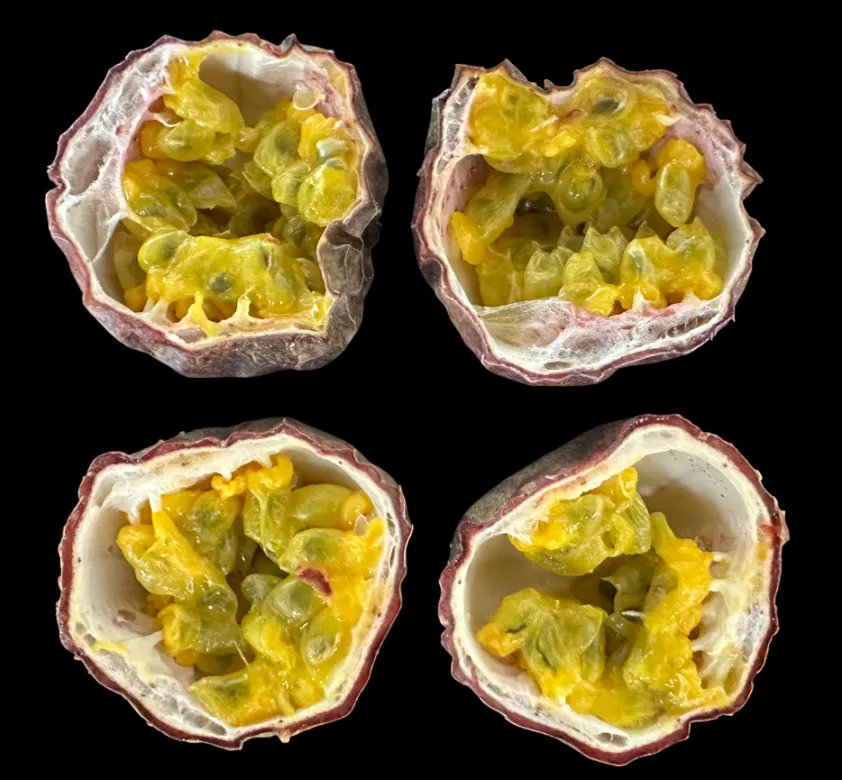
Passion fruit are climacteric and continue to ripen after harvest, changing in peel color to deep purple or golden yellow depending on the cultivar. Moisture loss during storage often causes peel shriveling, which is commonly mistaken for being overripe. As ripening progresses, volatile compounds increase, enhancing aroma and sweetness through changes in the sugar-to-acid ratio and a reduction in both acidity and TSS. Proper postharvest storage is crucial for maintaining quality, extending shelf life, and minimizing losses. Temperature plays a key role in slowing physicochemical changes, such as weight loss, respiration, and TSS concentrations. Yellow cultivars should be stored at 10°C (50°F) for two weeks, while purple types are more chilling tolerant and can be stored at 5°C to 7°C (41°F to 45°F) for three to five weeks. This cold storage can extend the shelf life of passion fruit by 50% compared with those stored at room temperature. Shriveling is a major postharvest concern in passion fruit (Figure 10), primarily caused by moisture loss. Although pulp quality remains largely unaffected initially (Figure 11), the resulting shriveled appearance during storage can reduce consumer appeal and contribute to postharvest losses up to 50%. Shriveling is more pronounced in fruit at advanced ripening stages, and it indicates the onset of senescence. To minimize peel shriveling and excessive moisture loss, fruit should be stored at 90% to 95% relative humidity.

Credit: Fariborz Habibi and Ali Sarkhosh, UF/IFAS
Credit: Fariborz Habibi and Ali Sarkhosh, UF/IFAS
Postharvest Treatments to Extend Shelf Life
As a climacteric fruit, passion fruit produces ethylene, which accelerates ripening. Treatments with ethylene inhibitors such as 1-methylcyclopropene (1-MCP) and storage in ethylene-free environments can delay ripening and extend shelf life during transit and storage. Modified atmosphere packaging (MAP) helps preserve freshness by lowering oxygen and increasing carbon dioxide levels around the fruit. This reduces respiration and moisture loss while maintaining flavor and aroma. High oxygen (90%) in packaging has also been shown to reduce peel shrinkage.
Storage conditions can reduce cutin content in the fruit peel, compromising its protective barrier and contributing to moisture loss and quality deterioration. Edible coatings, such as wax or chitosan, act as semi-permeable barriers, slowing gas exchange and moisture loss. They also enhance visual appeal by maintaining peel glossiness and turgidity. Tea polyphenol coatings have shown promise in delaying senescence and maintaining structural integrity.
Postharvest calcium applications, particularly calcium chloride (CaCl2) at 2%, strengthen cell walls, reduce decay, and improve firmness. These treatments can be applied via dips, sprays, or coatings to help maintain peel color, inhibit browning, and delay senescence during storage. Melatonin (N-acetyl-5-methoxytryptamine) has been used in horticultural crops to maintain fruit quality. In passion fruit, melatonin (200 μmol/L) can reduce shriveling, browning, weight loss, ethylene, and respiration to maintain overall fruit quality. No synthetic fungicides are currently registered for postharvest application to passion fruit. Environmental and health concerns have limited the use of synthetic fungicides, prompting interest in safer alternatives such as rinses with sanitized water.
Incorporating one or more postharvest treatments can help maintain fruit quality and extend shelf life. These approaches, whether physical, chemical, or packaging-based, offer tools for reducing losses and improving marketability. Ongoing research aims to improve the practicality and affordability of these methods for Florida producers.
Postharvest Physiological Disorders
Chilling Injury
Storage under low but non-freezing temperatures can cause chilling injury (CI) in passion fruit depending on the type. Storage below 10°C (50°F) for yellow types or below 5°C (41°F) for purple types will induce CI. Symptoms include peel discoloration, pitting, internal pulp darkening, water-soaking, uneven ripening, and off-flavor development (Figure 12). Discoloration may extend into the exocarp. Severity depends on both temperature and duration of exposure, with colder and prolonged conditions increasing CI risk.

Credit: Fariborz Habibi and Ali Sarkhosh, UF/IFAS
Postharvest Pulp Fermentation
Postharvest pulp fermentation is a notable concern that can adversely affect fruit quality and marketability. This issue arises from anaerobic respiration within the endocarp when the fruit becomes overripe, leading to ethanol accumulation and off-flavor development. Contributing factors include improper storage conditions and overly thick, impermeable edible coatings. To prevent fermentation, it is essential to maintain appropriate temperature and humidity levels during storage.
Postharvest Pathological Disorders
Passion fruit is susceptible to several postharvest diseases (Figure 13) that can reduce shelf life, lower market value, and cause significant economic loss (Figure 14). Mechanical injuries from poor harvesting practices, such as dropping fruit, overfilling containers, or causing stem abrasions, create entry points for pathogens during storage and ripening. Common postharvest fungal diseases include brown spot (Alternaria passiflorae), Phytophthora fruit rot (Phytophthora nicotianae var. parasitica), and Septoria spot (Septoria passiflorae), as well as various infections by Fusarium spp., Colletotrichum spp., and Alternaria spp. Purple cultivars have higher resistances than yellow cultivars. Flavonoids and phenylpropanoids may contribute to this enhanced resistance of purple peels against decay development. Effective prevention involves performing good field sanitation, pruning to improve air circulation, applying preharvest fungicides, carefully handling to avoid damage, washing and rinsing with sanitizing water, and storing fruit at appropriate temperatures.

Credit: Fariborz Habibi and Ali Sarkhosh, UF/IFAS

Credit: Fariborz Habibi and Ali Sarkhosh, UF/IFAS
Acknowledgment
This work was supported by the Southern Sustainable Agriculture Research and Education (S-SARE) program, award no. LS23-380, from the U.S. Department of Agriculture’s National Institute of Food and Agriculture.
Further Reading
Bailey, M., A. Sarkhosh, A. Rezazadeh, J. Anderson, A. Chambers, and J. H. Crane. 2021. “The Passion Fruit in Florida: HS1406, 1/2021.” EDIS 2021 (1). https://doi.org/10.32473/edis-hs1406-2021
Cai, S., Z. Zhang, J. Wang, et al. 2024. “Effect of Exogenous Melatonin on Postharvest Storage Quality of Passion Fruit Through Antioxidant Metabolism.” LWT 194: 115835. https://doi.org/10.1016/j.lwt.2024.115835
Chen, F. P., X. Y. Xu, Z. Luo, Y. Chen, Y. Xu, and G. Xiao. 2018. “Effect of High O₂ Atmosphere Packaging on Postharvest Quality of Purple Passion Fruit ( Sims).” Journal of Food Processing and Preservation 42 (9): e13749. https://doi.org/10.1111/jfpp.13749
Fonseca, A. M., M. V. Geraldi, M. R. M. Junior, A. J. Silvestre, and S. M. Rocha. 2022. “Purple Passion Fruit ( f. edulis): A Comprehensive Review on the Nutritional Value, Phytochemical Profile and Associated Health Effects.” Food Research International 160: 111665. https://doi.org/10.1016/j.foodres.2022.111665
Habibi, F., U. Khalil, S. A. Sargent, and A. Sarkhosh. 2026. “Postharvest Quality of Purple Passion Fruit in Packaging Alone or Combined with Fungicide and Wax During Ripening Under Ambient Conditions.” Applied Food Research 6 (1): 101775. https://doi.org/10.1016/j.afres.2026.101775
Habibi, F., U. Khalil, and A. Sarkhosh. 2025. “Physicochemical and Quality Attributes of ‘Possum Purple’ Passion Fruit in Relation to Fruit Weight Categories.” HortScience 60 (9): 1561–1568. https://doi.org/10.21273/HORTSCI18699-25
Joy, P. P., and B. Divya. 2016. Post-Harvest Handling of Passion Fruit. Kerala Agricultural University Pineapple Research Station.
Rizwan, H. M., L. Zhimin, W. Harsonowati, et al. 2021. “Identification of Fungal Pathogens to Control Postharvest Passion Fruit () Decays and Multi-Omics Comparative Pathway Analysis Reveals Purple Is More Resistant to Pathogens than a Yellow Cultivar.” Journal of Fungi 7 (10): 879. https://doi.org/10.3390/jof7100879
Sargent, S. A., J. K. Brecht, M. M. Madison, and S. Yang. 2019. FoodTransport App. University of Florida Institute of Food and Agricultural Sciences (UF/IFAS) Extension. Available for Android and iOS platforms.
Schotsmans, W. C., and G. Fischer. 2011. “Passion Fruit ( Sims).” In Postharvest Biology and Technology of Tropical and Subtropical Fruits, edited by E. M. Yahia. Woodhead Publishing. https://doi.org/10.1533/9780857092618.125
Tang, Y., P. Wang, J. Chen, et al. 2025. “The Accumulation Pattern of Sugars and Organic Acids in Diverse Fruit Pulps Coordinates Sweet–Sour Taste of Passion Fruit.” LWT 225: 117948. https://doi.org/10.1016/j.lwt.2025.117948
Wang, Y., W. Jia, X. Wang, M. M. Aslam, W. Li, and Y. Shao. 2025. “Tea Polyphenols Coating Improves Physiological Properties, Microstructure and Chemical Composition of Cuticle to Suppress Quality Deterioration of Passion Fruit during Cold Storage.” Food Chemistry 463: 141524. https://doi.org/10.1016/j.foodchem.2024.141524
Xu, H., P. Qiao, J. Pan, et al. 2023. “CaCl₂ Treatment Effectively Delays Postharvest Senescence of Passion Fruit.” Food Chemistry 417: 135786. https://doi.org/10.1016/j.foodchem.2023.135786
Yang, H., X. Li, Y. Tan, and Y. Pan. 2024. “Revealing the Crucial Role of Cuticular Wax Components in Postharvest Water Loss in Passion Fruit ( Sims).” Postharvest Biology and Technology 213: 112974. https://doi.org/10.1016/j.postharvbio.2024.112974
You, M., X. Duan, X. Li, et al. 2022. “Effect of 1-Methylcyclopropene Combined with Chitosan-Coated Film on Storage Quality of Passion Fruit.” Sustainable Chemistry and Pharmacy 27: 100679. https://doi.org/10.1016/j.scp.2022.100679