
Abstract
Oropouche virus (OROV), which causes Oropouche fever, is an emerging infectious human pathogen that is undergoing rapid geographic expansion in the American tropics. The virus is primarily transmitted by Culicoides paraensis, a biting midge (no-see-um) species that is found throughout many of the forested areas of eastern North and South America. Symptoms of Oropouche fever include sudden onset of fever, severe headache, chills, muscle aches, joint pain, tiredness, dizziness, nausea, vomiting, and light sensitivity. Oropouche virus is endemic to tropical forest environments of South America, where regular outbreaks occur, particularly in the Amazon Region of Brazil. In recent years, OROV has begun to spread northward from South America to the Caribbean, being detected in Haiti (2014) and then in Cuba (2024), where numerous human cases of Oropouche fever were reported. Given Cuba’s proximity to Florida and the frequency of human travel between the two locations, the approximately 100 travel-associated OROV cases in Florida reported in 2024 are unsurprising. Whether travel-associated OROV cases in Florida result in local transmission of OROV depends on several factors, chief of which is the presence and abundance of potential vector species in Florida. While a few mosquito species, particularly Culex quinquefasciatus, have been found naturally infected with OROV during outbreaks, laboratory experiments have demonstrated that this mosquito species is unlikely to transmit OROV to humans. Other mosquito species examined are similarly unlikely to transmit OROV to humans. Additionally, it is unlikely that Florida’s “coastal pest” insects, specifically the biting midge and mosquito species along Florida coasts, are transmitting OROV to humans or will transmit OROV to humans in the future.
The purpose of this publication is to educate anyone interested in learning more about OROV and provide information on potential OROV vectors in Florida.
Introduction
Oropouche virus was discovered in 1955 in Trinidad and Tobago (Anderson et al. 1961), when it was isolated from the blood of a 24-year-old man who worked as a charcoal burner in a forested area of the island of Trinidad (Figure 1). The patient’s symptoms included backache, cough, and fever of 104°F that lasted around three days. The virologists with the Trinidad Regional Virus Laboratory who isolated the new virus from the patient’s blood named it “Oropouche virus” for the locality where the patient resided, near the village of Vega de Oropouche (Oropouche meadow). Since the discovery of OROV, human cases of Oropouche fever have been observed in several tropical American countries, including Colombia, Cuba, Ecuador, Haiti, Panama, Peru, and Brazil. Although the virus is considered to occur over a vast area in the neotropics, the majority of OROV outbreaks have occurred in the Amazon region of northern Brazil (Figure 1).
The first documented epidemic of OROV occurred in 1961 in the city of Belém (Figure 1) located in the northern Brazilian state of Pará, which is traversed by the Amazon River. During this first documented outbreak, it is estimated that 11,000 people were infected with OROV. In the 1970s and early 1980s, widespread epidemics of OROV occurred in the Amazonian states of Pará and Amazonas in Brazil, with at least 260,000 people infected (LeDuc and Pinheiro 1989). In recent years, transmission of OROV has begun to spread northward from South America to the Caribbean, being detected in Haiti in 2014 (Elbadry et al. 2021), then in Cuba in 2024 (PAHO/WHO 2024; CDC 2024a). Over 10,000 OROV cases were reported in 2024, with most cases occurring in Brazil (PAHO/WHO 2024). Approximately 100 travel-related cases were reported in the United States in 2024. Common symptoms experienced during recent OROV outbreaks include fever, severe headache, chills, muscle aches, joint pains, tiredness, dizziness, nausea, vomiting, and light sensitivity, with mortality rare (CDC 2024b).

Credit: Nathan Burkett-Cadena, UF/IFAS.
Oropouche Virus
Oropouche virus is a member of the virus genus Orthobunyavirus (family Peribunyaviridae) along with a number of recognized human pathogens, including California encephalitis virus, La Crosse virus, and Jamestown Canyon virus. Most viruses in the genus Orthobunyavirus are transmitted by mosquitoes, particularly species of Aedes and Culiseta. Vertical transmission, in which the virus is passed from the mother mosquito to her offspring, is unusually common among Orthobunyaviruses and is recognized as a feature in the maintenance of La Crosse virus and Jamestown Canyon virus in nature. Various wild mammals are the natural vertebrate hosts of Orthobunyaviruses, and the specific hosts vary between virus species. Squirrels and chipmunks are the natural hosts of La Crosse virus, while deer are the natural hosts of Jamestown Canyon virus, for example.
Oropouche Fever Symptoms, Treatment, and Prevention
Oropouche fever symptoms generally appear three to eight days after a person is bitten by an infected vector and are similar to those caused by other vector-borne viruses, such as dengue, West Nile, yellow fever, Zika, and chikungunya (Sakkas et al. 2018). Infection with OROV typically results in a flu-like illness that usually lasts between two to seven days and may include symptoms such as fever, usually between 100°F to 104°F (38°C to 40°C); chills; headache; muscle and joint pain; tiredness; dizziness; nausea; vomiting; light sensitivity; and pain behind the eyes. Although the illness is generally mild, hemorrhagic manifestations, such as spontaneous bleeding, or neuroinvasive disease (e.g., meningitis or meningoencephalitis) may develop in a small percentage (less than 5%) of people infected with OROV, particularly in immunocompromised individuals and children (CDC 2024b).
While Oropouche fever typically lasts a week or less, recurrence of symptoms can occur, particularly within the first ten days after the initial symptoms (Sakkas et al. 2018). Symptoms may also reappear one or two weeks after recovery in about 60% of patients (Zhang et al. 2024). Recently, the first two reported deaths due to OROV were documented in Brazil. Additionally, OROV is suspected to have been transmitted to fetuses during pregnancy and to have caused poor pregnancy outcomes. Cases of fetal death, miscarriages, and newborns born with microcephaly have been reported (PAHO/WHO 2024).
Currently, there is no specific treatment or vaccine for OROV. Symptom management and supportive care remain the primary approaches to managing the disease (Sakkas et al. 2018). The CDC advises postponing international travel to OROV-endemic areas, especially for pregnant women. For those unable to avoid travel, it is crucial to prevent insect bites by using personal protective measures against mosquitoes and biting midges.
History of Oropouche Virus Outbreaks
Since its first detection in 1955 on the island of Trinidad, OROV has caused at least 30 epidemics in South America, with Brazil reporting the highest number of OROV fever cases (Sakkas et al. 2018). The first notable outbreak of OROV fever occurred in 1961 in the city Belém, Pará State, Brazil, affecting approximately 11,000 individuals. By 1981, nine additional outbreaks had occurred in Pará, with the two largest epidemics between 1980 and 1981 infecting over 100,000 people (Sakkas et al. 2018). Afterward, the virus spread to northern, northeastern, and southeastern Brazilian states.
OROV re-emerged in 2003–2004 with two small outbreaks in Pará, followed by a significant epidemic in 2006 that infected 18,000 people and marked the return of OROV outbreaks in Pará after 26 years. Further outbreaks were recorded in 2007–2008 and 2011–2012 in states within the Amazon region. In 2016, the virus was detected outside this region, with cases reported in São Paulo.
Outside Brazil, OROV was isolated in Panama in 1989, though no major outbreaks followed. In 1992, the virus was found in patients living along the Amazon River in Peru (Da Rosa et al. 2017). From 1980 to 2005, sporadic cases and self-limiting outbreaks occurred in the Peruvian Amazon, with the last outbreak taking place in 2016 (Sakkas et al. 2018). Epidemiological surveillance confirmed the presence of OROV in Argentina, Bolivia, Colombia, Ecuador, and Venezuela (Da Rosa et al. 2017; Romero-Alvarez et al. 2018).
The most recent OROV outbreak began in November of 2023 and continued through mid-2025 (PAHO/WHO 2025). A notable surge in cases was reported in Brazil, Bolivia, Colombia, Peru, and, for the first time, in Cuba (PAHO/WHO 2024; Scachetti et al. 2024). In 2024, over 10,000 cases were documented in Barbados, Bolivia, Brazil, Colombia, Cuba, the Dominican Republic, Ecuador, Guyana, Panama, and Peru (PAHO/WHO 2024). Numerous travel-related cases were reported in the United States, Canada, and Europe. Between June and December 2024, the highest number of travel-related OROV fever cases recorded in the United States was reported from Florida (103 cases), while California, Colorado, Kentucky, and New York each reported at least one case (CDC 2024a). All cases reported from the United States, including those in Florida, were linked to travel to Cuba (FDOH 2024); however, undetected travel-related cases from other countries or even local transmission may have occurred that were not recognized because appropriate diagnostics were not performed. In 2024, over half of the travel-related OROV cases in Florida were documented in Miami-Dade County (53 cases), followed by substantial numbers in Hillsborough (12 cases), Lee (five cases), Polk (four cases), Broward (three cases), Orange (three cases), Pasco (three cases), and Palm Beach (two cases) counties. Single cases were reported from at least three other Florida counties.
Arthropod Vectors of Oropouche Virus
Despite the widespread occurrence of OROV in the American tropics and the large numbers of human cases that have been documented, robust information on the specific arthropod vectors of OROV in nature is relatively scarce. The insect species that are suspected of transmitting OROV are relatively common in areas where outbreaks have occurred. However, the rate of OROV infection in these insects is quite low: less than 1 in 10,000 females, even during outbreaks. Due to the low OROV infection rates observed in suspected vectors during outbreaks, experts hypothesize that transmission is maintained via the overwhelming abundance of vectors during these outbreaks (LeDuc and Pinheiro 1989).
While biting midges (Ceratopogonidae: Culicoides) and mosquitoes (Culicidae) have been found infected during OROV outbreaks (Table 1), only biting midges have been shown to transmit the virus from infected to uninfected hosts. Researchers that studied outbreaks of Oropouche fever in the American tropics hypothesize that OROV is transmitted in two distinct cycles: (1) an “epidemic” or “urban” cycle in which humans are the primary vertebrate hosts of the virus; and (2) an “enzootic” or “sylvatic” cycle in which wild sloths maintain the virus (LeDuc and Pinheiro 1989). Culicoides paraensis, a biting midge, transmits OROV between humans in the urban OROV cycle (Table 1) and may also transmit OROV between sloths and humans in the sylvatic OROV cycle.
Table 1. Summary of OROV detected in suspected insect vectors in Brazil. Data summarized from Pinheiro et al. (1981).
During the 2024 Oropouche fever outbreak in Cuba, mosquitoes and biting midges were found infected with OROV. One out of the two pools of biting midges tested (50%) and five out of the nine pools of Culex quinquefasciatus mosquitoes tested (56%) were positive for OROV RNA (Benitez et al. 2024). Unfortunately, since the biting midges were identified to the family and not species level, it is not known whether the pool of Ceratopogonidae midges consisted of Culicoides paraensis and/or other biting midge species. At the time (2024), Culicoides paraensis had not been recorded to occur in Cuba. Cuban researchers later (May of 2025) reported the first record of Culicoides paraensis in Cuba (Perez et al. 2025). The researchers collected females of Culicoides paraensis attempting to bite humans in three provinces where Oropouche fever had recently been documented in humans, suggesting that it may have been the vector during the Oropouche fever outbreak.
Culicoides paraensis (Figure 2), described from the Brazilian state of Pará in 1905, is a very widespread species of biting midge that occurs over much of South, Central and North America. Culicoides paraensis is associated with forested habitats because females lay their eggs in wet tree holes of living trees, and the immature stages (larvae and pupae) develop in those tree holes (Figure 2). These midges are not known to develop in water-filled manmade containers or in bromeliads (Hribar 2008). In the United States, Culicoides paraensis is found in several eastern states, from Pennsylvania in the north, through Florida in the south, and west to Louisiana (Blanton and Wirth 1979). In Florida, Culicoides paraensis is most abundant in the northern half of the state, where hardwood forests dominate (Figure 2). This biting midge species has not been recorded from urban south Florida (Miami, Fort Lauderdale, or West Palm Beach, for example). In hardwood forests of the southeastern United States, Culicoides paraensis can be abundant enough to be a notable biting pest of humans (Blanton and Wirth 1979); however, it most often bites small mammals (squirrels, raccoons, etc.) in nature (McGregor et al. 2019).
In the American tropics, Culicoides paraensis also frequently utilizes the cut stumps of banana trees and discarded fruit pods of cacao (the major ingredient in chocolate) as habitats for developing immatures. In areas of banana and cacao production, Culicoides paraensis can be extremely numerous, and this biting midge can be a severe nuisance and pose a serious threat to human health through transmission of OROV. In 1982, researchers in Brazil (Pinheiro et al. 1982) demonstrated that Culicoides paraensis is capable of transmitting OROV from virus-infected human patients to laboratory animals (hamsters) after a five-day incubation period. This was an important step demonstrating that Culicoides paraensis is a biological vector of OROV in the urban cycle of OROV transmission in South America and may also transmit OROV in the sylvatic cycle.
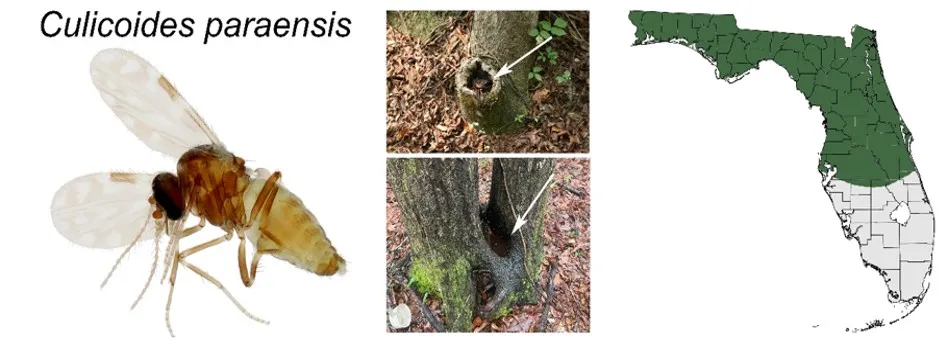
Credit: Nathan Burkett-Cadena, UF/IFAS.
Mosquitoes (Figure 3) of several species have been found naturally infected with OROV during outbreaks. Culex quinquefasciatus (Figure 3a) has received considerable attention as a potential vector of OROV because it is common during OROV outbreaks and has been found infected with OROV during the outbreaks (Pinheiro et al. 1981; Benitez et al. 2024). Multiple research groups have examined whether Culex quinquefasciatus can transmit OROV in the laboratory and their studies generally conclude that the threshold of OROV titer (concentration) in host blood required for infecting Culex quinquefasciatus is much higher than that observed in human blood (Hoch et al. 1987; de Mendonça et al. 2021), leading to the conclusion that Culex quinquefasciatus would be unlikely to transmit OROV in nature. Other mosquito species found to be infected with OROV during outbreaks include Aedes serratus (Figure 3b), Aedes scapularis (Figure 3c) and Coquillettidia venezuelensis (Figure 3d). It is not known whether these mosquito species can transmit OROV from infected to uninfected people. Researchers have evaluated the ability of some other mosquito species to transmit OROV and have generally found that those mosquito species cannot transmit the virus. Species that have been found incapable of transmitting OROV include Aedes aegypti, Aedes albopictus, Culex pipiens, Culex tarsalis, and Anopheles quadrimaculatus (McGregor et al. 2021; Payne et al. 2025).
Mosquitoes are diverse in Florida, with around 90 species of mosquito recorded from the state. As with the biting midges, some of the mosquito species that are pestiferous in coastal areas, especially Aedes taeniorhynchus, may be found in tropical areas where OROV transmission occurs. These mosquitoes have not been found infected with OROV, nor have they been implicated in OROV transmission. It is unlikely that pestiferous coastal mosquito species transmit OROV in nature. A recent laboratory study of two species that commonly bite humans, Aedes aegypti and Culex quinquefasciatus, found that these two species are unlikely to transmit either the OROV strain isolated in 1955 or the OROV strain isolated in 2024 (Kim et al. 2025).

Credit: Nathan Burkett-Cadena, UF/IFAS.
Biting midges (no-see-ums) in Florida are infamous for their annoying and painful bites, especially in coastal areas of the state. Important pest species in coastal areas include Culicoides furens (Atlantic Coast), Culicoides mississippiensis (Gulf Coast), Culicoides barbosai (southern Florida coasts), and Culicoides hollensis (northern Florida Atlantic Coast). Several of these coastal pest biting midge species also occur in the American tropics, where OROV is transmitted. It is unlikely that pestiferous coastal biting midge species transmit OROV in nature; however, this should be evaluated through laboratory investigation. In Florida, Culicoides paraensis is not a coastal pest. There are approximately 50 species of biting midges recorded from Florida (Blosser et al. 2024).
Oropouche Virus Transmission Cycles
Oropouche virus is transmitted between vertebrate hosts by biting midges and/or mosquitoes in two distinct cycles: a sylvatic cycle and an urban cycle. The sylvatic cycle may be considered the natural transmission cycle for the virus, and it occurs in densely forested areas of the Amazon region of South America. Most isolations of OROV in wild animals have been from sloths, in particular the pale-throated sloth, Bradypus tridactylus. During outbreak investigations in the 1970s and 1980s, Brazilian investigators (Pinheiro et al. 1981) sampled blood from over 20,000 vertebrates, including 406 marsupials, 1,085 rodents, 581 primates, 15 carnivores, 59 ungulates, 90 reptiles, 169 bats, and 11,338 wild birds. While antibodies showed that a number of animals had been exposed to the virus, OROV was only isolated from the blood of sloths (Pinheiro et al. 1981). An OROV strain was later isolated from the blood of a marmoset (Callithrix sp.) in southeastern Brazil (Nunes et al. 2005). Culicoides paraensis is likely the vector in the sylvatic cycle, transmitting OROV between wild vertebrate hosts and humans (Figure 4).
In the urban cycle of OROV transmission, humans serve as the vertebrate host for the virus. OROV can replicate and circulate in human blood at concentrations (titers) high enough to infect blood-feeding vectors. In the Amazon region of South America, Culicoides paraensis can reach high densities in some developed areas and is likely an important vector in the urban transmission cycle of OROV (Figure 4).
It is not yet known whether any wild or domesticated animals in Florida can serve as an amplifying or maintenance host of OROV. It is possible that there are susceptible vertebrate hosts, as yet unidentified in Florida, that can support transmission of the virus, particularly as the virus undergoes genetic changes that increase its ability to replicate in hosts and/or vectors. Should local transmission of OROV occur in Florida, studies will be needed to assess the host competence of various vertebrates, particularly mammals and birds.

Credit: Nathan Burkett-Cadena, UF/IFAS. Three-toed sloth photo by Daniel Burkett-Cadena, used with permission.
Disclaimer
This publication is based on knowledge and information available as of September 18, 2025, and that information is subject to change.
Selected References
Anderson, C. R., L. Spence, W. G. Downs, and T. H. G. Aitken. 1961. “Oropouche Virus: A New Human Disease Agent from Trinidad, West Indies.” The American Journal of Tropical Medicine and Hygiene 10:574–578. https://doi.org/10.4269/ajtmh.1961.10.574
Benitez, A. J., M. Alvarez, L. Perez, et al. 2024. “Oropouche Fever, Cuba, May 2024.” Emerging Infectious Diseases 30 (10): 2155–2159. https://doi.org/10.3201/eid3010.240900
Blanton, F. S., and W. W. Wirth. 1979. “The Sand Flies (Culicoides) of Florida (Diptera: Ceratopogonidae).” Arthropods of Florida and Neighboring Land Areas, Volume 10. Florida Department of Agriculture and Consumer Services. Gainesville, FL. P. 204. https://doi.org/10.64338/fsca.af.10.netzj
Blosser, E. M., B. L. McGregor, and N. D. Burkett-Cadena. 2024. “A Photographic Key to the Adult Female Biting Midges (Diptera: Ceratopogonidae: Culicoides) of Florida, USA.” Zootaxa 5433 (2): 151–182. http://doi.org/10.11646/zootaxa.5433.2.1
Centers for Disease Control and Prevention (CDC). 2024a. National Center for Zoonotic and Infectious Disease: Oropouche in the United States. https://www.cdc.gov/oropouche/data-maps/current-year-data.html Accessed 26 September 2024.
Centers for Disease Control and Prevention CDC. 2024b. National Center for Zoonotic and Infectious Disease: About Oropouche. https://www.cdc.gov/oropouche/about/index.html Accessed 30 July 2024.
da Rosa, J. F. T. , W. M. de Souza, F. P. Pinheiro, et al. 2017. “Oropouche Virus: Clinical, Epidemiological, and Molecular Aspects of a Neglected Orthobunyavirus.” The American Journal of Tropical Medicine and Hygiene 96 (5): 1019. https://doi.org/10.4269/ajtmh.16-0672
de Mendonça, S. F., M. N. Rocha, F. V. Ferreira, et al. 2021. “Evaluation of Aedes aegypti, Aedes albopictus, and Culex quinquefasciatus Mosquitoes Competence to Oropouche virus Infection.” Viruses 13 (5): 755. https://doi.org/10.3390/v13050755
Elbadry, M. A., R. Durães-Carvalho, G. M. Blohm, et al. 2021. “Orthobunyaviruses in the Caribbean: Melao and Oropouche virus Infections in School Children in Haiti in 2014.” PLoS Neglected Tropical Diseases 15 (6): e0009494. https://doi.org/10.1371/journal.pntd.0009494
Florida Department of Health (FDOH). 2024. Florida arbovirus surveillance. https://www.floridahealth.gov/statistics-data/populationsurveillance/
Hoch, A. L., F. D. Pinheiro, D. R. Roberts, and M. D. Gomez. 1987. “Laboratory Transmission of Oropouche virus by Culex quinquefasciatus Say.” Bulletin of the Pan American Health Organization (PAHO) 21 (1): 55–61.
Hribar, L. J. 2008. “An Unusual Larval Habitat for Culicoides arboricola (Root & Hoffman) (Diptera: Ceratopogonidae) in the Florida Keys, USA.” Florida Entomologist 87 (2): 199–203.
Kim, D., T. M. S. Stenn, S. M. Dittman, et al. 2025. "Anthropophagic Florida Mosquito Species Are Poor Vectors of Prototype and Emerging Strains of Oropouche Virus." PLoS Neglected Tropical Diseases 19 (12): e0013755. https://doi.org/10.1371/journal.pntd.0013755
LeDuc, J. W., and F. P. Pinheiro. 1989. Oropouche Fever. In The Arboviruses: Epidemiology and Ecology, edited by T. P. Monath. CRC Press.
McGregor, B. L., C. R. Connelly, and J. L. Kenney. 2021. “Infection, Dissemination, and Transmission Potential of North American Culex quinquefasciatus, Culex tarsalis, and Culicoides sonorensis for Oropouche Virus.” Viruses 13 (2): 226. https://doi.org/10.3390/v13020226
McGregor, B. L., T. Stenn, K. A. Sayler, et al. 2019. “Host Use Patterns of Culicoides spp. Biting Midges at a Big Game Preserve in Florida, USA, and Implications for the Transmission of Orbiviruses.” Medical and Veterinary Entomology 33 (1): 110–120. http://doi.org/10.1111/mve.12331
Nunes, M. R., L. C. Martins, S. G. Rodrigues, et al. 2005. “Oropouche virus Isolation, Southeast Brazil.” Emerging Infectious Diseases 11 (10): 1610–1613. https://doi.org/10.3201/eid1110.050464
PAHO (Pan American Health Organization)/ World Health Organization (WHO). 2024. Epidemiological Alert: Oropouche in the Americas Region, 13 December 2024. Washington, D.C. https://www.paho.org/en/documents/epidemiological-alert-oropouche-americas-region-13-december-2024
PAHO (Pan American Health Organization)/WHO (World Health Organization). 2025. Epidemiological Alert: Chikungunya and Oropouche in the Americas Region, 28 August 2025. Washington, D.C.
https://www.paho.org/sites/default/files/2025-09/2025-ago-28-phe-alerta-chkvorovengfinal.pdf
Payne, A. F., J. Stout, P. Dumoulin, et al. 2025. “Lack of Competence of US Mosquito Species for Circulating Oropouche Virus.” Emerging Infectious Diseases 31 (3): 619. https://doi.org/10.3201/eid3103.241886
Pérez, Y. M., A. C. Ibáñez, Z. M. Díaz, et al. 2025. “First Report of Culicoides paraensis (Goeldi, 1905) (Diptera: Ceratopogonidae) in Cuba: A New Challenge for Public Health.” Parasite Epidemiology and Control. 1:29:e00423. https://doi.org/10.1016/j.parepi.2025.e00423
Pinheiro, F. P., M. Pinheiro, G. Bensabath, O. R. Causey, and R. E. Shope. 1962. “Epidemia de vírus Oropouche em Belém.” Revista do Servico Especial de Saúde Pública 12:15–23.
Pinheiro, F. P., A. P. Travassos da Rosa, M. L. Gomes, J. W. LeDuc, and A. L. Hoch. 1982. “Transmission of Oropouche Virus from Man to Hamster by the Midge Culicoides paraensis.” Science 215 (4537): 1251–1253. http://doi.org/10.1126/science.6800036
Pinheiro, F. P., A. P. Travassos da Rosa, and J. F. Travassos da Rosa. 1981. “Oropouche Virus: I. A Review of Clinical, Epidemiological, and Ecological Findings.” American Journal of Tropical Medicine and Hygiene 30 (1): 149–160. https://doi.org/10.4269/ajtmh.1981.30.149
Reeves, L. E., and N. D. Burkett-Cadena. 2022. “Lizards Are Important Hosts for Zoonotic Flavivirus Vectors, Subgenus Culex, in the Southern USA.” Frontiers in Tropical Diseases 3:842523. http://doi.org/10.3389/fitd.2022.842523
Romero-Alvarez, D., and L. E. Escobar. 2018. “Oropouche fever, an emergent disease from the Americas. Microbes and Infection 20 (3): 135–146. http://doi.org/10.1016/j.micinf.2017.11.013
Sakkas, H., P. Bozidis, A. Franks, and C. Papadopoulou. 2018. “Oropouche Fever: A Review.” Viruses 10 (4): 175. http://doi.org/10.3390/v10040175
Scachetti, G. C., J. Forato, I. M. Claro, et al. 2024. “Re-emergence of Oropouche virus Between 2023 and 2024 in Brazil: An Observational Epidemiological Study.” The Lancet Infectious Diseases (pre-print published online 15 October 2024). https://doi.org/10.1016/S1473-3099(24)00619-4.
Stenn, T., K. J. Peck, G. Rocha Pereira, and N. D. Burkett-Cadena. 2019. “Vertebrate Hosts of Aedes aegypti, Aedes albopictus, and Culex quinquefasciatus (Diptera: Culicidae) as Potential Vectors of Zika Virus in Florida.” Journal of Medical Entomology 56 (1): 10–17. http://doi.org/10.1093/jme/tjy148
Zhang, Y., X. Liu, Z. Wu, et al. 2024. “Oropouche virus: A Neglected Global Arboviral Threat.” Virus Research 341 (2024): 199318. http://doi.org/10.1016/j.virusres.2024.199318