
Key Points
- Florida’s predominantly sandy soils have low organic matter and are highly susceptible to nutrient leaching and degradation.
- Rising temperatures increase organic matter decomposition, soil carbon loss, and crop water demand.
- More frequent droughts, floods, and storms intensify erosion, runoff, and nutrient losses.
- Sea level rise increases saltwater intrusion, causing soil salinization and reduced agricultural productivity.
- Conservation tillage, cover crops, organic amendments, and efficient irrigation strengthen soil resilience.
Introduction
Soil health is a cornerstone of sustainable agriculture, defined as the capacity of soil to function as a living ecosystem for sustaining plants, animals, and humans by regulating water, supporting biodiversity, filtering pollutants, cycling nutrients, and providing physical stability (USDA-NRCS 2026). However, climate change poses significant challenges to these essential functions by exacerbating erosion, compaction, and soil fertility loss, all driven by rising temperatures, shifting precipitation patterns, and more frequent extreme weather events. Such challenges endanger food security, environmental sustainability, and the long-term productivity of agricultural soils (Lal 2011; Brevik 2013).
Florida’s agriculture, the state’s second-largest industry, relies on diverse soils that vary across the state, from sandy marine sediments in the north to organic and carbonaceous materials in the south (Figure 1). Soil health across Florida is shaped by statewide variation in parent material, texture, hydrology, and land management practices, but most surface soils share common functional limitations. Florida soils are predominantly sandy—often exceeding 85% sand—which results in low organic matter content, low cation exchange capacity, and limited water- and nutrient-holding capacities. Differences in soil development, drainage conditions, and underlying parent materials—including sandy marine sediments, organic deposits, and limestone—create variability in soil behavior across the state. In some areas, shallow water tables and calcareous materials further constrain nutrient availability and effective soil water storage. Compared with many regions of the United States, Florida soils generally have lower water-holding capacity and are highly susceptible to nutrient leaching. These inherent soil properties, combined with a subtropical climate characterized by frequent rainfall and warm temperatures, promote rapid organic matter mineralization and nutrient losses, increasing vulnerability to soil degradation and posing ongoing challenges for sustaining soil fertility and agricultural productivity (McIntyre et al. 2022; Mylavarapu et al. 2014).
Climate change and variability are expected to continue impacting Florida's agricultural productivity in the coming decades through increases in rainfall variability, rising temperatures, and sea level rise. These climatic shifts deplete soil nutrients, intensify erosion, and reduce productivity. In this context, soil resilience—the ability of soil to recover its structure and function after disturbance—is critical for sustaining agricultural systems. To help mitigate impacts, effective soil management practices—such as fertilization with organic amendments, cover cropping, soil aeration, and implementing routine soil testing to help guide decisions—are essential. This publication serves as a valuable resource for Florida’s agricultural industry, including farmers, growers, and ranchers, as well as crop consultants, researchers, policymakers, and state agencies like the U.S. Department of Agriculture (USDA) and the Florida Department of Agriculture and Consumer Services (FDACS).

Credit: Florida Soil Survey Geographic Database [SSURGO].
Climate Change in Florida
Florida is highly vulnerable to climate change due to rising temperatures and sea levels. The state has warmed by more than 1°F over the past century, with the sea level rising about 1 inch per decade, and continued CO₂-driven warming is expected to intensify extreme heat, flooding, and risks to ecosystems and coastal infrastructure (EPA 2016). Projections further indicate that sea level could rise by approximately 1–3 feet over the next century, with even a 1-foot increase capable of accelerating coastal erosion, inundating low-lying areas, and amplifying storm impacts (Borisova et al. 2009).
Historical climate records from the NOAA National Centers for Environmental Information (NCEI) show pronounced interannual variability in rainfall across Florida, including recurring periods of intense storms and flooding, with climate projections indicating continued variability rather than a uniform long-term increase in average annual precipitation (NOAA-NCEI 2023). While total precipitation trends remain spatially and temporally inconsistent, both minimum and maximum air temperatures across Florida have increased over the past century and are projected to continue rising throughout the 21st century, with more frequent hot days, warmer nights, and longer heat waves (Papacek et al. 2020). These warming trends, combined with rainfall variability, intensifying drought–flood cycles, and sea level rise, pose significant challenges for Florida’s agriculture, water resources, soils, and ecosystems. Elevated temperatures accelerate evapotranspiration and soil organic matter loss, increase crop water demand, and exacerbate nutrient losses from soils, while extreme rainfall events intensify erosion, runoff, and nutrient transport to surface waters (Mylavarapu et al. 2014; Reidmiller et al. 2018).
Rising temperatures also accelerate the decomposition of organic matter, reducing soil organic carbon stocks—the total mass of carbon stored per unit area—in Florida, particularly in the Everglades Agricultural Area, where peat or muck soils contain over 12% organic carbon. These warmer conditions favor greater microbial activity, which requires carbon as an energy source, further depleting carbon reserves through mineralization and potentially accelerating soil subsidence (Bhadha et al. 2020). Projections suggest that by 2050, nearly half of the Everglades Agricultural Area could have soil depths less than 8 inches (20 cm), particularly south of the Bolles Canal, which would make sugarcane production more difficult and costly (Wright et al. 2009; Bhadha et al. 2020). Warmer conditions also stimulate microbial activity, leading to greater nitrogen losses through volatilization and leaching. Higher temperatures worsen water loss from Florida’s sandy soils, potentially limiting plant growth and increasing irrigation management demands. Climate projections further indicate that rising temperatures will elevate atmospheric evapotranspiration, leading to greater crop water needs and irrigation requirements under current management practices by mid-century.
Extreme weather events associated with climate change, including intense rainfall, droughts, hurricanes, and storm surges, pose increasing risks to Florida’s agricultural soils. Projected increases in rainfall intensity, particularly in coastal areas, can accelerate surface runoff, soil erosion, and nutrient leaching in Florida’s predominantly sandy soils (Wang et al. 2013). Hurricanes and flooding events can cause episodic soil loss, prolonged saturation, and physical disruption of soil structure, further degrading soil quality. In coastal and low-lying regions, sea level rise and storm surge increase the risk of saltwater intrusion into soils and shallow aquifers, leading to soil salinization and reduced agricultural suitability (Karl et al. 2009). Ongoing efforts by the South Florida Water Management District to evaluate rates of soil and sediment accretion near Florida Bay are aimed at determining whether natural sediment buildup can partially offset the impact of sea level rise on soils (Obeysekera et al. 2011). However, these processes may not be sufficient to counteract the combined impacts of rising seas and extreme weather on agricultural soils.
Elevated atmospheric carbon dioxide (CO₂) is a direct component of climate change; however, its effects on soil health in Florida are expected to be more limited than those of climatic events. This is partly because much of Florida’s vegetation consists of C4 grasses and plants (including many warm-season grasses and crops such as corn and sugarcane). C4 species show a relatively small photosynthetic response to elevated CO₂ compared with C3 species (including most trees and many broadleaf plants). Although elevated CO₂ can influence root growth, soil respiration, and nutrient cycling in some ecosystems, studies in Florida scrub oak systems indicate a steady decline in the active surface-soil carbon pool under elevated CO₂. Overall, these effects appear modest and highly variable and often constrained by nutrient limitations, particularly nitrogen (Johnson et al. 2001).
Adaptive Management Strategies for Improving Soil Health
Together, these climatic stressors underscore the need for adaptive management strategies, such as improved soil health practices, water conservation, and thoughtful land-use planning. Their implementation could enhance ecosystem resilience and sustain agricultural productivity by addressing the impacts of climate variability on Florida’s soil health. Although these practices are not exclusively designed for climate change, they are broadly effective in improving soil function and mitigating poor or degraded soil conditions, regardless of the underlying cause.
Conservation Tillage
Conservation tillage is most effective when residues from either the cover crop or the previous cash crop comprise at least 30% of the soil surface (Her et al. 2017). Conservation tillage in combination with cover crops can limit subsurface compaction, promote root growth, and preserve soil macropores. This practice enhances water retention by limiting evaporation between crops, thereby increasing plant-available water. An increase in available water can help crops withstand Florida's periodic droughts. Additionally, it helps buffer soil temperatures.
Cover Crops
Cover crops play a vital role in mitigating the impacts of climate change on soil health by potentially enhancing soil structure, reducing erosion, and increasing organic matter, which supports greater soil fertility (Figure 2). Over the long term, cover-crop root systems improve soil pore structure, increase infiltration and water-holding capacity, and enhance water dynamics. However, soil moisture responses are context dependent. During the interval between cover-crop termination and establishment of the succeeding cash crop, soil moisture may be temporarily reduced relative to fallow systems, potentially increasing the need for supplemental irrigation. Additionally, cover crops may buffer soil temperature changes, suppress weeds, and reduce nutrient leaching and soil erosion losses. Because they add plant residues and root exudates to the soil, cover crops influence soil microbial processes that regulate nutrient cycling and soil aggregation. Although microbial activity may increase organic matter turnover under certain conditions, these processes can also enhance soil structure and nutrient availability, supporting soil function and successful crop establishment under climate variability.
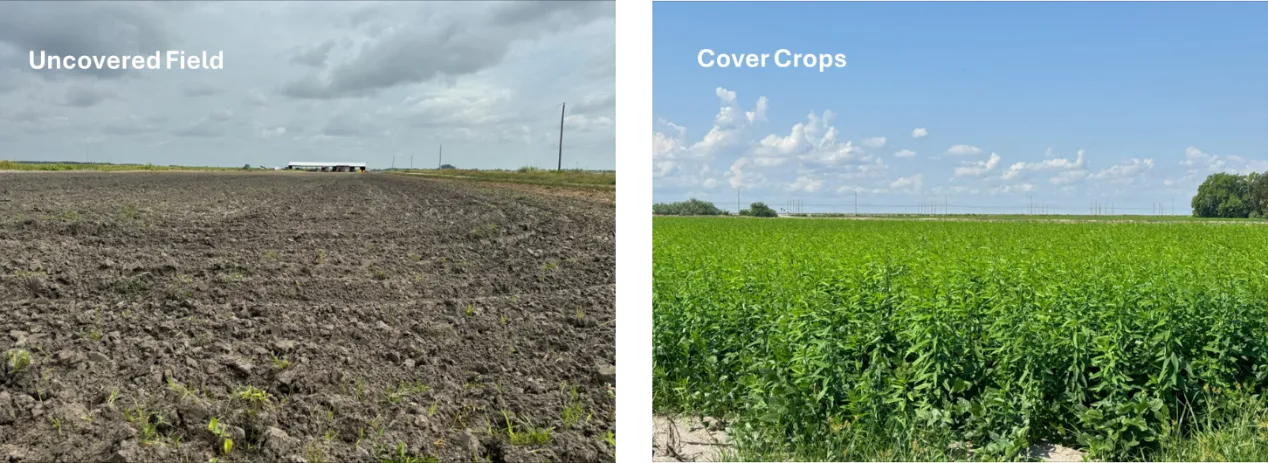
Credit: Tanjila Jesmin, UF/IFAS
Organic Amendments
Organic amendments such as compost, manure, and biochar can improve soil function under appropriate soil, climate, and management conditions, but their effects are highly context dependent. Compost primarily contributes stabilized organic matter that can improve soil aggregation, infiltration, and microbial activity. Meanwhile, manure supplies readily available nutrients that may enhance fertility but can also increase the risk of nutrient losses or disease pressure if overapplied (Figure 3). Biochar is more chemically stable and may improve water retention and cation exchange capacity in sandy soils, though its impacts vary with feedstock, application rate, and soil type. When properly managed, these amendments can support soil structure, nutrient cycling, and resilience to climate stressors; however, inappropriate use may promote nutrient imbalances, plant diseases, or water quality impairment. Therefore, application rates and timing should follow UF/IFAS best management practices to ensure agronomic benefits while minimizing environmental risks.

Credit: Xue Bai, UF/IFAS
Integrated Water Management
Integrated water management (IWM) involves the coordinated planning and management of water supply, drainage, soil moisture, and land use to optimize water use efficiency, protect water quality, and sustain ecosystem function under variable climatic conditions. Within this framework, IWM strategies are essential for supporting soil health as projected increases in drought frequency and intensity pose growing challenges under climate change. In Florida, where sandy soils have low water-holding capacity, systems like microirrigation (drip and micro-sprinklers), sprinkler irrigation (center-pivot), subsurface irrigation, and variable-rate irrigation (Figure 4) provide targeted and efficient water management. Microirrigation reduces evaporative losses, while subsurface drip systems deliver water directly to the root zone, minimizing nutrient leaching and soil erosion. Variable-rate irrigation optimizes water use by adjusting application rates based on soil variability and plant growth, thus conserving resources and preventing over-irrigation. Collectively, these IWM approaches improve soil moisture regulation and enhance agricultural system resilience under changing climatic conditions.

Credit: Tanjila Jesmin, UF/IFAS
Agroforestry Systems
Agroforestry is a production system that integrates trees with crops and/or livestock to create diverse agricultural systems that enhance environmental quality and build resilience to climate change. In Florida, where alternating wet–dry conditions and heat stress limit plant performance, these systems can improve water infiltration (Kumar et al. 2012), reduce erosion, and strengthen nutrient cycling. Evidence from tropical agroforestry indicates that interactions between deep and shallow rooting systems enhance nitrogen uptake and minimize nutrient losses, thereby lowering the risk of surface and groundwater contamination (Nair and Graetz 2004). Together, these processes increase soil stability, organic matter inputs, and water retention, supporting long-term soil health, economic viability, and reduced production risk under changing climatic conditions.
Soil Salinity Management
Increasing saltwater intrusion from sea level rise significantly impacts Florida's soil health, leading to increased soil salinity near coasts and reducing agricultural productivity. To mitigate these effects, adaptive strategies include cultivating salt-tolerant crops, improving drainage systems to limit salt accumulation, and implementing regular soil testing to monitor salinity levels. Additionally, where it is available, applying freshwater can leach salts from the root zone, reducing soil salinity and helping restore soil balance.
Knowledge Gaps and Future Research
Despite advancements in understanding the interplay between climate change and soil health, knowledge gaps remain. Future research should prioritize
- developing climate-resilient crop varieties,
- exploring the role of microbial communities in enhancing soil resilience to climate stressors, and
- quantifying the long-term effects of elevated CO2 and temperature on soil nutrient dynamics in Florida.
Conclusion
Florida’s soils face increasing pressure from climate change due to their sandy texture, low organic matter content, and sensitivity to hydrologic and temperature extremes. Gradual increases in temperature, greater rainfall variability, and sea level rise are contributing to nutrient losses, erosion, organic matter decline, and salinization, with implications for agricultural productivity and ecosystem sustainability. These trends highlight the importance of strengthening soil resilience as part of climate adaptation in Florida. Addressing these challenges will require a combination of adaptive management practices, technological innovations, and collaboration among researchers, policymakers, and farmers to maintain healthy, productive soils for future generations.
References
Bhadha, J. H., A. L. Wright, and G. H. Snyder. 2020. “Everglades Agricultural Area Soil Subsidence and Sustainability: SL 311/SS523, rev. 3/2020.” EDIS 2020 (2). https://doi.org/10.32473/edis-ss523-2020
Borisova, T., N. Breuer, and R. Carriker. 2009. “Economic Impacts of Climate Change on Florida: Estimates from Two Studies: FE787/FE787, 12/2008.” EDIS 2009 (1). https://doi.org/10.32473/edis-fe787-2008
Brevik, E. C. 2013. “The Potential Impact of Climate Change on Soil Properties and Processes and Corresponding Influence on Food Security.” Agriculture 3 (3): 398–417. https://doi.org/10.3390/agriculture3030398
Her, Y. G., K. J. Boote, K. W. Migliaccio, et al. 2017. "Climate Change Impacts and Adaptation in Florida’s Agriculture." In Florida's Climate: Changes, Variations, & Impacts, edited by E. P. Chassignet, J. W. Jones, V. Mistra, and J. Obeysekera. Florida Climate Institute.
Johnson, D. W., B. A. Hungate, P. Dijkstra, G. Hymus, and B. Drake. 2001. “Effects of Elevated Carbon Dioxide on Soils in a Florida Scrub Oak Ecosystem.” Journal of Environmental Quality 30 (2): 501–507. https://doi.org/10.2134/jeq2001.302501x
Karl, T. R., J. M. Melillo, T. C. Peterson, and S. J. Hassol, eds. 2009. Global Climate Change Impacts in the United States. Cambridge University Press.
Kumar, S., S. H. Anderson, R. P. Udawatta, and R. L. Kallenbach. 2012. ”Water Infiltration Influenced by Agroforestry and Grass Buffers for a Grazed Pasture System.” Agroforestry Systems 84: 325–335. https://doi.org/10.1007/s10457-011-9474-4
Lal, R. 2011. “Soil Health and Climate Change: An Overview.” In Soil Health and Climate Change, edited by B. P. Singh, A. L. Cowie, and K. Y. Chan. Vol. 29. Springer. https://doi.org/10.1007/978-3-642-20256-8_1
McIntyre, T., R. Gutner, T. Silvasy, and E. Momol. 2022. “Soil Health and Fertility of Florida-Friendly Edible Landscapes: EP624/ENH1360, 8/2022.” EDIS 2022 (4). https://doi.org/10.32473/edis-ep624-2022
Mylavarapu, R., C. C. Mitchell, and H. J. Savoy. 2014. “Soils of the Southeastern US.” In Soil Test Methods from the Southeastern United States, edited by F. J. Sikora and K. P. Moore. Southern Cooperative Series.
Nair, V. D., and D. A. Graetz. 2004. “Agroforestry as an Approach to Minimizing Nutrient Loss from Heavily Fertilized Soils: The Florida Experience.” Agroforestry Systems 61: 269–279. https://doi.org/10.1023/B:AGFO.0000029004.03475.1d
NOAA National Centers for Environmental Information (NCEI). 2023. “2022 Year-to-Date Temperatures Versus Previous Years.” Monthly Global Climate Report for Annual 2022. Retrieved December 16, 2025. https://www.ncei.noaa.gov/access/monitoring/monthly-report/global/202213/page-1
Obeysekera, J., J. Park, M. Irizarry-Ortiz, et al. 2011. Past and Projected Trends in Climate and Sea Level for South Florida. Interdepartmental Climate Change Group. South Florida Water Management District, West Palm Beach, Florida, Hydrologic and Environmental Systems Modeling Technical Report.
Papacek, J., A. Smyth, H. Abeels, and A. Betancourt. 2020. “Climate Change and Florida: Frequently Asked Questions: SL469/SS682, 8/2020.” EDIS 2020 (5). https://doi.org/10.32473/edis-ss682-2020
Reidmiller, D. R., C. W. Avery, D. R. Easterling, et al. 2018. Impacts, Risks, and Adaptation in the United States: Fourth National Climate Assessment. Vol. 2. NOAA Institutional Repository. https://repository.library.noaa.gov/view/noaa/19487/noaa_19487_DS1.pdf
U.S. Department of Agriculture, Natural Resources Conservation Service (USDA-NRCS). 2026. “Soil Health.” Retrieved July 7, 2026. https://www.nrcs.usda.gov/conservation-basics/natural-resource-concerns/soils/soil-health
U.S. Environmental Protection Agency (EPA). 2016. What Climate Change Means for Florida. EPA 430-F-16-011.
Wang, D., S. C. Hagen, and K. Alizad. 2013. “Climate Change Impact and Uncertainty Analysis of Extreme Rainfall Events in the Apalachicola River Basin, Florida." Journal of Hydrology 480: 125–135. https://doi.org/10.1016/j.jhydrol.2012.12.015
Wright, A. L., E. A. Hanlon, R. W. Rice, and G. H. Snyder. 2009. “Soil Subsidence and Sustainability of Agriculture in the Everglades Agricultural Area.” Soil and Crop Science Society of Florida Proceedings 68: 69–75.