
Introduction
Unless irrigated or on a wet site, red maple does best north of USDA hardiness zone 9. 'Armstrong' red maple is a fast-growing, upright tree, reaching a height of 50 to 60 feet with a 15 to 25 foot spread, and has very attractive silver-grey bark. Trees are often shorter in the southern part of its range. This tree is preferred over columnar sugar maple or columnar Norway maple because it much more vigorous and tolerates heat better. The newly emerging leaves and red flowers and fruits signal that spring has come. They appear in December and January in Florida, later in the northern part of its range. The seeds of red maple are quite popular with squirrels and birds. 'Armstrong' red maple has nice red, orange, or yellow fall color lasting several weeks and is often one of the first trees to color up in autumn.
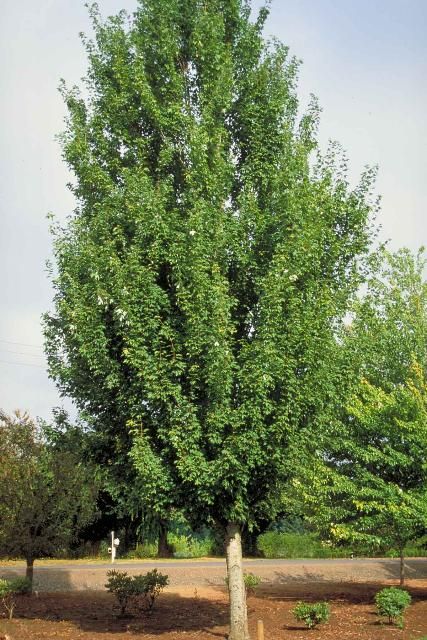
Credit: Ed Gilman
General Information
Scientific name: Acer rubrum
Pronunciation: AY-ser ROO-brum
Common name(s): 'Armstrong' red maple
Family: Aceraceae
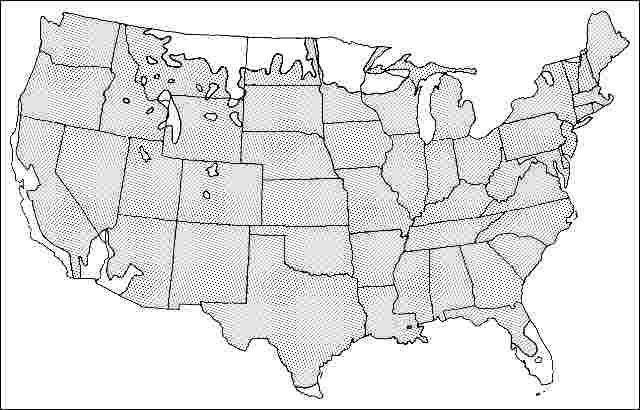
USDA hardiness zones: 4A through 9A (Fig. 2)
Origin: native to North America
Invasive potential: little invasive potential
Uses: reclamation; highway median; specimen; screen; street without sidewalk; tree lawn 4–6 feet wide; tree lawn > 6 ft wide; Bonsai
Availability: somewhat available, may have to go out of the region to find the tree
Description
Height: 50 to 60 feet
Spread: 15 to 25 feet
Crown uniformity: symmetrical
Crown shape: upright/erect, columnar
Crown density: moderate
Growth rate: fast
Texture: medium
Foliage
Leaf arrangement: opposite/subopposite (Fig. 3)
Leaf type: simple
Leaf margin: lobed, incised, serrate
Leaf shape: star-shaped
Leaf venation: palmate
Leaf type and persistence: deciduous
Leaf blade length: 2 to 4 inches
Leaf color: green
Fall color: yellow, orange, red
Fall characteristic: showy

Flower
Flower color: red
Flower characteristics: showy
Fruit
Fruit shape: elongated
Fruit length: 1 to 3 inches
Fruit covering: dry or hard
Fruit color: red
Fruit characteristics: attracts squirrels/mammals; showy; fruit/leaves not a litter problem
Trunk and Branches
Trunk/bark/branches: branches don't droop; not showy; typically one trunk; thorns
Pruning requirement: needed for strong structure
Breakage: susceptible to breakage
Current year twig color: reddish, gray
Current year twig thickness: medium
Wood specific gravity: 0.54
Culture
Light requirement: full sun, partial sun or partial shade
Soil tolerances: sand; loam; clay; acidic; well-drained; extended flooding
Drought tolerance: moderate
Aerosol salt tolerance: low
Other
Roots: can form large surface roots
Winter interest: yes
Outstanding tree: yes
Ozone sensitivity: unknown
Verticillium wilt susceptibility: susceptible
Pest resistance: resistant to pests/diseases
Use and Management
Having strong wood, it is well suited as a street tree in northern and mid-southern climates in residential and other suburban areas. Probably not suited for many downtown areas due to poor, dry soil. However, the narrow crown width makes it suitable for areas with limited horizontal space, such as a planting site close to a building. The upright-oriented branches and multiple trunks can develop embedded bark, creating a weak crotch that could split causing the branch to break out from the tree. Be sure to prune the tree to prevent this problem from developing by removing or pruning aggressive upright trunks so they do not become larger than about half the diameter of the main trunk. Thin bark is easily damaged in transport to the landscape and by lawn maintenance equipment.
The tree makes the best growth in wet or moist places and has no particular soil texture preference. However, chlorosis may develop on alkaline soil. The tree grows rapidly and has a moderately dense canopy in the sun but opens up in the partial shade. Irrigation is often needed to support street tree plantings in well-drained soil in the south. However, it appears to adapt to no irrigation in the south on a site where roots can explore on unlimited soil space. Roots raise sidewalks less often than silver maples do because of a slower growth rate and less aggressive root system. 'Armstrong' red maple is easily transplanted but can develop surface roots in soil ranging from well-drained sand to clay. 'Armstrong' red maple is moderately drought tolerant, benefitting from occasional irrigation, particularly in the southern part of the range.
Propagation is by grafting or cuttings, but own-root cuttings are preferred to avoid graft incompatibilities.
Pests
'Armstrong' is susceptible to leaf hoppers.
Aphids infest maples, usually Norway maple, and may be numerous at times. High populations can cause leaf drop. Another sign of heavy aphid infestation is honey dew on lower leaves and objects beneath the tree. Aphids are controlled by spraying or they may be left alone. If not sprayed, predatory insects will bring the aphid population under control.
Scales are an occasional problem on maples. Perhaps the most common is cottony maple scale. The insect forms a cottony mass on the lower sides of branches. Scales are usually controlled with horticultural oil sprays. Scales may also be controlled with well-timed sprays to kill the crawlers.
If borers become a problem it is an indication the tree is not growing well. Controlling borers involves keeping trees healthy. Chemical controls of existing infestations are more difficult. Proper control involves identification of the borer infesting the tree then applying insecticides at the proper time.
Diseases
Some scorch occurs during periods of high temperatures accompanied by wind. Trees with diseased or inadequate root systems will also show scorching. When trees do not get enough water they scorch. Scorch symptoms are light brown or tan dead areas between leaf veins and along the leaf margins. The symptoms are on all parts of the tree or only on the side exposed to sun and wind. Scorching due to dry soil may be prevented by watering. If scorching is due to an inadequate or diseased root system, watering will have no effect.
Nutrient deficiency symptoms are yellow or yellowish-green leaves with darker green veins. The most commonly deficient nutrient on maple is manganese. Implanting capsules containing a manganese source in the trunk will temporarily alleviate the symptoms. Test soil samples to determine if the soil pH is too high for best manganese availability. Plants exposed to weed killers may also show similar symptoms.