
Introduction
Three-flowered maple slowly grows to a height of 20 to 25 feet with an equal width, and the dense, rounded canopy casting dense shade below. The 1.5- to 3.5-inch-long, compound leaves are slightly hairy and turn attractive shades of orange and red in the fall before dropping. True to its name, three-flowered maple produces three greenish-yellow flowers clustered together in springtime and these are followed by 1- to 1.5-inch-long winged seeds, which persist on the tree. The red/brown bark is quite attractive and peels off in long, thin strips.

General Information
Scientific name: Acer triflorum
Pronunciation: AY-ser try-FLOR-um
Common name(s): Three-flowered maple
Family: Aceraceae
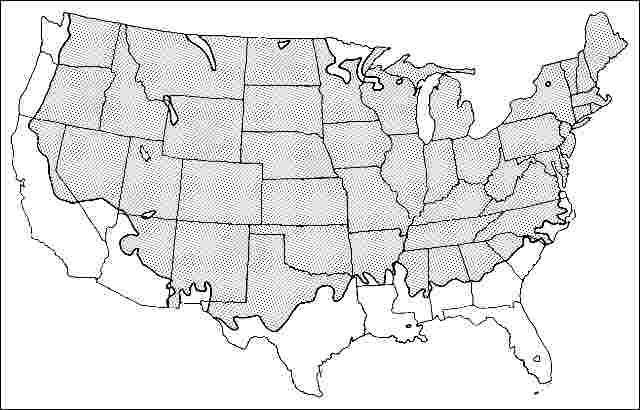
USDA hardiness zones: 3B through 7B (Fig. 2)
Origin: not native to North America
Invasive potential: little invasive potential
Uses: container or planter; trained as a standard; street without sidewalk; deck or patio; screen; specimen; tree lawn 3–4 feet wide; tree lawn 4–6 feet wide; tree lawn > 6 ft. wide
Availability: not native to North America
Description
Height: 15 to 25 feet
Spread: 15 to 25 feet
Crown uniformity: symmetrical
Crown shape: round, spreading
Crown density: dense
Growth rate: slow
Texture: fine
Foliage
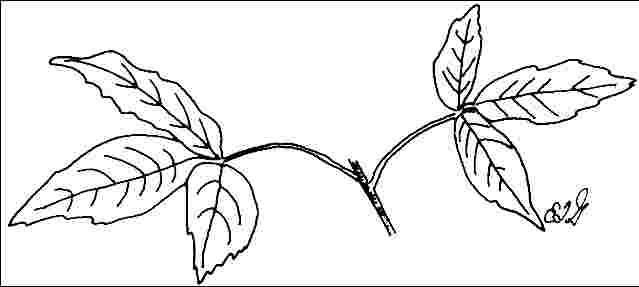
Leaf arrangement: opposite/subopposite (Fig. 3)
Leaf type: trifoliate, odd-pinnately compound
Leaf margin: entire
Leaf shape: oblong, lanceolate
Leaf venation: pinnate
Leaf type and persistence: deciduous
Leaf blade length: 2 to 4 inches
Leaf color: green
Fall color: orange, yellow, red
Fall characteristic: showy
Flower
Flower color: green, yellow
Flower characteristics: not showy
Fruit
Fruit shape: elongated
Fruit length: 1 to 3 inches
Fruit covering: dry or hard
Fruit color: green, tan
Fruit characteristics: does not attract wildlife; showy; fruit/leaves not a litter problem
Trunk and Branches
Trunk/bark/branches: branches droop; very showy; can be trained to one trunk; thorns
Pruning requirement: little required
Breakage: resistant
Current year twig color: brown
Current year twig thickness: thin, medium
Wood specific gravity: unknown
Culture
Light requirement: partial sun or partial shade, shade tolerant
Soil tolerances: clay; sand; loam; acidic; slightly alkaline; well-drained
Drought tolerance: moderate
Aerosol salt tolerance: moderate
Other
Roots: not a problem
Winter interest: yes
Outstanding tree: yes
Ozone sensitivity: unknown
Verticillium wilt susceptibility: susceptible
Pest resistance: resistant to pests/diseases
Use and Management
This handsome tree is well suited for use as a specimen planted in the lawn or in a low ground cover. The showy bark and fine texture combine to generate a striking display during the growing season. It provides interest in the winter when branches are bare to show the darkened bark, which contrasts nicely against snow.
Three-flowered maple grows best in full sun or partial shade on well drained soil. Due to its shallow root system, three-flowered maple will not tolerate soil compaction. It does not tolerate soil that remains wet for periods of time.
Pests and Diseases
No pests or diseases are of major concern.