
Introduction
Yellow buckeye reaches 60 to 75 feet in height with an oval to slightly spreading canopy and large, dark green leaves composed of five-fingered leaflets, casting dense shade below. The thick canopy makes this tree well suited for a tall screen or shade tree. Small yellow/green flowers appear in dense, upwardly-pointing, 6- to 7-inch-long, terminal panicles in early spring, and are followed by 2.5-inch-long, smooth, pear-shaped capsules containing bitter, poisonous seeds. The leaves change to brilliant yellow before dropping in autumn.

Credit: Ed Gilman
General Information
Scientific name: Aesculus flava
Pronunciation: ESS-kew-lus FLAY-vuh
Common name(s): Yellow buckeye, sweet buckeye
Family: Hippocastanaceae
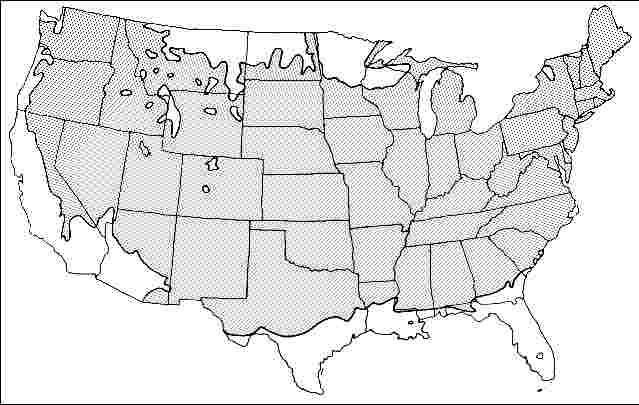
USDA hardiness zones: 4A through 8A (Fig. 2)
Origin: native to North America
Invasive potential: little invasive potential
Uses: screen; specimen; shade; highway median
Availability: somewhat available, may have to go out of the region to find the tree
Description
Height: 60 to 75 feet
Spread: 25 to 35 feet
Crown uniformity: symmetrical
Crown shape: oval
Crown density: dense
Growth rate: moderate
Texture: coarse
Foliage
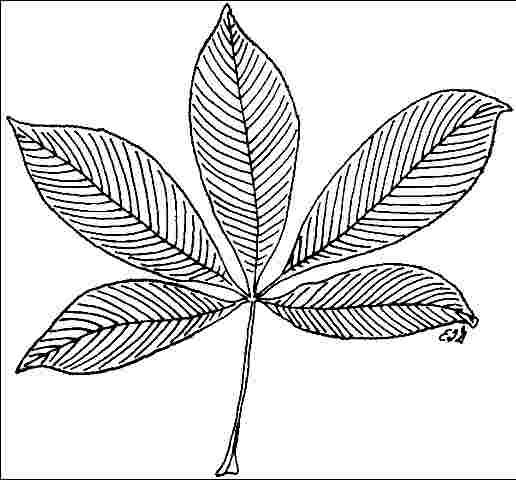
Leaf arrangement: opposite/subopposite (Fig. 3)
Leaf type: palmately compound
Leaf margin: serrate
Leaf shape: elliptic (oval)
Leaf venation: pinnate
Leaf type and persistence: deciduous
Leaf blade length: 4 to 8 inches
Leaf color: green
Fall color: yellow
Fall characteristic: showy
Flower
Flower color: yellow
Flower characteristics: very showy
Fruit
Fruit shape: oval, round
Fruit length: 1 to 3 inches
Fruit covering: dry or hard
Fruit color: brown
Fruit characteristics: attracts squirrels/mammals; showy; fruit/leaves a litter problem
Trunk and Branches
Trunk/bark/branches: branches droop; not showy; typically one trunk; thorns
Pruning requirement: needed for strong structure
Breakage: resistant
Current year twig color: brown, green
Current year twig thickness: thick
Wood specific gravity: unknown
Culture
Light requirement: full sun
Soil tolerances: clay; sand; loam; acidic; well-drained
Drought tolerance: moderate
Aerosol salt tolerance: moderate
Other
Roots: not a problem
Winter interest: no
Outstanding tree: yes
Ozone sensitivity: unknown
Verticillium wilt susceptibility: resistant
Pest resistance: resistant to pests/diseases
Use and Management
The tree has a striking, coarse texture and leaves that are as dark as any other tree, attracting attention as a specimen plant. But save it for large areas so the wonderful form of this large tree can be appreciated. Certainly not suited for small residences due to its overpowering size and texture. Leaf and flower litter in the summer and fall may be objectionable to some people. The nuts make good food for wildlife, but you may not want it scattered along city streets.
A North American native, yellow buckeye grows best along stream beds in full sun or partial shade and should be planted in moist, well-drained soil rich in organic matter. It is not as susceptible to foliage diseases as Aesculus hippocastanum.
Propagation is by seed.
Pests and Diseases
No pests or diseases of major concern are known at this time.