
Introduction
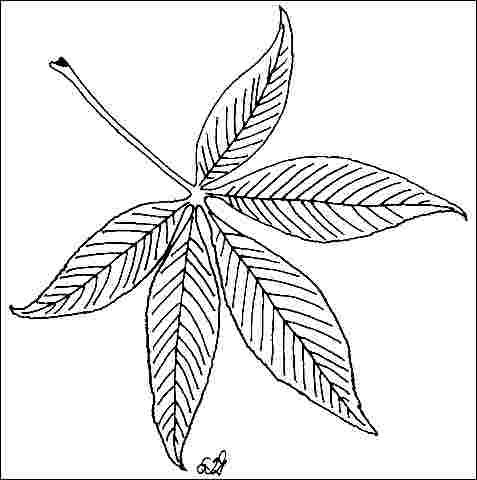
A true North American native, Ohio buckeye forms a short trunk with a low branching structure, creating an oval to rounded canopy 40 to 50 feet wide on a tree 50 to 70 feet tall. The four- to six-inch-long, coarse, bright green, palmately compound leaves have an unpleasant odor when crushed, as do the twigs, giving this tree its other common name of "fetid buckeye". The fragrance should be a warning sign for this plant since all parts of it are poisonous, a factor which should be considered when placing it in the landscape. One of the first trees to shed its leaves in autumn, Ohio buckeye puts on a vivid display of bright orange and yellow fall foliage. The spring flowers are also quite showy, the erect, yellow/green, six-inch-high panicles decorating the branches. The one- to two-inch-long, showy, brown fruits ripen in late summer and may become a litter problem since they are very prickly. These fruits are quite popular with squirrels and other wildlife.

General Information
Scientific name: Aesculus glabra
Pronunciation: ESS-kew-lus GLAY-bruh
Common name(s): Ohio buckeye, fetid buckeye
Family: Hippocastanaceae
USDA hardiness zones: 4A through 7A (Fig. 2)
Origin: native to North America
Invasive potential: little invasive potential
Uses: shade; highway median
Availability: not native to North America

Description
Height: 50 to 70 feet
Spread: 40 to 50 feet
Crown uniformity: symmetrical
Crown shape: round
Crown density: dense
Growth rate: moderate
Texture: coarse
Foliage
Leaf arrangement: opposite/subopposite (Fig. 3)
Leaf type: palmately compound
Leaf margin: serrate
Leaf shape: elliptic (oval), ovate
Leaf venation: pinnate
Leaf type and persistence: deciduous
Leaf blade length: 2 to 4 inches, 4 to 8 inches
Leaf color: green
Fall color: yellow, orange
Fall characteristic: showy
Flower
Flower color: yellow
Flower characteristics: very showy
Fruit
Fruit shape: oval, round
Fruit length: 1 to 3 inches
Fruit covering: dry or hard
Fruit color: brown
Fruit characteristics: attracts squirrels/mammals; showy; fruit/leaves a litter problem
Trunk and Branches
Trunk/bark/branches: branches droop; not showy; typically one trunk; thorns
Pruning requirement: needed for strong structure
Breakage: resistant
Current year twig color: reddish, brown
Current year twig thickness: thick
Wood specific gravity: unknown
Culture
Light requirement: full sun, partial sun or partial shade
Soil tolerances: sand; loam; clay; acidic; extended flooding; well-drained
Drought tolerance: moderate
Aerosol salt tolerance: none
Other
Roots: not a problem
Winter interest: yes
Outstanding tree: no
Ozone sensitivity: sensitive
Verticillium wilt susceptibility: resistant
Pest resistance: sensitive to pests/diseases
Use and Management
Ohio buckeye will grow in full sun or partial shade on well drained, fertile soil but should not be exposed to extended drought or excessive heat, two factors which make this tree unsuitable for use as a street tree. Falling fruit would also be a problem along streets. It is suited for naturalized plantings or for establishing a native grove in a park. The fruit can be quite entertaining for children.
Propagation is by seed.
Pests
No pests are of major concern.
Diseases
Leaf blotch, powdery mildew, and leaf scorch.