
Introduction
This non-native deciduous tree will rapidly grow to 70 to 100 feet in height and produces an open canopy of stout branches covered with one- to three-foot-long, pinnately compound, dark green leaves. Broken stems smell of rancid peanut butter, and males reportedly smell worse than female trees. The leaves turn only slightly yellow in fall before dropping. The small, green, male and female flowers are produced on separate trees and appear in dense, terminal clusters. The 1.5-inch-long, yellow to red/brown, winged fruits that follow the blossoms will persist on the tree in dense clusters throughout the fall and into the winter months, and are quite attractive. They can create a crunchy mess when they fall to the ground. Seeds sprout easily and seedlings usually invade surrounding land.
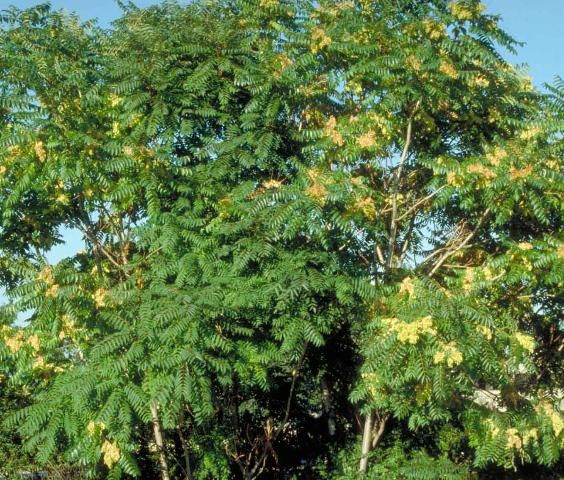
Credit: Ed Gilman
General Information
Scientific name: Ailanthus altissima
Pronunciation: ay-LANTH-us al-TISS-sim-muh
Common name(s): Tree-of-heaven
Family: Simaroubaceae
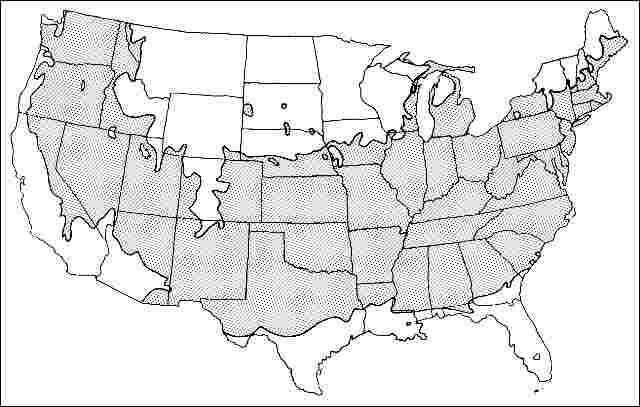
USDA hardiness zones: 5A through 8A (Fig. 2)
Origin: not native to North America
Invasive potential: invasive non-native
Uses: reclamation
Availability: not native to North America
Description
Height: 60 to 75 feet
Spread: 35 to 50 feet
Crown uniformity: irregular
Crown shape: upright/erect
Crown density: open
Growth rate: fast
Texture: coarse
Foliage
Leaf arrangement: alternate (Fig. 3)
Leaf type: even-pinnately compound
Leaf margin: ciliate
Leaf shape: ovate
Leaf venation: pinnate
Leaf type and persistence: deciduous
Leaf blade length: 2 to 4 inches, 4 to 8 inches
Leaf color: green
Fall color: no color change
Fall characteristic: not showy

Flower
Flower color: green
Flower characteristics: showy
Fruit
Fruit shape: elongated
Fruit length: 1 to 3 inches
Fruit covering: dry or hard
Fruit color: orange, yellow
Fruit characteristics: does not attract wildlife; showy; fruit/leaves a litter problem
Trunk and Branches
Trunk/bark/branches: branches don't droop; not showy; typically one trunk; thorns
Pruning requirement: needed for strong structure
Breakage: susceptible to breakage
Current year twig color: brown, reddish
Current year twig thickness: very thick
Wood specific gravity: unknown
Culture
Light requirement: full sun, partial sun or partial shade
Soil tolerances: clay; sand; loam; alkaline; acidic; occasionally wet; well-drained
Drought tolerance: high
Aerosol salt tolerance: moderate
Other
Roots: can form large surface roots
Winter interest: yes
Outstanding tree: no
Ozone sensitivity: sensitive
Verticillium wilt susceptibility: susceptible
Pest resistance: resistant to pests/diseases
Use and Management
Tree-of-heaven performs best in full sun on well drained, moist soil, but this is a tree that will survive almost anywhere, under any cultural conditions—smoke, dust, hot, cold, wet, or dry. It has been known to appear in cracks of pavement or even trash piles, and it will survive where no other trees will grow. Spreading rapidly by seed and suckers, tree-of-heaven is viewed by many as a pest- and weed-tree. But if well cared for, this tree can persist for a long time. Large specimens are known to grow trunks up to five feet in diameter.
Propagation is by seed and suckers.
Pests
No pests are of major concern.
Diseases
No diseases are of major concern, except for verticillium wilt.