
Introduction
Researchers who visited post-hurricane sites found that many incidents of tree failure could have been prevented with appropriate design and management. Many trees of a large size had been placed too close to curbs, sidewalks, foundations, and pavement. Roots on mature trees had been deflected, decayed, or cut close to the trunk. These conditions resulted in trees toppling in high winds.
A strong root system is one of the most critical factors that allow trees to withstand hurricane-force winds in urban landscapes, where space for root growth is often limited. Limited rooting space presents a challenge for creating sustainable landscapes. Strategies for developing strong root systems on newly planted trees and preserving the roots of existing trees will be discussed in this document. Other elements of wind-resistant design such as tree grouping and species selection will also be introduced.
Research shows that the more rooting space trees have, the less likely they are to fall. Root systems that grow without being deflected by curbs, sidewalks, pavement, and other urban soil structures have a chance to develop a strong supporting base for the tree. Main roots close to the trunk should be straight. If these roots are deflected or cut during construction, then the risk of failure increases significantly. Trees growing in groups have higher rates of survival than trees that stand individually. Groups of trees also divert wind, so they offer more protection for nearby buildings compared to isolated trees.
Good design includes designing the underground soil space to support trees and selecting the right tree. However, many landscapes have already been established. So, it is important to first address design solutions for existing situations where trees conflict with the landscape.
Existing Design Situations
Every day people pass by trees that are growing in conflict with the existing landscape: the parking lot of the grocery store, the sidewalks downtown, the front yards of their homes, and so on. In each of these situations, when trees have a limited space to grow, pavement begins to interfere with root expansion 10 to 20 years after planting (Figure 1). The problem can begin as a crack in the surface of the pavement, which attracts growing roots and eventually results in an entire section being lifted. This can present a trip hazard to pedestrians passing by. Large maturing trees grown in small spaces will do one of two things: grow and disturb the hardscape or decline and eventually die.
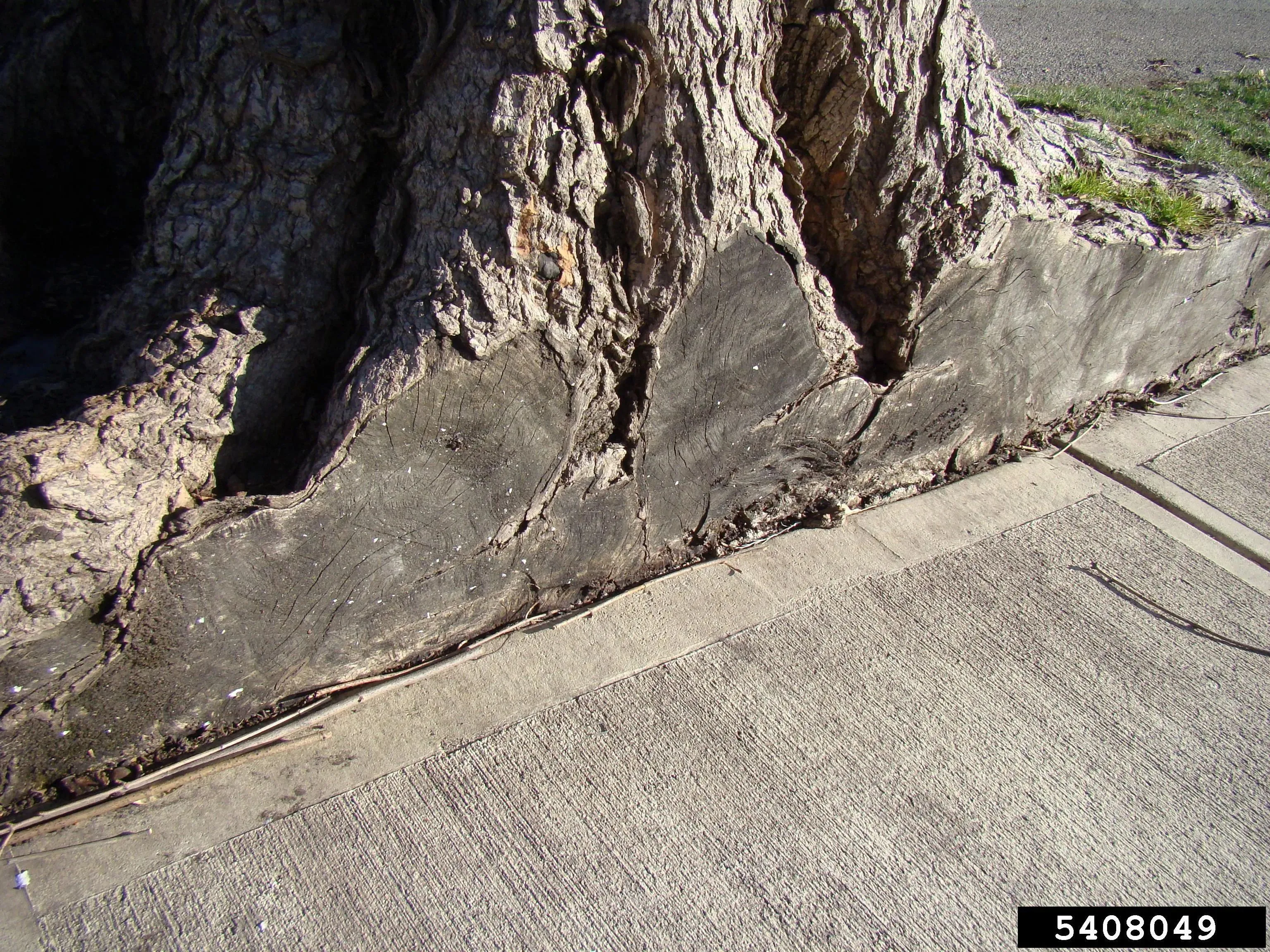
The latter outcome is wasteful and impractical because the cost of planting a tree in an urban area can range from hundreds to thousands of dollars. Tree removal and replanting is yet another expense, and still the design objective is not fulfilled. In the former scenario, in which the tree continues to grow in conflict with the hardscape, often the large anchoring roots are cut when the hardscape is repaired (Figure 2). Many urban tree managers have learned from experience that cutting structural or support roots is a poor decision because it makes the tree unstable. Trees with cut roots have fallen over and damaged homes and vehicles. They have even killed people. It should be clear that for the sake of wind resistance, cutting or damaging the root system that anchors the tree is not an option! Trees that lack their main supporting roots are often a high or unacceptable risk in the landscape.
When root pruning is necessary, the general guideline is to preserve all roots within an area of about five times the trunk diameter. For example, if the trunk diameter is 2 feet, then do not prune roots within 10 feet of the trunk. Although this will not guarantee that the tree will remain standing, it is better than cutting closer to the trunk.

Photo Credit: Adobe Stock, Simone
Credit: Photo UF/IFAS, Dr. Ed Gilman
Design Solutions for Situations Where Roots Conflict With the Landscape
Rather than cutting the roots, there are many different techniques that have been used that do not interfere with the root system of the tree. Several of these are discussed below.
Install different surface material
Materials other than concrete can be used as a surface for sidewalks. Some examples are crushed granite, gravel, rubber surfacing, wood decking, brick-in-sand, and asphalt (Figure 3). Porous pavers and porous asphalt have been used for parking lots with success. A potential benefit to these alternate surface materials is that they provide some aeration to the soil beneath, versus concrete, which traps moisture and can encourage roots to grow directly under and break the pavement. Most of these materials are flexible, so they are less likely to crack from root growth than a rigid surface like concrete. Repairing these alternate surface materials can also be less expensive than traditional hard surfaces.
Stone dust
Surface materials like gravel, limestone, or stone dust allow continued root growth and expansion. The surface can be easily repaired as roots continue to expand in diameter. Crushed rock is inexpensive and easy to install, and the surface is porous. It is best used on flat surfaces because rain can cause erosion on sloping ground. The use of brick pavers can provide a route for pedestrians walking from the parking lot to the other side of the street. Displaced stones will need to be replaced occasionally and may be a nuisance when using equipment such as a leaf blower (Gibbons, 1999).

Photo Credit: Adobe Stock, krsprs
Porous pavers
- This solution is most used for paved areas such as parking lots (Figure 4). Porous surfaces are a good idea for areas prone to flooding because they allow some water to permeate for more even distribution and can help reduce runoff problems. This is an especially important design detail for Florida and the Gulf Coast, which is prone to heavy tropical rains.
Soil should be added around the roots to prepare a base for the pavers. Coarse sand works nicely as a sub-base for the porous pavers because it compacts yet allows enough air space between particles for air movement. Be sure that the soil grade is not lowered during the construction process, because this will damage roots.

Photo Credit: Adobe Stock, heerim studio
Fill and re-pour sidewalk
Like many other solutions, this can be a short-term solution that often requires repair in the future. Perhaps using alternate sub-base materials like gravel or rubber chips (instead of soil) and then re-pouring will prevent roots from growing directly under the pavement and lifting them. Reinforcing the concrete with rebar can extend the life of the sidewalk or driveway by forcing the expanding roots to lift the entire slab. This can prevent cracking because the root can deform and become flattened under the slab instead of lifting it.
Bridging
Surface materials such as interlocking concrete pavers, wood decking, rubber sidewalks, or metal can be used to bridge over roots.
Reroute
Where possible, redirecting the sidewalk is a great option if there is space. This solution is used for many trees in urban areas. Be sure to put a mechanism in place that prevents contractors from damaging the main support roots during sidewalk repair.
New Design/Construction: Designing the Right Place
A good design should provide enough soil space to support root growth of the tree. The volume of soil required depends on the expected size of the tree. Unfortunately, many trees are squeezed into soil spaces that are large enough for the root ball at planting but way too small for future root growth. This is a main reason for poor growth and instability of trees in hurricanes.
Current design practices will have to change significantly to give trees the appropriate amount of soil space. A typical design specification can call for a volume of 200 cubic feet of soil for trees, whereas 2,000 to 3,000 cubic feet would be an ideal amount. This is a drastic difference! The table and design solutions presented here attempt to strike a compromise between these two extremes.
Soil requirements
For situations where the planting area is surrounded by paved surfaces, Table 1 provides guidelines for the minimum amount of soil to provide based on tree size at maturity. There are two components to soil space: 1) the total soil volume needed to sustain a tree for a reasonable period, and 2) the open soil area needed immediately surrounding the trunk to accommodate trunk flare growth. Open soil space is soil that is not covered by a solid hard surface such as a sidewalk, pavement, or building.
Table 1. Soil requirements for trees based on their size at maturity
Measurements for when root-able soil depth is 3 feet or greater. For soil less than 3 feet deep, smaller maturing trees are recommended.
The soil guidelines in Table 1 are minimum recommendations intended for good quality, well-drained soils. When the soil has limitations such as compaction, high water table, poor drainage, etc., provide more space, or choose small maturing trees. Although these recommendations are significantly different from a typical specification, much more rooting space is necessary for trees to be more stable in the landscape and to be appropriately considered a wind-resistant design. For species specific planting widths and distances, see “ENH 1328, How Much Space Does My Shade Tree Need?” (Hilbert et al. 2020).
Design Solutions for Urban Situations Where Space Is Limited
There are many options for increasing soil area for trees in downtown landscapes, malls, and other urban situations where pavement is very close in proximity to the trunk. This section will list options for increasing soil area in this type of environment or making better use of existing site soil.
Step 1-Plant trees in the open space available
Study Figure 5 carefully—notice the limited size of the cutout that the tree is planted in. If planted in the open lawn, the trees have a better chance to become large, provide shade for people using the space, and reduce cooling costs for nearby buildings. Instead, they will have a shorter lifespan due to the limited growing space. Tree grates like that shown cause more harm than good. Pavers are a better option.

Photo Credit: Adobe Stock, Doublelee
We are accustomed to seeing trees planted in a thin strip of lawn between the sidewalk and street (Figure 6). Sidewalks often become displaced and broken as roots expand in diameter. Not only is damage to the sidewalk from root expansion expensive to repair, but trees would be more stable if they were planted in the open space on the other side of the walk. This is a simple solution that can reduce the incidences of trees blowing over. When fewer curbs surround the tree, the tree grows faster and has a more balanced root system. The tree becomes more stable because the root flare can fully develop without obstruction from the sidewalk and curb.

Photo Credit: Adobe Stock, Doublelee
Step 2—If there is no open space, provide more root-able soil
Sidewalks in high-traffic downtown areas must be designed to support emergency vehicle weight. Hence, the soil beneath the sidewalk is compacted to prevent settlement and cracking of the sidewalk. However, trees thrive best in loose, porous soil that encourages root growth. These two objectives—stable walks and loose soil for roots—typically conflict with each other unless we design the space appropriately. So how do you create a stable wearing surface and space for trees to grow?
Root paths are narrow channels of loose soil that provide a small path for air that encourages root growth under pavement. A trenching machine is used to cut an opening through the compacted soil. Aeration mats are then placed in the trenches, which are backfilled with loose soil once the mat is in place. Roots tend to follow the paths because they provide a channel for airflow adjacent to the mat; roots follow the air. Encouraging roots to spread under the pavement can help to prevent roots from circling around in the small cutout in the sidewalk, which is a common cause for trees blowing over during hurricanes. This method is preferred over just providing a cutout or box of soil, though it does not significantly increase the amount of soil space.
Planting strips are long sections of soil without pavement on top that provide much more soil volume for trees than root paths. This is a necessary design consideration because it is important to keep pedestrian traffic off the open soil around these trees to prevent soil compaction. Given this consideration, planting strips may be more practical in areas that are less busy. Planting turf and flowers at the base of the tree makes it far more likely that the trees will receive adequate irrigation and could improve tree growth, though this may attract people to sit or walk on the turf. Never pile soil on top of the root ball or on the trunk.
The minimum width of a planting strip, or planting location between a curb and sidewalk, should consider that expected tree size and typical habitat the tree is native to (Hilbert et al., 2020). As the expected tree size increases, more growing space is needed. For example, a minimum of 12- (upland species) to 14- (wetland species) foot planting strips should be designed for growing larger trees (40-inch trunk diameter). This would give approximately 4.5 to 5.5 feet of growing space beyond the tree trunk. The upfront designed space will minimize future infrastructure damage, allow desired expected tree sizes, and increase resistance to blowing over during a hurricane.
Structural soil
Structural soil is designed to support the weight of walks, roads, pedestrians and vehicles, as well as to provide a well-aerated soil substrate for tree root growth. In structural soil, weight is transferred from one aggregate (rock) to another, with enough soil to almost fill the space between the aggregates. The aggregates are angular rocks that are typically about 1 inch in diameter. Roots grow well in the soil between the aggregates, which is not compacted because load is transferred to the rocks.
This technique is being used in urban areas due to its effectiveness at supporting heavy traffic and allowing tree growth in tough urban situations. The process of mixing the soil can be labor intensive and needs to be done very carefully. Because 80 percent of the volume of structural soil consists of rocks, a large amount is needed to meet adequate root volume requirements.
Suspended sidewalk
Sidewalk suspension or cantilever can allow a great deal of soil volume for trees and addresses the issue of compaction. There is no contact between the bottom of the sidewalk slab and the soil; the slabs rest on supports and pilings. This allows the planting pit to be filled with well-aerated quality soil. Suspending the sidewalk avoids issues with soil compaction so that roots can spread without interrupting the hardscape. One product, Silva Cells®, is an example of the suspended sidewalk technique.
Step 3—Plant trees in groups
In addition to root space, a key design consideration for a wind-resistant landscape is to plant trees in groups (Figure 7). The definition for grouping is five or more trees sharing the same soil space. The goal is to create a healthy urban forest with a mixture of young and mature trees that provide benefits such as canopy cover and protection from high winds. Damage to buildings and other structures is usually less severe on properties with high tree density than on properties with isolated trees spaced far apart.

Credit: Photo Adobe Stock, Production Perig
New Design/Construction: Selecting the Right Tree
When soil space is limited, or the soil is shallow (less than 2- or 3-feet depth), rocky, or of poor quality, plant small maturing trees (those that mature at less than about 35 feet). There is an exciting variety of small trees, currently underused for urban plantings, but some of them are not available in large sizes. Although they are shorter than large maturing trees, small trees still provide some shade benefits. Rather than planting a large tree in a confined space, where much damage could occur from the tree blowing down during a hurricane, the preferred option is to go with the smaller tree which is more likely to survive a hurricane (see Choosing Suitable Trees for Urban and Suburban Sites: Site Evaluation and Species Selection). Research has found that certain tree species, including many native species and palms, tolerate hurricanes (see Selecting Species for Wind Resistance: Coastal Plain and Tropical and Subtropical).