
This document is a part of a series originally written by Edward F. Gilman.
Introduction
Baby sun rose is a perennial groundcover with a prostrate growth habit. This plant may reach a height of 3 to 4 inches and spreads in the landscape, hugging the ground forming a tight, almost clipped appearance (Figure 1). This plant has 1-inch-long dark green glossy foliage (Figure 2) and bright red, pink, or purple aster-like flowers that bloom nearly year-round (Figure 3). This plant is well suited for use in a hanging basket, cascading down a wall, as a groundcover, or in a mass planting.

Credit: © harrylurling, some rights reserved (CC-BY-ND) via iNaturalist
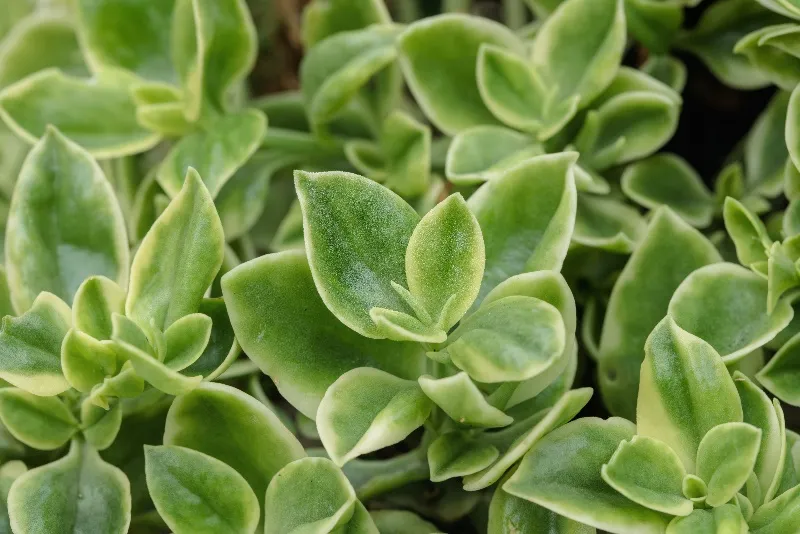
Credit: Amalia Gruber via Adobe Stock

Credit: © gricel_arancibia, some rights reserved (CC-BY-NC) via iNaturalist
General Information
Scientific name: Mesembryanthemum cordifolium
Previous name(s): Aptenia cordifolia
Pronunciation: mes-em-bry-ANT-thee-mum cor-di-FULL-e-um
Common name(s): baby sun rose, heartleaf iceplant
Family: Aizoaceae
Plant type: groundcover
USDA hardiness zones: 10A through 11B (Figures 4 and 5)

Credit: This map is based on the 2023 USDA Plant Hardiness Zone Map. Visit https://planthardiness.ars.usda.gov/ for specific zone information.

Credit: This map is based on the 2023 USDA Plant Hardiness Zone Map. Visit https://planthardiness.ars.usda.gov/ for specific zone information.
Planting month for zones 10 and 11: year-round
Origin: native to Africa
Invasive potential: Not considered a problem species at this time
Uses: hanging basket; cascading down a wall; groundcover; mass planting; bedding plant; annual; rock garden
Availability: somewhat available, may have to go out of the region to find the plant
Description
Height: up to 4 inches
Spread: 1 to 2 feet
Plant habit: prostrate (flat)
Plant density: dense
Growth rate: slow
Texture: fine
Foliage
Leaf arrangement: opposite/subopposite
Leaf type: simple
Leaf margin: entire
Leaf shape: ovate
Leaf venation: none, or difficult to see
Leaf type and persistence: evergreen
Leaf blade length: less than 2 inches
Leaf color: green
Fall color: no fall color change
Fall characteristic: not showy
Flower
Flower color: red; pink; purple
Flower characteristic: spring-flowering; summer-flowering; fall-flowering; nyctinastic (flowers open during the day and close at night)
Fruit
Fruit shape: round; capsule
Fruit length: less than 1 inch
Fruit cover: dry or hard
Fruit color: brown
Fruit characteristic: inconspicuous and not showy
Trunk and Branches
Trunk/bark/branches: not applicable
Current year stem/twig color: green
Current year stem/twig thickness: medium
Culture
Light requirement: plant grows in full sun
Soil tolerances: acidic; slightly alkaline; sand; loam
Drought tolerance: high
Soil salt tolerances: good
Plant spacing: 24 to 36 inches
Other
Roots: not applicable
Winter interest: evergreen foliage
Pest resistance: long-term health usually not affected by pests
Use and Management
Baby sun rose should be planted in full sun, in well-drained soil to prevent root rot. After watering plants in containers, be sure to allow the soil to become fairly dry before watering again. Established landscape plants should require little if any irrigation in most years. A light fertilization two or three times during the year should be all the plant needs to maintain a good appearance.
This plant is best suited for a coastal landscape where wind and sandy soil keep the soil dry. It may be grown in a hanging basket in a well-drained medium or as a groundcover in a small landscape or rock garden.
Design Considerations
The low-growing habit and small leaves of the baby sun rose cover the ground in a thick, lush layer of green, perfect for filling in among other plants in the landscape. Simple forms and light or medium green foliage of companion plants will highlight the dark green glossy foliage of the sun rose. Clumping plants with upright form and larger textured leaves or strap-blade leaves would also contrast well with the matting, low-growing form. Locate it in front of an upright, grass or grass-like plant such as one of the ornamental grasses, African iris, or spartina to make a stunning, contrasting combination.
The mass of green works well with different flower colors, but bright and light colors will show the best next to the dark green foliage. Small or medium-size flowers with simple forms will contrast with the small dark flowers without adding too much detail.
Pests and Diseases
No pests or diseases of major concern. Overwatering can cause root rot, leading to poor plant growth, chlorosis, and plant death.