
This Florida-Friendly Landscaping™ publication is part of a series originally written by Edward F. Gilman. Visit https://FloridaFriendlyLandscaping.com to learn more about creating and maintaining attractive landscapes that protect Florida's water resources and environment.
Introduction
Smooth aster is a herbaceous perennial with an upright, branching growth habit that reaches a height of 3 feet and spread of 4 feet (Figure 1). The gray-silver leaves of smooth aster have a fine texture and clasp the stem, and lavender daisy-like flowers appear on the plant in the late summer through fall (Figures 2 and 3). This plant is an excellent option for pollinator gardens, as it will attract butterflies, bees, birds, and other pollinators. It is a late season bloomer and may reseed itself in the landscape. This Florida native plant is drought tolerant and adapts to a variety of site conditions. It is well suited in a naturalized area or pollinator garden, edging in landscape beds, or may be utilized as cut flowers.

Credit: beres via AdobeStock

Credit: © Levi smith, some rights reserved (CC-BY-NC) via iNaturalist
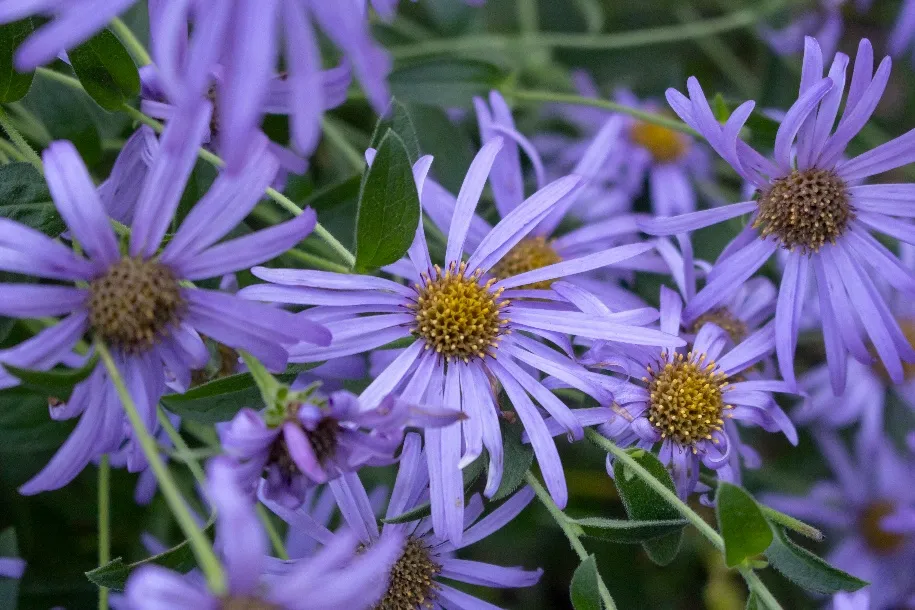
Credit: DAVID via AdobeStock
General Information
Scientific name: Symphyotrichum laeve
Previous scientific name(s): Aster laevis (synonym)
Pronunciation: sim-fy-oh-TRY-kum LAY-vey
Common name(s): smooth aster, smooth blue aster, smooth-leaf aster
Family: Asteraceae
Plant type: herbaceous, perennial
USDA hardiness zones: 4B through 8B (Figures 4 and 5)

Credit: This map is based on the 2023 USDA Plant Hardiness Zone Map. Visit https://planthardiness.ars.usda.gov/ for specific zone information.

Credit: This map is based on the 2023 USDA Plant Hardiness Zone Map. Visit https://planthardiness.ars.usda.gov/ for specific zone information.
Planting month for zone 7: year-round
Planting month for zone 8: year-round
Planting month for zone 9: year-round
Origin: native to Florida
Uses: mass planting; edging; attracts butterflies and other pollinators; cut flowers; naturalized area
Availability: somewhat available, may have to go out of the region to find the plant
Description
Height: 2 to 3 feet
Spread: 2 to 4 feet
Plant habit: upright, branching
Plant density: symmetrical habit with a regular (or smooth) outline and individuals having fairly identical forms
Growth rate: fast
Texture: fine
Foliage
Leaf arrangement: alternate
Leaf type: simple
Leaf margin: entire
Leaf shape: lanceolate
Leaf venation: none, or difficult to see
Leaf type and persistence: deciduous
Leaf blade length: 2 to 4 inches
Leaf color: green
Fall color: no fall color change
Fall characteristic: not showy
Flower
Flower color: lavender; yellow
Flower characteristic: fall flowering, showy
Fruit
Fruit shape: oblong
Fruit length: less than 1 inch
Fruit cover: dry or hard
Fruit color: brown
Fruit characteristic: inconspicuous and not showy
Trunk and Branches
Trunk/bark/branches: typically multi-trunked or clumping stems
Current year stem/twig color: green
Current year stem/twig thickness: thin
Culture
Light requirement: plant grows in full sun
Soil tolerances: acidic; slightly alkaline; sand; loam; clay
Drought tolerance: moderate
Soil salt tolerances: unknown
Plant spacing: 18 to 24 inches
Other
Roots: not applicable
Winter interest: no special winter interest, winter dormancy
Invasive potential: not known to be invasive
Pest resistance: long-term health usually not affected by pests
Use and Management
Smooth aster thrives when planted in full sun but tolerates partial shade. Full sun locations will encourage more prolific blooming. It is adaptable to a variety of soil conditions and is moderately drought tolerant. As this plant has an upright branching growth habit and rapid growth rate, some maintenance may be required. This plant performs well as edging in the landscape or in a group planting. It makes a nice component in a mixed border. Smooth aster is also a larval hostplant for the Pearl Cresent butterfly, and attractive to pollinators including butterflies, birds, and several species of specialized bees. The flowers of smooth aster can be cut for flower arrangements, as they last several days indoors.
Smooth aster is propagated by softwood cuttings or by division.
Design Use
To best showcase smooth aster, leverage its fine, gray-silver foliage and light blue-lavender flowers by creating strong visual contrast. Pair its cool tones with the warm golds of ornamental grasses or the deep burgundy of dark-leaved perennials to make the blooms pop, or set them against crisp white flowers for a clean, classic look. Texturally, you can either harmonize its delicate stems with other airy grasses for a soft, meadow-like feel, or contrast them against bold, broad-leaved plants to highlight their graceful form. For maximum impact, plant the aster in small drifts in the mid-to-back of the border, where its flowers can float above shorter plants against a solid evergreen backdrop. Placing these drifts near a pathway allows for close appreciation, while using a neat, low-growing edging plant will frame the aster's looser habit.
Pests and Diseases
No pests or diseases of major concern.