
This Florida-Friendly Landscaping™ publication is part of a series originally written by Edward F. Gilman. Visit https://ffl.ifas.ufl.edu/ to learn more about creating and maintaining attractive landscapes that protect Florida's water resources and environment.
Introduction
Pot marigold is an herbaceous cool-season annual in the daisy (Asteraceae) family, which is native to regions of Europe and the Mediterranean. This plant has a round growth form and may reach a height and spread up to 2 feet (Figure 1). Leaves are fragrant and vary in shape between lanceolate and obovate (Figure 2). Flowers are single or double and may be red, orange, or yellow (Figure 3). In USDA hardiness zones 9B, 10, and 11, pot marigold is generally planted in the fall for winter and spring color. This plant is well suited for containers or above-ground planters, adds dramatic color when planted en masse, may be used as cut flowers, or has culinary uses (flowers are edible when not sprayed by pesticides). This plant has been noted to be a natural herbivore and pest repellent.

Credit: © sunny1az, some rights reserved (CC BY-NC) via iNaturalist

Credit: © Alexander Baransky, some rights reserved (CC BY-NC) via iNaturalist
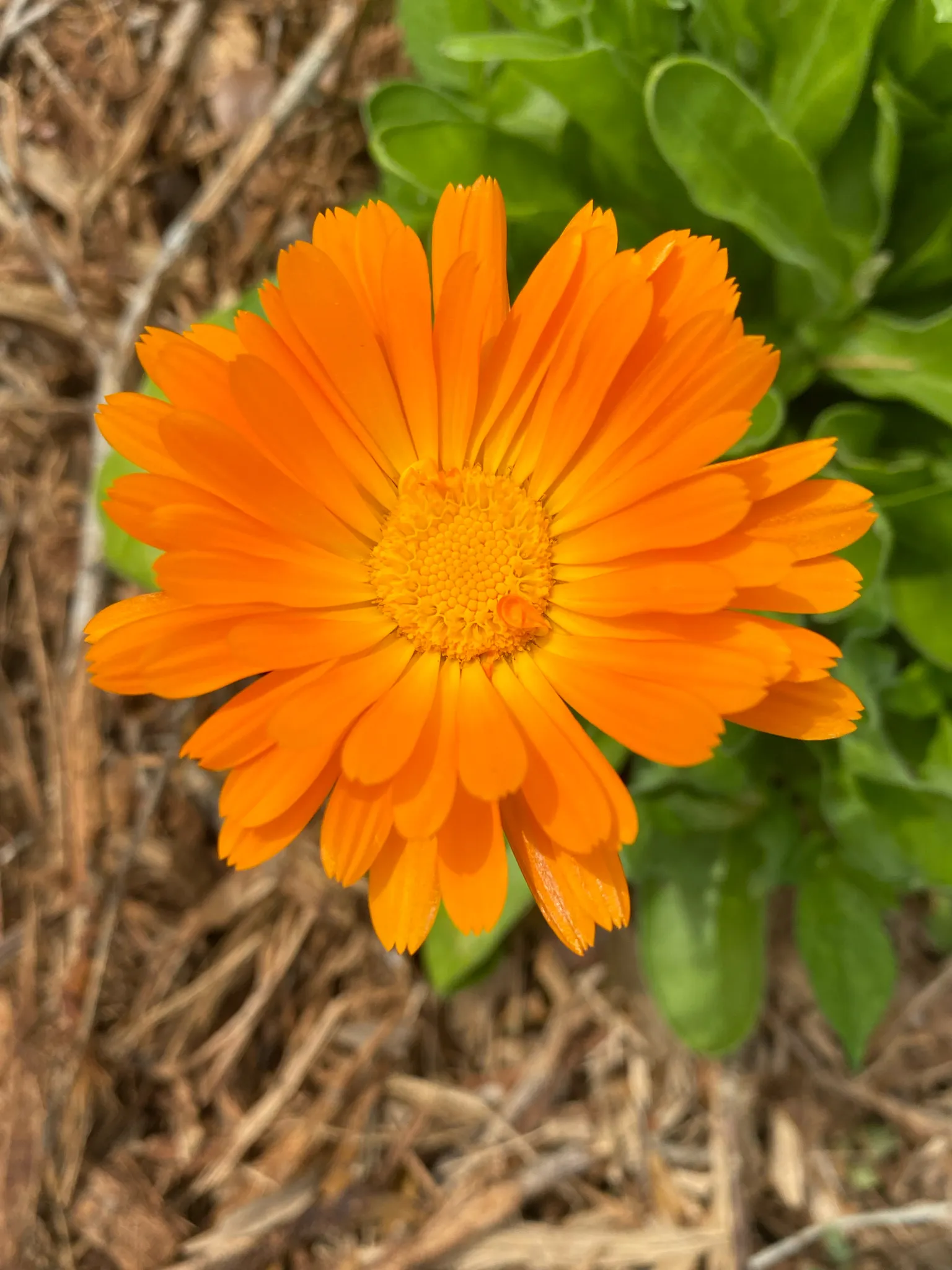
Credit: © Mandie Quark, some rights reserved (CC BY-NC) via iNaturalist
General Information
Scientific name: Calendula officinalis
Pronunciation: kuh-LEND-yoo-luh off-fiss-in-AY-liss
Common name(s): Calendula, pot marigold, English marigold, Scotch marigold
Family: Asteraceae
Plant type: herbaceous, annual
USDA hardiness zones: all zones (Figures 4 and 5)

Credit: This map is based on the 2023 USDA Plant Hardiness Zone Map. Visit https://planthardiness.ars.usda.gov/ for specific zone information.

Credit: This map is based on the 2023 USDA Plant Hardiness Zone Map. Visit https://planthardiness.ars.usda.gov/ for specific zone information.
Planting month for zone 7: May
Planting month for zone 8: Mar; Apr; Sep; Oct
Planting month for zone 9: Nov; Dec; Jan; Feb; Mar
Planting month for zones 10 and 11: Dec; Jan; Feb
Origin: not native to North America
Uses: container or above-ground planter; mass planting; cut flowers; attracts butterflies; culinary (when properly handled and no pesticides have been applied)
Availability: somewhat available, may have to go out of the region to find the plant
Description
Height: 1 to 2 feet
Spread: 1 to 2 feet
Plant habit: round
Plant density: dense
Growth rate: moderate
Texture: medium
Foliage
Leaf arrangement: alternate
Leaf type: simple
Leaf margin: entire
Leaf shape: ovate; obovate; lanceolate
Leaf venation: pinnate
Leaf type and persistence: not applicable, fragrant
Leaf blade length: 2 to 4 inches
Leaf color: green
Fall color: not applicable
Fall characteristic: not applicable
Flower
Flower color: yellow; orange; red
Flower characteristic: showy
Fruit
Fruit shape: irregular
Fruit length: less than 1 inch
Fruit cover: dry or hard
Fruit color: brown
Fruit characteristic: inconspicuous and not showy
Trunk and Branches
Trunk/bark/branches: not applicable
Current year stem/twig color: green
Current year stem/twig thickness: medium
Culture
Light requirement: plant grows in full sun
Soil tolerances: acidic; clay; sand; loam
Drought tolerance: low to moderate
Soil salt tolerances: unknown
Plant spacing: 6 to 12 inches
Other
Roots: not applicable
Winter interest: not applicable
Invasive potential: not known to be invasive
Pest resistance: long-term health usually not affected by pests
Use and Management
Pot marigold produces the best blooms when located in full sun. It may also tolerate some partial shade in warmer growing conditions; however, bloom frequency may decrease. This plant is highly adaptable to a range of soil conditions, given that the planting site is well drained. Pot marigold may exhibit moderate drought tolerance once established; however, it may require additional irrigation in drought conditions. In USDA hardiness zones 9B and below, this plant is generally planted during the fall to add winter and spring color to the landscape. Pot marigold is generally not a warm-season plant but may be cut back in the spring to encourage fall regrowth. Pinching this plant back at a node creates a fuller growth form, and removing spent flowers will encourage the plant to produce new blooms. Several cultivars are available but are less common than the species. They include variations in flower color; flower size; and petal structure, including single and double varieties.
Pot marigold is an annual that may be used in a variety of ways including in a container or above-ground planter, in mass plantings, as cut flowers, in pollinator gardens, as borders in walkways, or as accents in the landscape. Pot marigold is resistant to browsing by deer and rabbits.
Design Considerations
Pot marigold is a fantastic cool-season annual that delivers cheerful color through fall, winter, and spring, and offers edible petals for culinary use (when handled properly and not treated with pesticides). With a low mounding habit pot marigold can be used in mass plantings to create a bold, eye-catching groundcover. Spaced 12–18 inches apart, it is particularly effective under a small tree, and it also works beautifully as a cheerful border along walkways and in containers. For companion planting, pair pot marigold with other cool-season annuals that need sun and good drainage. Its warm oranges and yellows contrast beautifully with the purples and blues of pansies (Viola x wittrockiana), violas (Viola spp.), and petunias (Petunia x atkinsiana); dusty miller (Jacobaea maritima) adds silvery texture; snapdragons (Antirrhinum majus) provide vertical spikes. In vegetable beds, it complements leafy greens like kale and Swiss chard.
Pot marigolds are usually planted in a container or 12–18 inches apart in a mass planting. Their bright colors draw attention to an area. They look nice as an annual groundcover in an open bed or beneath a small tree. A tree with dark bark contrasts nicely with a mass planting of pot marigold.
Pests and Diseases
Pest issues include snails, whitefly, and aphids. Disease issues include powdery mildew and cucumber mosaic virus. Proper spacing and cultural conditions encourage plant health.