
This Florida-Friendly Landscaping™ publication is part of a series originally written by Edward F. Gilman. Visit https://ffl.ifas.ufl.edu to learn more about creating and maintaining attractive landscapes that protect Florida's water resources and environment.
Introduction
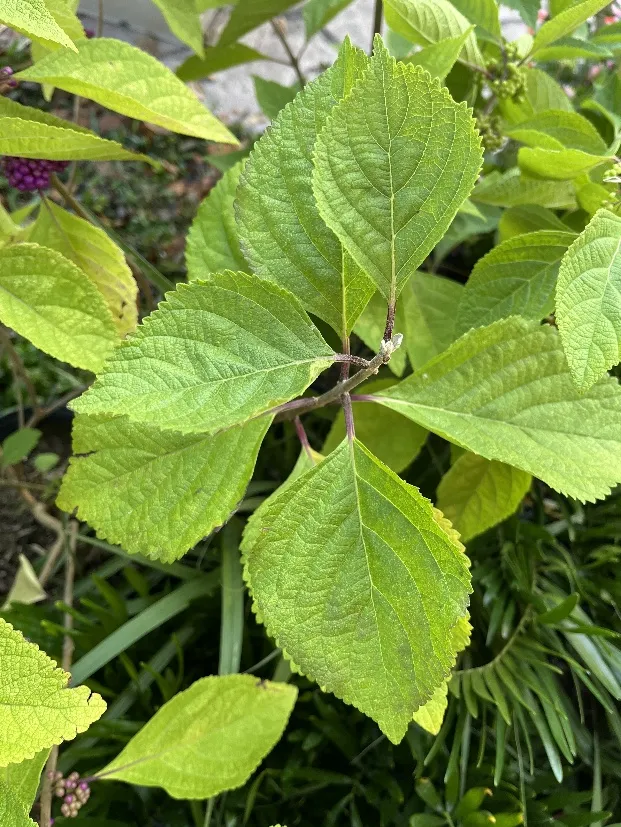
American beautyberry (Callicarpa americana) is a woody deciduous shrub, native to Florida and other states in the southeastern United States. This plant has a rounded growth habit and reaches a height and spread of 8 feet (Figure 1). Older, more established beautyberry shrubs have branches that arch towards the ground in an almost weeping growth habit. The large 4- to 8-inch leaves are light green and have a coarse to fuzzy texture (Figure 2). The small pink flowers are borne in clusters in the leaf axils during the bloom season of June through August (Figure 3). Clusters of showy purple berries are densely packed and encircle the stems following the flowers, from August through October (Figure 4). Certain varieties and cultivars of American beautyberry produce white or pink berries instead of the typical purple (Figure 5). Fruit persists on the plant for several weeks after leaves are dropped, into the start of winter. These fruits are a very attractive source of food for birds and other wildlife. This plant is highly tolerant to many environmental conditions including drought, heat, wet soil, and deters browsing from deer and rabbits.
Beautyberry is commonly found in meadows, forested areas, near water bodies and in other full sun to partially shaded locations. It is well suited for a variety of uses including used as a foundation plant, as a border, planted en masse, in a container or aboveground planter, or for naturalizing an area.

Credit: Keighly Graves, UF/IFAS
Credit: Keighly Graves, UF/IFAS

Credit: Ryan Fessenden

Credit: Keighly Graves, UF/IFAS

Credit: Donna Bollenbach via Adobe Stock
General Information
Scientific name: Callicarpa americana
Pronunciation: kal-lick-AR-puh uh-mair-rick-KAY-nuh
Common name(s): American beautyberry, American mulberry, beautyberry
Family: Lamiaceae
Plant type: shrub
USDA hardiness zones: 7A through 11B (Figures 6 and 7)

Credit: This map is based on the 2023 USDA Plant Hardiness Zone Map. Visit https://planthardiness.ars.usda.gov/ for specific zone information.

Credit: This map is based on the 2023 USDA Plant Hardiness Zone Map. Visit https://planthardiness.ars.usda.gov/ for specific zone information.
Planting month for zone 7: year-round
Planting month for zone 8: year-round
Planting month for zone 9: year-round
Planting month for zones 10 and 11: year-round
Origin: native to Florida
Invasive potential: may self-seed each year
Uses: foundation; specimen; border; mass planting; container or aboveground planter; naturalizing; larval host plant
Availability: somewhat available, may have to go out of the region to find the plant
Description
Height: 3 to 8 feet
Spread: 4 to 8 feet
Plant habit: round; spreading; vase shape; arching
Plant density: open
Growth rate: moderate
Texture: medium
Foliage
Leaf arrangement: opposite/subopposite
Leaf type: simple
Leaf margin: serrate
Leaf shape: ovate
Leaf venation: pinnate
Leaf type and persistence: fragrant; deciduous
Leaf blade length: 4 to 8 inches
Leaf color: green
Fall color: yellow
Fall characteristic: not showy
Flower
Flower color: pink
Flower characteristic: spring flowering
Fruit
Fruit shape: round
Fruit length: less than 1/2 inch
Fruit cover: fleshy
Fruit color: purple; pink; cream-white
Fruit characteristic: persists on the plant; attracts birds; showy
Trunk and Branches
Trunk/bark/branches: not particularly showy; typically multi-trunked or clumping stems
Current year stem/twig color: green
Current year stem/twig thickness: medium
Culture
Light requirement: plant grows in partial shade; plant grows in full sun
Soil tolerances: acidic; slightly alkaline; sand; loam; clay
Drought tolerance: moderate
Soil salt tolerances: poor
Plant spacing: 36 to 60 inches
Other
Roots: usually not a problem
Winter interest: berries persist through early winter
Invasive potential: may self-seed each year
Pest resistance: no serious pests are normally seen on the plant
Use and Management
American beautyberry is a hardy, relatively maintenance free plant that grows easily in full sun or light, dappled shade in a variety of soil conditions. It is both drought tolerant and tolerant of wet soils. Old wood should be pruned heavily in late fall to early spring since flowers and fruit are produced on new growth. The berries of this plant are a highly attractive food source for a variety of wildlife including birds and small mammals. The flowers of this plant also attract pollinators. This plant is also a larval host plant for the spring azure butterfly (Celastrina ladon) and snowberry clearwing moth (Hemaris diffinis).
Beautyberry occurs naturally in many habitats of the central and southeastern United States. It may also be used in the landscape in a variety of settings including naturalizing an area, may be planted near a pond or water body, used in a pollinator garden, or as part of a rain garden. This plant will lose its leaves in the winter; however, the showy berries bring winter interest. Propagation is by seed or softwood cuttings.
Design Considerations
Easy to maintain and a favorite of birds, American beautyberry is ideal for naturalistic gardens, blending well with pines and oaks. Its large, sprawling habit works for a specimen or informal screen, but requires ample space.
Companion plantings can include yaupon holly (Ilex vomitoria) and wax myrtle (Myrica cerifera), whose evergreen forms provide year-round structure that contrasts with the beautyberry’s deciduous habit. Firebush (Hamelia patens) is another excellent partner, offering bold foliage and vibrant summer flowers that complement the beautyberry's famous fall fruit.
Pests and Diseases
No pests or diseases of major concern.