
This Florida-Friendly Landscaping™ publication is part of a series originally written by Edward F. Gilman. Visit https://ffl.ifas.ufl.edu/ to learn more about creating and maintaining attractive landscapes that protect Florida's water resources and environment.
Introduction
Beach bean (Canavalia rosea) is a dense ground cover that is native to the coastal dune ecosystem of Florida. Beach bean is an important part of coastal ecosystems, as it stabilizes the sand dunes against erosion. This plant forms an evergreen groundcover that is 6 to 12 inches in height, but it may occasionally be found climbing a small tree (Figure 1). This plant spreads quickly in the landscape. The trifoliate leaves have elliptic 2½- to 3½-inch-long leaflets that are rounded at their apices. This plant’s leaves fold up in hot weather to conserve water (Figure 2). Small racemes of pink to purple flowers occur among these bright green leaves throughout the year, with a peak blooming season from summer to fall (Figure 3). These beautiful flowers are followed by robust, woody pods, which may be 4 to 6 inches long (Figure 4). Beach bean seed pods are transported by ocean currents and germinate in other locations along the shoreline. This plant is very hardy, salt tolerant, drought tolerant, tolerant of nutrient-poor soils and windy beachside conditions. Beach bean may be used in coastal restoration projects, in coastal landscaping, cascading down a wall, or as a dense groundcover in sandy areas.

Credit: © Evan C, some rights reserved (CC BY-NC-ND) via iNaturalist

Credit: © Alec Cowles, some rights reserved (CC BY-NC-ND) via iNaturalist

Credit: © genevieve, some rights reserved (CC BY-NC-ND) via iNaturalist

Credit: © karin taylor, some rights reserved (CC BY-NC-ND)
General Information
Scientific name: Canavalia rosea
Previous scientific name(s): Canavalia maritima
Pronunciation: kan-uh-VAL-ee-uh row-sea-ah
Common name(s): beach bean, bay bean, seaside jackbean
Family: Fabaceae
Plant type: vine; groundcover
USDA hardiness zones: 9B through 11B (Figures 5 and 6)
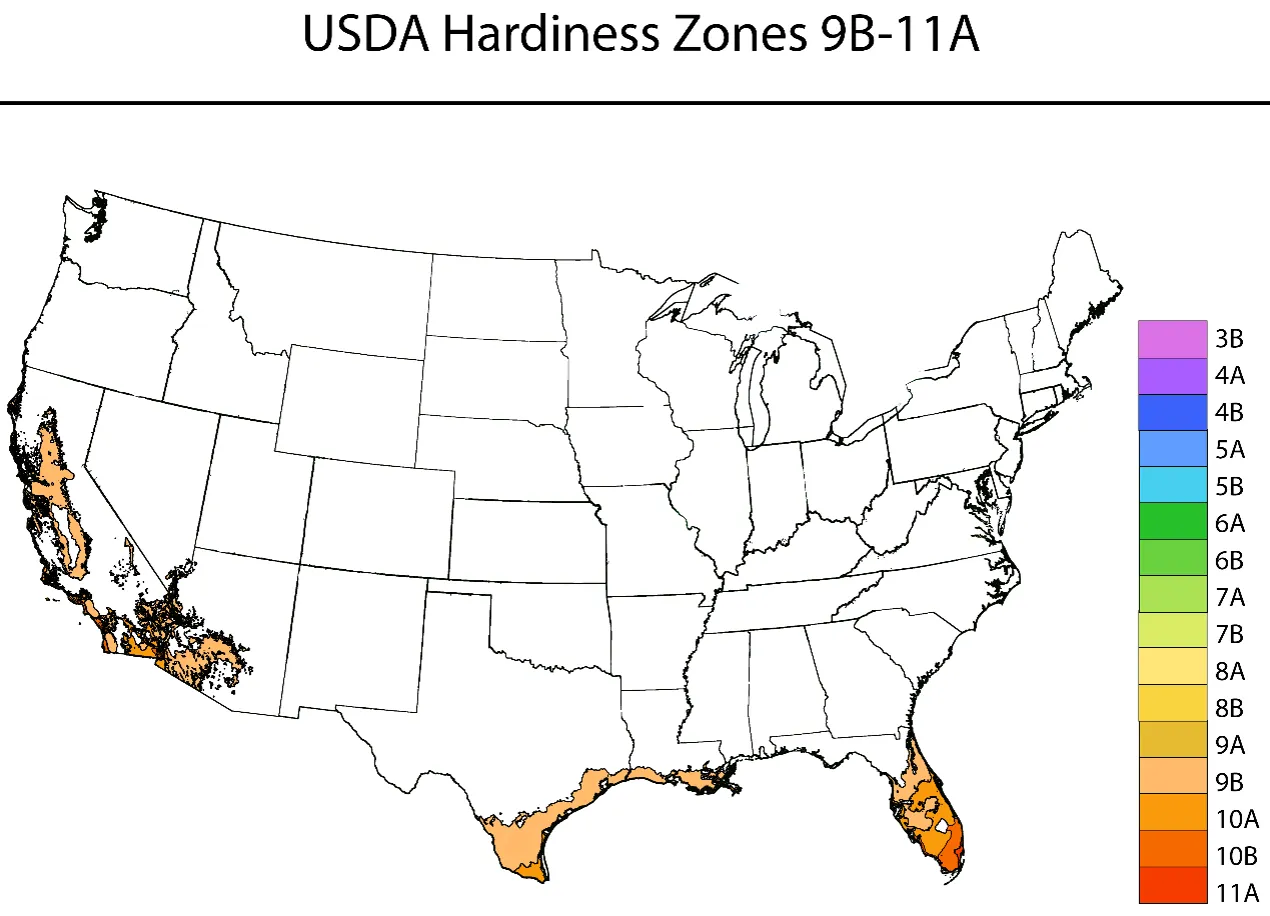
Credit: This map is based on the 2023 USDA Plant Hardiness Zone Map. Visit https://planthardiness.ars.usda.gov/ for specific zone information.

Credit: This map is based on the 2023 USDA Plant Hardiness Zone Map. Visit https://planthardiness.ars.usda.gov/ for specific zone information.
Planting month for zone 9B: year-round
Planting month for zones 10 and 11: year-round
Origin: native to Florida
Invasive potential: not known to be invasive
Uses: cascading down a wall; groundcover; coastal restoration
Availability: grown in small quantities by a small number of nurseries
Description
Height: 6–12 inches as a groundcover; depends upon supporting structure
Spread: depends upon space available
Plant habit: prostrate (flat); spreading
Plant density: open
Growth rate: fast
Texture: coarse
Foliage
Leaf arrangement: alternate
Leaf type: trifoliate
Leaf margin: entire
Leaf shape: elliptic (oval)
Leaf venation: brochidodromous; pinnate
Leaf type and persistence: evergreen
Leaf blade length: 2 to 4 inches
Leaf color: green
Fall color: no fall color change
Fall characteristic: not showy
Flower
Flower color: purple; pink
Flower characteristic: year-round flowering
Fruit
Fruit shape: pod or pod-like
Fruit length: 3 to 6 inches
Fruit cover: dry or hard
Fruit color: brown
Fruit characteristic: inconspicuous and not showy
Trunk and Branches
Trunk/bark/branches: not applicable
Current year stem/twig color: not applicable
Current year stem/twig thickness: not applicable
Culture
Light requirement: plant grows in full sun
Soil tolerances: acidic; slightly alkaline; sand; loam
Drought tolerance: high
Soil salt tolerances: good
Plant spacing: 24 to 36 inches
Other
Roots: not applicable
Winter interest: evergreen foliage; year-round flowers
Pest resistance: no serious pests are normally seen on the plant
Toxicity: this plant has toxic characteristics; seed pods and seeds contain canavanine; toxic if ingested
Use and Management
Beach bean should be planted on sandy, well-drained soil. It grows in full-sun coastal conditions, and is tolerant of salt spray, wind, drought, and nutrient-poor soils. This plant generally acts as a dense groundcover but may climb surrounding trees or structures. Maintenance may be required to keep the plant within bounds, as it can have a rapid growth rate. Beach bean is well-suited for landscapes close to coastal areas, dune restoration, or as a groundcover in sandy soils.
Design Considerations
Beach bean is a low, sprawling coastal groundcover with bright green foliage and pink‑purple flowers. Its dense roots stabilize sandy soils and help control erosion from wind and light surf, making it effective as a mass planting. For contrast, pair its uniform, horizontal habit with upright, textural plants: muhly grass (Muhlenbergia capillaris) offers fine, airy foliage and pink fall plumes; sea oats (Uniola paniculata) add bold, wind‑swept texture and iconic seed heads. For broader scale, use large‑leaved shrubs like seagrape (Coccoloba uvifera) for structure and cocoplum (Chrysobalanus icaco) for a dense, rounded form with glossy leaves and reddish new growth.
Pests and Diseases
No pests or diseases of major concern.