
This Florida-Friendly Landscaping™ publication is part of a document series originally written by Edward F. Gilman. Visit https://FloridaFriendlyLandscaping.com to learn more about creating and maintaining attractive landscapes that protect Florida's water resources and environment.
Introduction
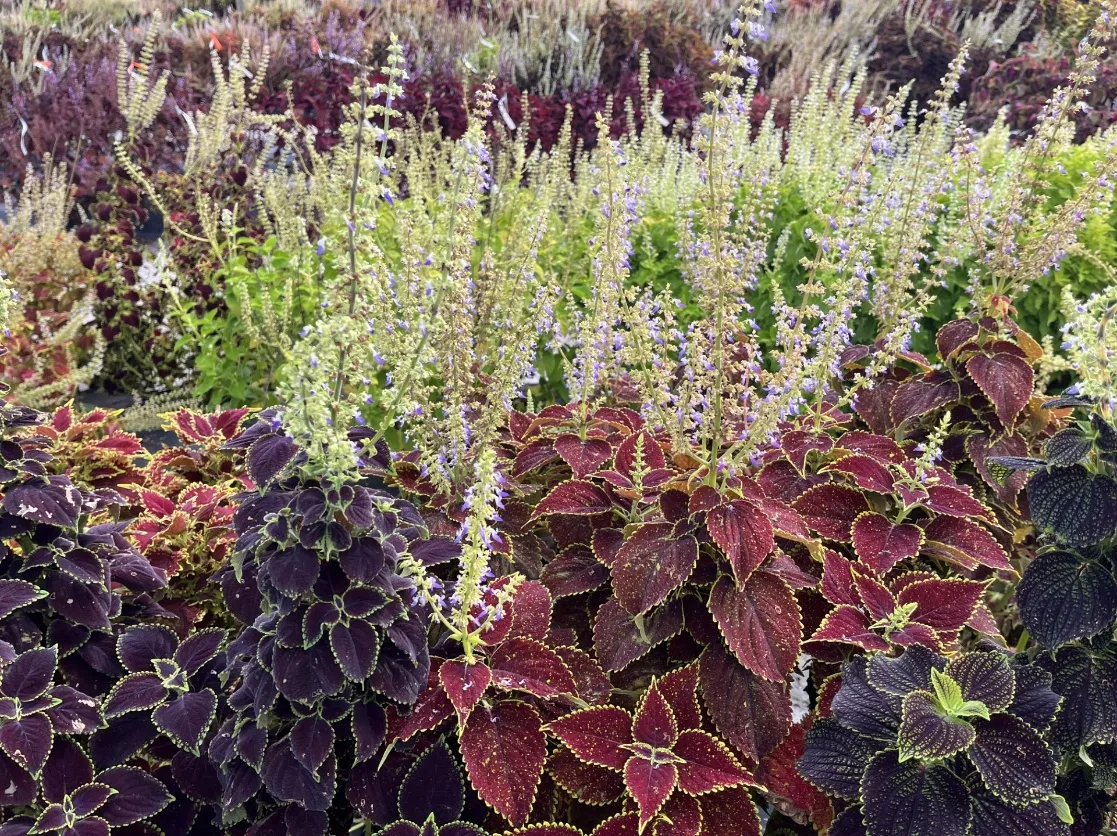
Coleus is an annual or tender perennial with a rounded growth form, and height and spread of 1 to 3 feet (Figure 1). Coleus is grown for its brightly colored ovate leaves, which may be purple, burgundy, brown, red, pink, orange, yellow, and white (Figure 2). There are numerous cultivars with varieties of color combinations and leaf shapes. The flowers are generally considered inconspicuous compared to the showy leaves. The small blue flowers are clustered on racemes and are attractive to pollinators (Figure 3). Removing these flower spikes from the plant encourages a fuller growth form. Coleus makes a dramatic statement in mass plantings (Figure 4), or may be used in containers or hanging baskets; it may be a houseplant, used as edging, or as an accent plant in the landscape.

Credit: © Emily Serrano, some rights reserved (CC BY-NC) via iNaturalist

Credit: Keighly Graves, UF/IFAS

Credit: Ryan Fessenden
Credit: Keighly Graves, UF/IFAS
General Information
Scientific name: Coleus scutellarioides
Pronunciation: KOE-lee-us scoot-tell-air-ROID-dees
Common name(s): coleus; painted nettle
Family: Lamiaceae
Plant type: annual; tender perennial
USDA hardiness zones: all zones (Figures 5 and 6)

Credit: This map is based on the 2023 USDA Plant Hardiness Zone Map. Visit https://planthardiness.ars.usda.gov/ for specific zone information.

Credit: This map is based on the 2023 USDA Plant Hardiness Zone Map. Visit https://planthardiness.ars.usda.gov/ for specific zone information.
Planting month for zone 7: Jun; Jul; Aug
Planting month for zone 8: May; Jun; Jul; Aug
Planting month for zone 9: Mar; Apr; May; Jun; Jul; Aug; Sep; Oct
Planting month for zones 10 and 11: Mar; Apr; May; Jun; Jul; Aug; Sep; Oct
Origin: not native to North America
Invasive potential: not known to be invasive
Uses: mass planting; container or above-ground planter; edging; accent; attracts pollinators
Availability: generally available in many areas within its hardiness range
Description
Height: 1 to 3 feet
Spread: 1 to 3 feet
Plant habit: round; upright
Plant density: dense
Growth rate: moderate
Texture: medium
Foliage
Leaf arrangement: opposite/subopposite
Leaf type: simple
Leaf margin: crenate; lobed; undulate
Leaf shape: ovate
Leaf venation: bowed
Leaf type and persistence: not applicable
Leaf blade length: 4 to 8 inches
Leaf color: purple; burgundy; brown; red; pink; orange; yellow; white; variegated; depends upon cultivar selection
Fall color: not applicable
Fall characteristic: not applicable
Flower
Flower color: blue
Flower characteristic: inconspicuous and not showy
Fruit
Fruit shape: round
Fruit length: less than 1 inch
Fruit cover: dry or hard
Fruit color: brown
Fruit characteristic: inconspicuous and not showy
Trunk and Branches
Trunk/bark/branches: not applicable
Current year stem/twig color: green
Current year stem/twig thickness: very thick; square
Culture
Light requirement: plant grows in partial shade; select cultivars grow in full sun; select cultivars grow in full shade
Soil tolerances: acidic; clay; sand; loam
Soil salt tolerances: low to none
Plant spacing: 12 to 18 inches
Other
Roots: not applicable
Winter interest: not applicable
Pest resistance: long-term health usually not affected by pests
Toxicity: this plant displays low toxic characteristics; leaves may cause contact dermatitis in some people
Use and Management
Coleus should be located in partial shade for optimal growth. Certain cultivars can tolerate full sun or full shade; however, careful selection should be used as full sun can lead to leaf bleaching and wilting. Coleus may tolerate full shade but will exhibit leggy growth. Coleus is adaptable to a range of soil conditions, but benefits from a moist, rich soil with slightly acidic to slightly alkaline pH. Plants may be pinched back at their nodes to encourage a fuller growth form. Coleus may be used in a variety of ways in the landscape including as a groundcover, used in mass plantings, as edging, as an accent, in containers or hanging baskets, or as a houseplant.
Coleus is propagated by seed and cuttings. Cuttings as short as two inches can be taken from newly grown shoots and rooted. The uncovered seed germinates in 10 to 14 days at 70°F to 75°F. Set plants outside after the weather has warmed. In USDA hardiness zones 8 to 11, coleus can be set out spring through late summer. Winter plantings are successful in south Florida in the full sun, provided adequate moisture is available. Coleus will freeze back in the winter and should be treated as an annual in cooler planting zones.
Design Considerations
Coleus is prized for its vivid foliage, delivering bold, season-long color in shades of chartreuse, burgundy, red, pink, and variegated patterns. Its upright, branching form and broad, textured leaves create an immediate focal point, making it highly effective for adding contrast and visual energy to shaded or partially shaded beds. Coleus performs well as a specimen in containers, a colorful border or edging plant, a vibrant mass planting for groundcover effect, or a midlayer accent in mixed annual or tropical designs. It pairs best with plants that complement or highlight its dramatic foliage, such as caladiums (Caladium bicolor and hybrids), impatiens (Impatiens spp. except I. walleriana), begonias (Begonia spp.), ferns, bromeliads (Aechmea spp., Billbergia spp., Guzmania spp.), and other low-growing groundcovers. It also works well with structural companions like ornamental grasses, or small palms that add height and form without competing with its color.
Pests and Diseases
Minor pest issues include mites, scale, mealybugs, and whitefly. No diseases of major concern.