
This Florida-Friendly Landscaping™ publication is part of a document series originally written by Edward F. Gilman. Visit https://FloridaFriendlyLandscaping.com to learn more about creating and maintaining attractive landscapes that protect Florida's water resources and environment.
Introduction
Colubrina (Colubrina arborescens) is a large shrub to small tree with an upright growth form, native to south Florida in the coastal upland plant community and the Caribbean Basin. This plant reaches a height of 15 to 25 feet, and a spread of 15 to 20 feet (Figure 1). The evergreen foliage is glossy and borne on thin twigs covered with rust-colored hairs (Figure 2). Hairs occasionally extend onto the underside of leaves. Prominent yellow veins contrast with the dark green leaves. Colubrina produces inconspicuous star-shaped green flowers in clusters at the leaf axils (Figure 3). These flowers appear year-round but are most abundant in late summer. Fruits are rounded black capsules and are attractive to birds (Figure 4). Colubrina has a variety of uses in the landscape including as a reclamation plant, may be trained as a standard or hedge, used as a specimen, as an espalier, for small parking lot islands, as a lawn tree or border in the landscape.

Credit: © Ann Stafford, some rights reserved (CC BY-NC) via iNaturalist

Credit: © Juan Gabriel, some rights reserved (CC BY-NC) via iNaturalist
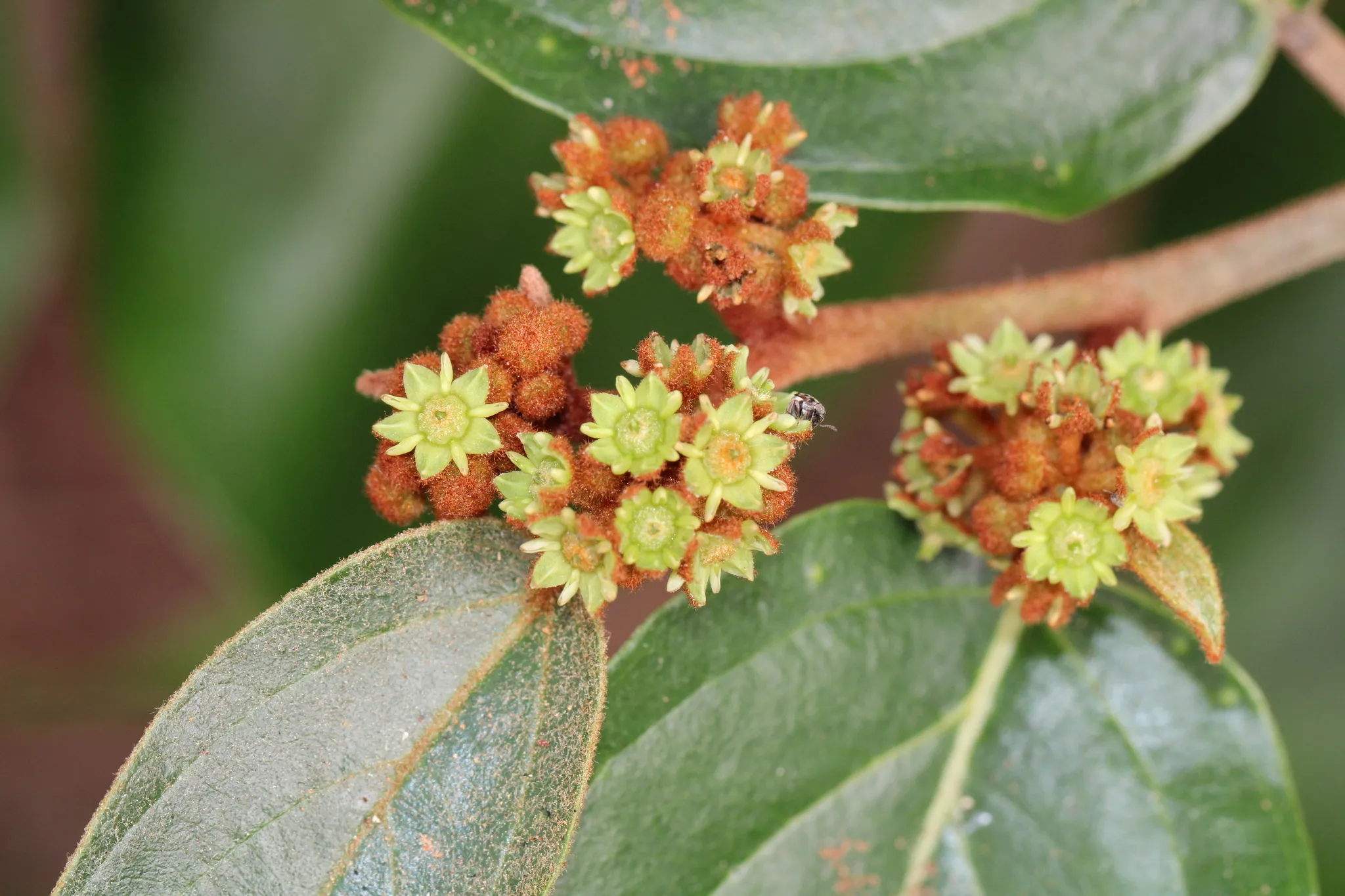
Credit: © Andres Vila, some rights reserved (CC BY-NC) via iNaturalist

Credit: © Joey Santore, some rights reserved (CC BY-NC) via iNaturalist
General Information
Scientific name: Colubrina arborescens
Pronunciation: kawl-yoo-BRYE-nuh ar-bor-RESS-enz
Common name(s): Colubrina, coffee colubrina, wild coffee, greenheart, soap bush
Family: Rhamnaceae
Plant type: tree
USDA hardiness zones: 10A through 11B (Figures 5 and 6)

Credit: This map is based on the 2023 USDA Plant Hardiness Zone Map. Visit https://planthardiness.ars.usda.gov/ for specific zone information.

Credit: This map is based on the 2023 USDA Plant Hardiness Zone Map. Visit https://planthardiness.ars.usda.gov/ for specific zone information.
Planting month for zones 10 and 11: year-round
Origin: native to Florida
Invasive potential: not known to be invasive
Uses: reclamation plant; trained as a standard; hedge; near a deck or patio; specimen; espalier; small parking lot islands (< 100 square feet in size); medium-sized parking lot islands (100-200 square feet in size); large parking lot islands (> 200 square feet in size); narrow tree lawns (3-4 feet wide); medium-sized tree lawns (4-6 feet wide); wide tree lawns (> 6 feet wide); recommended for buffer strips around parking lots or for median strip plantings in the highway; screen; border
Availability: somewhat available, may have to go out of the region to find the plant
Description
Height: 15 to 25 feet
Spread: 12 to 20 feet
Plant habit: round; oval
Plant density: dense
Growth rate: slow
Texture: medium
Foliage
Leaf arrangement: alternate
Leaf type: simple
Leaf margin: entire
Leaf shape: ovate
Leaf venation: pinnate
Leaf type and persistence: evergreen
Leaf blade length: 2 to 4 inches
Leaf color: green
Fall color: no fall color change
Fall characteristic: not showy
Flower
Flower color: yellow
Flower characteristic: year-round flowering; inconspicuous
Fruit
Fruit shape: round
Fruit length: less than 0.5 inch
Fruit cover: fleshy
Fruit color: black
Fruit characteristic: attracts birds
Trunk and Branches
Trunk/bark/branches: not particularly showy; typically multi-trunked or clumping stems
Current year stem/twig color: brown
Current year stem/twig thickness: medium
Culture
Light requirement: plant grows in partial shade; plant grows in the shade
Soil tolerances: occasionally wet; acidic; slightly alkaline; sand; loam; clay
Drought tolerance: high
Soil salt tolerances: good
Plant spacing: 36 to 60 inches
Other
Roots: usually not a problem
Winter interest: evergreen foliage
Pest resistance: long-term health usually not affected by pests
Use and Management
Colubrina makes a good hedge or screen planting due to the dense canopy. Plant on 5-feet centers to establish a solid mass of foliage several years after planting. Single plants can be trained into a small tree by periodically removing lower foliage and branches as the tree grows taller. It will make a nice ornamental next to the patio or deck—or may also be located near a swimming pool—because of its attractive foliage and small fruits.
Columbrina grows best in partial shade but may also be planted in full shade. Soil in its native habitat is well drained and sandy, usually with a slightly alkaline pH. In the Keys, plants grow in porous limestone. Colubrina is adaptable to a range of soil conditions, given that it is well drained. It will benefit from a hummus or organic material in the top layer.
Colubrina elliptica is a similar plant growing in the Florida Keys and the Caribbean Basin. Colubrina cubensis is an endangered plant in Florida.
Design Considerations
Colubrina offers glossy, deep-green foliage, a rounded to upright form, and clusters of small white flowers followed by red-to-black berries, providing year-round texture, subtle color, and strong habitat value in partial shade to sun. Its adaptable structure makes it effective as a specimen in naturalistic or coastal gardens, a foundation shrub on protected exposures, a loose hedge, or a midlayer element in mixed native borders. Pair with other resilient plants such as firebush (Hamelia patens), Simpson's stopper (Myrcianthes fragrans), and cocoplum (Chrysobalanus icaco) for a layered shrub border, or plant it with coontie (Hamelia patens) and beach sunflower (Helianthus debilis) at its base under the canopy of larger trees like gumbo limbo to create a cohesive, low-maintenance habitat.
Pests and Diseases
No pest or disease issues of major concern.