
This Florida-Friendly Landscaping™ publication is part of a document series originally written by Edward F. Gilman. Visit https://FloridaFriendlyLandscaping.com to learn more about creating and maintaining attractive landscapes that protect Florida's water resources and environment.
Introduction
Orange flame vine is a tropical evergreen vine with a spreading growth habit. This plant reaches a spread of 10 to 20 feet, and height depends upon supporting structure (Figure 1). The evergreen leaves are 4 to 8-inches long, elliptic, and glossy (Figure 2). Delicate orange and yellow brush-like flowers are borne in the axils of the opposite, simple leaves (Figure 3). This plant has a peak bloom season from late summer through fall. These showy clusters of flowers attract pollinators and hummingbirds. These flowers develop into clusters of red, four-winged seed pods (Figure 4). With its showy flowers and seed pods, this plant makes an excellent specimen, may be used to veil a trellis, or trained as an espalier or standard.

Credit: © pedro oppen, some rights reserved (CC BY-NC) via iNaturalist

Credit: © Maël Dewynter, some rights reserved (CC BY-NC) via iNaturalist

Credit: © Guillermo Andreo, some rights reserved (CC BY-NC) via iNaturalist
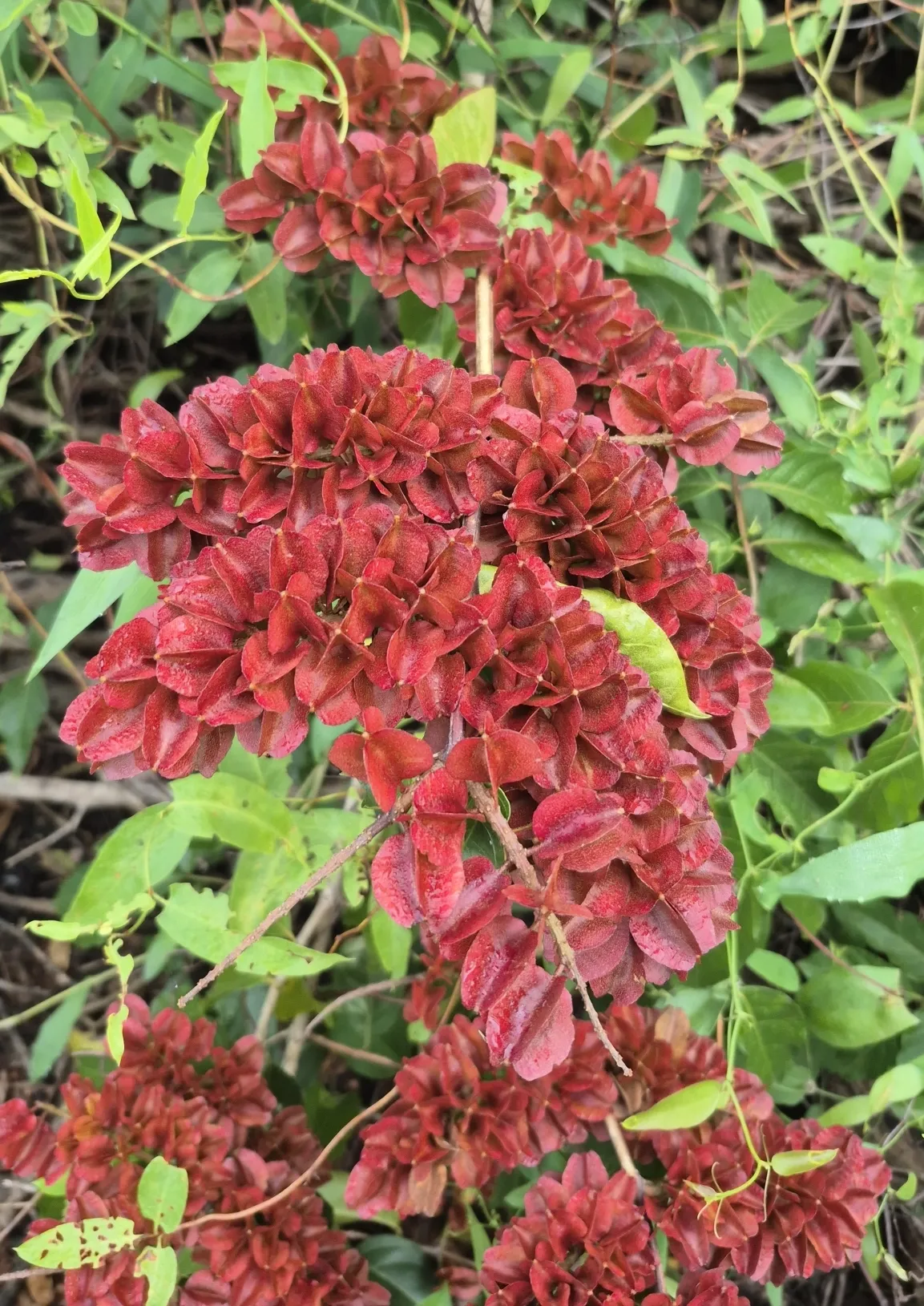
Credit: © Francisco González Táboas, some rights reserved (CC BY-NC) via iNaturalist
General Information
Scientific name: Combretum fruticosum
Pronunciation: kom-BREE-tum froo-tick-KOE-sum
Common name(s): orange flame vine
Family: Combretaceae
Plant type: vine
USDA hardiness zones: 9B through 11B (Figures 5 and 6)

Credit: This map is based on the 2023 USDA Plant Hardiness Zone Map. Visit https://planthardiness.ars.usda.gov/ for specific zone information.

Credit: This map is based on the 2023 USDA Plant Hardiness Zone Map. Visit https://planthardiness.ars.usda.gov/ for specific zone information.
Planting month for zone 9: year-round
Planting month for zones 10 and 11: year-round
Origin: not native to North America
Invasive potential: not known to be invasive
Uses: trained as a standard; espalier; specimen; veils a trellis
Availability: grown in small quantities by a small number of nurseries
Description
Height: depends upon supporting structure
Spread: 10 to 20 feet
Plant habit: spreading; round
Plant density: moderate
Growth rate: fast
Texture: medium
Foliage
Leaf arrangement: opposite/subopposite
Leaf type: simple
Leaf margin: entire
Leaf shape: elliptic (oval)
Leaf venation: pinnate
Leaf type and persistence: evergreen
Leaf blade length: 4 to 8 inches
Leaf color: green
Fall color: no fall color change
Fall characteristic: not showy
Flower
Flower color: orange
Flower characteristic: summer flowering; fall flowering; showy (brush-like flowers)
Fruit
Fruit type: samara-like
Fruit shape: elliptic
Fruit length: less than 1 inch
Fruit cover: dry or hard
Fruit color: red
Fruit : showy
Trunk and Branches
Trunk/bark/branches: not particularly showy; typically multi-trunked or clumping stems
Current year stem/twig color: reddish
Current year stem/twig thickness: thin
Culture
Light requirement: plant grows in full sun
Soil tolerances: acidic; slightly alkaline; sand; loam; clay
Drought tolerance: moderate
Soil salt tolerances: poor
Plant spacing: 36 to 60 inches
Other
Roots: usually not a problem
Winter interest: evergreen foliage
Pest resistance: long-term health usually not affected by pests
Use and Management
Orange flame vine should be planted in full sun for optimal flower production. This plant is adaptable to various soil conditions given that soil is well drained; however, it will benefit from incorporation of organic matter. Flowers are produced in the leaf axils of the new growth. If pruning is needed, it should occur after flowering has finished. Supply the plant with regular irrigation during dry weather to maintain good growth and flowering. Periodic fertilization during the year also helps keep the plant in flower.
Orange flame vine can also be grown as a loose shrub, becoming at least 10 to 15 feet wide and 6 to 8 feet tall. It can be planted 5 to 8 feet apart to form a solid mass within a couple of years after planting. It makes a good soil stabilizer for steep slopes. Shoots can extend several feet from the fence or other structure supporting the vine. Consider the growth habit of this plant before planting in the landscape as regular pruning will remove the flowers.
Other species exist including Combretum grandiflorum, which has red flowers and reddish new growth. Propagation is by stem cuttings in spring and summer, seed, or layering.
Design Considerations
Orange flame vine delivers vivid orange, brushlike flower clusters and a lush, twining habit that adds bold color, tropical texture, and strong seasonal drama to the landscape. Its vigorous, sprawling growth performs best in full sun on sturdy supports such as large arbors, pergolas, or fences where its cascading form can be fully appreciated. It pairs well with sun-loving companions that balance and extend its intensity—blue plumbago (Plumbago auiculata), purple salvia (Salvia spp.), porterweed (Stachytarpeta jamaciensis), and firebush (Hamelia patens)—and with foliage plants like gingers (various species), heliconias (Heliconia spp.), crotons (Codiaeum variegatum), and coontie (Zamia integrifolia) for added mass and structure. Finish the composition with drought-tolerant grasses or low groundcovers such as wild coffee (Psychotria nervosa) or pentas (Pentas lanceolata) to create a cohesive, layered base.
Pests and Diseases
No pests or diseases of major concern.