
Introduction
A team of scientists at the University of Florida/Institute of Food and Agricultural Sciences (UF/IFAS) has been tracking and studying major hurricanes since Hurricane Andrew in 1992 to determine their effect on the urban forest. One of the major goals of this study is to assemble lists of relative wind resistance for different urban tree species. These lists can assist communities to better prepare for the next hurricane season and to rebuild a healthy urban forest by selecting proper species.
This fact sheet presents the research and methodology that led to lists of relative wind resistance for tropical and subtropical tree species. It also discusses in detail its results and additional recommendations for selecting and establishing tropical and subtropical species for a healthier and more wind-resistant urban forest.

Credit: UF/IFAS
Study
Since 1992 when Hurricane Andrew struck south Florida, we have been studying the impacts of hurricanes on urban forests (Duryea et al. 1996; Duryea et al. 2007a; Duryea et al. 2007b). In 1998 when Hurricane Georges (177 km/h) crossed over the entire island of Puerto Rico, and in 2004 when Hurricanes Jeanne (193 km/h) and Charley (233 km/h) struck south Florida, we continued with these measurements. Hurricanes striking the subtropical and tropical regions of Florida and Puerto Rico, with their varied wind speeds, gave us the opportunity to study over 60 species and their comparable responses to wind. This study utilizes our results from hurricanes and incorporates results from a survey and the scientific literature to present lists of relative wind resistance for tropical and subtropical tree species.
Methods
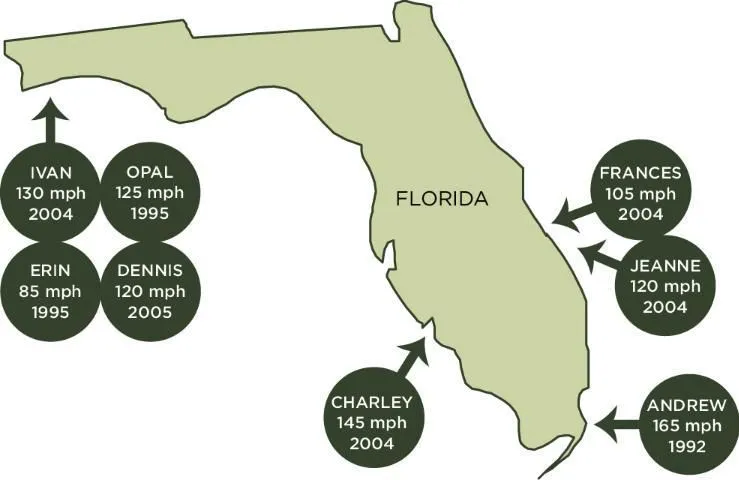
Urban tree damage was measured within 3 to 10 days of the two hurricanes that struck Florida (Charley and Jeanne 2004) and the one that struck Puerto Rico (Georges 1998). In this study, we also included the hurricane response of some tropical/subtropical species, such as live oak (Quercus virginiana) and sabal palm (Sabal palmetto), that occur throughout Florida and were impacted by Hurricanes Erin (1995), Opal (1995), and Ivan (2004) in the Florida panhandle (Figure 2).
Hurricane Andrew measurements involved a survey of 128 homeowners in Dade County, Florida who measured and reported to us about each tree in their yards (Duryea et al. 1996). The methodology for the other hurricanes was the same and is as follows: neighborhoods at the point of landfall of the hurricane were randomly chosen. For each neighborhood, all trees were observed along street transects. For each of the three hurricanes, we sampled 26 neighborhoods and 3,678 trees (Georges), 17 neighborhoods and 2,272 trees (Charley), and 7 neighborhoods and 1,642 trees (Jeanne). (Branch loss measurements for Hurricanes Frances [2005] and Jeanne were combined and made immediately following Hurricane Jeanne).
Credit: UF/IFAS
Results
Overall Urban Forest Loss
The percentage of urban forest loss (mortality) ranged from 13% for Hurricane Georges to 16% for Hurricane Jeanne to 18% for Hurricane Charley. The urban forest loss for these hurricanes combined with hurricanes striking the southeastern coastal plain is reported in Ask IFAS publication FOR118, Lessons Learned from Hurricanes. To evaluate tree survival and responses, we divided the species into four categories: palms, dicots, conifers, and Puerto Rico species. We then talk about native versus non-native species
Tree Survival and Branch Loss
Palms
Sabal palms along with the smaller palms such as areca (Chrysalidocarpus lutescens), Manila (Veitchia merrilii), and pygmy date (Phoenix roebelenii), had 89% or greater survival (Table 1). In Hurricane Charley, palm survival was 88% compared to 77% for all other tree species (p=0.0001). In Hurricane Jeanne, palm survival was 86% versus 76% for all other tree species (p<0.0001). When compared to dicots, palms have often been observed to be more resistant to winds (Francis and Gillespie 1993; Frangi and Lugo 1991). Zimmerman et al. (1994) conclude that palms are wind-resistant because they can lose all their leaves without losing their terminal meristem. Coconut palm (), which survived poorly in Hurricane Andrew (Duryea et al. 1996), exhibited intermediate survival in both Charley's and Georges' winds (77% survival) (Table 1). Royal palm (Roystonea elata), which had only 63% survival in Andrew, had improved survival (87%) in Hurricane Charley in the deeper soils of the Gulf Coast. Washington palm () survived well in Charley's 233 km/h (145 mph) winds (92%) but less well in Jeanne's winds of 193 km/h (120 mph) (80%). This was perplexing to us until we looked at the height comparisons of the two populations. Washington palms in the Ft. Pierce area that experienced Hurricane Jeanne averaged 11 m (36 ft) in height, with 42% of the palms above 10 m (32 ft), compared to an average of 4 m (13 ft) and only 7% over 10 m for Charley; perhaps as Washington palms acquire heights of 20 meters (65 feet) and above, their wind resistance starts to decline.
Tree Suvival and Branch Loss: Dicots
Of the dicot tree species, the poorest surviving were melaleuca (Melaleuca quinquenervia), Australian pine (Casuarina equisitifolia), and black olive (Bucida buceras) in Hurricane Charley. Dicots with highest survival were camphor (Cinnamomum camphora), gumbo limbo (Bursera simarouba), sea grape (Coccoloba uvifera), strangler fig (Ficus aurea), live oak, and laurel oak (Quercus laurifolia) (Figure 3).

Trees with large amounts of branch loss in a hurricane (Figure 4) may not be considered as healthy urban trees, so we re-analyzed survival considering branches lost. Standing trees with 50% or greater branch loss were called dead and a "new" survival was calculated (named "recalculated survival").

Some species such as camphor, strangler fig, laurel oak, and live oak may continue to stand in hurricane-force winds but at the same time lose large branches, especially at the 233 km/h (145 mph) winds of Charley (Figure 5).

After intermediate survival in Hurricane Andrew, West Indian mahogany (Swietenia mahagoni) and white cedar () exhibited higher survival in Hurricane Georges at 177 km/h (110 mph). After relatively poor survival in Andrew, 94% of the royal poinciana (Delonix regia) survived the relatively lighter winds of Hurricane Georges. In a study of 24 species of urban trees in San Juan, Puerto Rico, after Hurricane Georges, species with the highest survival (lowest failed stems) were West Indian mahogany (100%), mango () (98%), queen's crape myrtle (Lagerstroemia speciosa) (98%), and royal poinciana (98%) (Francis 2000). Species with the poorest survival were African tuliptree (Spathodea campanulata) (66%) and weeping banyan (Ficus benjamina) (70%) (Francis 2000). Studies summarized in Everham and Brokaw's table of species resistance to catastrophic wind (1996) rank gumbo limbo, mahogany, sea grape, baldcypress (Taxodium distichum), live oak, and white cedar with high wind resistance in at least two or more studies. Species that received the lowest wind resistance ratings in two or more studies were Australian pine (Casuarina equisetifolia), Honduras mahogany (Swietenia macrophylla), swamp mahogany (), and Caribbean pine (Pinus caribaea).
In the urban areas of the southeastern coastal plain, laurel oak trees did not survive as well as live oak and sand live oak (Quercus geminata) in four hurricanes (Duryea et al. 2007b). However, in the two south Florida hurricanes, both survival and branch loss for live and laurel oaks were similar (Figures 4 and 5). We also compared large trees of these species (greater than 50 cm diameter) and found that their survival, branch loss, and recalculated survival were not significantly different in Jeanne and Charley (Figure 6).
Speculations about the reasons for lack of difference between live oak and laurel oak in south Florida include:
(1) Laurel oak in south Florida may be a different cultivar or variety from those in north Florida and (2) sandier soils in south Florida and their accompanying lower site quality may result in laurel oaks with shorter heights or lower height-to-diameter ratio (as occurs between the north Florida and south Florida varieties of slash pine [Pinus elliottii var. elliottii and var. densa]). Still, many authors point to live oak as a tree with strong wood and little failure in hurricanes (Touliatos and Roth 1971; Swain 1979; Hook et al. 1991; Barry et al. 1993).
Tree Survival and Branch Loss: Conifers
Of the conifer species, baldcypress survived Hurricane Charley the best with 95% survival (Figure 3). Baldcypress also suffered little damage after Hurricane Hugo (Putz and Sharitz 1991; Gresham et al. 1991). After Hurricane Andrew, cypress trees in the Everglades National Park were still standing on the edges of the hammocks while many hardwoods had failed (Orr and Ogden 1992). Only 4% of the sand pine (Pinus clausa) survived Hurricane Jeanne; sand pine's poor survival has been measured in several other hurricanes (Duryea 1997; Duryea et al. 2007a). South Florida slash pine is next best in wind resistance for the conifers across the south Florida hurricanes (Figure 6); however, longleaf pine (Pinus palustris), which is usually similar to slash pine in wind resistance in the coastal plain hurricanes (Duryea et al. 2007a), had 57% survival in Hurricane Charley. Survival of south Florida slash pine in pine rockland ecosystems ranged from 78% to 88% in Hurricane Andrew. Mortality of the standing pine trees continued for one year with 17% to 25% dying (Platt et al. 2000). We returned three months after Hurricane Charley and found that 27% of the standing south Florida slash pines and 48% of the standing longleaf pines had died.

Credit: UF/IFAS

Credit: UF/IFAS
Puerto Rico Species
Of the species measured in Puerto Rico, the species with the highest survival and least branch damage were Santa Maria (Calophyllum calaba), Caribbean pine, schefflera, West Indian mahogany, and Chinese arborvitae (Platycladus orientalis) (Table 2).
Many trees had extensive branch loss that reduced survival further with the most notable species being Norfolk Island pine (Araucaria heterophylla), Napoleon's plume (Bauhinia monandra), apple blossom (Cassia javanica), yellow cassia (Cassia siamea), swamp mahogany, mahoe (Hibiscus elatus), and African tuliptree. The 24 tree species measured in Francis' study (2000) following Hurricane Georges also showed extensive branch damage ranging from 23% to 81%.
Similar to our study, Francis also found that West Indian mahogany was the best survivor (100% survival) and had the least branch loss, while African tuliptree suffered the most crown loss and was one of the poorest survivors (66% survival) (Francis 2000). Results for black olive and royal poinciana were also like those in our study, with trees surviving well (98%) but losing nearly half of their branches.
Tree Survival and Branch Loss: Native and Non-Native Species
Native tree species survived better in Hurricanes Jeanne, Charley, and Andrew but not in Hurricane Georges (Figure 8).
Native species also lost fewer branches than non-native species in Jeanne (21% versus 36%, p=0.0001) and Charley (36% versus 39%, p=0.0001). Some of the non-native species with low survival were melaleuca, Australian pine, and queen palm, and these can be compared to native species with high survival—live oak, gumbo limbo, and sabal palm. In their extensive review of hurricanes and forest damage, Everham and Brokaw (1996) summarize that there is a trend towards more damage in non-native forest plantations, although they also point out that these non-native forests are often monocultures. Out of the 35 tree species measured after Hurricane Georges in Puerto Rico (n≥20), only four were native trees to Puerto Rico—Santa Maria, black olive, white cedar, and common calabash tree (Crescentia cujete). Santa Maria survived very well (93%), but the other three had 84%, 83%, and 67% respectively, not surviving better than many of the non-native species (Table 2). Branch loss of non-natives and natives in Puerto Rico, too, appeared to be equal (31% for non-natives versus 27%, not statistically significant). With few non-native species in the urban forest population, natives also did not survive better in the southeastern US coastal plain during Hurricane Ivan.

The Survey
Arborists, urban foresters, and scientists confirmed many of our results about wind resistance but also provided new information about some species not frequently seen and measured in the urban forest. Consistent with our results, queen palm was ranked by the experts as the palm with the lowest wind resistance (Table 3). Royal palm and coconut palm were intermediate, again consistent with our results. Sabal palm was ranked high, which is consistent with our results from the tropical and northern areas of Florida (Duryea 1996; Duryea 1997; Duryea et al. 2007a). Some of the species with little information from our studies that were ranked high by the experts include pond apple (Annona glabra), cocoplum (Chrysobalanus icaco), and lignum vitae (Guaiacum sanctum). Species with little research information that were ranked with low wind resistance include weeping banyan, jacaranda (Jacaranda mimosifolia), and golden trumpet (Tabebuia chrysotricha). Species ranked with high wind resistance in agreement with our results were crape myrtle (Lagerstroemia indica), dahoon holly (Ilex cassine), southern magnolia (Magnolia grandiflora), sand live oak, live oak, and both species of cypress (Taxodium distichum and T. ascendens). One perplexing species is West Indian mahogany, which fared reasonably well in Georges and Andrew (Table 1); however, the survey respondents ranked it with medium to low wind resistance. In agreement with our results but in contrast to the survey results, another study of 24 species experiencing Hurricane Georges found West Indian mahogany had the best survival and the least branch loss (Francis 2000).
Recommendations
Taking the results from our studies and incorporating the survey results and the scientific literature, we have developed lists of relative wind resistance for tropical and subtropical tree species (Table 4). These lists should be used with caution, with the knowledge that no species and no tree is completely windproof, and with the consideration of local soil conditions, tree age, structure, and health, and other urban forest conditions. In addition, hurricane characteristics other than wind, such as total rainfall and storm duration, can also influence the ability of trees to survive hurricanes. In their thorough review of forest damage from wind, Everham and Brokaw (1996) concluded that species differences do exist and can be explained by differences in wood density, canopy architecture, rooting patterns, susceptibility to diseases, and bole shape. Yet these differences, they say, can also be masked by varied soil conditions, exposure, wind intensity, and cultural practices.
Wind resistance of tropical and subtropical tree species*
a Prohibited from use in Florida
b Invasive and not recommended for use in Florida
c Caution: may be used but must be managed to prevent escape in Florida (Fox et al. 2005)
*Wind resistance of tropical and subtropical tree species as estimated utilizing the hurricane measurements and the survey results in this study, and the scientific literature cited throughout this publication.
Highest Wind Resistance
Dicots
- Bursera simaruba, gumbo limbo
- Carya Floridana, Florida scrub hickory
- Conocarpus erectus, buttonwood
- Chrysobalanus icaco, cocoplum
- Cordia sebestena, geiger tree
- Eugenia axillaris, white stopper
- Eugenia confusa, redberry
- Eugenia foetida, boxleaf stopper
- Guaiacum sanctum, lignum vitae
- Ilex cassine, dahoon holly
- Krugiodendrum ferreum, ironwood
- Lagerstroemia indica, crape myrtle
- Magnolia grandiflora, southern magnolia
- Podocarpus spp. podocarpus Quercus virginiana, live oak
- Quercus geminata, sand live oak
Conifers
- Taxodium ascendens, pondcypress
- Taxodium distichum, baldcypress
Palms
- Butia capitata, pindo or jelly
- Coccothrinax argentata, Florida silver
- Dypsis lutescens, areca
- Hyophorbe lagenicaulis, bottle
- Hyophorbe verschaffeltii, spindle
- Latania loddigesii, blue latan
- Livistona chinensis, Chinese fanb
- Phoenix canariensis, Canary Island date
- Phoenix dactylifera, date
- Phoenix reclinata, Senegal dateb
- Phoenix roebelenii, pygmy date
- Ptychoesperma elegans, Alexander
- Sabal palmetto, cabbage, sabal
- Thrinax morrisii, key thatch
- Thrinax radiata, Florida thatch
- Veitchia merrillii, Manila
Fruit Trees
- N/A
Medium–High Wind Resistance
Dicots
- Annona glabra, pond apple
- Calophyllum calaba, Brazilian beautyleafc
- Chrysophyllum oliviforme, satinleaf
- Coccoloba diversifolia, pigeon plum
- Coccoloba uvifera, sea grape
- Liquidambar styraciflua, sweetgum
- Lysiloma latsiliqua, wild tamarind
- Magnolia virginiana, sweetbay magnolia
- Nyssa sylvatica, black tupelo
- Sideroxylon foetidissimum, mastic
- Simarouba glauca, paradise tree
- Swietenia mahagoni, mahogany
Conifers
- N/A
Palms
- Caryota mitis, fishtail
- Cocos nucifera, coconut
- Dypsis decaryi, triangle
- Roystonea elata, royal
Fruit Trees
- Litchi chinensis, lychee
Medium–Low Wind Resistance
Dicots
- Acer rubrum, red maple
- Bauhinia blakeana, Hong Kong orchid
- Bucidas buceras, black olive
- Callistemon spp., bottlebrush
- Cinnamomum camphora, camphorb
- Delonix regia, royal poincianac
- Enterolobium cyclocarpum, ear tree
- Eriobotrya japonica, loquatc
- Eucalyptus cinerea, silverdollar eucalyptus
- Ficus aurea, strangler fig
- Kigelia pinnata, sausage tree
- Myrica cerifera, wax myrtle
- Persea borbonia, redbay
- Platanus occidentalis, sycamore
- Quercus laurifolia, laurel oak
- , pink trumpet tree
- Terminalia catappa, tropical almondc
Conifers
- Pinus elliottii, slash pine
- Pinus palustris, longleaf pine
Palms
- N/A
Fruit trees
- Averrhoa carambola, star-fruit, carambola
- Citrus spp., oranges, limes, grapefruits
- , mango
Lowest Wind Resistance
Dicots
- Casuarina equisetifolia, Australian pinea
- Cassia fistula, golden shower
- Chorisia speciosa, floss-silk tree
- Ficus benjamina, weeping banyan
- Grevillea robusta, silk oak
- Jacaranda mimosifolia, jacaranda
- Melaleuca quinquenervia, melaleucaa
- Peltophorum pterocarpa, yellow poinciana
- Prunus caroliniana, Carolina laurelcherry
- Quercus nigra, water oak
- Sapium sebiferum, Chinese tallowa
- Spathodea campanulata, African tuliptree
- Tabebuia caraiba, silver trumpet tree
- Ulmus parvifolia, Chinese elm
Conifers
- Araucaria heterophylla, Norfolk Island pine
- x Cupressocyparis leylandii, Leyland cypress
- Juniperus silicicola, southern red cedar
- Pinus clausa, sand pine
Palms
- Syagnus romanzoffiana, queenc
- , Washington fan
Fruit trees
- Persea americana, avocado
Important Recommendations
- One of the most important findings reported is the rooting space results: the more rooting space that a tree has, the healthier it is, meaning better anchorage and resistance to wind.
- Another important cultural practice for broadleaved trees is pruning. Pruning conferred more wind resistance on trees and should be considered an important practice for tree health and wind resistance.
- Trees growing in groups or clusters were also more wind resistant compared to individual trees. This might be an especially good strategy for tree establishment in parks or larger yards.
- Especially in south Florida, native trees appear to survive winds better than non-natives. When considering species to plant, know which non-native species do not fare well in wind—some of these include melaleuca, Australian pine, queen palm, African tuliptree, and weeping banyan.
References
Duryea, M.L. 1997. Wind and trees: Surveys of tree damage in the Florida Panhandle after Hurricanes Erin and Opal. Circular 1183 of the University of Florida Cooperative Extension Service. Gainesville, FL. 7 pp.
Duryea, M.L., G.M. Blakeslee, W.G. Hubbard, and R.A. Vasquez. 1996. Wind and trees: A survey of homeowners after Hurricane Andrew. J. Arboric. 22(1):44–50. https://doi.org/10.48044/jauf.1996.006
Duryea, M.L., E. Kampf, and R.C. Littell. 2007a. Hurricanes and the Urban Forest: I. Effects on Southeastern U.S. Coastal Plain Tree Species. Arboric. & Urban Forestry 33(2):83–87. https://doi.org/10.48044/jauf.2007.010
Duryea, M.L., E. Kampf, R.C. Littell, and C.D. Rodríguez-Pedraza. 2007. Hurricanes and the Urban Forest: II. Effects on Tropical and Subtropical Tree Species. Arboric. & Urban Forestry 33(2):98–112. https://doi.org/10.48044/jauf.2007.011
Everham , E.M. III and N.V.L. Brokaw. 1996. Forest damage and recovery from catastrophic wind. The Botanical Review 62:113–185. https://doi.org/10.1007/BF02857920
Fox, A.M., D.R. Gordon, J.A. Dusky, L. Tyson, and R.K. Stocker. 2005. IFAS assessment of the status of non-native plants in Florida’s natural areas. SS-AGR-225 of the University of Florida IFAS Cooperative Extension Service. Gainesville, FL. 27 pp. https://assessment.ifas.ufl.edu/
Francis, J.K. 2000. Comparison of hurricane damage to several species of urban trees in San Juan, Puerto Rico. J. Arboric. 26:189–197. https://doi.org/10.48044/jauf.2000.022
Francis, J.K. and A.J.R. Gillespie. 1993. Relating gust speed to tree damage in Hurricane Hugo, 1989. J. Arboric. 19(6):368–372. https://doi.org/10.48044/jauf.1993.057
Frangi, J.L. and A.E. Lugo. 1991. Hurricane damage to a flood plain forest in the Luquillo Mountains of Puerto Rico. Biotropica 23(4) (Part A. Special Issue: Ecosystem, Plant, and Animal Responses to Hurricanes in the Caribbean):324–335. https://doi.org/10.2307/2388248
Gresham, C.A., T.M. Williams, and D.J. Lipscomb. 1991. Hurricane Hugo wind damage to Southeastern U.S. coastal forest tree species. Biotropica 23(4) (Part A. Special Issue: Ecosystem, Plant, and Animal Responses to Hurricanes in the Caribbean):420–426. https://doi.org/10.2307/2388261
Hook, D.D., M.A. Buford, and T.M. Williams. 1991. Impact of Hurricane Hugo on the South Carolina coastal plain forest. J. Coastal Res. (Special issue) 8:291–300.
Orr, D.W. and J.C. Ogden. 1992. The impact of Hurricane Andrew on the Ecosystems of South Florida. Conservation Biology 6(4):488–490. https://doi.org/10.1046/j.1523-1739.1992.06040488.x
Platt, W.J., R.F. Doren, and T.V. Armentano. 2000. Effects of Hurricane Andrew on stands of slash pine (Pinus elliottii var. densa) in the everglades region of south Florida (USA). Plant Ecology 146:43–60. https://doi.org/10.1023/A:1009829319862
Putz, F.E., and R.R. Sharitz. 1991. Hurricane damage to old-growth forests in Congaree Swamp National Monument, South Carolina, U.S.A. Can. J. For. Res. 21:1765–1770. https://doi.org/10.1139/x91-244
Swain, K.M. 1979. Minimizing timber damage from hurricanes. S. Lumberman 239:107–109.
Touliatos, P. and E. Roth. 1971. Hurricanes and trees: Ten lessons from Camille. J. For. 285–289. https://doi.org/10.1093/jof/69.5.285
Zimmerman, J.K., E.M. Everham III, R.B. Waide, D.J. Lodge, C.M. Taylor, and N.V.L. Brokaw. 1994. Responses of tree species to hurricane winds in a subtropical wet forest in Puerto Rico: Implications for tropical tree life histories. Ecology 82:911–922. https://doi.org/10.2307/2261454
Table 1. Survival of tropical and subtropical tree species after four hurricanes*
Table 2. Survival and branch loss of tree species in Puerto Rico after Hurricane Georges (110 mph)*
Table 3. Survey results for wind resistance of tropical and subtropical tree species*