
Introduction
The United States accounts for 71% of the world’s snapbean production, with Florida ranking second for domestic production (USDA-NASS 2024). Snapbeans are grown in many regions in Florida with a concentration of acreage in both south Florida and the Suwannee Valley region of north Florida. Unlike many legumes, snapbeans do not possess strong nodulation genes, making them less efficient at biological nitrogen fixation. Therefore, nitrogen application is often necessary for adequate snapbean yield. Nitrogen is generally considered a mobile nutrient, particularly in the nitrate form, which has a high risk of leaching in the Suwannee Valley’s sandy soils. Increasing nitrogen use efficiency (NUE) and decreasing environmental impacts are especially important, as several of the drainage basins in the Suwannee Valley area have been recognized as nitrate-impaired, with agriculture being identified as the primary nitrogen source (Rath et al. 2021).
To address these challenges, this publication examines strategies to improve NUE in snapbean production while minimizing nitrogen losses to the environment. This information may be beneficial for snapbean growers, Extension agents, crop consultants, and researchers seeking to optimize fertilizer management in Florida’s sandy soils.
Overview of Controlled-Release Fertilizers
Controlled-Release Fertilizers (CRFs) are fertilizers coated with a semipermeable polymer that allows nutrients to gradually release into the soil at rates in line with the crop’s growth stages. These coated fertilizers can deliver macronutrients, such as nitrogen, phosphorus, and potassium, as well as micronutrients. Soil temperature and the intended longevity of the product dictate the release rate of these nutrients. Commercial formulations are commonly available with release periods of a specific number of days, allowing growers to tailor nutrient delivery to the crop cycle and management system.
One of the primary advantages of CRF is its ability to reduce nutrient losses from leaching compared to conventional soluble fertilizers. Standard fertilizer programs often have significant inefficiencies, with up to 40% of applied nitrogen lost to the environment, typically due to leaching or volatilization (Timilsena et al. 2014). CRF helps mitigate those losses and increase nitrogen use efficiency by aligning nutrient release with the crop’s nutrient needs along its growth curve. In regions like the Suwannee Valley of north Florida, CRF products are most often formulated to control the release of nitrogen, as nitrogen leaching is the predominant nutrient management concern in sandy soils.
Research Farm Trials at North Florida Research and Education Center—Suwannee Valley
At the UF/IFAS North Florida Research and Education Center—Suwannee Valley (NFREC-SV), several trials have been conducted to test the efficacy of controlled-release fertilizer for snapbean production. The first trials were conducted during the spring seasons of 2021 and 2022 (Figure 1). The aim of this research was to compare conventional fertilizer versus CRF as a nitrogen source and compare banding versus broadcasting of CRF nitrogen. Both fertilizer types were banded into the soil at four different rates: 50, 100, 150, and 200 lb/acre (Table 1). One broadcast treatment applied CRF nitrogen at a rate of 100 lb/acre. Over both years, no significant differences in snapbean yield were found after nitrogen application, following a legume (peanut) crop the year before. This study suggests that CRF can perform as well as conventional fertilizer for both yield and quality of snapbeans (Singh et al. 2024).

Credit: Rajkaranbir Singh, UF/IFAS
Table 1. Conventional and controlled-release nitrogen (N) fertilizer treatments implemented for snapbean evaluation in 2021 and 2022.
In 2023, another trial was conducted to test banding and broadcasting CRF application methods in snapbean production (Figure 2). Broadcasting refers to evenly placing the fertilizer over the entire treatment area, while banding is applied in a specific, concentrated zone. In this experiment, banding was accomplished using the Y-drop method within a modified 15-inch swath. Although banding often requires specialized equipment, it can increase nitrogen use efficiency and reduce leaching by placing nutrients closer to the root zone. Positioning fertilizer near the row is particularly important for snapbeans, which have relatively shallow roots, to minimize the leaching risk associated with broadcast applications. In both trials, a 43-0-0 CRF was applied at a rate of 100 lb/acre. Harvest results showed no significant difference in yield between the two fertilizer application methods. However, in-season soil testing showed a trend of higher soil nitrate levels in-row for banding application. Conversely, the broadcast method showed higher soil nitrate levels mid-row, which were inaccessible to the snapbean root system. These findings suggest that the method of application may not directly impact yield, but banding may reduce leaching risk (Singh et al. 2025).

Credit: Rajkaranbir Singh, UF/IFAS
These research projects helped build confidence in CRF performance in commercial snapbean production by demonstrating that CRF can reduce nutrient leaching without sacrificing yield. CRF sources of fertilizer are more expensive per pound, so decisions to use CRF must typically be balanced against other factors such as reduced fertilizer rates, fewer trips across the field, reduced labor, or other environmental considerations.
Commercial Farm Trials
During the spring 2025 season, UF/IFAS Extension agents conducted the first on-farm CRF snapbean demonstration in the Suwannee Valley on a 100-acre farm in Trenton, Florida (Figures 3 and 4). This field received 25 lb/acre of conventional starter nitrogen through the planter, followed by a broadcast application of a CRF blend of 18-0-25 at the rate of 400 lb/acre 10 days after planting, resulting in 72 lbs/acre of nitrogen. This program matched the IFAS recommendation of 100 lb/acre total nitrogen and produced a yield of 232 bushels/acre. Leaf tissue analysis was conducted throughout the season to ensure the crop was receiving sufficient nitrogen. Several other best management practices (BMPs) were implemented on the farm to help ensure the success of CRF, such as grid soil sampling, soil moisture sensors, pivot irrigation uniformity performance assessments, and remote pivot irrigation management. For comparison, a nearby field of snapbeans was grown by the same farmer using a conventional nitrogen fertilizer broadcast at a rate of 122 lbs per acre and yielded 231 bushels/acre. Across the 100-acre demonstration field, the nitrogen reduction from CRF implementation equates to 2,500 lb of nitrogen saved, with no decrease in yield. This trial demonstrates the effectiveness of CRF in snapbean production by showing that growers can meet yield expectations while applying less nitrogen fertilizer and reducing the risk of nitrogen losses to the environment. The results highlight CRF as a practical BMP that aligns with UF/IFAS nutrient management recommendations and supports both yield and environmental stewardship.

Credit: Taite Miller, UF/IFAS
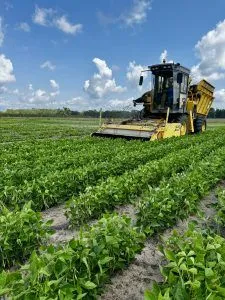
Credit: Sydney Williams, UF/IFAS
Practical Considerations for Grower Adoption
Grower adoption of CRF depends on several practical management considerations that influence ease of implementation. Application method is often the first factor. While broadcasting CRF generally requires no modification to existing fertilizer broadcast application equipment, banding may need sidedressing modifications to place fertilizer close to the row. This may limit adoption for operations lacking such equipment. Timing is another key consideration as CRF blends are typically applied early in the season, when plant root systems are smaller and the risk of leaching is greatest. Proper placement is another important consideration because snapbeans have shallow and small root systems that may not reach nutrients between rows out of the root zone, increasing the risk of early-season between-row soluble nitrate-nitrogen leaching. Since CRF is often applied in only one or two applications per season, using a large hopper that holds more fertilizer per application can help minimize the amount of time required to refill it. Growers must also consider the often higher upfront cost of CRF against potential savings from fewer tractor passes and reduced nitrogen losses. These practical factors shape how CRF can be integrated into commercial snapbean production.
Summary
- Results of the trials confirm that the UF/IFAS (Plant Nutrient Oversight Committee) N rate recommendation of 100 lb/acre is sufficient to produce maximum yields in the sandy soils of north Florida.
- No significant yield increase was observed after the N rate of 100 lb/acre across both years and trials, following a crop of peanuts (legume) the year before.
- Banding or broadcasting nitrogen fertilizer did not result in any significant differences in yield. Therefore, both methods are useful, but banding may result in more efficient N usage and reduce the risk of leaching.
References
Rath, S., M. Zamora-Re, W. Graham, M. Dukes, and D. Kaplan. 2021. “Quantifying Nitrate Leaching to Groundwater from a Corn-Peanut Rotation Under a Variety of Irrigation and Nutrient Management Practices in the Suwannee River Basin, Florida.” Agricultural Water Management 246: 106634. https://doi.org/10.1016/j.agwat.2020.106634
Singh, R., R. C. Hochmuth, D. Arruda Huggins de Sá Leitão, and L. K. Sharma. 2024. “Nitrogen Fertilization in Snap Bean Following a Legume in the Sandy Soils of North Florida.” HortTechnology 34 (5): 521–532. https://doi.org/10.21273/horttech05442-24
Singh, R., R. C. Hochmuth, D. Arruda Huggins de Sá Leitão, et al. 2025. “Nitrogen Fertilizer Placement and Its Influence on Snap Bean Production in North Florida.” Agrosystems, Geosciences & Environment 8 (3). https://doi.org/10.1002/agg2.70199
Timilsena, Y. P., R. Adhikari, P. Casey, T. Muster, H. Gill, and B. Adhikari. 2014. “Enhanced Efficiency Fertilisers: A Review of Formulation and Nutrient Release Patterns.” Journal of the Science of Food and Agriculture 95 (6): 1131–1142. https://doi.org/10.1002/jsfa.6812
U. S. Department of Agriculture, National Agricultural Statistics Service (USDA-NASS). 2024. 2024 State Agriculture Overview of Florida. Quick Stats Database. https://www.nass.usda.gov/Quick_Stats/Ag_Overview/stateOverview.php?state=Florida&year=2024