
Introduction
The Florida maple—Acer barbatum (Acer saccharum var. floridum)—is considered by some taxonomists to be a separate species. The correct taxonomic nomenclature appears to depend on which botanist, horticulturist, etc., you rely upon as your "expert." It reaches 50 to 60 feet in height but is often smaller. Displaying muted yellow or orange fall leaf color, Florida maple is ideal for use as a specimen or park tree, or for use in woodland areas and is much preferred over sugar maple in USDA hardiness zones 8b through 9. The edges of the leaves turn under slightly giving them a distinct appearance. The trunk on older specimens resembles that on the northern sugar maple, which is an attractive gray with longitudinal ribs. The round to oval growth habit makes it an ideal shade or street tree.
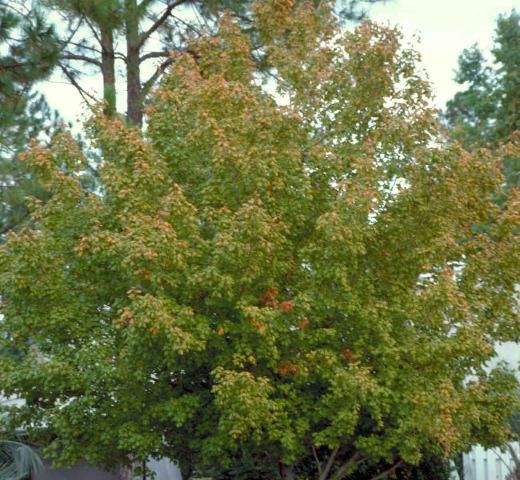
Credit: Ed Gilman
General Information
Scientific name: Acer barbatum (saccharum) var . caddo
Pronunciation: AY-ser bar-BAY-tum variety KAD-oh
Common name(s): Caddo Florida maple, Caddo southern sugar maple
Family: Aceraceae
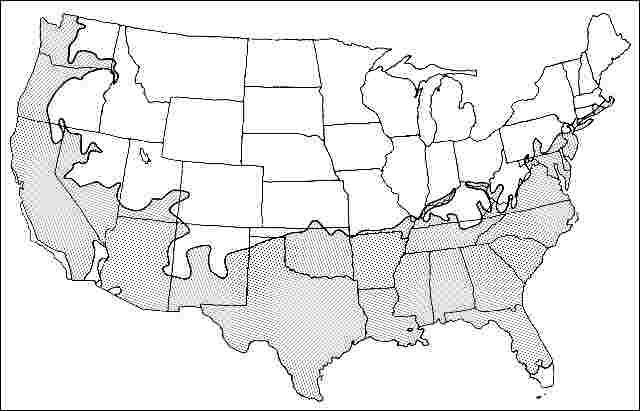
USDA hardiness zones: 6B through 9B (Fig. 2)
Origin: native to North America
Invasive potential: little invasive potential
Uses: highway median; shade; street without sidewalk; deck or patio; tree lawn 4–6 feet wide; tree lawn > 6 ft. wide; Bonsai
Availability: somewhat available, may have to go out of the region to find the tree
Description
Height: 50 to 60 feet
Spread: 20 to 35 feet
Crown uniformity: symmetrical
Crown shape: oval, upright/erect
Crown density: moderate
Growth rate: moderate
Texture: medium
Foliage
Leaf arrangement: opposite/subopposite (Fig. 3)
Leaf type: simple
Leaf margin: lobed, entire, undulate
Leaf shape: star-shaped
Leaf venation: palmate
Leaf type and persistence: deciduous
Leaf blade length: 2 to 4 inches
Leaf color: green
Fall color: yellow
Fall characteristic: showy

Flower
Flower color: red
Flower characteristics: not showy
Fruit
Fruit shape: oval
Fruit length: 1 to 3 inches
Fruit covering: dry or hard
Fruit color: brown, green
Fruit characteristics: does not attract wildlife; not showy; fruit/leaves not a litter problem
Trunk and Branches
Trunk/bark/branches: branches don't droop; showy; typically one trunk; thorns
Pruning requirement: little required
Breakage: resistant
Current year twig color: brown
Current year twig thickness: medium
Wood specific gravity: unknown
Culture
Light requirement: full sun, partial sun or partial shade
Soil tolerances: clay; sand; loam; slightly alkaline; acidic; well-drained
Drought tolerance: moderate
Aerosol salt tolerance: none
Other
Roots: not a problem
Winter interest: yes
Outstanding tree: no
Ozone sensitivity: unknown
Verticillium wilt susceptibility: susceptible
Pest resistance: free of serious pests and diseases
Use and Management
'Caddo' southern sugar maple is a hard-wooded tree with a moderate to slow growth rate. It grows about 1 foot each year in most soils but is sensitive to reflected heat, and to drought, turning the leaves brown (scorch) along their edges. Leaf scorch from dry soil is often evident in areas where the root system is restricted to a small soil area, such as a street tree planting. It is more drought-tolerant in open areas where the roots can proliferate into a large soil space.
The dense, well-branched crown creates dense shade, and along with many surface roots will prevent good lawn growth. Branches are usually well-attached to trunks resulting in a low branch failure rate. The tree transplants fairly easily but may develop girdling roots which can reduce growth, or in extreme cases kill the tree. Remove roots which appear to be growing around the trunk as soon as they are recognized.
The limbs of sugar maple are usually strong and not susceptible to wind damage. The bark forms attractive bright gray plates which stand out especially during the winter. Roots are often shallow and reach the surface at an early age, even in sandy soil. Plant in an area where grass below it will not need to be mowed so the roots will not be damaged by the mower. A variety of birds use the tree for food, nesting and cover and the fruits are especially popular with squirrels.
Growing in full sun or shade, sugar maple will tolerate a wide variety of soil types (except compacted soil) but is not salt-tolerant. Established trees look better when given some irrigation during dry weather, particularly in the south. In the south, many leaves remain in the central portion of the canopy for much of the winter, giving the tree a somewhat unkempt appearance. Sugar maples are not recommended for the Dallas area, in many cases due to alkaline soils causing chlorosis. Sensitivity to compaction, heat, drought and road salt limit usage of sugar maple for urban street plantings, but it is still recommended for parks and other areas away from roads where soil is loose and well-drained. Acer nigrum, a similar species, is more tolerant of heat and drought.
Propagation is by seeds or cuttings.
Pests
Cottony maple scale, borers, aphids, and gall mites may be problems for Florida maple.
Diseases
Florida maple can be susceptible to a wilt disease.