
Introduction
This deciduous, 30-to 45-foot-high by 25-foot-wide tree has beautiful 3-inch-wide, tri-lobed leaves, glossy green above and paler underneath, which turn various shades of red, orange, and yellow in autumn. Flowers are bright yellow and showy in the spring. Trident maple naturally exhibits low spreading growth and multiple stems but can be trained to a single trunk and pruned to make it branch higher, allowing passage below its broad, oval to rounded canopy. With its moderate growth rate, attractive orange-brown peeling bark, and easy maintenance, trident maple is popular as a patio or street tree and is also highly valued as a bonsai subject. Crown form is often variable and selection of a uniformly-shaped, vigorous cultivar is needed.

Credit: Ed Gilman
General Information
Scientific name: Acer buergeranum
Pronunciation: AY-ser ber-jair-AY-num
Common name(s): Trident maple
Family: Aceraceae
USDA hardiness zones: 4B through 9B (Fig. 2)
Origin: not native to North America
Invasive potential: little invasive potential
Uses: specimen; deck or patio; street without sidewalk; container or planter; shade; parking lot island < 100 sq. ft.; parking lot island 100-200 sq. ft.; parking lot island > 200 sq. ft.; tree lawn 3-4 feet wide; tree lawn 4-6 feet wide; tree lawn > 6 ft. wide; urban tolerant; highway median; Bonsai
Availability: somewhat available, may have to go out of the region to find the tree

Description
Height: 30 to 45 feet
Spread: 25 to 30 feet
Crown uniformity: irregular
Crown shape: oval, round
Crown density: moderate
Growth rate: moderate
Texture: medium
Foliage
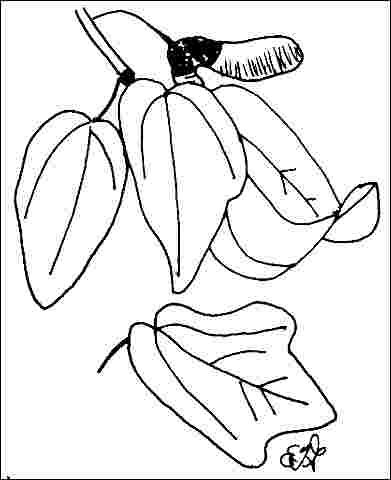
Leaf arrangement: opposite/subopposite (Fig. 3)
Leaf type: simple
Leaf margin: serrate
Leaf shape: star-shaped
Leaf venation: palmate
Leaf type and persistence: deciduous
Leaf blade length: less than 2 inches, 2 to 4 inches
Leaf color: green
Fall color: red, orange, yellow
Fall characteristic: showy
Flower
Flower color: yellow
Flower characteristics: showy
Fruit
Fruit shape: oval
Fruit length: .5 to 1 inch
Fruit covering: dry or hard
Fruit color: red
Fruit characteristics: does not attract wildlife; not showy; fruit/leaves not a litter problem
Trunk and Branches
Trunk/bark/branches: branches don't droop; showy; typically multi-trunked; thorns
Pruning requirement: needed for strong structure
Breakage: resistant
Current year twig color: gray, brown
Current year twig thickness: thin, medium
Wood specific gravity: unknown
Culture
Light requirement: full sun, partial sun or partial shade
Soil tolerances: clay; sand; loam; acidic; alkaline; well-drained
Drought tolerance: moderate
Aerosol salt tolerance: moderate
Other
Roots: not a problem
Winter interest: yes
Outstanding tree: yes
Ozone sensitivity: unknown
Verticillium wilt susceptibility: susceptible
Pest resistance: free of serious pests and diseases
Use and Management
Trees grown in partial shade can grow much taller (up to 60 feet tall), especially when the crown is touching adjacent trees preventing branches from spreading. The tree is reported to be weak-wooded in North Carolina but some of this may be due to poor structure, not weak wood. This can be at least partially prevented by pruning major lateral branches so they grow no larger than half the diameter of the main trunk. Be sure that there are no weak crotches with embedded bark, or double or multiple leaders which could cause the tree to split apart. Specify single-leadered trees when planting along streets or in parking lots or other commercial landscapes.
Trident maple has not been extensively used as a street tree, probably due to its unavailability, but the cultural requirements, size, and form make it a great candidate. It should also be planted more around residences and commercial landscapes due to its pleasing form and small size.
Trident maple should be planted in full sun or partial shade on any well-drained, acid soil and is quite tolerant of salt, air pollution, wind, and drought. Like other maples, some chlorosis can develop in soils with pH over 7 but it is moderately tolerant of soil salt. It performs well in urban areas where soils are often poor and compacted. Trees are easily transplanted due to their shallow root system and are fairly 'clean' trees since they do not drop messy leaves, fruit or flowers.
Several cultivars are known, with trees having dwarf growth, corky bark, variegated leaves, and a variety of leaf shapes. Some particularly good cultivars include: 'Akebono', 'Goshiki Kaede', 'Maruba', and 'Mino Yatsubusa'. They have not been tested extensively in urban areas and will probably be very hard to find.
Propagation is by seed or young-seedling cuttings.
Pests and Diseases
No pests or diseases are of major concern, a very clean tree.