
Introduction
Ivy-leaf maple reaches 20 to 30 feet in height and is equally wide, with a broad, rounded, very dense, fine-textured canopy. The branches have a twisted and contorted growth habit which, along with the smooth, grey bark, creates an attractive winter silhouette. Upper branches are upright, middle ones horizontal and lower branches slightly pendulous. The crown is made up of a large number of finely-divided, small diameter branches with none really dominant.
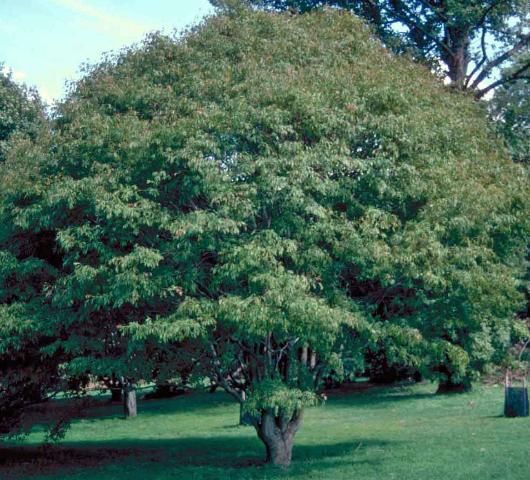
Credit: Ed Gilman
General Information
Scientific name: Acer cissifolium
Pronunciation: AY-ser siss-ih-FOLE-ee-um
Common name(s): Ivy-leaf maple
Family: Aceraceae
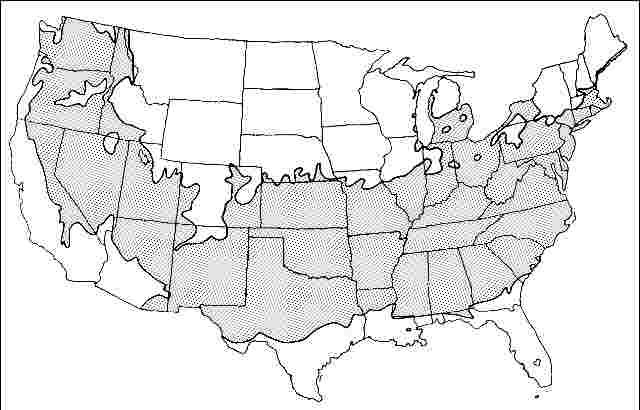
USDA hardiness zones: 5B through 8A (Fig. 2)
Origin: not native to North America
Invasive potential: little invasive potential
Uses: hedge; tree lawn 3-4 feet wide; tree lawn 4-6 feet wide; tree lawn > 6 ft. wide; sidewalk cutout (tree pit); deck or patio; specimen; street without sidewalk; container or planter; Bonsai
Availability: not native to North America
Description
Height: 15 to 25 feet
Spread: 20 to 30 feet
Crown uniformity: symmetrical
Crown shape: round
Crown density: dense
Growth rate: slow
Texture: fine
Foliage
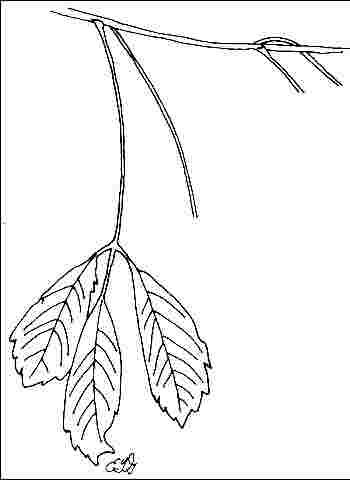
Leaf arrangement: opposite/subopposite (Fig. 3)
Leaf type: trifoliate, odd-pinnately compound
Leaf margin: serrate
Leaf shape: ovate, obovate
Leaf venation: pinnate
Leaf type and persistence: deciduous
Leaf blade length: less than 2 inches, 2 to 4 inches
Leaf color: green
Fall color: red, yellow
Fall characteristic: not showy
Flower
Flower color: yellow
Flower characteristics: not showy
Fruit
Fruit shape: elongated
Fruit length: .5 to 1 inch
Fruit covering: dry or hard
Fruit color: brown, green
Fruit characteristics: does not attract wildlife; not showy; fruit/leaves not a litter problem
Trunk and Branches
Trunk/bark/branches: branches don't droop; showy; typically multi-trunked; thorns
Pruning requirement: needed for strong structure
Breakage: resistant
Current year twig color: reddish, green
Current year twig thickness: thin
Wood specific gravity: unknown
Culture
Light requirement: partial sun or partial shade, full sun
Soil tolerances: clay; sand; loam; acidic; slightly alkaline; well-drained
Drought tolerance: moderate
Aerosol salt tolerance: unknown
Other
Roots: not a problem
Winter interest: yes
Outstanding tree: no
Ozone sensitivity: unknown
Verticillium wilt susceptibility: susceptible
Pest resistance: free of serious pests and diseases
Use and Management
The divided leaflets turn muted shades of red and yellow before dropping in fall. Probably best used as a patio tree or specimen, it could be tried as a street tree, particularly in areas where overhead space is restricted such as beneath power lines. It would make a lovely tree for planting on 20 foot centers along an entry driveway to a commercial landscape, or along a suburban street. Set them back from the street 8 to 12 feet if large trucks use the street regularly since the tree loses its attractiveness (just like the Callery pears) when lower branches are removed for vehicle clearance. They can be planted closer if the street is residential and predominantly travelled by automobiles.
Ivy-leaf maple prefers a partially shaded location (particularly in the southern part of its range) but will grow well in full sun when grown on well-drained, moist, acid soil. Tolerating drought without leaf scorch except in the driest, sandy soils, ivy-leaf maple appears to be a tough maple deserving greater usage in urban and suburban landscapes.
Propagation is by cuttings.
Pests and Diseases
It has problems similar to other maples.