
Introduction
Perhaps the most beautiful maple, paperbark maple has trifoliate leaves and wonderfully orange to bronze, peeling, papery bark which provides year round interest. The bark begins peeling on the sculptured trunk and on 2-or 3-year-old branches. It may be cinnamon brown or orange but is usually a dark reddish-brown, looking particularly striking in the snow. Even small branches display exfoliating bark making this a true specimen tree, even at a young age. Most specimens are seen with multiple trunks which branch close to the ground, but proper training when young can create a single trunk. Paperbark maple has vibrant, scarlet, autumn foliage.

General Information
Scientific name: Acer griseum
Pronunciation: AY-ser GRISS-ee-um
Common name(s): Paperbark maple
Family: Aceraceae
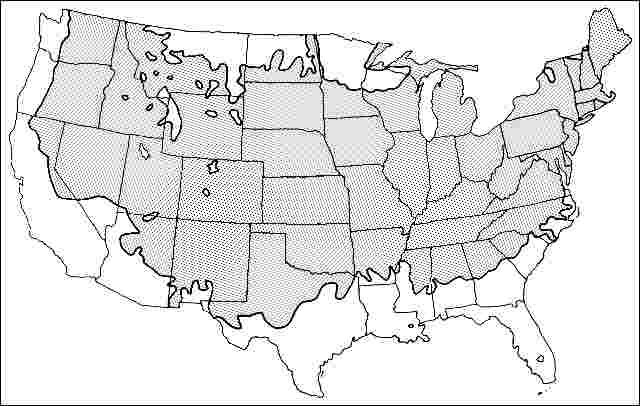
USDA hardiness zones: 4A through 7B (Fig. 2)
Origin: not native to North America
Invasive potential: little invasive potential
Uses: highway median; container or planter; specimen; deck or patio; Bonsai
Availability: not native to North America
Description
Height: 15 to 25 feet
Spread: 15 to 25 feet
Crown uniformity: irregular
Crown shape: vase, oval, upright/erect
Crown density: open
Growth rate: slow
Texture: fine
Foliage
Leaf arrangement: opposite/subopposite (Fig. 3)
Leaf type: trifoliate, odd-pinnately compound
Leaf margin: serrate
Leaf shape: elliptic (oval), ovate
Leaf venation: pinnate
Leaf type and persistence: deciduous
Leaf blade length: 2 to 4 inches, 4 to 8 inches
Leaf color: green
Fall color: red
Fall characteristic: showy

Flower
Flower color: green
Flower characteristics: not showy
Fruit
Fruit shape: elongated, oval
Fruit length: 1 to 3 inches
Fruit covering: dry or hard
Fruit color: brown
Fruit characteristics: does not attract wildlife; showy; fruit/leaves not a litter problem
Trunk and Branches
Trunk/bark/branches: branches don't droop; very showy; typically multi-trunked; thorns
Pruning requirement: little required
Breakage: resistant
Current year twig color: brown
Current year twig thickness: thin, medium
Wood specific gravity: unknown
Culture
Light requirement: full sun, partial sun or partial shade, shade tolerant
Soil tolerances: clay; sand; loam; acidic; slightly alkaline; well-drained
Drought tolerance: moderate
Aerosol salt tolerance: moderate
Other
Roots: not a problem
Winter interest: yes
Outstanding tree: yes
Ozone sensitivity: unknown
Verticillium wilt susceptibility: susceptible
Pest resistance: resistant to pests/diseases
Use and Management
The multi-stemmed habit, unusual leaves, and wonderful bark makes this a prime candidate for specimen planting in any commercial, institutional, or residential landscape. If you can find it, plant it by a patio or other prime location and light it from below for nighttime enjoyment.
The tree is hardy, grows very slowly to 25 or 30 feet tall, but, unfortunately, is difficult and expensive to propagate. It does not tolerate extended drought or other environmental stresses in the south or in poor soil (moderate drought-tolerance in sandy loam) but will grow in sun or shade. Leaves will scorch during dry summers unless provided with some irrigation. Probably best in partial shade if planted in the south. The beauty of this tree makes up for the extra effort required to grow it. If this plant could be easily propagated, it would be widely used because the price of the plant would drop to levels acceptable to most people.
Pests and Diseases
Probably has similar pest and disease problems as other maples.