
Introduction
This 25-to 30-foot-tall native North American tree is reportedly quite similar to Acer barbatum or Florida Maple and is often seen with multiple trunks. The chalky white or light gray bark is quite attractive, with the bark on older trees becoming ridged and blackened near the ground. The two-to three-inch-diameter, lobed leaves, with fuzzy undersides, give a spectacular display in the fall months, ranging from shimmering yellow to vivid orange and deep red.
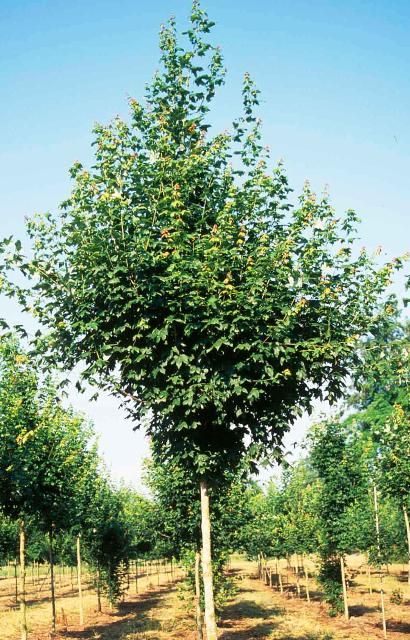
Credit: Ed Gilman
General Information
Scientific name: Acer leucoderme
Pronunciation: AY-ser loo-koe-DER-mee
Common name(s): Chalk maple, whitebark maple
Family: Aceraceae
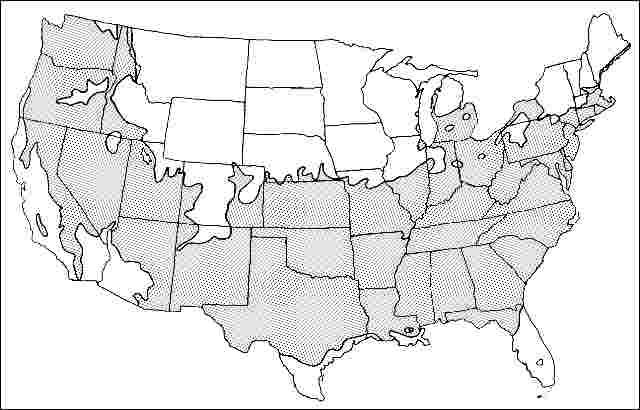
USDA hardiness zones: 5B through 8B (Fig. 2)
Origin: native to North America
Invasive potential: little invasive potential
Uses: deck or patio; shade; reclamation; specimen; parking lot island 100-200 sq ft; parking lot island > 200 sq ft; tree lawn 4-6 feet wide; tree lawn > 6 ft wide; highway median
Availability: not native to North America
Description
Height: 25 to 30 feet
Spread: 15 to 30 feet
Crown uniformity: symmetrical
Crown shape: oval
Crown density: dense
Growth rate: slow
Texture: medium
Foliage
Leaf arrangement: opposite/subopposite
Leaf type: simple
Leaf margin: entire, lobed
Leaf shape: star-shaped
Leaf venation: palmate
Leaf type and persistence: deciduous
Leaf blade length: 4 to 8 inches, 2 to 4 inches
Leaf color: green
Fall color: yellow, red, orange
Fall characteristic: showy
Flower
Flower color: yellow, green
Flower characteristics: not showy
Fruit
Fruit shape: elongated
Fruit length: 1 to 3 inches
Fruit covering: dry or hard
Fruit color: unknown
Fruit characteristics: does not attract wildlife; not showy; fruit/leaves not a litter problem
Trunk and Branches
Trunk/bark/branches: branches don't droop; showy; typically multi-trunked; thorns
Pruning requirement: needed for strong structure
Breakage: resistant
Current year twig color: brown
Current year twig thickness: medium
Wood specific gravity: unknown
Culture
Light requirement: full sun, partial sun or partial shade, shade tolerant
Soil tolerances: clay; sand; loam; acidic; slightly alkaline; occasionally wet; well-drained
Drought tolerance: high
Aerosol salt tolerance: unknown
Other
Roots: not a problem
Winter interest: yes
Outstanding tree: no
Ozone sensitivity: unknown
Verticillium wilt susceptibility: susceptible
Pest resistance: free of serious pests and diseases
Use and Management
The striking white bark makes this maple well suited for planting as a specimen displayed against a dark background. A row of these maples planted along a dark glass building wall or other dark structure would get people's attention. Surprisingly underused, this small maple is well suited for a variety of sites, including residences.
Chalk maple grows well in full sun, partial shade, or deep shade, and has a high tolerance for dry soils. The tree is quite popular in the midwest in areas with alkaline soil pH.
Pests and Diseases
No pests or diseases are of major concern.