
Introduction
This red leaf Japanese maple has finely-divided, lacy leaves of a deep red in the spring but foliage color fades to light green in early summer. Leaves take on a beautiful golden, orange or red color in fall. A small, deciduous tree with delicate, upright branches, 'Atropurpureum' Japanese maple reaches a height and spread of about 20 feet, forming a vase-shaped specimen tree. The multiple trunks are picturesque and show nicely when lit up at night from beneath the canopy. This cultivar of Japanese maple is grown for its colored leaves and interesting growth habit.

Credit: Ed Gilman
General Information
Scientific name: Acer palmatum
Pronunciation: AY-ser pal-MAY-tum
Common name(s): 'Atropurpureum' Japanese maple
Family: Aceraceae
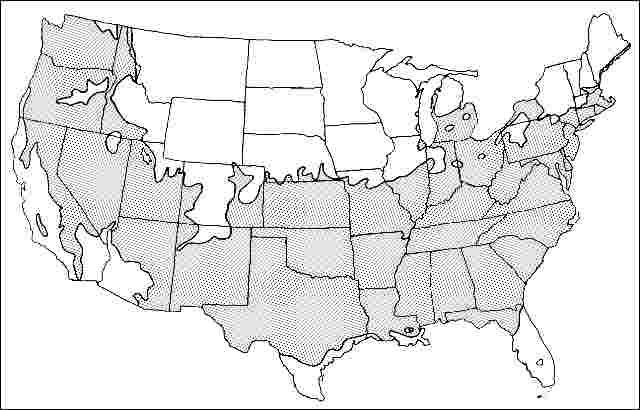
USDA hardiness zones: 5B through 8B (Fig. 2)
Origin: not native to North America
Invasive potential: little invasive potential
Uses: Bonsai; specimen; deck or patio; trained as a standard; container or planter
Availability: somewhat available, may have to go out of the region to find the tree
Description
Height: 15 to 25 feet
Spread: 15 to 25 feet
Crown uniformity: symmetrical
Crown shape: vase, round
Crown density: moderate
Growth rate: slow
Texture: medium
Foliage
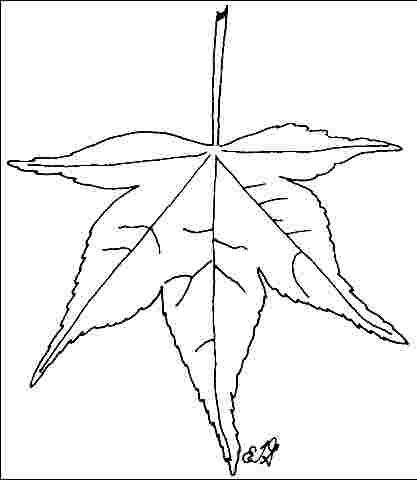
Leaf arrangement: opposite/subopposite (Fig. 3)
Leaf type: simple
Leaf margin: serrate, lobed
Leaf shape: star-shaped
Leaf venation: palmate
Leaf type and persistence: deciduous
Leaf blade length: 2 to 4 inches
Leaf color: purple/red
Fall color: red
Fall characteristic: showy
Flower
Flower color: red
Flower characteristics: not showy
Fruit
Fruit shape: elongated
Fruit length: .5 to 1 inch
Fruit covering: dry or hard
Fruit color: red
Fruit characteristics: does not attract wildlife; not showy; fruit/leaves not a litter problem
Trunk and Branches
Trunk/bark/branches: branches don't droop; showy; typically multi-trunked; thorns
Pruning requirement: needed for strong structure
Breakage: resistant
Current year twig color: green, reddish
Current year twig thickness: thin
Wood specific gravity: unknown
Culture
Light requirement: partial sun or partial shade, shade tolerant
Soil tolerances: sand; loam; clay; acidic; well-drained
Drought tolerance: moderate
Aerosol salt tolerance: none
Other
Roots: not a problem
Winter interest: yes
Outstanding tree: yes
Ozone sensitivity: unknown
Verticillium wilt susceptibility: susceptible
Pest resistance: resistant to pests/diseases
Use and Management
Be sure to clear all turf away from beneath the branches to reduce competition with turf. Train the trunks and branches so they will not touch each other. Eliminate branches with embedded bark or those which are likely to develop it as soon as possible. This reduces the likelihood of one splitting from the tree later when it has grown to become an important part of the landscape. Locate the tree properly, taking into account the ultimate size since the tree looks best if it is not pruned to control size. The tree can enhance any landscape with its delightful spring flush of red foliage, but remember that it will fade to green in the beginning of the summer. It can be the centerpiece of your landscape if properly located.
This small tree tends to leaf out early, so it may be injured by spring frosts. Protect them from drying winds and direct sun by providing partial shade and well-drained, acid soil with plenty of organic matter, particularly in the southern part of its range. Leaves often scorch in hot summer weather in USDA hardiness zones 7b and 8, unless they are in a mostly shaded spot or irrigated during dry weather. More direct sun can be tolerated in the northern part of the range (USDA hardiness zones 5 and 6). Be sure drainage is maintained and never allow water to stand around the roots. Grows fine in clay soils provided the ground is sloped so water does not accumulate in the soil. Responds well to several inches of mulch placed beneath the canopy.
'Dissectum Atropurpureum' ('Ever Red') is a slow-growing, compact shrub, 6 to 10 feet high, with deep red foliage which fades during the growing season to purple-green or green. The fall color is a brilliant, flaming orange. 'Ornatum' has dark red leaves that fade to bronze-green. 'Bloodgood' also has red leaves and may not fade to green as early as 'Atropurpureum', and it has excellent fall color.
Pests
Aphids infest maples, usually Norway maple, and may be numerous at times. High populations can cause leaf drop. Another sign of heavy aphid infestation is honey dew on lower leaves and objects beneath the tree. Aphids are controlled by spraying or they may be left alone. If not sprayed, predatory insects will normally bring the aphid population under control.
Scales are an occasional problem on maples. Perhaps the most common is cottony maple scale. The insect forms a cottony mass on the lower sides of branches. Scales are usually controlled with horticultural oil sprays. Scales may also be controlled with well-timed sprays to kill the crawlers.
If borers become a problem it is an indication the tree is not growing well. Controlling borers involves keeping trees healthy. Chemical controls of existing infestations are more difficult. Proper control involves identification of the borer infesting the tree then applying insecticides at the proper time.
Diseases
No diseases are of major concern.
Scorch occurs during periods of high temperatures accompanied by wind. Trees with diseased or inadequate root systems will also show scorching. When trees do not get enough water they scorch. Scorch symptoms are light brown or tan dead areas along leaf margins or between leaf veins. The symptoms appear on all parts of the tree or only on the side exposed to sun and wind. Scorching due to dry soil may be overcome by watering. If scorching is due to an inadequate or diseased root system, watering will have no effect.