
Introduction
This large deciduous tree is normally seen at 40 to 60 feet in height although sycamore maple is capable of reaching over 100 feet in height. The spreading branches form an oval or rounded canopy and the dark green, three-to seven-inch-diameter, lobed leaves do not ordinarily become showy in the fall, changing only to a muted yellow before dropping, but this will vary. The gray to reddish-brown, scaly bark flakes off in small scales to reveal the showy, orange, inner bark. The green, springtime flowers appear in three-to six-inch-long hanging panicles among the leaves in late spring and are followed by one-to two-inch-long, winged seeds.

General Information
Scientific name: Acer pseudoplatanus
Pronunciation: AY-ser soo-doe-PLAT-uh-nus
Common name(s): Sycamore maple, planetree maple
Family: Aceraceae
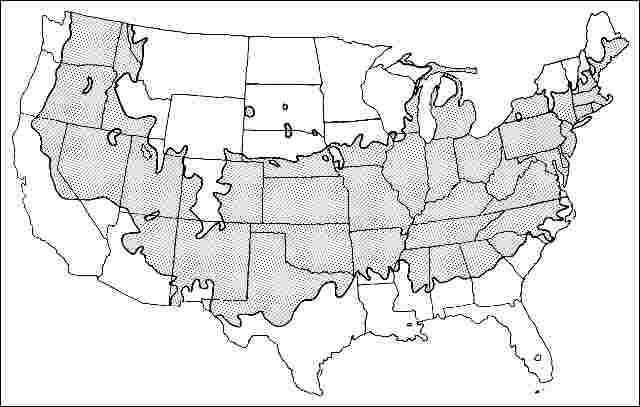
USDA hardiness zones: 5A through 7B (Fig. 2)
Origin: not native to North America
Invasive potential: invasive non-native
Uses: sidewalk cutout (tree pit); tree lawn > 6 ft. wide; parking lot island > 200 sq. ft.; shade
Availability: somewhat available, may have to go out of the region to find the tree
Description
Height: 60 to 70 feet
Spread: 40 to 60 feet
Crown uniformity: symmetrical
Crown shape: round, spreading
Crown density: moderate
Growth rate: fast
Texture: coarse
Foliage
Leaf arrangement: opposite/subopposite (Fig. 3)
Leaf type: simple
Leaf margin: serrate, lobed
Leaf shape: ovate
Leaf venation: palmate
Leaf type and persistence: deciduous
Leaf blade length: 4 to 8 inches
Leaf color: green
Fall color: no color change
Fall characteristic: not showy

Flower
Flower color: green
Flower characteristics: not showy
Fruit
Fruit shape: elongated
Fruit length: 1 to 3 inches
Fruit covering: dry or hard
Fruit color: green
Fruit characteristics: does not attract wildlife; showy; fruit/leaves not a litter problem
Trunk and Branches
Trunk/bark/branches: branches droop; showy; typically one trunk; thorns
Pruning requirement: little required
Breakage: resistant
Current year twig color: gray, brown
Current year twig thickness: medium
Wood specific gravity: unknown
Culture
Light requirement: full sun, partial sun or partial shade
Soil tolerances: clay; sand; loam; alkaline; acidic; occasionally wet; well-drained
Drought tolerance: moderate
Aerosol salt tolerance: high
Other
Roots: not a problem
Winter interest: no
Outstanding tree: no
Ozone sensitivity: tolerant
Verticillium wilt susceptibility: susceptible
Pest resistance: sensitive to pests/diseases
Use and Management
This is a large tree which requires space to spread. Not for the small landscape, its large, falling leaves and early defoliation in the fall can create a challenge for even the most enthusiastic gardener. Many bags of leaves will be raked from beneath this handsome tree. This tree may be best saved for the park or other large open-space planting site since its coarse texture blends poorly with residential and many commercial landscapes.
Sycamore maple grows in full sun or partial shade on almost any well-drained soil, acid, or alkaline. Sycamoremaple is quite adaptable to various soils and is also highly salt-tolerant. Little pruning is needed to develop a good trunk and branch structure.
Pests
No pests are of major concern.
Diseases
Sycamore maple is susceptible to trunk and branch cankers.