
Introduction
A North American native commonly found along streams, white alder is a quick-growing tree (to 30 inches per year) reaching 50 to 75 feet in height, sometimes up to 100 feet, and has a spread of 30 to 40 feet. The deciduous four-inch-long, glossy leaves are dark green above and lighter below and appear just after the springtime display of the six-inch-long, greenish-yellow catkins. These flowers are followed by the appearance of brown, cone-like fruits that persist on the tree throughout most of the year and are quite popular for use in dried flower arrangements. White alder creates an interesting specimen during the winter with a straight trunk, persistent fruits, attractive silver/grey bark, and slender, horizontal branches with pendulous tips. The crown takes on a pyramidal shape in youth becoming more oval with age. Any necessary pruning should be done in winter or early spring. Once chosen, the central leader dominates the tree forming a pyramidal crown shape.

Credit: Ed Gilman
General Information
Scientific name: Alnus rhombifolia
Pronunciation: AL-nus rom-bih-FOLE-ee-uh
Common name(s): White alder
Family: Betulaceae
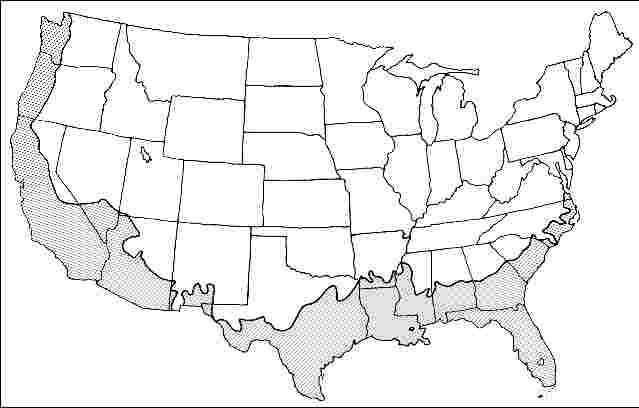
USDA hardiness zones: 8A through 11 (Fig. 2)
Origin: native to North America
Uses: street without sidewalk; parking lot island > 200 sq. ft.; tree lawn > 6 ft. wide
Availability: not native to North America
Description
Height: 50 to 75 feet
Spread: 30 to 40 feet
Crown uniformity: symmetrical
Crown shape: pyramidal, oval
Crown density: moderate
Growth rate: fast
Texture: medium
Foliage
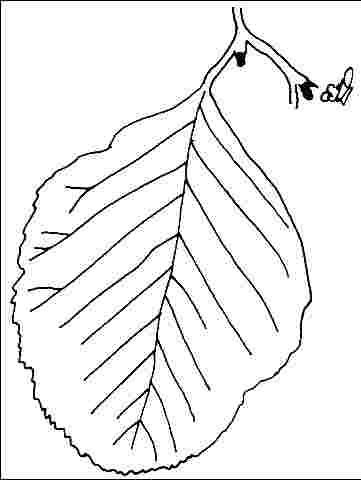
Leaf arrangement: alternate (Fig. 3)
Leaf type: simple
Leaf margin: serrate
Leaf shape: elliptic (oval)
Leaf venation: pinnate
Leaf type and persistence: deciduous
Leaf blade length: 2 to 4 inches
Leaf color: green
Fall color: no color change
Fall characteristic: not showy
Flower
Flower color: yellow
Flower characteristics: not showy
Fruit
Fruit shape: elongated
Fruit length: .5 to 1 inch
Fruit covering: dry or hard
Fruit color: brown
Fruit characteristics: does not attract wildlife; not showy; fruit/leaves not a litter problem
Trunk and Branches
Trunk/bark/branches: branches don't droop; showy; typically one trunk; thorns
Pruning requirement: little required
Breakage: resistant
Current year twig color: brown
Current year twig thickness: thin
Wood specific gravity: unknown
Culture
Light requirement: full sun, partial sun or partial shade
Soil tolerances: clay; sand; loam; acidic; alkaline; occasionally wet; well-drained
Drought tolerance: moderate
Aerosol salt tolerance: unknown
Other
Roots: not a problem
Winter interest: yes
Outstanding tree: no
Ozone sensitivity: unknown
Verticillium wilt susceptibility: resistant
Pest resistance: sensitive to pests/diseases
Use and Management
White alder will grow easily in full sun or partial shade in any moist soil and will happily tolerate the wettest conditions. It is usually not grown or offered by nurseries in the eastern United States, but is common in some areas of California.
Propagation is by fresh seeds or by cuttings.
Pests
White alder is attacked and killed by the flatheaded borer in California. This borer is closely related to the bronze birch borer. Prune infested branches during late summer and fall when the infestation is visible and easy to detect and the beetle does not fly. Avoid pruning in the spring.
Tent caterpillars.
Diseases
No diseases are of major concern.