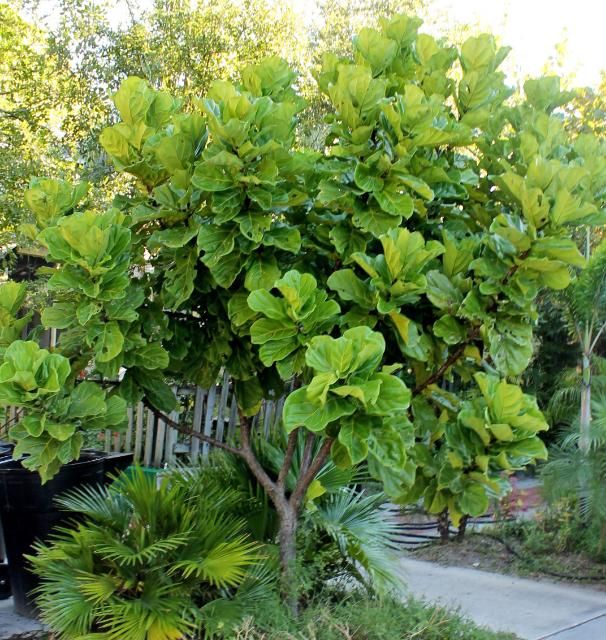
A 25 to 50-foot-tall, evergreen tree of upright-spreading, irregular growth, fiddleleaf fig produces 8 to 15-inch-long and 10-inch-wide, dull green, thick, fiddle-shaped leaves which are quite attractive. The trunk can grow to several feet thick. Most trees in the landscape are 15 to 25 feet tall. Larger ones sometimes break apart in strong winds due to tight branch crotches and embedded bark. Corrective pruning early in the life of the tree can help prevent this from occurring. Plant them in a place protected from the wind, such as a courtyard to increase longevity in the landscape.
Figure 1. Full Form—Ficus lyrata: Fiddleleaf fig
General Information
Scientific name: Ficus lyrata
Pronunciation: FYE-kuss lye-RAY-tuh
Common name(s): Fiddleleaf fig
Family: Moraceae
USDA hardiness zones: 10B through 11 (Figure 2)
Origin: native to tropical western and central Africa
UF/IFAS Invasive Assessment Status: not considered a problem species at this time, may be recommended (North, Central, South)
Uses: indoors; deck or patio; specimen; container or planter; espalier; highway median; street without sidewalk; shade
Figure 2. Range
Description
Height: 25 to 50 feet
Spread: 25 to 35 feet
Crown uniformity: irregular
Crown shape: vase, round, spreading
Crown density: moderate
Growth rate: moderate
Texture: coarse
Foliage
Leaf arrangement: alternate
Leaf type: simple
Leaf margin: undulate, entire
Leaf shape: obovate
Leaf venation: pinnate, brachidodrome
Leaf type and persistence: evergreen, broadleaf evergreen
Leaf blade length: 8 to 15 inches
Leaf color: dull green on top, paler green underneath
Fall color: no color change
Fall characteristic: not showy
Figure 3. Leaf—Ficus lyrata: Fiddleleaf fig
Flower
Flower color: unknown
Flower characteristics: not showy; emerges in clusters inside of the syconium produced by this tree
Fruit
Fruit shape: round
Fruit length: ½ inch
Fruit covering: fleshy fig with creamy white dots
Fruit color: turns from green to red when ripe
Fruit characteristics: does not attract wildlife; not showy; fruit/leaves a litter problem
Figure 4. Fruit—Ficus lyrata: Fiddleleaf fig
Trunk and Branches
Trunk/branches: branches droop; not showy; typically one trunk; no thorns; broken stems excrete a milky sap
Bark: brown, flaky, becoming gray and smooth with age
Fiddleleaf fig can be used in containers when young or can be planted to make a striking specimen tree. They create quite an accent by a patio or in shrub bed because of the coarse leaf texture. Due to their large size, the leaves can be a nuisance to some people when they fall but there are never too many of them.
Fiddleleaf fig will grow moderately fast in full sun or partial shade on any well-drained soil and should receive regular watering. Be sure to cut roots circling the container before planting since these can cause the tree to become unstable as it grows older. There are some aerial roots produced from the branches but not as many as on some other Ficus species, such as Ficus benjamina.
Propagation is by layering and cuttings.
Pests and Diseases
No pests or diseases are of major concern but occasionally scales are a problem.
Reference
Koeser, A.K., Friedman, M.H., Hasing, G., Finley, H., Schelb, J. 2017. Trees: South Florida and the Keys. Gainesville: University of Florida Institute of Food and Agricultural Sciences.