
Target Audience
This publication is the first in a three-part series designed as a resource for turfgrass professionals, Extension specialists, and clientele, offering a practical overview of foundational concepts and identifying key factors that contribute to incidents of herbicide underperformance across warm-season turfgrass systems. While examples and management considerations are drawn primarily from Florida turfgrasses, the principles discussed are broadly applicable to other warm-season turf regions. This installment focuses specifically on how plant biology and related factors influence herbicide efficacy and safety.
Introduction
Herbicides are widely used in turfgrass systems to manage weeds (Figure 1), yet applications do not always deliver the expected level of control, even when seemingly applied correctly. While some incidents of such herbicide failure may result from a single, easily identifiable cause, they more often arise from a combination of plant biology, environmental conditions, herbicide properties, and application-related factors. Understanding each of these factors independently is essential for interpreting their interactions, diagnosing herbicide failures, and preventing their recurrence. By recognizing these challenges and implementing best-management practices, turfgrass managers can improve weed control outcomes, reduce losses from unsuccessful applications, and build more sustainable long-term weed management programs. This publication is the first in a series and focuses on plant-driven causes. For a deeper understanding of the full range of herbicide performance challenges, see the other publications in this series, “Part 2: Environmental Conditions” and “Part 3: Herbicide Limitations and Handling Errors.”

Credit: Alejandra Sierra, UF/IFAS
Plant-Related Causes
From a plant biology perspective, herbicide underperformance stems directly from target weed characteristics. Accurate identification at the species level remains the essential first step in developing a successful control program, as effective management depends on understanding survival mechanisms and related traits such as tolerance and/or resistance, life cycle and reproductive strategies, growth habit, barriers to uptake, perennating structures, phenotypic plasticity, etc. Without this knowledge, herbicide applications are more likely to be poorly selected, mistimed, and ultimately ineffective.
Tolerance vs. Resistance
Once herbicide is applied, there are generally two possible outcomes for the plant. The first and only desirable aspect from a weed control perspective is that the plant dies, indicating it is susceptible to herbicide and unable to survive the treatment. Alternatively, the plant may survive, potentially exhibiting some injury but ultimately withstanding the application. This survival is typically due to either the plant’s tolerance or resistance, two distinct events with different implications for management.
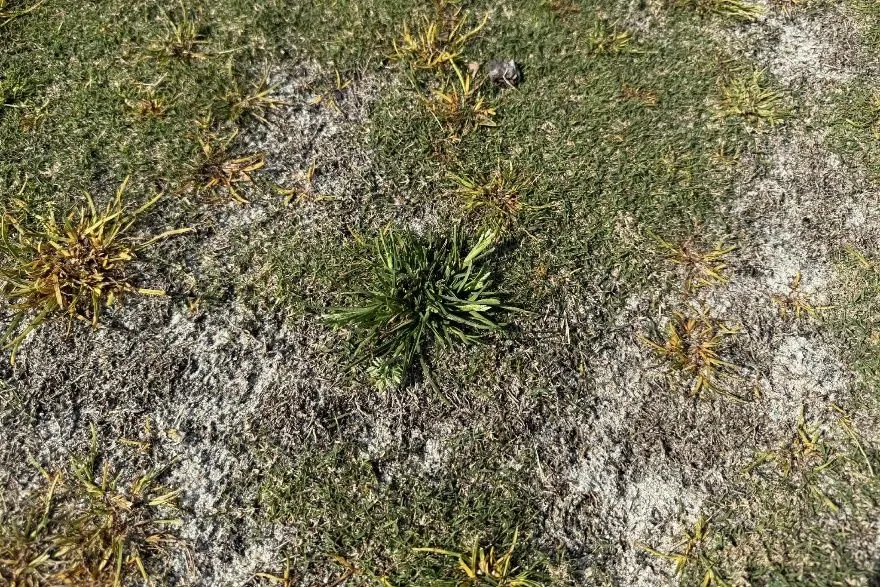
Tolerance is defined as the plant’s “innate ability to remain uninjured by a dose of an herbicide normally lethal to other plant species” (Petelewicz and Unruh 2025). Tolerance is an inherent characteristic of the species and does not result from a history of herbicide exposure. Resistance (Figure 2), on the other hand, is a plant’s “inherited ability to survive and reproduce following exposure to a dose of herbicide normally lethal to the wild type” (Petelewicz and Unruh 2025). A more up-to-date definition of resistance is that it is “evolved capacity of a previously-susceptible weed population to withstand an herbicide and complete its life cycle when the herbicide is used at a normal rate in an agricultural situation” (Petelewicz and Unruh 2025).
Credit: Pawel Petelewicz, UF/IFAS
In summary, tolerance is a naturally occurring characteristic of certain species, not driven by selective pressure or genetic manipulation. In contrast, resistance develops within a weed population over time in response to repeated selection pressure from herbicide use. This process promotes the survival and reproduction of individuals that already possess the ability to withstand herbicide rates that would normally be lethal, particularly when the same mode of action is used repeatedly. Herbicide resistance and appropriate mitigation strategies are already discussed in detail in Ask IFAS publication SS-AGR-394, “Turfgrass Herbicides: Mechanisms of Action and Resistance Management.” Therefore, the focus below will be on plant characteristics and survival strategies that contribute to herbicide tolerance.
Selectivity
Herbicide selectivity is the ability to control weeds without causing unacceptable injury to the desired turfgrass. This balance is achieved by applying a rate high enough to suppress or kill the weed, yet low enough to avoid damaging the turf. In essence, selectivity lies between the maximum rate the turf can tolerate, and the minimum rate required for effective weed control.
In practice, when multiple weed species are present at a single site, they are often grouped based on shared characteristics, such as broadleaves, grasses, or sedges, and managed using herbicides labeled for those particular categories. However, even within a targeted group (e.g., broadleaf weeds treated with auxin-mimicking herbicides), certain species may exhibit the ability to metabolize or detoxify the herbicide effectively, allowing them to survive applications at rates that are labeled for turf. In these cases, increasing the herbicide rate might overcome the weed’s defense mechanism, but would also pose a risk of turf injury, making such an approach impractical. Instead, alternative herbicide solutions that are more specific to the particular problematic species (i.e., delivering its effective control) should be considered and integrated into a program while still maintaining turf safety.
Life Cycle and Propagation Strategy
Weeds vary in their survival tactics. As a result, their biology, particularly life cycle, propagation strategy, growth habit, and developmental stage, plays a critical role in the effectiveness of herbicide applications.
Annual weeds rely entirely on seed production for propagation, making preemergence (PRE) herbicides essential for effective control. A common cause of failure is applying them too late, after the first leaf or cotyledon has emerged from the soil (Figure 3). At that stage, even if plants are barely visible, the herbicide will have little to no effect because it targets the germinating radicle, the first root emerging from the seed, not established shoots and leaves. This missed application window, often caused by scheduling challenges, is one of the most frequent reasons PRE programs fail to deliver effective prevention and, in Florida, can quickly necessitate the use of postemergence (POST) options at the very beginning of the growing season. To avoid this, PRE applications should be timed before environmental conditions favor germination of the earliest species among the target group. The ideal approach is to base timing on close monitoring of weather patterns. However, this is often challenging in turfgrass management due to variability within weed species resulting in staggered germination patterns. The difficulty is further exacerbated by the lack of reliable germination forecasting tools or logistical constraints, such as those faced by lawn care services or multisite contractors serving multiple properties on a rotational cycle. This often necessitates application scheduling based on the calendar and historical emergence data, rather than current, real-time conditions. This method is vulnerable to annual weather fluctuations resulting in potential escapes. In these cases, turfgrass managers should consider applying PRE treatments slightly ahead of the regular schedule to intercept seedlings that germinate earlier than the typical historical window, then follow up with sequential applications as PRE residual activity declines to maintain continuous prevention, rather than relying on POST herbicides to manage escapes early in the season.

Credit: Pawel Petelewicz, UF/IFAS
Beyond timing, certain biological traits of annual weeds may also undermine PRE control. These include seed dormancy, staggered or late-season germination, and multiple germination flushes throughout the season. As the residual activity of PRE herbicides declines over time due to microbial degradation and/or environmental factors, new cohorts of weeds may emerge. Additionally, some annual species have short life cycles and may produce multiple generations within a single growing season. In such cases, extended control programs involving sequential applications and rotation of herbicides with different modes of action are required. In high weed pressure situations, a season-long, wall-to-wall PRE program may be necessary.
Typically, PRE herbicides are applied in either liquid or granular formulations. While granular products are often considered more convenient and easier to apply, they sometimes fail to ensure uniform coverage across the soil surface. Incomplete distribution may result in gaps in PRE barrier, allowing weed seedlings to emerge. This uniformity is particularly important for some of the most problematic annual weeds, such as goosegrass, annual bluegrass, doveweed, or spotted spurge, which can produce extremely large quantities of seed and contribute heavily to the soil seedbank. In these cases, liquid applications, which generally provide more consistent coverage and thus improved overall efficacy, are preferred to prevent significant weed escapes.
Some perennial weed species may also spread by seed and thus be partially managed with PRE herbicides. However, as discussed later in this document, PRE herbicides are often ineffective at preventing spread from vegetative structures such as stolons, rhizomes, or tubers. In areas of Florida where frost occurs, certain perennials, such as tropical signalgrass, may die back during winter and reemerge in the spring. This seasonal dieback can make these species appear to behave like annuals, misleading managers into relying solely on PRE treatments when a more integrated approach is required from the onset of the growing season.
From the POST perspective, the timing of herbicide applications relative to the weed’s growth stage is another critical factor influencing success. Weeds are often targeted when they are most visible or disruptive, which does not always align with when they are most susceptible to control. Even when herbicide is labeled for control of a specific species, poor performance is often observed if the application is made outside the optimal treatment window. For most annual weeds, failure commonly occurs when plants are allowed to mature. For example, the effectiveness of foramsulfuron or sulfentrazone against goosegrass declines drastically once the plant exceeds the three-tiller stage. Similarly, with perennial species, applications made during the peak of the season, when plants are actively growing, may also result in poor control. Rapidly growing weeds can outpace the injury caused by herbicides or metabolize the active ingredient before it can inflict sufficient damage. The general rule is that POST herbicides are most effective when the target weed is at its most vulnerable. For annuals, this means applications should be made when the weeds are young and susceptible, preferably at the seedling stage, way before they reach maturity. Perennial weeds can also be controlled effectively early in their development, before they establish persistent storage structures. However, once such structures are formed, additional strategies are often necessary to achieve long-term control. These may include fall applications timed to coincide with periods of energy shift into belowground organs, or the use of systemic herbicides capable of translocating into those structures. These approaches are discussed in more detail in the latter part of this publication.
Physiological or Mechanical Barriers
Certain physiological and structural traits of weeds can significantly reduce herbicide uptake, movement, or activity within the plant, leading to poor control. Thick, waxy cuticles (Figure 4), dense leaf hairs (Figure 5), and narrow or upright leaf angles can all reduce spray droplet retention and limit herbicide penetration into leaf tissues. In some cases, the cuticle itself may be largely impermeable, or the tissues beneath may resist absorption, especially when the leaf surface is dry and rough. Similarly, for herbicides that require root uptake, limited root activity or a mismatch between where roots are active and where the herbicide resides in the soil profile (e.g., when herbicide movement places the active ingredient below the shallow roots or when it does not reach deeper, actively growing roots) can reduce absorption, particularly under stress conditions. These types of mechanical or physiological barriers often require specific strategies to overcome, such as selecting herbicides with strong systemic activity, including appropriate adjuvants, or utilizing root-absorbed chemistries when foliar entry is compromised, and vice versa when root absorption is restricted.

Credit: Pawel Petelewicz, UF/IFAS

Credit: Pawel Petelewicz, UF/IFAS
Perennating Structures
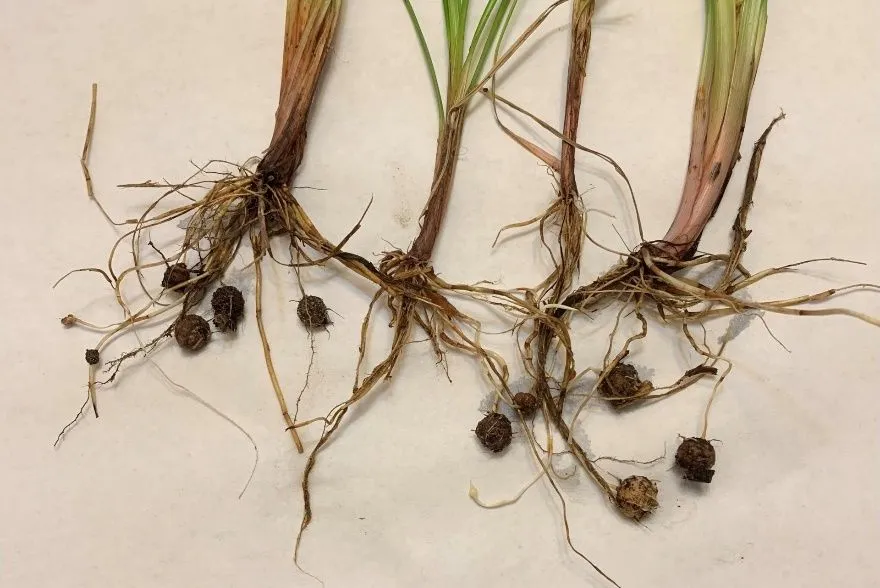
Herbicide mobility within the plant is another important factor to consider. While contact herbicides or fast-acting products with limited translocation may be effective for controlling annual weeds with shallow or weak root systems, they often fail to provide lasting control of species that develop deep root systems or other perennating structures (above/belowground storage organs) such as rhizomes (e.g., torpedograss) (Figure 6), stolons (e.g., bermudagrass) (Figure 7), taproots (e.g., black medic), tubers (e.g., yellow nutsedge, Florida betony) (Figures 8 and 9), and bulbs (e.g., wild garlic). Following herbicide application, control may appear effective at first, as the aboveground portions of the plant die or are severely injured. However, in these cases, only the treated foliage is damaged. These underground structures, by their very function, allow the plants to survive periods of unfavorable conditions, enabling regrowth after the herbicide dissipates and limiting long-term control. For species that produce such structures, effective management can be achieved by selecting systemic herbicides that can translocate into and kill these belowground organs and by properly timing applications. Such plants should be targeted at the early stages of growth, when plants are emerging, young, and more susceptible to herbicides and before these perennating structures are developed and begin storing energy, or mature belowground storage organs should be targeted after the plant has completed energy accumulation in those structures. Moreover, in the case of large, branched structures such as rhizomes and stolons, reaching these with foliar-absorbed herbicides can be difficult. In such cases, root-absorbed chemistries may offer a more effective alternative.

Credit: Chris Marble, UF/IFAS

Credit: Pawel Petelewicz, UF/IFAS
Credit: Todd Lowe, Todd Lowe Consulting

Credit: Chris Marble, UF/IFAS
Phenotypic Plasticity
Phenotypic plasticity is the ability of a species to express different physical or behavioral traits in response to environmental conditions without undergoing genetic change. In weeds, it functions as an avoidance mechanism that can reduce herbicide performance by allowing individuals to adapt their phenotype or emergence patterns. This may be observed as variability in growth habits, emergence timing, and morphological traits within the same species. Weeds may emerge outside the expected treatment window, adopt growth forms that limit herbicide coverage or uptake, or display features such as altered leaf angle, increased waxiness, or reduced stature. As a result, even well-planned herbicide applications may miss portions of the population or fail to achieve adequate control. To mitigate this challenge, weed management programs should include multiple application timings (such as sequential treatments), the use of multiple modes of action, and cultural practices that reduce the selection pressure for highly variable growth patterns across seasons. Importantly, weed management programs should be periodically evaluated and updated as target weed populations change. Because weeds adjust to management pressure through phenotypic plasticity, control programs must also remain adaptive to stay effective.
Key Takeaways
Herbicide underperformance in turfgrass systems is often driven by biological characteristics of the target weed rather than by application errors alone. Key plant-related factors include inherent tolerance or evolved resistance, variable selectivity, life cycle and propagation strategy, growth habit, developmental stage at the time of application, and physiological or structural barriers that limit herbicide uptake or movement within the plant. In addition, mismatches between herbicide placement and active rooting zones, the presence of perennating structures, and high phenotypic plasticity within weed populations can further reduce control. These challenges are often compounded by staggered or extended germination, limited forecasting capability, and logistical constraints that complicate precise application timing.
To reduce the risk of herbicide failure, turfgrass managers should prioritize accurate species identification and tailor herbicide selection, rates, and application timing to the biology of problematic species rather than broad weed groupings, using local recommendations and herbicide performance data when available. Effective programs should account for weed life cycle, propagation strategy, and growth stage, with PRE applications timed ahead of environmental conditions that favor germination of the earliest-emerging species and followed by sequential applications as residual activity declines to maintain continuous control. Programs incorporating sequential treatments, rotation or combination of multiple modes of action, and, when necessary, targeted chemistries that address specific species while preserving turf safety are often required. Where coverage is critical, liquid applications generally provide more consistent performance and reduce the risk of escapes. Because weeds adapt to management pressure, weed management programs should remain flexible and be periodically adjusted to maintain effectiveness and stay one step ahead. Recognizing plant-driven limitations early allows managers to set realistic expectations, refine management strategies, and improve long-term weed control outcomes.
Additional Resources
For a comprehensive summary of professional-grade herbicides for use in turfgrass and information on proper resistance management practices, consult Ask IFAS publication SS-AGR-394, “Turfgrass Herbicides: Mechanisms of Action and Resistance Management.”
For additional information and guidance on proper management practices and control strategies for weeds in turfgrass and landscape, consult Ask IFAS publications ENH884, “Weed Management Guide for Florida Lawns”; ENH1262, “Improving Weed Control in Landscape Planting Beds”; ENH1311, “Florida Homeowner Herbicide Guide: Considerations, Applications, and Selection”; and/or ENH95, “Postemergent Herbicides for Use in Ornamentals.”
References
Marble, C. 2019. “Florida Homeowner Herbicide Guide: Considerations, Applications, and Selection: ENH1331/EP575, 8/2019.” EDIS 2019(4). https://doi.org/10.32473/edis-ep575-2019
Marble, C., and A. Koeser. 2022. “Improving Weed Control in Landscape Planting Beds: ENH1262/EP523.” EDIS. https://doi.org/10.32473/edis-ep523-2015
Petelewicz, P., and J. B. Unruh. 2025. “Turfgrass Herbicides: Mechanisms of Action and Resistance Management: SS-AGR-394/AG398, rev. 1/2025.” EDIS 2025(1). https://doi.org/10.32473/edis-ag398-2015
Turgeon, A. J., L. B. McCarty, and N. Christians. 2009. Weed Control in Turf and Ornamentals. Prentice Hall.
Unruh, J. B., P. Petelewicz, L. E. Trenholm, E. E. Harlow, and R. Leon. 2024. “Weed Management Guide for Florida Lawns: ENH884/EP141, rev. 12/2024.” EDIS 2024(6). https://doi.org/10.32473/edis-ep141-2019