
This document is part of a series originally written by Edward F. Gilman.
Introduction
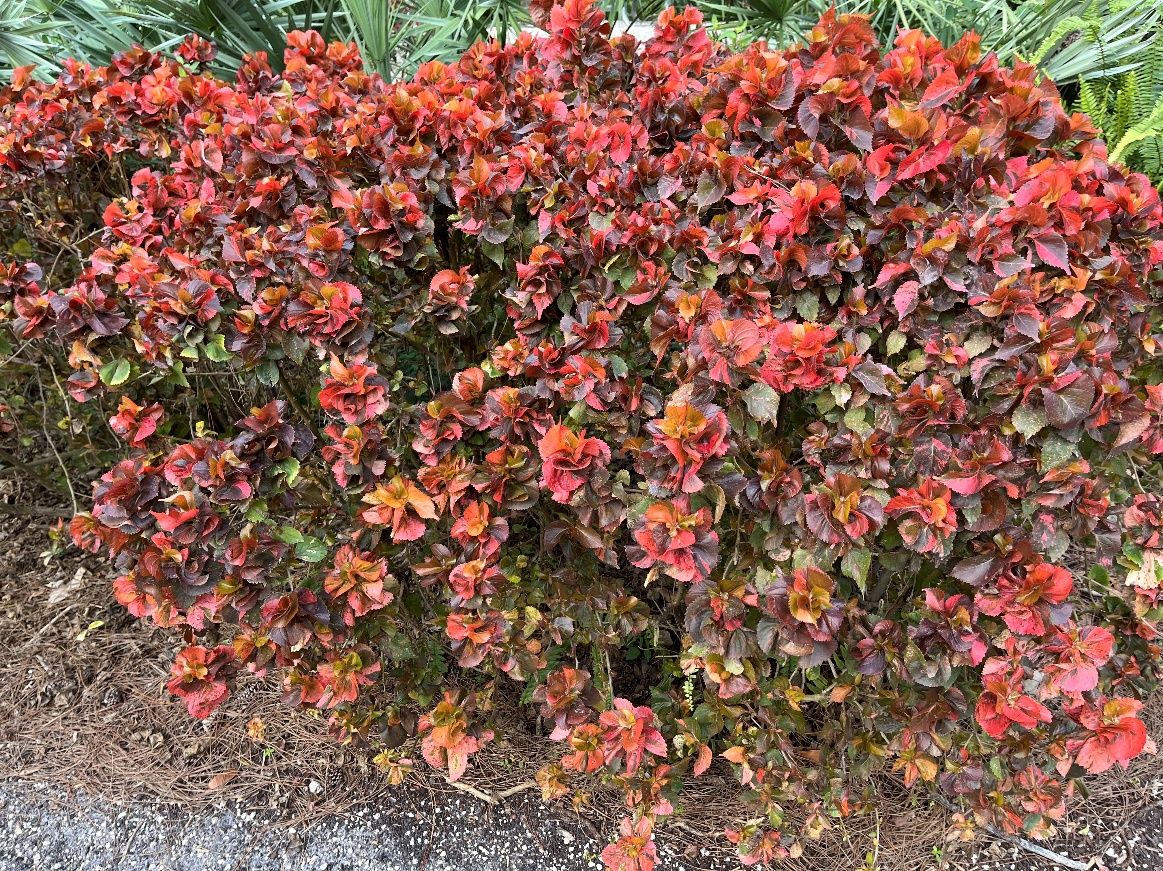
Copperleaf is a fast-growing evergreen shrub that provides a continuous splash of color in the landscape (Figure 1). This plant’s 4- to 8-inch-long heart-shaped leaves are available in varying mottled color combinations, depending upon cultivar selection (Figure 2). Color combinations range from bronze to muted red, green, maroon, yellow, orange, pink, or white (Figure 3). Cultivars with varying leaf shape and color are available (Figure 4). These colors give copperleaf a bold aesthetic, and overuse of this plant can be overpowering in a landscape. Utilizing two or three plants is usually sufficient for specimen or accent plantings in mixed shrubbery borders. Copperleaf may also be used as a hedge or screen when planted on 3- to 5-foot centers. The dense, multi-branched upright growth habit creates a full shape that can reach 8 to 12 feet in height. The upright and side branches eventually droop, and the plant can spread to about 8 feet wide. The 8- to 12-inch long unusual fuzzy, catkin-like flowers hang pendulously from leaf axils (Figure 5). Copperleaf plants occasionally need shaping to maintain a neat appearance.
Credit: Keighly Graves, UF/IFAS

Credit: Edward F. Gilman, UF/IFAS

Credit: Keighly Graves, UF/IFAS

Credit: Keighly Graves, UF/IFAS

Credit: Keighly Graves, UF/IFAS
General Information
Scientific name: Acalypha wilkesiana
Previous name(s): Acalypha amentacea subsp. wilkesiana
Pronunciation: ack-uh-LIFE-uh wilk-see-AY-nuh
Common name(s): copperleaf, Jacob's coat, Wilkes' copperleaf
Family: Euphorbiaceae
Plant type: shrub
USDA hardiness zones: 9B through 11B (Figures 6 and 7)

Credit: This map is based on the 2023 USDA Plant Hardiness Zone Map. Visit https://planthardiness.ars.usda.gov/ for specific zone information.

Credit: This map is based on the 2023 USDA Plant Hardiness Zone Map. Visit https://planthardiness.ars.usda.gov/ for specific zone information.
Planting month for zone 9B: year-round
Planting month for zones 10 and 11: year-round
Origin: not native to North America
Invasive potential: not considered a problem species at this time and may be recommended by UF/IFAS faculty (reassess in 10 years)
Uses: hedge; border; mass planting; container or above-ground planter; screen; accent
Availability: generally available in many areas within its hardiness range
Description
Height: 8 to 12 feet
Spread: 6 to 8 feet
Plant habit: round; upright
Plant density: dense
Growth rate: fast
Texture: coarse
Foliage
Leaf arrangement: alternate
Leaf type: simple
Leaf margin: dentate
Leaf shape: reniform
Leaf venation: pinnate
Leaf type and persistence: evergreen; showy
Leaf color: bronze to muted red; maroon; pink; orange; yellow; green; white; dependent upon cultivar selection (Table 1)
Leaf blade length: 4 to 8 inches
Fall color: no fall color change
Fall characteristic: not showy
Flower
Flower color: red; yellow; green
Flower characteristic: summer flowering
Fruit
Fruit shape: capsule
Fruit length: less than 1 inch
Fruit cover: dry or hard
Fruit color: red
Fruit characteristic: inconspicuous and not showy
Trunk and Branches
Trunk/bark/branches: not particularly showy; typically multi-trunked or clumping stems
Current year stem/twig color: green
Current year stem/twig thickness: medium
Culture
Light requirement: plant grows in partial shade; plant grows in full sun
Soil tolerances: acidic; slightly alkaline; sand; loam; occasionally wet
Drought tolerance: moderate
Soil salt tolerance: unknown
Plant spacing: 36 to 60 inches
Other
Roots: usually not a problem
Winter interest: plant has winter interest due to unusual form and colorful and/or variegated evergreen foliage
Pest resistance: long-term health usually not affected by pests
Use and Management
The upright, rounded shape of the copperleaf plant makes it well-suited to be utilized as a hedge or screen in the landscape. It may require additional pruning to maintain size and shape when used in this way. Copperleaf is also well-suited as a border or accent in the landscape as well as container plantings. Copperleaf gives a bold aesthetic to the landscape when planted en masse, and care should be taken to blend the elements and colors in the landscape.
Copperleaf thrives in full sun, frost-free locations. Planting in partial shade will cause copperleaf to reduce its lateral growth, causing a less-full specimen. The colorful foliage will become more intense with increased light levels. While tolerant of drought, it looks best when provided with regular watering during drought conditions. Copperleaf grows in a wide variety of garden soils.
Propagation is by air-layering or cuttings.
Table 1. Popular copperleaf cultivars in the industry, and their size and notable traits.
|
Cultivar Name |
Cultivar Image |
Size (H x W) |
Notable Traits |
|---|---|---|---|
|
‘Blaze’ |
|
3-4' H x 3-4' W |
Medium growth habit, copper foliage with pinkish-white margins |
|
‘Java White’ |
|
2-4' H x 2-4' W |
Yellow, white, and green mottled foliage |
|
‘Kona Gold’ |
|
Up to 10 H x 10 W |
Light green, dark green, and yellow foliage |
|
‘Louisiana Red’ |
|
6-8' H x 4-6' W |
Shiny, glabrous burgundy-red to bronze foliage |
|
‘Tricolor’ |
|
3-6' W x 3-6' H |
Foliage is mottled red, green, and yellow in coloration |
|
Photo Credits: ‘Blaze': Wyatt Richardson; ‘Java White': Keighly Graves, UF/IFAS; ‘Kona Gold’: Khalril via Adobe Stock; ‘Louisiana Red’: jobi_pro via Adobe Stock; ‘Tricolor’: Getting Green Plant Service | |||


Design Considerations
The intense colors of copperleaf foliage make for a striking display in the landscape, so it should be used with care. One to three plants carefully located for a dramatic focal point is the best use of the plant. Red shows best in full or part sun and would pair well with shrubs with medium green or dark green foliage. Small shrubs and groundcover plants with large dark green, glossy leaves would also contrast well with the foliage of the copperleaf plant. Pair copperleaf with plants that have simple forms but contrasting texture, such as mounding grasses with narrow strap blades, or clumping form with wide-blade smooth foliage.
Pests and Diseases
Aphids, mites, whitefly, and scales are pests of copperleaf plants. No diseases of major concern.