
This document is part of a series originally written by Edward F. Gilman.
Introduction
Japanese maple has a rounded, spreading form that reaches a height and spread of 20 feet. Certain cultivars of Japanese maple may exhibit a weeping growth form (Figure 1). Japanese maple is grown for its colorful leaves, interesting growth habit, and fine leaf texture. This species is noted for its palm-like foliage, which exhibits yellow and green coloration during the summer, that deepens to orange and red during fall depending on cultivar selection (Figure 2). The leaves of this plant are finely dissected to the base of the leaf, having a double-toothed margin, which creates an interesting texture in the landscape (Figure 3). Japanese maple produces small red flowers during the spring, which are then followed by winged seed pods called samaras (Figures 4 and 5). This tree is generally multi-trunked and has attractive gray bark with rugose texture. Japanese maple is well-suited for an accent or specimen, used in containers or above-ground planters, or may be trained as a standard.

Credit: Ed Gilman, UF/IFAS
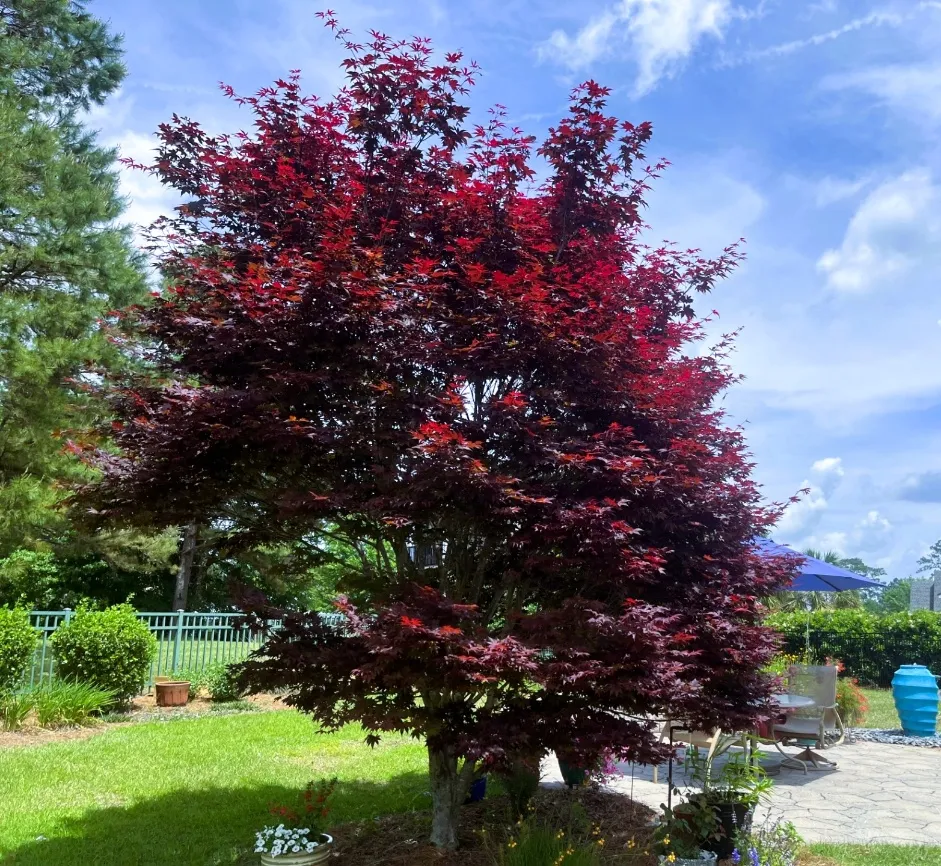
Credit: Keighly Graves, UF/IFAS

Credit: John Caley via Adobe Stock

Credit: © Paul B., some rights reserved (CC-BY-NC-ND) via iNaturalist

Credit: Keighly Graves, UF/IFAS
General Information
Scientific name: Acer palmatum
Pronunciation: AY-sir pal-MAY-tum
Common name(s): Japanese maple
Family: Sapindaceae
Plant type: tree
USDA hardiness zones: 5B through 8B (Figures 6 and 7)
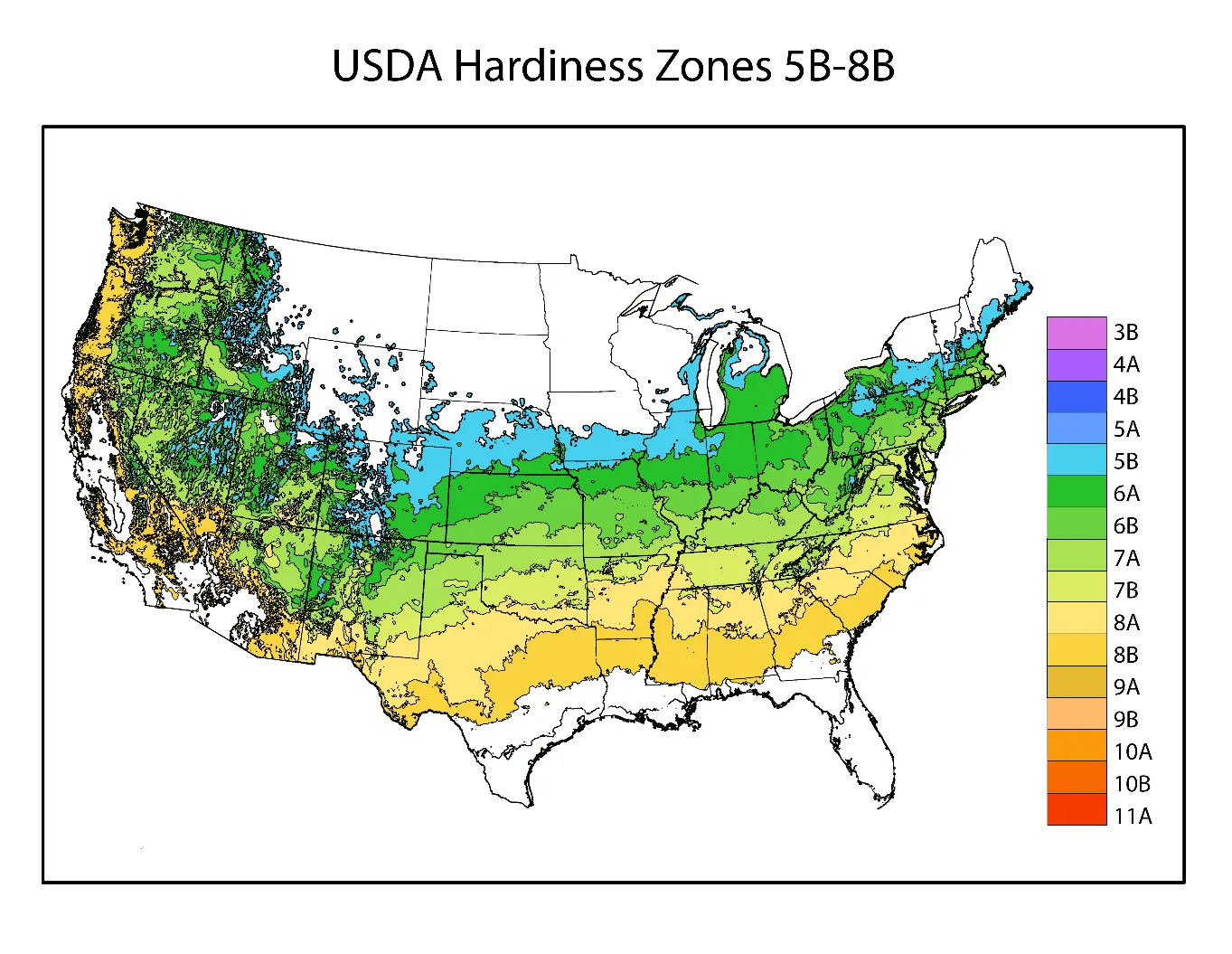
Credit: This map is based on the 2023 USDA Plant Hardiness Zone Map. Visit https://planthardiness.ars.usda.gov/ for specific zone information.

Credit: This map is based on the 2023 USDA Plant Hardiness Zone Map. Visit https://planthardiness.ars.usda.gov/ for specific zone information.
Planting month for zones 5 and 6: spring; summer; fall
Planting month for zone 7: year-round
Planting month for zone 8: year-round
Origin: not native to North America
Uses: near a deck or patio; accent; specimen; bonsai; container or above-ground planter; trained as a standard
Availability: generally available in many areas within its hardiness range
Description
Height: 10 to 20 feet
Spread: 10 to 20 feet
Plant habit: weeping; rounded; spreading
Plant density: dense; symmetrical habit with regular outline and individuals having fairly identical forms
Growth rate: slow
Texture: fine to medium
Foliage
Leaf arrangement: opposite/subopposite
Leaf type: simple
Leaf margin: deeply lobed; parted; double-toothed leaf margin
Leaf shape: stellate or star-shaped
Leaf venation: palmate
Leaf type and persistence: deciduous
Leaf blade length: 2 to 4 inches
Leaf color: green
Fall color: bright yellow; orange; red; purple
Fall characteristic: showy
Flower
Flower color: red; purple
Flower characteristic: spring flowering
Fruit
Fruit shape: elongated; samara
Fruit length: 0.5 to 1 inch
Fruit cover: dry or hard
Fruit color: red
Fruit characteristic: showy
Trunk and Branches
Trunk/bark/branches: showy; no thorns; multi-trunked; rugose texture
Current year stem/twig color: reddish
Current year stem/twig thickness: thin
Culture
Light requirement: plant grows in the shade; plant grows in partial shade; plant grows in full sun; dependent upon planting zone and conditions
Soil tolerances: slightly alkaline; acidic; well-drained; clay; sand; loam
Drought tolerance: moderate
Soil salt tolerance: moderate
Plant spacing: 3 to 12 feet
Other
Roots: usually not a problem
Winter interest: plant has winter interest because of its unusual form and interestingly textured trunk
Invasive potential: not known to be invasive
Pest resistance: long-term health usually not affected by pests
Use and Management
Japanese maple should be planted in partial shade, particularly in the southern part of its range; however, it may tolerate more direct sun in the northern part of its range. Leaf scorch may occur if Japanese maple is in an overly sunny location. Soil should be well drained and free from standing water around the roots. Maintaining a 2- to 3-inch-layer of mulch around the base of the plant and canopy is beneficial to this plant as it protects it from mechanical damage caused by lawn maintenance, and conserves soil moisture. This large shrub or small tree tends to leaf out early, so it may be injured by spring frosts.
Japanese maples are well suited to a variety of uses in the landscape including as a specimen or accent tree near a deck or patio, may be utilized in small spaces, trained as a bonsai, or are appropriate for use in a Japanese-style garden.
There are numerous cultivars of Acer palmatum, which are available in the horticulture trade. They vary in foliage coloration and growth habits. Common cultivars include ‘Dissectum', which has deeply lobed and fine leaves that appear feather-like; ‘Bloodgood’ has intense red coloration of the foliage during the summer. Other cultivars are available within the tree’s planting range.
Design Considerations
As a specimen plant, the Japanese maple should be located to create a focal point. Background plants should have a simple form and full foliage to create a solid mass that highlights the form of the maple. Low-growing shrubs and groundcover plants with light or medium green, glossy leaves would contrast well with the reddish color foliage of the maple. Pair with low-growing plants with simple forms and fine texture, such as mounding grasses with narrow strap blades or the sprawling/mounding forms of juniper with fine needles. White or pink flowers on surrounding plants will highlight the red foliage. Low-growing plants at the base will allow the attractive bark and multiple trunks to show in trimmed trees.
Pests and Diseases
Pest issues include aphids (symptoms include leaf drop and honeydew, may be sprayed to treat or predatory insects will bring aphids under control), scale (cottony mass on lower sides of branches, treated with horticultural oils or sprays), and borers (indicates poor tree growth; identify the borer and apply insecticides at the proper time). Disease issues include tar spot and a variety of leaf spots but are rarely serious enough to require control.
Scorch occurs during periods of high temperatures accompanied by wind. Scorch symptoms are light brown or tan dead areas between leaf veins. The symptoms are on all parts of the tree or only on the side exposed to sun and wind. Trees with diseased or inadequate root systems, or those receiving an inadequate amount of water, will also show scorching. Scorching due to dry soil may be overcome by watering and proper mulching. If scorching is due to an inadequate or diseased root system, watering may have no effect.
Symptoms of nutrient deficiencies include yellow or yellow-green leaves with darker green leaves. Manganese is the most common nutrient deficiency in maples. Applying manganese sulfate or implanting capsules containing a manganese source in the trunk will alleviate the symptoms. Test soil samples to determine if the soil pH is too high for best manganese availability. Plants exposed to weed killers may also show similar symptoms.