
This document is a part of a series originally written by Edward F. Gilman.
Introduction
Anthurium is a genus of tropical plants native to regions of Latin America and the Caribbean. These plants are either epiphytic or terrestrial in their native habitat. There are over 1,300 species of Anthurium, with varying leaf shapes and growth habits. Anthurium is the largest genus in the Aroid, or Araceae, family. Typically, the most well-known Anthurium species contain a large, brightly colored spathe, which surrounds the flower structure. There are numerous species with various flower structures, including those with less prominent flower structures, but showy foliage.
Anthurium is an herbaceous perennial plant with an upright growth habit, reaching a height and spread of 3 feet (Figure 1). This plant has shiny dark green, oblong, cordate (heart-shaped) evergreen leaves (Figure 2). The foliage can span 8 to 12 inches long and may vary in shape depending upon species. The inflorescence is composed of the spathe (which is a modified leaf, called a bract) that is generally the showy colorful part of the floral structure, and the spadix (pale yellow tail-like cluster of flowers in the center of the spathe). This flower structure is common in the Aroid (Araceae) plant family (Figure 3). The spathe may be red, rose, pink, white, green, orange or other colors depending on the species. Although rarely produced, the fruit is a showy cluster of red berries (Figure 4).
Anthurium species that produce showy flowers will bloom 4 to 6 times during the year, with each flower lasting about six weeks. This plant lends the landscape a tropical feel, and is well suited as a specimen or accent, in a container or above-ground planter, as a border or edging in the landscape, as a groundcover in mass plantings, or as a houseplant. Anthurium flowers last several weeks as cut flowers in arrangements. This plant is epiphytic or grows upon the surface of other plants or trees, in its natural habitat, and is known for its air purifying qualities. Anthurium is a tropical plant and requires frost protection or should be used as a houseplant in northern areas.

Credit: © kdiebold, some rights reserved (CC-BY-NC) via iNaturalist

Credit: Keighly Graves, UF/IFAS

Credit: Keighly Graves, UF/IFAS

Credit: Ruth P. Peterkin via Adobe Stock
General Information
Scientific name: Anthurium spp.
Pronunciation: an-THUR-ee-um species
Common name(s): tailflower, flamingo flower, Anthurium, painter’s palate
Family: Araceae
Plant type: perennial; herbaceous
USDA hardiness zones: 10A through 11B; dependent upon species (Figures 5 and 6)
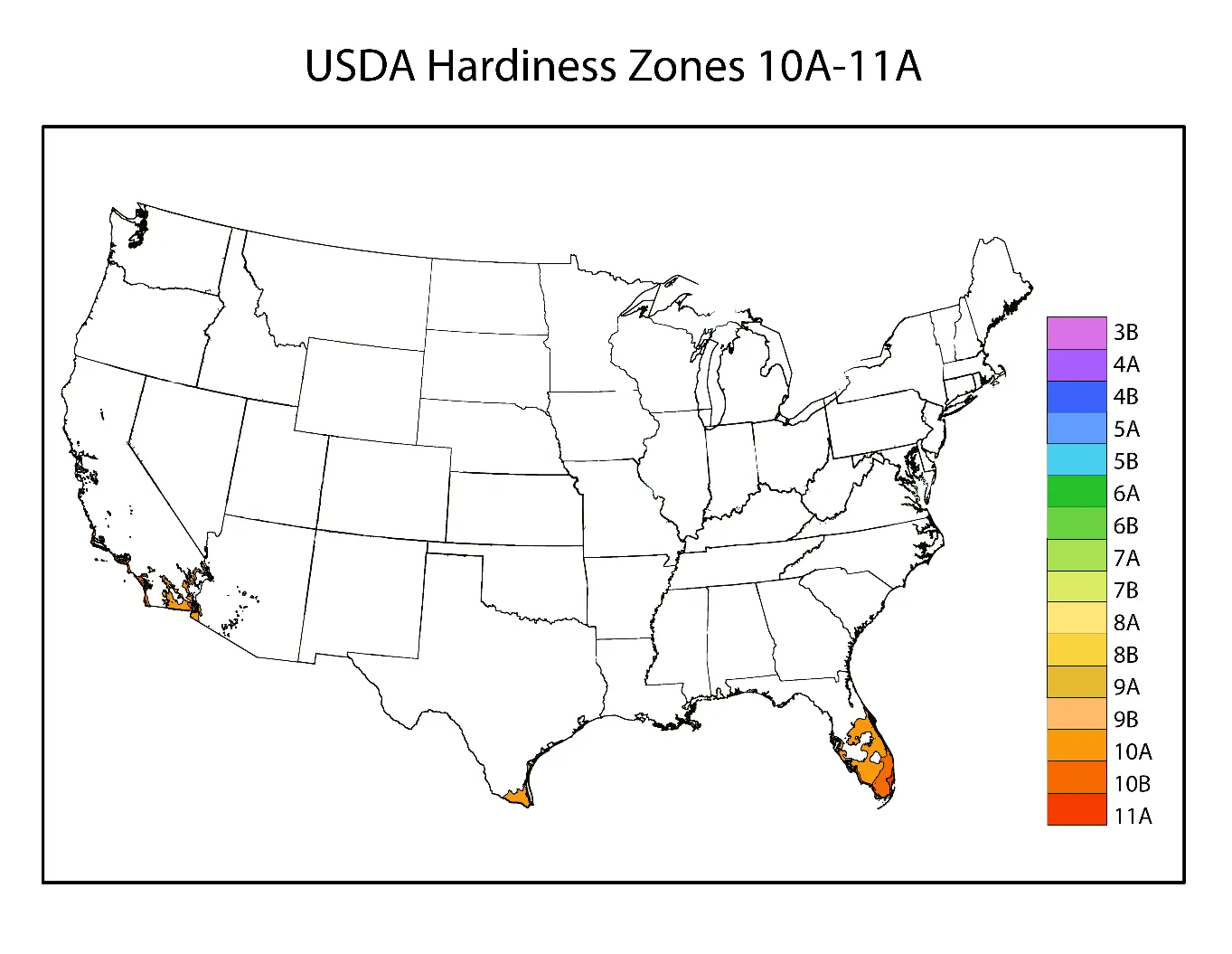
Credit: This map is based on the 2023 USDA Plant Hardiness Zone Map. Visit https://planthardiness.ars.usda.gov/ for specific zone information.

Credit: This map is based on the 2023 USDA Plant Hardiness Zone Map. Visit https://planthardiness.ars.usda.gov/ for specific zone information.
Planting month for zones 10 and 11: year-round
Origin: not native to North America
Invasive potential: not known to be invasive
Uses: specimen; container or above-ground planter; border; ground cover; cut flowers; accent; edging; suitable for growing indoors
Availability: somewhat available, may have to go out of the region to find the plant
Description
Height: 2 to 3 feet; dependent upon species
Spread: 2 to 3 feet; dependent upon species
Plant habit: upright
Plant density: open
Growth rate: slow
Texture: coarse
Foliage
Leaf arrangement: alternate
Leaf type: simple
Leaf margin: revolute
Leaf shape: cordate (heart-shaped); a few species have strapped leaves
Leaf venation: brochidodromous; pinnate
Leaf type and persistence: evergreen
Leaf blade length: 8 to 12 inches; dependent upon species
Leaf color: green
Fall color: no fall color change
Fall characteristic: not showy
Flower
Flower color: composed of spathe/bracts, which may be red, pink, salmon, orange, white, cream, variegated, dependent upon cultivar; spadix is pale yellow
Flower characteristic: year-round flowering
Fruit
Fruit shape: elongated; globose
Fruit length: less than 1 inch
Fruit cover: fleshy
Fruit color: red
Fruit characteristic: fruits rarely produced; red berry-like clusters produced on a stalk; showy
Trunk and Branches
Trunk/bark/branches: usually with one stem/trunk
Current year stem/twig color: not applicable
Current year stem/twig thickness: not applicable
Culture
Light requirement: plant grows in the shade; plant grows in partial shade
Soil tolerances: acidic; sand; loam
Drought tolerance: moderate
Soil salt tolerance: poor
Plant spacing: 18 to 24 inches
Other
Roots: usually not a problem
Winter interest: no special winter interest
Pest resistance: long-term health usually not affected by pests
Toxicity: this species exhibits low toxicity characteristics; all parts of the plant can cause contact dermatitis; gastroenteric irritant; toxic principle includes calcium oxalate crystals
Use and Management
Anthurium plants should be located in shaded areas with humidity above 50%. If the relative humidity drops below this level, the leaves lose their shiny texture and may potentially die off. These plants also require soil that is high in organic matter. For interior use, keep potted plants on trays of moist gravel or spray several times per day with water and protect from drafts. Single plants are best used in small gardens. In larger landscapes, a mass of many plants together looks best when planted on two- to three-foot centers.
Propagation is by cuttings or seed.
Table 1. Anthurium species and their traits.


Design Considerations
From a design perspective, Anthurium functions as a structural accent and a source of exotic color. Its bold, glossy, heart-shaped leaves provide a strong textural statement that contrasts beautifully with finer-textured plants. Pair with plants that are softer with small foliage and low-growing mounding or spreading forms, or with other large-leaf tropicals with coarse texture such as Philodendrons. Yellow-green or variegated green foliage in the companion plants will highlight the deep green of the leaves. When pairing with other flowering plants, use white and bright yellows to contrast the deep green and highlight the warm reds of the flower bracts and the yellow spadix.
Pest and Diseases
Potential pests include mites, scales, mealy bugs, and nematodes. No diseases are of major concern.