
This document is part of a series originally written by Edward F. Gilman.
Introduction
Butterfly weed is an herbaceous upright perennial, and a member of the milkweed family. It is native to most of the United States (excluding some northwestern states) and is found naturally growing in sandy site conditions. It has a height and spread of 2 to 3 feet (Figure 1). This plant flowers from July to September, once established. The orange, red, or yellow flowers are borne in clusters atop the foliage (Figure 2). Butterfly weed is a deciduous perennial that exhibits dormancy. The plant will die back to the ground in the winter; however, it will resprout from the roots the following year and may also reseed itself. The deciduous leaves have a somewhat hairy texture and spiral the stem (Figure 3). Butterfly weed produces a spindle-shaped seed capsule that starts as a green color and turns brown once mature (Figure 4). This Florida native milkweed is also a larval host plant for the monarch, soldier, and queen butterflies (Danaus spp., Figure 5). This plant is well suited for pollinator gardens, as it attracts butterflies, hummingbirds, and other pollinators. In addition, it may be used in containers, mass plantings, for naturalizing landscapes, or utilized as cut flowers in arrangements.

Credit: Wendy Wilber, UF/IFAS

Credit: © michaelgold, some rights reserved (CC-BY-NC) via iNaturalist

Credit: © Kevin, some rights reserved (CC-BY-NC) via iNaturalist
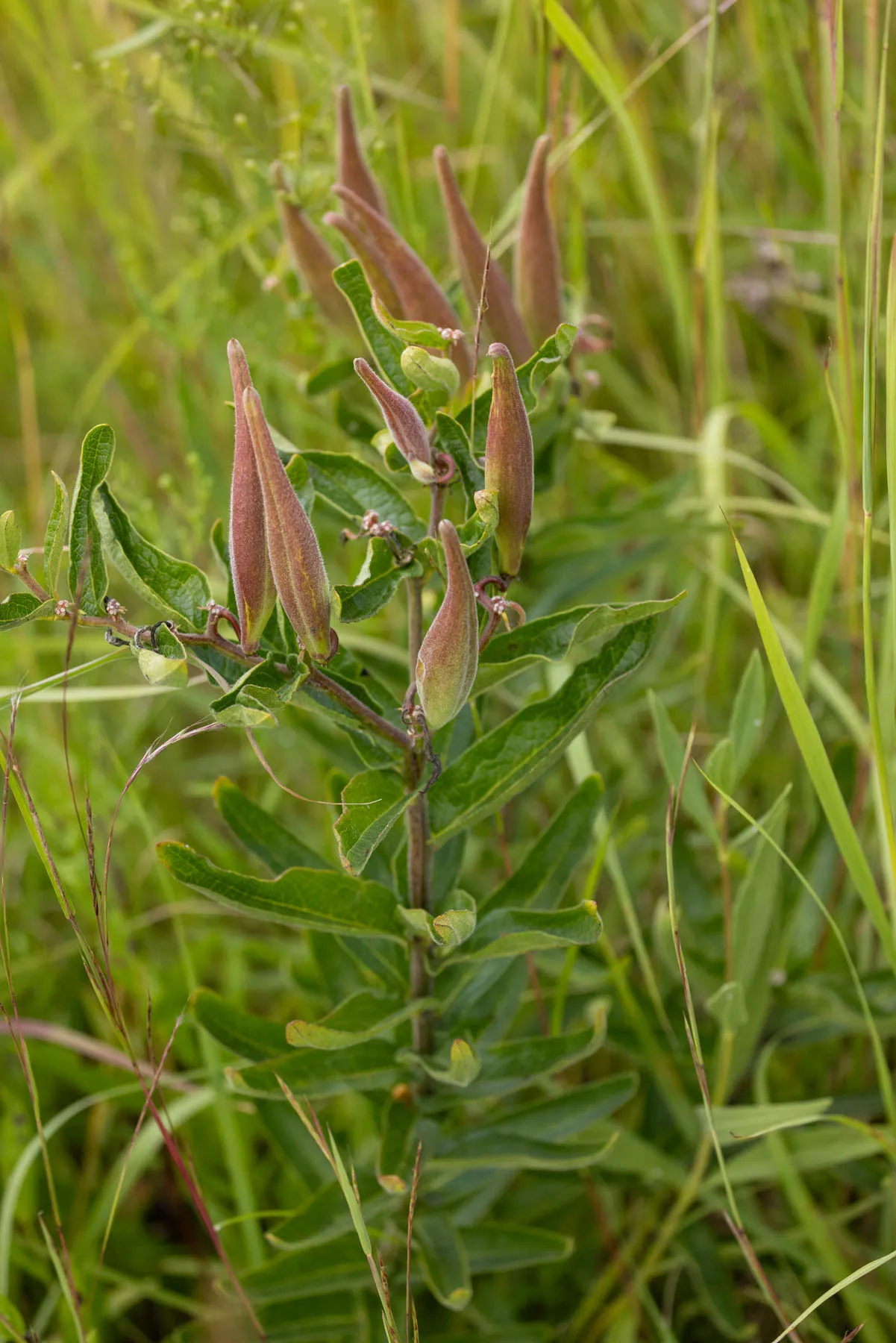
Credit: © Kevin, some rights reserved (CC-BY-NC) via iNaturalist

Credit: MediaMarketing via Adobe Stock
General Information
Scientific name: Asclepias tuberosa
Pronunciation: as-KLEE-pee-us too-bur-O-suh
Common name(s): butterfly weed, Indian paintbrush, butterfly milkweed
Family: Apocynaceae
Plant type: herbaceous; perennial
USDA hardiness zones: 3B through 10B (Figures 6 and 7)

Credit: This map is based on the 2023 USDA Plant Hardiness Zone Map. Visit https://planthardiness.ars.usda.gov/ for specific zone information.

Credit: This map is based on the 2023 USDA Plant Hardiness Zone Map. Visit https://planthardiness.ars.usda.gov/ for specific zone information.
Planting months for zone 8: May; June; July; August
Planting months for zone 9: March; April; May; June; July; August; September
Planting months for zones 10 and 11: February; March; April; May; June; July; August; September; October; November; December
Origin: native to Florida; three highly integrated subspecies exist, but further genetic study is needed in this area
Invasive potential: may self-seed each year
Uses: naturalizing; container or above-ground planter; cut flowers; mass planting; attracts butterflies, hummingbirds, and other pollinators
Availability: somewhat available; may have to go out of the region to find the plant; available at certain native plant nurseries
Description
Height: 2 to 3 feet
Spread: 2 to 3 feet
Plant habit: round; upright; sprawling
Plant density: moderate
Growth rate: moderate to fast
Texture: medium
Foliage
Leaf arrangement: alternate; whorled
Leaf type: simple
Leaf margin: entire
Leaf shape: oblong
Leaf venation: brochidodromous
Leaf type and persistence: deciduous; hairy
Leaf blade length: 4 to 8 inches
Leaf color: green
Fall color: not applicable
Fall characteristic: not applicable
Flower
Flower color: red; yellow; orange
Flower characteristic: spring-flowering; summer-flowering
Fruit
Fruit shape: elongated
Fruit length: 4 to 6 inches
Fruit cover: dry or hard
Fruit color: brown
Fruit characteristic: inconspicuous and not showy
Trunk and Branches
Trunk/bark/branches: not applicable
Current year stem/twig color: green
Current year stem/twig thickness: thick
Culture
Light requirement: plant grows in full sun; plant grows in partial shade
Soil tolerances: acidic; sand; loam; clay
Drought tolerance: moderate
Soil salt tolerance: poor
Plant spacing: 18 to 24 inches
Other
Roots: not applicable
Winter interest: no special winter interest; displays winter dormancy
Pest resistance: aphids may affect plant health or aesthetics
Toxicity: this plant exhibits low toxic characteristics; all parts of this plant contain cardiac glycosides and resinoids; ingestion causes vomiting and gastrointestinal issues; sap may cause contact dermatitis
Use and Management
Butterfly weed thrives in full sun but also tolerates partial shade. It is moderately drought tolerant and may be planted in a wide range of soil conditions, excluding heavy soil. As this is a larval host plant, it will attract monarch butterflies, along with other pollinators to the landscape. Utilizing multiples of these plants in the landscape is more attractive to butterflies than a single specimen planting. This plant may reseed itself and spread beyond the intended cultivated area.
This deciduous plant exhibits dormancy and will die back to the ground in winter. As it is also slow to start its growth in the spring, mark its location to prevent damage to the easily injured dormant crowns. A taproot makes transplanting difficult. Once established, do not disturb butterfly weed unnecessarily. This plant will grow back the following spring.
Butterfly weed may be utilized for pollinator gardens in the landscape when planted in mass, in container or above-ground planters, or mixed into landscaping beds. As this plant is a larval host plant, it will have varying aesthetic appeal in the landscape as caterpillars utilize its foliage to complete their life cycle into butterflies.
Propagation is by seed or division in the spring. The seed germinates in 3 to 4 weeks at 70°F to 75°F. Plants may be planted in a cold frame in spring or fall. Fresh seed may need chilling.
Design Considerations
The thin stems and widely spaced leaves of the butterfly weed give a slightly weedy appearance (hence the name) so most gardeners mix them with shorter plants where the bright red, orange, and yellow flowers can be easily seen above the ground cover. The leaves can be stripped by caterpillars, and the plant often looks stick-like at certain times of the year, so using ground cover also helps hide the bare stems until they can be cut back. Pair with plants with large foliage and mounding or loose spreading forms to help the butterfly weed poke through the plants. White or purple flowers are complementary colors to yellow and red, which will contrast nicely.
Pest and Diseases
Pest issues include aphids. This plant is a larval host plant for the monarch caterpillar, which may defoliate, but not kill the plant. Disease issues include minor leaf spot diseases, rusts (reddish-colored spots), and cucumber mosaic virus (leaf mottling, no treatment available).