
This Florida-Friendly Landscaping™ publication is part of a series originally written by Edward F. Gilman. Visit https://ffl.ifas.ufl.edu/ to learn more about creating and maintaining attractive landscapes that protect Florida's water resources and environment.
Introduction
Wintergreen barberry is a rapidly growing perennial shrub that reaches a height of 10 feet and spread of 8 feet (Figures 1 and 2). It is ideal for use as an almost impenetrable hedge or barrier planting, with its dense branching growth habit, spiny leaves up to three inches long, and the three-parted spines located along the stiff stems (Figures 3 and 4). It is also one of the hardiest evergreen barberries. The leaves of wintergreen barberry may turn wine-red or purplish-bronze in the winter (Figure 5). Clusters of small, lemon-yellow blooms appear in late spring for 1 to 2 weeks and may occasionally have an unpleasant fragrance (Figure 6). Clusters of blue-black berries follow the flowers and persist on the plant (Figure 7). Fairly upright but more rounded with age, wintergreen barberry also works well in mixed shrubbery borders or as a foundation planting. Grouping three plants together in a shrubbery border makes for a nice contrasting textural effect.

Credit: © Carlos Muñoz-Amezcua, some rights reserved (CC BY) via iNaturalist


Credit: © Wolfgang Bacher, some rights reserved (CC BY-NC) via iNaturalist
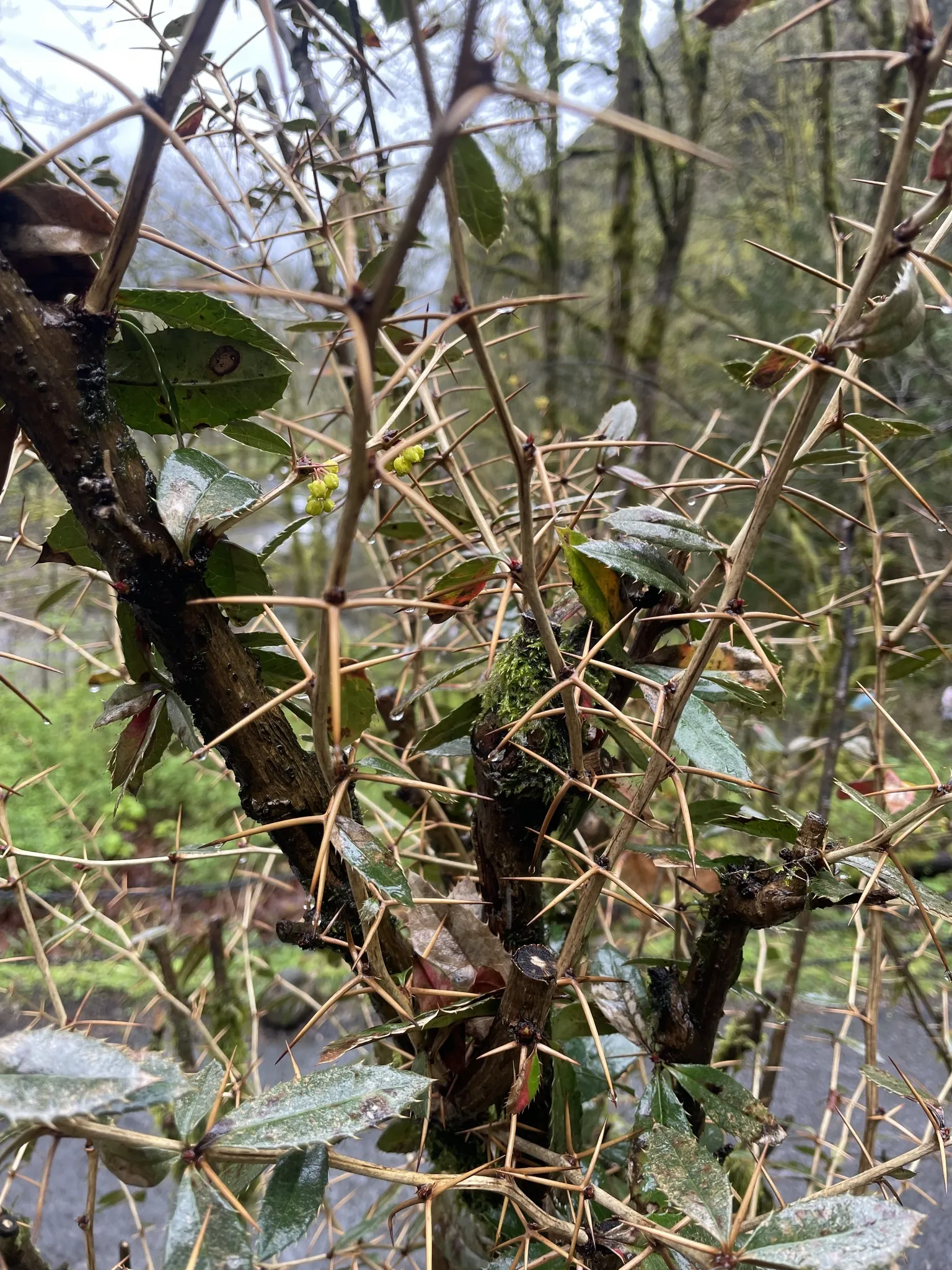
Credit: © pav_i, some rights reserved (CC BY-NC)

Credit: © Benigno Veraz, some rights reserved (CC BY-NC) via iNaturalist

Credit: © David Hocken, some rights reserved (CC BY-NC) via iNaturalist

Credit: © Mariia N. Kuznetsova, some rights reserved (CC BY-NC) via iNaturalist
General Information
Scientific name: Berberis julianae
Pronunciation: BUR-bur-iss jool-ee-AN-ee
Common name(s): wintergreen barberry
Family: Berberidaceae
Plant type: shrub; perennial
USDA hardiness zones: 6A through 8B (Figures 8 and 9)

Credit: This map is based on the 2023 USDA Plant Hardiness Zone Map. Visit https://planthardiness.ars.usda.gov/ for specific zone information.

Credit: This map is based on the 2023 USDA Plant Hardiness Zone Map. Visit https://planthardiness.ars.usda.gov/ for specific zone information.
Planting month for zone 7: year-round
Planting month for zone 8: year-round
Planting month for zone 9: year-round
Origin: native to temperate Asia
Invasive potential: not considered a problem species at this time and may be recommended by UF/IFAS faculty (reassess in 10 years); may be considered invasive in other parts of North America
Uses: hedge; border; screen; shrubbery border; foundation plant
Availability: somewhat available, may have to go out of the region to find the plant
Description
Height: 6 to 10 feet
Spread: 4 to 8 feet
Plant habit: vase shape; round; upright
Plant density: dense
Growth rate: rapid
Texture: coarse
Foliage
Leaf arrangement: alternate
Leaf type: simple
Leaf margin: spiny
Leaf shape: lanceolate
Leaf venation: pinnate
Leaf type and persistence: fragrant; evergreen
Leaf blade length: 2 to 4 inches
Leaf color: green; new growth red on certain cultivars
Fall color: red
Fall characteristic: showy
Flower
Flower color: yellow
Flower characteristic: spring flowering
Fruit
Fruit shape: oval
Fruit length: less than 1/2 inch
Fruit cover: fleshy
Fruit color: blue; black
Fruit characteristic: persists on the plant; attracts birds; attracts pollinators
Trunk and Branches
Trunk/bark/branches: typically multi-trunked or clumping stems; thorns present
Current year stem/twig color: yellow
Current year stem/twig thickness: medium
Culture
Light requirement: plant grows in full sun; plant grows in partial shade
Soil tolerances: acidic; slightly alkaline; loam; clay; sand; well-drained
Drought tolerance: moderate
Soil salt tolerances: moderate
Plant spacing: 36 to 60 inches
Other
Roots: usually not a problem
Winter interest: plant has winter interest due to evergreen foliage and persistent fruit
Pest resistance: long-term health usually not affected by pests
Use and Management
Wintergreen barberry is adaptable to a wide range of soil conditions but looks best when grown on rich, somewhat moist soil in full sun or light shifting shade. Plants will require some pruning to maintain their best form. In time, the center of the plant becomes thick with dead and living stems massed together in a thicket. Remove the dead stems and thin the living stems to allow more light to reach the interior of the plant. Wear heavy gloves and a long-sleeved shirt when pruning this plant, as it has spines.
Propagation is by semi-hardwood cuttings rooted under mist.
Cultivars Include
‘Nana’, having a compact growth habit 4 feet in height, dark green foliage becomes wine red in winter, may be difficult to source commercially; Compactum’, reaching a height of 5 feet; Spring Glory’, having red new growth. Berberis gagnepainii is a related species that is wider and has pendulous branches.
Design Considerations
Given its rapid, dense growth and the presence of sharp spines, wintergreen barberry is an outstanding choice for creating a functional hedge or an impenetrable barrier. It serves as an effective low-maintenance screen for privacy and security, and is particularly valuable in landscapes where deer browsing is a concern. It also performs well as a structural shrub in a mixed border or as a foundation plant against a building. Winter barberry is exceptionally resilient, showing high tolerance for both drought and salt, which makes it a reliable option for challenging sites like coastal areas or roadside plantings. However, thoughtful placement is critical due to its thorns. To prevent injury, locate it away from walkways, patios, and children's play areas where people might accidentally brush against it. To soften the barberry's appearance and create a dynamic garden scene, pair it with plants that offer contrasting colors, forms, and textures. Muhly grass with its fall-blooming soft, airy pink plumes provides a stunning textural contrast to the barberry's rigid and dense structure. Coontie is a tough Florida native plant, that offers a bold, sculptural texture that creates an attractive, low-maintenance layer in front of or beside the barberry.
Pests and Diseases
No pests of major concern or diseases of major concern.