
This Florida-Friendly Landscaping™ publication is part of a series originally written by Edward F. Gilman. Visit https://ffl.ifas.ufl.edu/ to learn more about creating and maintaining attractive landscapes that protect Florida's water resources and environment.
Introduction
Borrichia is a genus in the Aster family (Asteraceae), which contains two species, B. arborescens and B. frutescens, and some hybrids. The two species have a similar habitat, flower structures, and leaves, but differ slightly in their growth form. Borrichia, commonly referred to as seaside tansy, can reach a height of between 3 to 5 feet (Figure 1). B. frutescens is considered more of a perennial herb to shrub with an upright to sprawling growth habit and may reach a height up to 3 feet. B. arborescens, sometimes commonly referred to as tall sea oxeye, is more of an upright perennial, which may reach a height of 5 feet.
The leaves of this plant are fleshy, leathery, and gray-green in coloration (Figure 2). The daisy-like flowers have yellow disks that are larger than their yellow rays (Figure 3). Flowers are produced mostly in the spring, but some can be seen into the summer. It may also produce flowers sporadically throughout the year. This plant has fruits that are small, sharp, needle-like structures called cypselae (Figure 4). This Florida native plant is found in the salt marshes and tidal flats of coastal counties throughout the state. This plant is extremely salt tolerant. This plant may be used as a groundcover or planted en masse and is attractive to butterflies. This plant is well suited for use as a groundcover, in coastal landscaping or restoration, mixed wildflower beds, or as a border.

Credit: © Peter Joseph, some rights reserved (CC BY-NC-ND) via iNaturalist

Credit: © E Redick, some rights reserved (CC BY-NC-ND) via iNaturalist

Credit: © Michael Price, some rights reserved (CC BY-NC-ND) via iNaturalist

Credit: © Chris Wood, some rights reserved (CC BY-NC-ND) via iNaturalist
General Information
Scientific name: Borrichia spp.
Pronunciation: bor-RICK-ee-uh species
Common name(s): sea oxeye, sea oxeye daisy, seaside tansy
Family: Asteraceae
Plant type: shrub, groundcover
USDA hardiness zones: coastal areas of 8B through 11B (Figures 5 and 6)
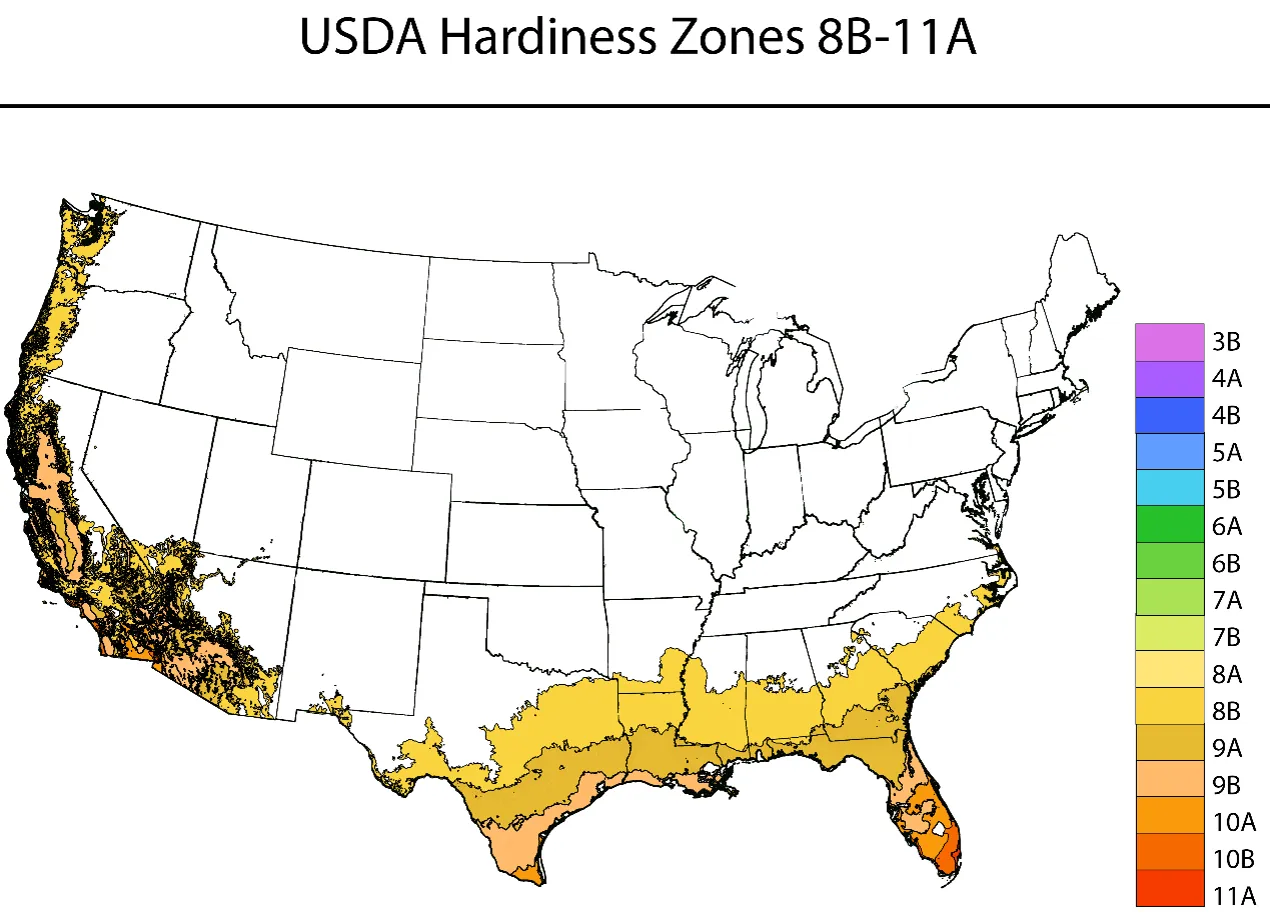
Credit: This map is based on the 2023 USDA Plant Hardiness Zone Map. Visit https://planthardiness.ars.usda.gov/ for specific zone information.

Credit: This map is based on the 2023 USDA Plant Hardiness Zone Map. Visit https://planthardiness.ars.usda.gov/ for specific zone information.
Planting month for zone 9: year-round
Planting month for zones 10 and 11: year-round
Origin: native to Florida
Uses: mass planting; groundcover; attracts butterflies; coastal landscaping; restoration
Availability: somewhat available, may have to go out of the region to find the plant
Description
Height: 2 to 5 feet; dependent upon species selection
Spread: 2 to 3 feet; dependent upon species selection
Plant habit: upright; sprawling
Plant density: moderate
Growth rate: slow
Texture: medium
Foliage
Leaf arrangement: opposite/subopposite
Leaf type: simple
Leaf margin: terminal spine
Leaf shape: obovate
Leaf venation: pinnate
Leaf type and persistence: evergreen
Leaf blade length: 2 to 4 inches
Leaf color: green
Fall color: no fall color change
Fall characteristic: not showy
Flower
Flower color: yellow
Flower characteristic: spring flowering, summer flowering; sporadic year-round flowering
Fruit
Fruit shape: elongated
Fruit length: 1 to 3 inches
Fruit cover: dry or hard
Fruit color: brown
Fruit characteristic: inconspicuous and not showy
Trunk and Branches
Trunk/bark/branches: not particularly showy; typically multi-trunked or clumping stems
Current year stem/twig color: gray/silver
Current year stem/twig thickness: medium
Culture
Light requirement: plant grows in full sun
Soil tolerances: extended flooding; acidic; alkaline; sand
Drought tolerance: moderate
Soil salt tolerances: high
Plant spacing: 36 to 60 inches
Other
Roots: usually not a problem
Winter interest: evergreen foliage; year-round flowering
Invasive potential: not known to be invasive
Pest resistance: no serious pests are normally seen on the plant
Use and Management
The sea oxeye daisy is native to saltwater wetlands in Florida, the Bahamas, and the Caribbean, and is commonly associated with mangrove communities. It fills swales and ditches on our barrier islands and will endure brackish conditions and diverse soils. It requires a position in the landscape that receives full sun and can survive the extremely dry conditions of winter and early spring. It should adapt to conditions in many landscapes, provided they are not irrigated regularly. This plant performs well as a low hedge or groundcover near the ocean. This plant takes shearing well and is often used in a garden as an edging along a sidewalk. This plant has a spreading growth habit and may form dense patches that may be trimmed if desired.
Propagation is by seed or cuttings.
Design Considerations
Sea oxeye daisy is an excellent choice for challenging spots, particularly in coastal landscapes where it serves as a tough, spreading groundcover. Its fibrous roots are fantastic for binding sand, making it effective on dunes and banks, especially when planted with a taller stabilizer like sea oats (Uniola paniculata). It thrives in full sun and is exceptionally tolerant of salt spray and drought, so it's ideal for seaside gardens, roadway medians, and other hot, dry areas with poor soil where less hardy plants might fail. Because it spreads aggressively by rhizomes, give ample space when planting. Ensure plants are back from narrow paths, as their branches can sprawl. To create a cohesive design, consider pairing it with dune sunflower (Helianthus debilis); this carries the yellow color palette to a different height and extends seasonal interest.
Pests and Diseases
No pests or disease issues of major concern.