
This Florida-Friendly Landscaping™ publication is part of a series originally written by Edward F. Gilman. Visit https://ffl.ifas.ufl.edu/ to learn more about creating and maintaining attractive landscapes that protect Florida's water resources and environment.
Introduction
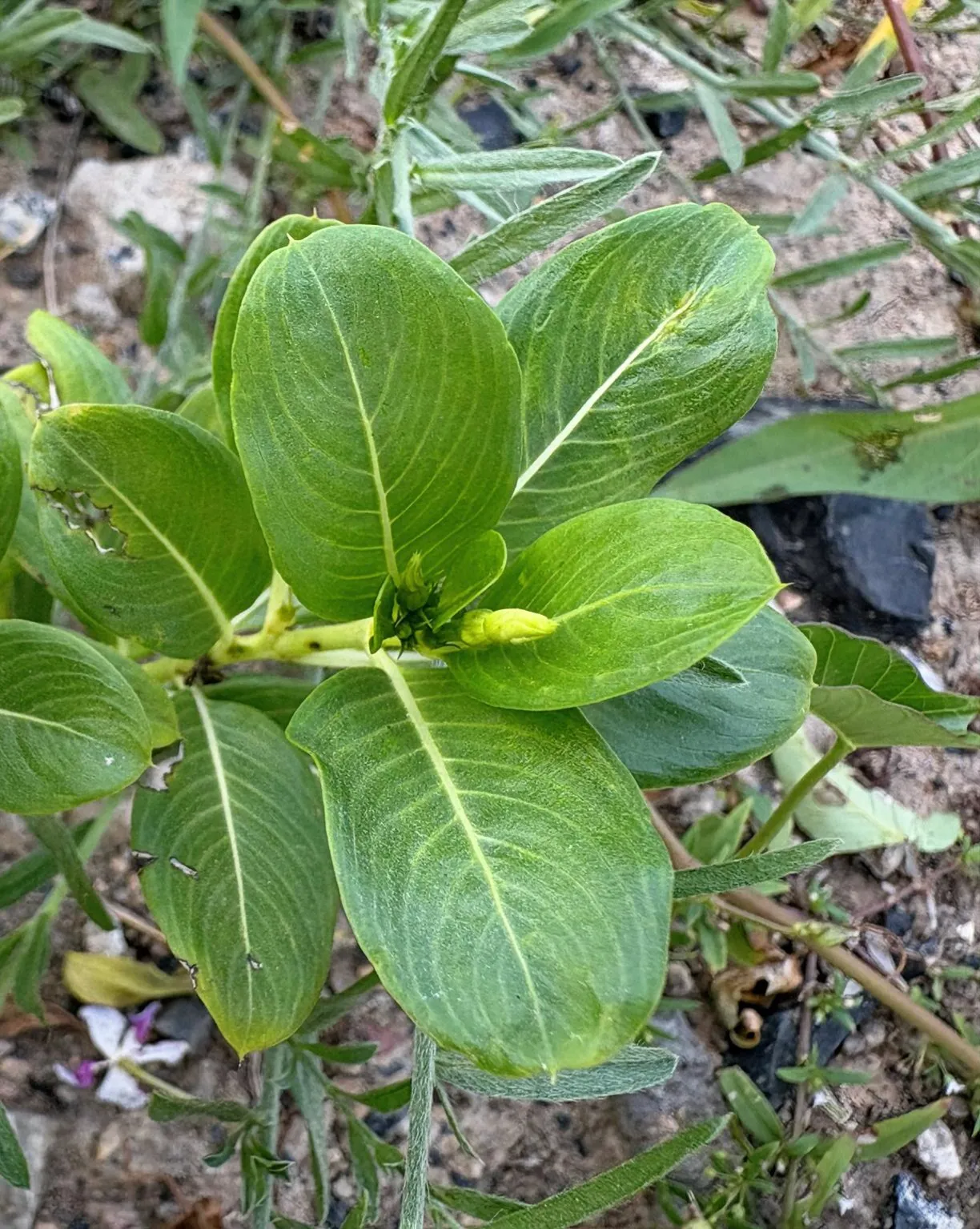
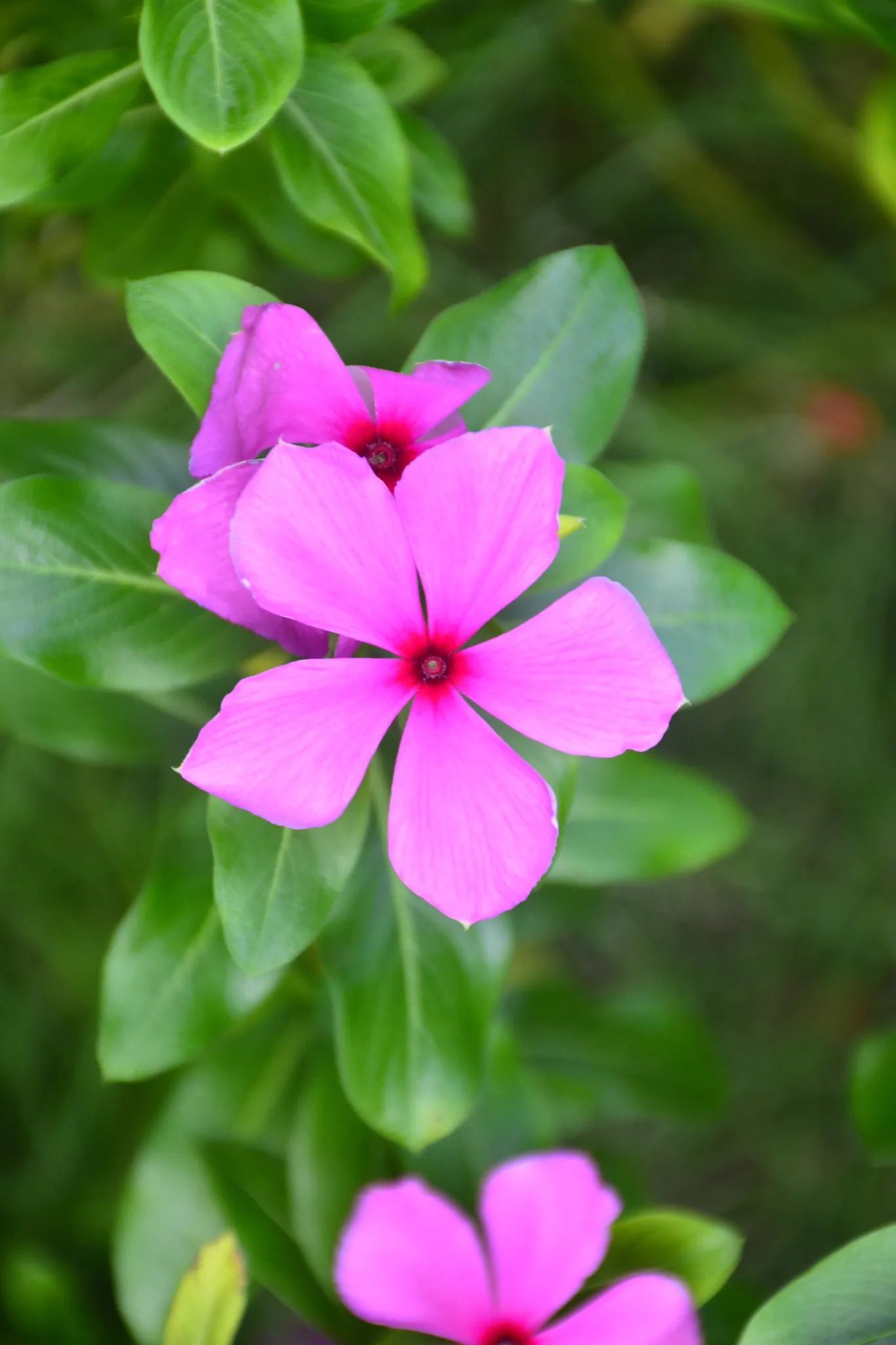
Madagascar periwinkle () is a tender evergreen perennial that is often grown as a warm season annual in frost-prone hardiness zones. This plant has a rounded growth habit and reaches a height and spread up to two feet, depending upon cultivar selection (Figure 1). Cultivars with carpet-like or upright growth habits are also available. The semi-evergreen foliage is elliptic and has a glossy sheen and pale midrib (Figure 2). This species produces showy tubular flowers with five petals that may be white, pink, red, or lavender (Figure 3). Madagascar periwinkle has a long bloom period, and flowering is prolific from summer through fall., Although plants may establish poorly in very hot weather, this plant tolerates heat and flowers in the hottest weather better than most other flowering groundcovers. This plant may be used in a variety of settings in the landscape including as edging or a border, utilized as a groundcover or in a mass planting, or may be used in hanging baskets or for a cascading effect when planted near a wall.

Credit: Ryan Fessenden
Credit: © Naveen Pandey, some rights reserved (CC BY-NC) via iNaturalist
Credit: © MUH IDRIS, some rights reserved (CC BY-NC) via iNaturalist
General Information
Scientific name:
Previous name(s): Vinca rosea, Vinca multiflora
Pronunciation: kath-uh-RANTH-us ROE-zee-us
Common name(s): periwinkle, vinca, Madagascar periwinkle
Family: Apocynaceae
Plant type: annual; perennial; herbaceous; groundcover
USDA hardiness zones: 9B through 11B (Figures 4 and 5); may be planted in all zones as a warm season annual

Credit: This map is based on the 2023 USDA Plant Hardiness Zone Map. Visit https://planthardiness.ars.usda.gov/ for specific zone information.

Credit: This map is based on the 2023 USDA Plant Hardiness Zone Map. Visit https://planthardiness.ars.usda.gov/ for specific zone information.
Planting month for zone 7: Jun
Planting month for zone 8: May; Jun
Planting month for zone 9: Apr; May; Jun; Sep; Oct
Planting month for zones 10 and 11: Feb; Mar; Apr; May; Sep; Oct; Nov; Dec
Origin: native to Africa
Invasive potential: Caution in South Florida—may be recommended by UF/IFAS faculty but should be managed to prevent its escape (reassess in 2 years)
Uses: edging; groundcover; mass planting; naturalizing; hanging basket; container or above ground planter; cascading down a wall; border
Availability: generally available in many areas within its hardiness range
Description
Height: 1 to 2 feet; dependent upon cultivar selection
Spread: 1 to 2 feet; dependent upon cultivar selection
Plant habit: round; spreading
Plant density: moderate
Growth rate: moderate
Texture: medium
Foliage
Leaf arrangement: opposite/subopposite
Leaf type: simple
Leaf margin: entire
Leaf shape: elliptic (oval)
Leaf venation: pinnate
Leaf type and persistence: deciduous
Leaf blade length: 2 to 4 inches
Leaf color: green
Fall color: not applicable
Fall characteristic: not applicable
Flower
Flower color: pink; red; purple; lavender; white
Flower characteristic: spring flowering; summer flowering; fall flowering; showy
Fruit
Fruit shape: pod or pod-like
Fruit length: 1/2 to 1 inch
Fruit cover: dry or hard
Fruit color: green
Fruit characteristic: inconspicuous and not showy
Trunk and Branches
Trunk/bark/branches: not applicable
Current year stem/twig color: green
Current year stem/twig thickness: medium
Culture
Light requirement: plant grows in partial shade; plant grows in full sun
Soil tolerances: acidic; slightly alkaline; clay; sand; loam
Drought tolerance: high
Soil salt tolerances: appears to have some salt tolerance
Plant spacing: 12 to 18 inches
Other
Roots: not applicable
Winter interest: this species is semi-evergreen in USDA zones 10 and 11
Pest resistance: very sensitive to Phytophthora root rot and other diseases listed below; improved cultivars exhibit increased disease resistance
Toxicity: this plant exhibits low toxicity traits; all parts of this plant contain vinca alkaloids; consuming large amounts causes a variety of symptoms
Use and Management
Madagascar periwinkle may be located in full sun to partial shade. Full sun locations will promote increased blooms; however, the plant may struggle to establish in hardiness zones with warmer temperatures. This plant is adaptable to a variety of soil conditions, given that the soil is well drained. Over-irrigation of this plant will cause root rot and other disease issues. Irrigation frequency should be reduced once established, particularly during the rainy summer season.
Madagascar periwinkle is a semi-evergreen plant that is generally planted as a warm season annual. Once plants are removed in the fall, this plant may be replaced with another annual to finish the season, if desired. This plant may also be used in a container with well-drained soil. Spaced 12 to 20 inches apart, plants will form a solid mass of mounded foliage. Periwinkle will cascade over a wall or container and makes a nice hanging basket. Plants may reseed themselves into the landscape. Improved cultivars are available with increased disease resistance, various growth forms, and additional flower colors. Cultivars from the Cora® Group and Nirvana® Group are resistant to Phytophthora and other diseases, while plants from the Titan™ Group and Pacifica Group have increased drought tolerance.
Propagation is by seed or cuttings. Softwood cuttings can be taken and rooted during summer. The seed germinates in one week at a temperature of 70°F to 75°F. Keep the flat of seeds in the dark until the seed germinates and do not overwater. Planting may be done at any time during the year in USDA hardiness zones 10 and 11.
Design Considerations
Madagascar periwinkle delivers continuous, high-impact color from late spring to frost. Its simple, pinwheel flowers and glossy dark green foliage create a polished look that thrives in extreme heat.
Ideal for any hot, sunny, well-drained location; it excels in mass plantings, as a uniform border edge, or to fill gaps in foundation beds. Trailing varieties are particularly effective in containers, window boxes, and hanging baskets.
Pair it with other heat-lovers for contrasting form and texture, such as the upright spires of Angelonia (Angelonia angustifolia), the colorful trailing foliage of sweet potato vine (Ipomoea batatas), and the butterfly-attracting flower clusters of wild sage (Lantana involucrata).
Pests and Diseases
No pests are of major concern. Disease issues include Fusarium wilt, blight (black spots on the leaf caused by overcrowding plants), canker and dieback (death of the plant starting at the top, caused by overwatering), Phytophthora root rot and stem rot (caused by overwatering). Fungal leaf spots are generally harmless. Selecting disease-resistant cultivars and using proper cultural practices (spacing plants properly and avoiding overhead irrigation and over-irrigation) promotes plant health.