
 IFAS Extension

2026–2029 Florida Citrus Production Guide: Citrus under Protective Screen (CUPS) Production Systems
Arnold Schumann, Mark Ritenour, Jawwad Qureshi, andFernando Alferez
Contacts: Tripti Vashisth
Related Collections
47 publications
Effective and safe citrus production strategies for use in commercial groves only.
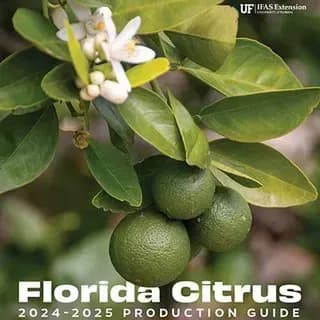
This annual reference guide for the Florida citrus grower offers up-to-date recommendations on the safest and most effective means of controlling pests of Florida citrus. Includes sections on horticultural practices; mites, insects and nematodes; diseases; weeds; and pesticides currently registered for use on Florida citrus.
Also available on UF/IFAS Citrus REC's Production Guide website.
Related Topics


Citrus can be grown under protective screen structures for fresh-fruit production to exclude the Asian citrus psyllid —which is the vector of the causal pathogen of huanglongbing (HLB), or citrus greening disease—and thereby produce disease-free healthy fruit.
The production of high-value vegetables and other horticultural crops in greenhouses and vertical farms. It allows farmers to grow cash crops on small plots in marginal, water-deficient areas where traditional cropping may not be viable. Also called protected agriculture or protected crop production.
Related Units

The UF/IFAS Citrus Research and Education Center (CREC) is the oldest and largest off-campus experiment station in UF's Institute of Food and Agricultural Sciences (UF/IFAS) and is unique among research centers in that it focuses entirely on one commodity, citrus. [website]

"Florida's agricultural industry generates more than $103 billion in annual economic impact and employs more than 500,000 people. Florida's farmers produce nearly 300 commodities, and winter vegetables and citrus consistently lead the national rankings. To meet the needs of this diverse industry, research and extension programs in the areas of fruit and vegetable production, postharvest technology and weed science are delivered on a county, regional and statewide basis using a variety of methods including field days, intensive hands-on training, and distance learning. Excellence in programming facilitates the exchange of information and technology and contributes to the professional development of extension faculty and the agricultural clientele they serve."
--- Extension Programs, Horticultural Sciences Department
Publication #CMG19
